domingo, junho 21, 2015

E quando o mundo muda?

"building the business is often the easy part. Growing and maintaining the business can be much tougher and figuring out how to appeal to new consumers is no small feat.
One reason is that consumers are far from homogeneous. Different segments have different risk tolerances, ways of making decisions, and — perhaps most challenging for growing businesses — preferences for when and how they adopt innovations."
Retirei este trecho de um artigo com o título "Focus On the Customers You Want, Not the Ones You Have"
.
E quando o mundo muda e uma empresa precisa de mudar de clientes-alvo, de geografia de actuação, de tipo de oferta, de proposta de valor, de modelo de negócio?
.
Por exemplo, quando vou para o centro de Gaia, chego de comboio às Devesas e subo até ao jardim Soares dos Reis. Pelo caminho, vejo um ginásio numa cave, há anos era uma loja chinesa. Os vidros estão cobertos com fotos de jovens de ambos os sexos, erguendo pesos e realçando a sua musculação.
.
Penso sempre neste gráfico:
E na demografia europeia, sendo Portugal um dos países mais envelhecido da Europa.
.
E penso nas razões porque os europeus não fazem exercício físico:

E interrogo-me porque é que nunca vi um ginásio dedicado explicitamente ao sector sénior?
.
Têm dimensão, têm tempo livre, têm poder de compra, têm um trabalho concreto por realizar (recuperar/manter e prolongar qualidade de vida, autonomia, autoestima, ...)
.
BTW, o preço é o sexto motivo! Não é nem o primeiro, nem o segundo, nem o terceiro.


Que tipo de relação?

"co-creation is a function of interaction. Consequently, direct and indirect interaction lead to different forms of value creation and co-creation; co-creation can occur only when two or more parties influence one another.
...
“Since customer relationships do not all have the same value-creation potential, they can at worst tie up customer and provider resources that could have been used to create value in more efficient ways. From the provider’s perspective, it is therefore vital to review them, and identify how to allocate resources in such a way as to enhance the interactions and consequent value creation. From the customer’s perspective, it makes no sense to allocate resources to collaboration with a provider whose offerings focus mainly on value-in-exchange if it is possible to derive more value-in-use from a similar collaboration with a more competitive provider.”
...
As Grönroos points out, not all customers want to engage in relationships with their suppliers. Hence, even if the Nordic School emphasises mutual value creation, it does not assume that relationship investments and interactions will per se increase customer value, or that relationship marketing is a panacea for competitive advantage. Overall, however, I would argue that the main challenge for companies is not the lack of arm’s-length relationships. Quite the contrary: the excessive and endemic short-term orientation of the actors (including customers and shareholders) inhibits value creation and competitive advantage at both company and value-constellation level."
Que tipo de relação é a mais adequada para construir um posicionamento diferenciador? Que tipo de cliente, que tipo de trabalho e em que contexto?

Trechos retirados de "Business Markewting– A Nordic School Perspective" de  Christian Kowalkowski

Não começar sem saber qual o trabalho e o contexto seleccionado

"They have a job to get done.
Your product gets hired to solve that job. That’s what causes purchase and use.
...
I am hungry and I have 15 minutes to eat lunch at work. That’s the job.
I hire a sandwich from the deli in the lobby of my building.
My hunger at work, with only 15 minutes to spare, caused me to purchase at the deli.
Did my age, martial status, viewing habbits, number of kids, gender, cause me to purchase? No. These are attributes of a buyer that might be correlated to purchase but don’t cause purchase.
...
Same type of job, hunger, but different situation and different hiring criteria.
...
For the job, the situation is critical. [Moi ici: O contexto] As Clayton Christensen says: “the customer is the wrong unit of analysis.” It’s the job in a situation.
.
Also, the job is stable over time. I’m repeatedly hungry, but in different situations. The solutions you choose to hire change. This is critical to your differentiation efforts.
...
There is a job that we want to get done. That causes us to purchase.
.
Don’t start your segmentation, development, messaging or much of anything until you know the job to be done.
...
emphasize the need to understand what will cause the customer to buy, not what is correlated.
...
If you don’t know the job in the situation, stop. You are wasting time and money and you probably don’t even know it. You need to improve upon the job someone is trying to get done. Make it easier, more convenient or less expensive.
.
How you frame a market determines how you serve it. The job to be done is the frame. That’s the market, the job in the situation. Getting it right will trim your list of features, relieve some of the pressure on the development team, and give you confidence to decide what NOT to include in the product.
...
Understand and uncover the emotional jobs associated with a functional job. The Re-Wired Group calls this the “forces” and the emotional energy people use when using, buying or switching to a product/service. Progress hindering forces could include loss aversion, cognitive load (also called cognitive miser), sunk cost effect, social bias comparison, choice paradox, endowment effect (also called divestiture aversion) and many more.
...
Deeply understanding the job to be done in that situation is the starting point for how to frame, design and deliver the complete solution….that will cause that person to buy."


Trechos retirados de "This Causes People to Purchase"

sábado, junho 20, 2015

Curiosidade do dia

Via @YoungmeMoon

"Talvez a solução passe por empresas menos grandes" (parte II)

Neste postal "Talvez a solução passe por empresas menos grandes" terminámos escrevendo:
"Talvez a solução passe por empresas menos grandes, por menos corporações, e mais proximidade com os clientes-alvo."
Em "The Last Mover Advantage" encontro:
"Yet what guarantees Facebook a part in our future? Imagine how much cheaper it would be to replicate Facebook today than it was to build from scratch.[Moi ici: Recordar as minhas profecias acerca das plataformas de 2ª geração]
...
in a world where the possible becomes more remarkable and easier everyday, it’s always best to have been built only with that new possibility at the core.
.
This is the age of Digital Darwinism, where technology and society evolve faster than any organization can adapt. The best advantage you can leverage is being built for the newly possible.
...
Perhaps succession management in companies should no longer be about grooming a replacement but creating new companies or products to take over the role of the establishment for the future."

densidade e modelos de negócio

Quem segue este blogue sabe o quanto aprecio e uso o conceito de ecossistema da procura.
.
uns anos descobri e li "Reframing Business: When the Map Changes the Landscape" de Normann, R.. Quando comprei o livro não imaginava o efeito e importância que teria em mim.
"the idea of ‘density’ propounded by Normann (2001) aligns very well with the SDL concept of value creation through resource integration and both mesh well with the ideas of interactivity and networks.
...
Normann had used such novel concepts as ‘dematerialization’, ‘liquidity’, and ‘density’ to explore the shaping and fluidity of markets through reconfiguration of value-creating systems. A prerequisite for that rearrangement is ‘reframing’ of the overall system, by means of which ‘prime movers’ redefine their own and other actors’ roles. [Moi ici: Como não recordar este postal de ontem] These actors organise the creation of value [Moi ici: Criam novos modelos de negócio - novos circuitos de informação, para aumentar a densidade das relações e valorizar o intangível. Criar camadas de significado para lá da coisa material que se transacciona] beyond their own boundaries, not only through new offerings but also by way of novel value constellations and value-creating systems (that is, business ecosystems) in which they would normally not be found. Normann suggested the word ‘ecogenesis’ for such system-level reconfiguration, which lead to permanent changes in the daily lives of consumers or organisations. All economic actors should strive to become prime movers in relation to their own position in the system. [Moi ici: Daí que um dos primeiros passos de qualquer reflexão estratégica deva passar por perceber qual é o ecossistema actual e, se ele pode ser de alguma forma alterado em nosso favor, reconhecendo os pivôs e como podem ser induzidos a trabalhar connosco e para nós através de relações ganhar-ganhar-ganharA general principle is that resources and offerings do not have intrinsic value, but rather positional value, which is contingent upon the particular system of which they and the firm are parts."
Trechos retirados de "Business Markewting– A Nordic School Perspective" de  Christian Kowalkowski

Acerca da evolução do desemprego (parte II)

Parte IPrevisão,
.
A propósito dos números do IEFP de Maio de 2015 sobre a evolução do desemprego (desempregados à procura de emprego):

No bom caminho para chegarmos a Julho de 2009.
.
Já quanto ao número total de desempregados, estamos já abaixo de Janeiro de 2011:

Interessante como o desemprego registado por actividade económica, caiu 19,5% homólogos na indústria e só 11,4 nos serviços.

sexta-feira, junho 19, 2015

Curiosidade do dia


Tantos empresários e tantos políticos seguem esta abordagem:
A esperança como estratégia!
Se fizermos figas, talvez a tempestade passe ao largo sem nos afectar.
.
Pois...

- Como posso ajudar?

"Nestlé dispensa 15% dos trabalhadores em África" ou "Classe média “desilude”. Nestlé dispensa 15% dos trabalhadores em África"
.
Mais um caso exemplar de tentativa falhada de transplantar uma abordagem euro-americana numa região em vias de desenvolvimento?
.
Acho particularmente interessante:
"Deste modo, esta diminuição do universo laboral da Nestlé pode demonstrar a dificuldade que as empresas internacionais têm em estabelecer-se no mercado africano. Nestas zonas, os mercados são controlados, principalmente, por pequenas empresas locais com produtos com características específicas e preços mais baixos."
Interessante como uma multinacional cheia de recursos e com uma marca poderosa não conseguiu entrar.
.
Gosto sobretudo daquele:
"pequenas empresas locais com produtos com características específicas e preços mais baixos"
Até que ponto as multinacionais perdem, apesar dos seus recursos, por criarem modelos de negócio baseados nos seus produtos e não nos seus clientes-alvo?
.
A artesã de Bragança, que vende um produto autêntico, um produto artesanal, pode partir do seu produto para pensar numa proposta de valor a oferecer aos alemães.
.
Será que uma multinacional, que aposta na eficiência e nos "hits" pode seguir o mesmo percurso? Julgo que não.
.
Uma multinacional deve tornar-se humilde e partir dos clientes-alvo e perguntar:
- Como posso ajudar?

A grande vantagem das PME

"Most companies are not built for agility.

Most businesses today are not designed with agility in mind. Their systems are tightly coupled, because their growth has been driven by a desire for efficiency rather than flexibility.

.
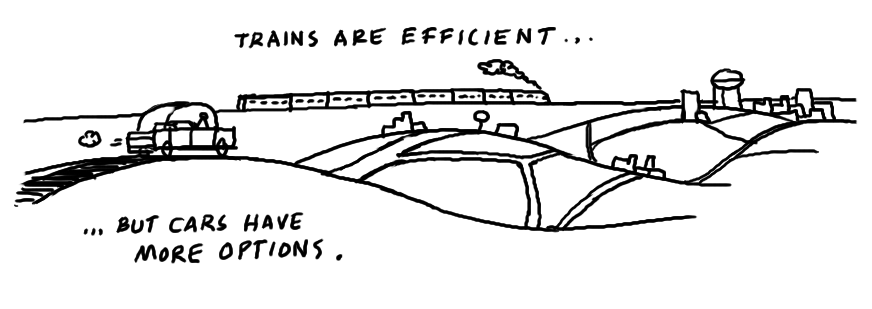
Consider the difference between a car on a road and a train on a train track. The car and the road are loosely coupled, so the car is capable of independent action. It’s more agile. It can do more complex things. ... But the train has fewer options — forward and back. If something is blocking the track, the train can’t just go around it. It’s efficient but not very flexible.
Many business systems are tightly coupled, like trains on a track, in order to maximize control and efficiency. But what the business environment requires today is not efficiency but flexibility. So we have these tightly coupled systems and the rails are not pointing in the right direction. And changing the rails, although we feel it is necessary, is complex and expensive to do. So we sit in these business meetings, setting goals and making our strategic plans, arguing about which way the rails should be pointing, when what we really need is to get off the train altogether and embrace a completely different system and approach.
.
This seems simple when you think about it. But it’s difficult to do. It’s hard to even think about it, especially when you are sitting on a business train that’s going a hundred miles an hour and you feel like it’s headed in the wrong direction."
Esta é a grande vantagem das PME, a flexibilidade, a rapidez com que podem mudar de agulha. Mesmo multinacionais cheias de recursos e de informação... estão tolhidas pela inércia.
.
Infelizmente, a maioria das PME não tem consciência desta realidade e, por isso, não a usam, não fazem a batota que podiam e deviam. Mais, iludidas pelo tempo de antena que os media dão aos grandes, revêem-se nas suas decisões, problemas e modelos mentais em vez de pensarem pela sua cabeça e verem o mundo pela sua perspectiva.
Quando o fazem... o mundo muda para elas e revela-se pleno de oportunidades!!!

Trechos retirados de "Wrangling complexity"


De produto para resultados e, destes para progresso

Nos últimos dias tenho encontrado uma série de textos muito interessantes e merecedores de reflexão e, sintonizados com o tema da procura:

Ontem, mais um texto a acrescentar a esta série "Design for progress, not outcomes":
"Why do so many people sign up for gym memberships, but then stop going after a month?
...
Outcomes and goals are static. They are binary. You lost 5 pounds or you didn’t. You drove to work or you didn’t.
.
But we’re not static. We’re not binary. We’re dynamic.
.
We don’t wait until we’ve lost 5 pounds before determining if a gym is right for us. We don’t wait until an outcome has been achieved, before deciding if we will continue to use a product.
...
Outcomes are lagging indicators. They only tell you if something did, or didn’t work. They don’t tell you if it’s working.
.
When you design for outcomes, you’re designing for your customers’s future past — the moment, at some end, when they look back and evaluate. [Moi ici: Quem está habituado a fazer este exercício, reconhece a exactidão desta descrição... eu costumo falar de "vamos fazer uma viagem ao futuro" ou de "começar pelo fim"] You’re chosing to ignore the question: after customers reach an outcome, what’s next? [Moi ici: Confesso que esta doeu porque muitas vezes rematamos isto para o campo do "Desenvolvimento da relação" e não lhe damos a atenção que requer... cheira a querer marcar o segundo golo antes de marcar o primeiro. Faz-me recordar o ar de indignação do empresário que vê o cliente fidelizado partir para a concorrência... depois, pergunto-lhe o que fizeram para lhe lançar novos desafios. Depois, defendo que a opção do cliente foi perfeitamente previsível... ele já aprendeu tudo o que tinha a aprender convosco, a relação para ele já não dá pica]
...
When you design for progress, you’re thinking about how to deliver value to customers over time. How can we keep people coming to the gym?
...
If you want people to use your product more, you need to give them a sense that things are going to be better. This is a sense that extends before, during and after achieving an outcome. If they stop believing your product is going to deliver them progress towards how they want their life to be, they’ll switch to something else.
.
People don’t want the product; they want what the product does for them.
.
People don’t want just the outcomes; they want the progress outcomes represent."


Ter uma estratégia clara = escolhas claras = ideias claras = desejar sucesso à concorrência (parte VII)

Parte I, parte IIparte IIIparte IVparte V e parte VI.

Na parte III desta série acerca dos ginásios e do finess escrevi:
"E, com isto, fico a pensar num modelo de negócio de loja multimarcas. Um espaço comum gerido por uma entidade que o promove e aluga a profissionais especializados em disciplinas de fitness, cobrando aos clientes e pagando aos profissionais. Uma espécie de El Corte Ingles de serviços de fitness?"
Entretanto, ontem descobri este exemplo de modelo de negócio "Meet The Hair Salon Franchise That Turns Stylists Into Entrepreneurs".
.
Imaginem um espaço gerido por uma entidade, como uma espécie de co-working, que aluga os "pods" a profissionais. Cada pod é ocupado por um profissional.
.
É claro que o modelo de negócio é alterado pela entidade:
"That’s because Sola Salons has a coworking-style business model. Its franchisees lease large retail spaces, then subdivide them into individual salon shops. The chain isn’t selling hair styling—it’s selling stylists. Sola recruits top performing stylists at neighborhood shops who already have a significant following. Those stylists can set up at Sola, paying rent for the opportunity to operate their own one-person business. [Moi ici: Algo que julgo merece reflexão é o perceber que num mesmo espaço estarão concentrados n concorrentes....Serão mesmo concorrentes? Ou terão de optar por se diferenciarem, como os rouxinóis, para evitar guerras de preços. Daí a importância daquele "The chain isn’t selling hair styling—it’s selling stylists"]
...
Solomon: Who do you see as your ultimate customer – is it the franchisee, the stylists, or the end customers?
Briger: Our primary customer is the stylist. We think we have turned this industry on its head because that salon professional is our customer.
...
For the most part consumers aren’t going to a particular salon, they’re going to see a particular stylist."
Um exemplo que ilustra em toda a sua extensão o título desta série, desde o ter uma estratégia (como vou ser diferente) até ao desejar sucesso à concorrência, sem o sucesso dos outros o noss "pod" não chega para sustentar o espaço no seu todo.
.
A quantos outros serviços se podia aplicar esta abordagem?
.
Será uma espécie de versão moderna e privada do mercado municipal?

quinta-feira, junho 18, 2015

Curiosidade do dia

A propósito de "That Finnish teaching success".
.
Julgo que por cá qualquer pessoa pode matricular-se para ser professor e, uma vez acabada a formação, sente-se com direito a um lugar no sistema.
.
Entretanto, na Finlândia, pratica-se esta segregação exigente:
"But the five-year master’s degree for primary school teachers is not in question. Competition is fierce – only 7% of applicants in Helsinki were accepted this year, leaving more than 1,400 disappointed."
Segregação que por cá seria provavelmente considerada inconstitucional e merecedora de um festival de providências cautelares pelo eterno Nogueira.

Satisficing vs Constraints

"nature evolves away from constraints, not toward goals"
Como eu gosto desta citação.
.
A Natureza, que não é humana, que não reflecte, acaba sempre por encontrar uma solução, não porque se direccione para metas mas porque foge das restrições e constrangimentos.
.
Acredito que muitas PME actuam da mesma forma. Apesar da massa cinzenta que têm no seu interior, são muitas vezes prisioneiras da humana preferência pela  satisficiência, em vez da maximização racionalista (o que é bom, por causa da lição dos nabateus). Ou seja, o que está na base do sucesso das PME é, quase sempre, a fuga a uma restrição que as empurrou para fora da zona de conforto e, as obrigou a mudar.
.
Matt Ridley em "Waterloo or railways" faz esta concatenação interessante:
"there is a tenuous connection between Napoleon and Stephenson. If Bonaparte’s conquests and the corn laws had not driven up the price of corn, then horse feed would have been cheaper and the coal owners who employed Stephenson would not have risked so much money in letting him build a machine to try to find a less expensive way to pull wagons of coals from the pithead in Killingworth to the staithes on the Tyne."

Não culpem a caneta pelas asneiras do escrevedor

A propósito de "5 Reasons to Break Up with SWOT Analysis", recordar este texto relativamente recente aqui no blogue "Acerca da análise SWOT e do leite" que por sua vez remete para outros três que chamam a atenção para algumas precauções a ter com o uso do SWOT.
.
A análise SWOT é perfeita?
Não, claro que não.
.
A principal crítica que faço à ferramenta é ser utilizada num limbo asséptico independentemente da estratégia. Não faz sentido dizer que um ponto fraco da empresa é "Praticamos preços altos" sem considerar que a empresa actua no segmento premium e tem produtos adequados a esse segmento.
.
Agora, considerando as razões avançadas pelo artigo, como justificação para deixar de usar a ferramenta:

  • "1. Internal bias. A SWOT analysis is usually dominated by your internal view – your perceptions of your performance and market. It’s biased by whoever compiles the information. [Moi ici: Qual é a ferramenta que não sofre deste problema?
  • 2. No prioritization. It organizes strategic factors that impact your business, but it doesn’t prioritize them. There’s no guidance on how to evaluate the importance of each piece of data. [Moi ici: Qual é a ferramenta que não sofre deste problema?]
  • 3. Doesn’t translate to action. A SWOT analysis doesn’t offer solutions. [Moi ici: As ferramentas não determinam soluções, as ferramentas alimentam e organizam a informação para que os humanos, com a sua experiência e subjectividade tomem decisões]
  • 4.Aggregate and high level. Teams can spend an entire day collaborating on a SWOT analysis and generate a TON of information, but not all of it is useful for developing future strategies. [Moi ici: A ferramenta é útil para identificar pontos relevantes para a execução de uma estratégia, não para a sua formulação. E relacionado com o ponto 3 ver o marcador TOWS
  • 5.It’s not used consistently. SWOT analyses tend to be used sporadically, so there’s the risk of missing changes in your market and not acting quickly enough. [Moi ici: E isto é um problema da ferramenta ou do uso que os humanos fazem dela?]

Tão anos 80

A propósito de "At IKEA, Ensuring ‘Quality as an Enabler of Lower Cost’".
.
Quais são as três prioridades de qualquer modelo de negócio baseado no low-cost?
.
Aprendi essa lição no livro Kaizen de Masaaki Imai, QCD:

  • Quality (aqui como ausência de defeitos e não como sinónimo de mais atributos);
  • Cost; and
  • Delivery.
Michael Porter no histórico artigo de 1996, What is Strategy?, dizia acerca dos japoneses:
"Differences in operational effectiveness were at the heart of the Japanese challenge to Western companies in the 1980s. The Japanese were so far ahead of rivals in operational effectiveness that they could offer lower cost and superior quality at the same time."
O IKEA segue um modelo de negócio que fez do low-cost a sua vantagem competitiva, logo o controlo da qualidade é fundamental.
.
Por que é que o IKEA só agora sentiu necessidade de formalizar a chefia do controlo da qualidade? O que terá motivado a mudança?
.
BTW, se eu tivesse de concorrer com o IKEA concentrar-me-ia neste ponto:
"The products being tested are ones that will be released at some point in the future. “We are not here today, we’re in 2018,” said Mattias Andersson, a manager at the IKEA test lab, as he led journalists through the lab on a tour last month."
Tão nórdicos, tão certinhos, tão computáveis, tão lentos... tão Sandy.

Imaginem uma Zara a competir com eles: rapidez, moda.
Imaginem um concorrente que aposte na flexibilidade, na customização, na co-criação.
.
Não sei é se os seus clientes-alvo estarão dispostos a trocar preço por moda, ou flexibilidade, ou customização, ou co-criação.
.
O título do artigo e as figuras:
(do artigo de Porter)
(deste postal)

Produtos versus resultados

Na linha do que escrevemos aqui e aplicamos na nossa vida profissional, esta mensagem importante:

  • deixar de vender produtos;
  • deixar de nos concentrarmos na venda da coisa que muda de mãos no momento da transacção;
  • pensar no produto como um recurso que é usado pelo cliente para atingir um resultado;
  • o que conta, o que interessa é o resultado.

De certa forma alinhado com o tema de ontem "Produto e proposta de valor".
.
Claro que será uma transformação difícil que obrigará a trabalhar com mais do que um modelo de negócio em simultâneo:
"At the time, it was a radical business model change for Xerox, and required transformation in many functions ranging from sales and marketing to field service to supply chain management, and required multiple innovations in product engineering, data collection, and analytics. But it was a necessary change to mitigate the increasing commoditization in the market."
BTW, em sintonia com o nosso conselho "É meter código nisso":
"With the impending Internet of Everyday Things, where low-cost, even disposable products will have digital capabilities through low-cost sensors via printed electronics and connectivity enabled by Content-Centric Networking, a myriad of consumer products will have analytics capabilities previously reserved for more expensive industrial equipment. How will the product experience change – from household goods to appliances to sports equipment? Will every product come with a mobile app? What new partnerships need to be formed between manufacturing, retail, customer care, and field services? Will we see new services companies appear or will existing companies change their business models?"

Trechos retirados`de "Stop Selling Products and Offer Outcome-based Services Instead"

quarta-feira, junho 17, 2015

Curiosidade do dia

"This is nuts, what could possibly go wrong?" e "Chinese Firms Put Cash to Work in Stocks"

Isto vai dar um lindo resultado.

"the mindset of extracting and the alternative of feeding"

Excelente reflexão de Seth Godin "Overcoming the extraction mindset".
.
Fico a pensar se é este o critério, legítimo, seguido pelos decisores nos programas do tipo "Sark Tank", o da extracção rápida.
"This chasm between the mindset of extracting and the alternative of feeding becomes more urgent as networks (online ones, environmental ones, tribal ones) become ever more powerful.
.
The chasm is so deep, people on each side of it have trouble imagining what the other side is thinking.
...
It's expensive and time-consuming to choose a path that doesn't deliver maximum value today. Unless you do the math on what happens tomorrow. Tomorrow, the network is either more productive or less. Tomorrow, the network is either trusting or suspicious. Tomorrow, the network is either healthier or sick."

Tem uma estratégia para dar a volta?

"Portugal é o quinto país da Europa onde se consome mais marcas próprias"

"“A marca própria é uma realidade que veio para ficar”"

"A boa relação que os portugueses têm com marcas ‘Premium’ é um dos factores de atracção de Portugal."

A merecer reflexão pelos fabricantes.
.
Não vale acusar os donos das prateleiras nem os consumidores.
.
Tem uma estratégia para dar a volta?
.
Conhece os seus consumidores? Conhece mesmo? Sabe o que eles procuram e valorizam?
.
O que está a fazer para inverter a situação?
Acha que é uma questão de ser mais eficiente?
.
Do you feel lucky?

Produto e proposta de valor

Em "Construir uma proposta de valor" escrevi:
"uma proposta de valor é sobre o que prometemos... e esta sequência concentra-me no que oferecemos para suportar a promessa.. o nosso produto. Contudo, acho que a nossa promessa deve partir das experiências procuradas e valorizadas pelos clientes-alvo.
...
A proposta de valor é a promessa que fazemos sobre o que os clientes vão sentir na sua vida, durante o uso. É uma tentativa de trazer a experiência futura desejada para o momento da compra, para o momento da troca."
Em "How to build a startup" escrevi:
"Fiquei com dúvidas se a interpretação que Blank dá a "proposta de valor" é a mesma que eu dou.
...
Só depois de identificados e caracterizados os clientes-alvo é que vem a formulação da proposta de valor. E, só depois da formulação da proposta de valor é que vem a definição do produto/serviço."
Ontem, li "The Offer is Only One Building Block to Fulfill the Value Proposition":
"one of the most important concepts is that the value proposition is not the product.
...
It’s not the product that creates value but the value proposition. The whole value architecture including the product, the revenue model and the team & values all have to deliver the value the value proposition is proposing.
...
A good, and even meaningful value proposition depends from your customers, the job-to-be-done and the benefit you create for your customers. These building blocks make up the value proposition. The offer aka product is just one part to fulfill the value proposition. That is extremely important distinction.
...
The value proposition is where the value is defined. The whole business model has to deliver the value proposition, even the revenue model since the right pricing adds value as well.
...
Always separate the value proposition from your offer. The value proposition is what excites your customers. The products is one building block to create the excitement but has to be supported by all other building blocks."

Acerca do desafio de uma empresa e dois modelos de negócio

A propósito de "3 exemplos de: uma empresa e dois modelos de negócio diferentes", entretanto, recordei este artigo de Dezembro passado na HBR, "Case Study: Can One Business Unit Have 2 Revenue Models?"

terça-feira, junho 16, 2015

Curiosidade do dia

Isto foi escrito para humanos "The Undeniable Benefits of Being Weird"
.
No entanto, se aplicarmos a mensagem às empresas, continuará a fazer sentido:
"All my life I’ve heard the same refrain, “Why can’t you be… Normal?” But, everything in life has its risks including (and especially) being ‘Normal.’ Most of us understand there’s risk when taking the chance and aspiring to something more. But even more are ignorant of the cost of Normal, the cost of not taking chances, and the risk of complacency.
...
The road to normal is well-paved and even has rush hours. But weird? Weird is a solitary path.
...
I’m more inspired by the heroic stories of those who possess the real courage to be weird when it’s not easy, the proverbial “Mad Ones.” Those at the day-to-day job of taking risks, before their weirdness is validated with money, notoriety, or any level of success. To be weird when it’s hard work. That means you.
...
The things that made you weird as a kid, make you great today. Accepting that weirdness is a hard personal choice, but quite frankly, exciting and enriching. We don’t do it for the reward or the success but for our own freedom and to light the way for others.
Accept it, you’re weird."
Tantas e tantas empresas que aproveitaram um acaso, uma brincadeira, um truque... lembrei-me agora da história da Nexx.
.
BTW, com umas meias coloridas calçadas, recomendo "People Who Wear Crazy Socks Are Rebellious, Intriguing And Successful"

Radiografia da DIS ISO 9001:2015

Eis a radiografia que Martin Hinsch faz em "Die neue ISO 9001:2015 – Status, Neuerungen und Perspektiven" da comparação entre a versão DIS da ISO 9001:2015 e a versão de 2008.
.
Os sublinhados são meus, só para sublinhar onde estão as principais novidades:


3 exemplos de: uma empresa e dois modelos de negócio diferentes

"As exportações portuguesas de têxteis técnicos cresceram 10,8% no ano passado e prometem continuar a ganhar peso no sector. No final da década, 30% do volume de negócios gerado poderá ser já em produtos de alta tecnicidade, diz o Plano Estratégico da fileira.
...
"Penteadora - Fazer tecidos técnicos para diversificar
...
A médio prazo, a empresa espera ter nos produtos de elevada tecnicidade mais de 25% das suas vendas.
...
Têxteis Penedo - Dar luz às cortinas para multiplicar as vendas
...
A empresa exporta 99% do que faz, viu as suas vendas crescer 7% em 2014, para os €10,5 milhões e espera crescer dois dígitos este ano.
...
Faria da Costa - Aquecer meias com um chip para ganhar valor
...
""É uma aposta na diferenciação e valorização do produto porque a concorrência nos artigos básicos é feroz. Acreditamos obter, assim, também um maior reconhecimento para a nossa oferta de peúgas tradicionais", explica o gestor, à espera de um crescimento de 10% a 15% nas vendas este ano, depois de faturar €3 milhões em 2014, com as exportações a responderem por 95% deste valor." 
Três casos em que fica claro que:
  • a oferta é diferente;
  • a proposta de valor é diferente;
  • os clientes-alvo são diferentes;
  • os ecossistemas da procura são diferentes;
  • as feiras e canais de divulgação são diferentes;
  • os argumentos de venda e o pricing são diferentes;
  • os processos-chave são diferentes (no caso da Penteadora e da Têxteis Penedo, o artigo do Expresso, "Empresas que fazem têxteis muito à frente", refere que ambas as empresas investiram 1 milhão de euros em equipamentos);
  • as competências-chave são diferentes;
  • as matérias-primas são diferentes; e
  • os parceiros são diferentes.
Quantas empresas estão dispostas e preparadas para fazer esta revolução? Mais, a maioria delas não abdica do negócio anterior. Assim, terá de ter um comportamento algo esquizofrénico: uma empresa dois universos produtivos e comerciais. Ou seja, uma empresa e dois modelos de negócio diferentes.

Gráfico interessante

E volto ao artigo "Como convencer o “Zé da PME” a contratar doutorados?".
.
Pesquisando, encontrei um gráfico interessante:

Quase 60% dos doutorados portugueses são nas áreas das Humanidades, Ciências Sociais e Ciências Médicas e da Saúde.
.
Não quero dizer que estes doutorados não tenham lugar nas PME portuguesas, contudo, exige muita mais de ambas as partes para chegar a um "acordo".
.
Gráfico retirado de "Empregabilidade de Doutorados nas Empresas Portuguesas"


E o burro era eu!

Aqui neste blogue escreve-se muitas vezes sobre a necessidade de subir preços, e  sobre a comparação do impacte de subir os preços vs o impacte de praticar descontos.
.
Quando aos 28 anos vi pela primeira vez o gráfico de Marn e Rosiello:
Estribado nas certezas que a minha ignorância alimentava, logo classifiquei os autores:
- BURROS!!!
Como é que é possível subir os preços e não perder clientes!!! Subir os preços é um bónus dado à concorrência.
.
Se na altura lesse "Newsonomics: Single-copy Newspaper Sales Are Collapsing, and It’s Largely a Self-Inflicted Wound" de certeza que utilizaria o seu conteúdo para corroborar aquela classificação.
"Single-copy newspaper sales — which not that long ago made up as much as 15 to 25 percent of sales — are obsolescent, dropping in double digits per year and, for many papers, 25 to 50 percent or more in just the past three years. Single copy is just one corner of a disappearing world, and it’s one we’ve paid little attention to. In its decline, though, we can see the print-to-digital transformation from another angle.
.
Why the drop? Of course, digital reading is a prime reason, propelled by the smartphone revolution; more than one billion smartphones were shipped for sale around the world last year, a mind-boggling number.
.
But it’s not the only reason. Right up there on the list would be newspaper company strategy, as expressed in its pricing decisions. Call it quarteritis — a piling on of quarters, raising single-copy prices from 50 cents to 75 cents and then to a dollar and more."
A esta hora, quem acompanha este blogue estará a murmurar:
- Então não é isso que tu propões ò caramelo?! Subir preços?! 
STOP!!!
.
Como é que fazem os governos? Aumentam os preços dos serviços e reduzem a qualidade dos mesmos. Pudera, são monopolistas!
.
Como é que os jornais fizeram?
"What’s happened in newspaper pricing is that too many publishers have doubled their prices while halving the size, and quality, of their products. I can’t think — nominations invited — of other industries that have done that with longer-term success."
Ou seja, fizeram o mesmo.
.
Recordar "Sonho? Tomo a nuvem por Juno? Ou será o jornalismo do Estranhistão?"
.
Hoje, olho para o gráfico de Marn e Rosiello e murmuro:
- O BURRO era eu!
.
Como é que numa sociedade capitalista:

  • em que há concorrência;
  • em que os clientes não estão condenados a comprar uma oferta em particular;
é possível aumentar os preços, não perder clientes e ganhar mais?
.
Fazendo um trade-off, mais caro por mais valor.
.
Julgo que, nestes tempos de tabletes e smartphones, o sucesso desta revista em papel deve fazer muita gente reflectir "Australia’s Popular New Philosopher Magazine Blurs the Line Between Indie and Mainstream:
"Why did you decide to start a printed magazine about philosophy?
When looking around at other publications there seemed to be a gaping hole for content that was intellectually stimulating. Existing publications seemed to seriously underestimate their readers’ capacity to reason and their curiosity about the world around them
...
New Philosopher has no ads; it’s funded entirely by subscriptions and newsstand sales. How have you managed to make this model viable?
Plenty of people are sick of the number of ads in the media and they’re prepared to pay a little more to avoid them. Given we have no advertising, we also had to look for other revenue streams."
Claro que fazer um produto insosso, que sirva para todo o tipo de leitor, não serve, não atrai ninguém, não faz a diferença, não gera paixão.

segunda-feira, junho 15, 2015

Curiosidade do dia

Perante o título "Como convencer o “Zé da PME” a contratar doutorados?", não posso deixar de pensar que ele encerra um certo preconceito... "o "Zé da PME" cheira a algo depreciativo.
.
As PME sabem que a tolice dos governos não funciona, as empresas não existem para criar empregos, existem para servir clientes.
  1. Quantas PME têm uma estratégia clara?
  2. Quantas PME com um estratégia clara optam pela inovação como a sua orientação?
  3. Quantas PME que optam pela inovação alinham os seus processos e competências de forma conveniente?
Só na etapa 3 aparecerá a necessidade, aparecerão os doutorados como um recurso adequado à execução da estratégia.


Um exemplo interessante

Um exemplo interessante que gostava de estudar:
"Na Faria da Costa, o preço médio de um par de meias à saída da fábrica ronda os €1,5, mas o novo modelo de aquecimento ativo WYFeet — Warm your Feet, que propõe diretamente aquecer os pés do cliente, vai passar os €50 e, no final do ano, estará à venda na Noruega, a €250 por par, e poderá calçar militares na Índia."
Uma empresa habituada a vender pares de meias a €1,5, tem uma organização interna dedicada a produzir e comercializar esse tipo de meias. Contudo, as meias vendidas a €50 o par pertencem a outro campeonato. Os clientes-alvo podem ser outros, com diferentes JTBD certamente.
.
Assim, precisam de ser divulgadas e expostas noutros canais e prateleiras, têm de ser vendidas com outra proposta de valor e, com outros argumentos.
.
Será que mereciam uma spin-off ou basta uma espécie de "plant-within-plant"?
.
Trecho retirado de "Meias capazes de se aquecerem? Estão aqui e são portuguesas"

Estratégia e humanos

"It is hard to study competitive strategy. As a result, we don’t know much about what actually works.
.
We don’t lack anecdotes and stories. A business goes under, we get an instant autopsy. A business takes off, we get an instant reverse-engineered recipe. That’s entertaining but not rigorous.
...
There’s plenty of evidence about what’s profitable to have.
...
There’s much less evidence about how businesses can get what’s profitable to have."
O autor relata o que aprendeu até agora com a realização de uma simulação, um torneio onde os participantes podem fazer uso da sua capacidade de formular estratégias:
  • "People selected different strategies in the three industries. [Moi ici: Formular uma estratégia é uma actividade eminentemente idiossincrática] ... 
  • People specified their goals — profitability, market share, or a combination— differently in the three industries  [Moi ici: Diferentes pessoas valorizam diferentes objectivos] ....
  • Some people selected their strategies saying they wanted to achieve high profits without regard to market share. Others adopted precisely the same strategies saying they wanted to achieve high market share without regard to profits. ...
  • Everyone chose the strategies he or she thought best. If they thought a different strategy would be better, they’d have chosen that. However, the range of outcomes their strategies produce is very wide. That suggests people find it hard to tell the difference between a good strategy — i.e., one that will get them what they want — and a bad strategy. ...
In my experience running business war games and real-time strategy simulations, people tend to think move by move. They speak of it as fine-tuning their strategies, but I think it’s more accurate to say they react to perceived events. I suspect that that’s a reason why people had such variation in their Tournament results: many are used to reacting, not to strategizing.  [Moi ici: Um trecho profundo e a merecer reflexão. Muitas vezes também encontro este comportamento. E, nós humanos, somos tão bons a arranjar justificações para enquadrar estas reacções no âmbito de uma certa estratégia]
.
Until we know what works – or perhaps until we’re more comfortable and skilled at letting computers test and appraise strategies for us, but that’s a different discussion – human strategists must continue to react, guess, and gamble with competitive strategy. No experiment and no computer will find a (legal) strategy guaranteed to work.  [Moi ici: Convém nunca esquecer esta realidade. As estratégias vencedoras são sempre transientes, são sempre transitórias. O que é verdade e funciona hoje, deixa de funcionar amanhã] But we don’t need perfection. It takes only a few percentage points to separate the casino from the gambler."


Trechos retirados de "A Tournament Pits Strategists Against Each Other to See What Works"

Como eu os entendo

Tantas e tantas vezes volto a esta figura que desenhei em Julho de 2008:

Como eu os entendo "German industrialists fear cheap money".
.
"Cheap money" significa que:

  • a rentabilidade exigida para iniciar um investimento será mais baixa;
  • muitos investimentos que em condições normais não veriam a luz do dia vão avançar;
  • a oferta vai aumentar muito mais do que a procura.
Podemos ter um festival de bolhas.
"“You hear from national bankers and the ECB that we have to focus in the future on managing bubbles. So this is of course something that concerns me — because quantitative easing is pumping plentiful funds into the economy without actually achieving what is intended. The growth is not really boosted.”
...
“I’m concerned that this will lead to another crazy scenario,” he added. “I have a certain unease. Is this a sustainable, healthy environment? I’m not sure ... I’m concerned that this leads to another bubble.”
...
You also have to look for growth opportunities but one has to be careful and disciplined because obviously the zero money policy leads you in a way that you make investments that you would not make if there was a cost-item related to lending money."
Como li algures, free stuff faz com que as pessoas adoptem comportamentos estranhos.

O poder das plataformas (parte II)

Na parte I convido à leitura de artigo que descreve como a Blockbuster, depois de ter recuperado no mercado da entrada da Netflix, perdeu tudo por causa dos tiros nos pés dados pelas partes interessadas, nomeadamente os investidores, que queriam ganhar mais.
.
Agora, pensem no dinheiro que os investidores têm a render na Uber... como o ressarcirão?
.
Como é que as plataformas de 2ª geração, propriedade de cooperativas dos donos dos activos, poderão vencer? Fazer o que fez a Netflix e esperar que as culturas internas instaladas, não vejam para lá do horizonte que é o que vão jantar logo.

domingo, junho 14, 2015

Curiosidade do dia

Sobre esta imagem escrevi em Junho passado "Curiosidade do dia"
.
Um ano depois Tyler Cowen também a viu e registou:
"This politically incorrect shop sign would have been taken down a while ago elsewhere in Europe; it is a reflection of the city’s remnant status."

Nenhuma derrota é definitiva

Coisas que os caviares não percebem e até abominam:
"WHAT HAS BEEN YOUR BIGGEST SUCCESS?
Being able to support myself financially from my business has been my biggest success."
E um conselho para todos nós:
"Be flexible, inventive, and positive. It’s much easier said than done, but things aren’t always going to work out the way you planned. So, instead of letting obstacles get you down, look at it from a few different angles and be creative – there’s always more than one solution."
Na senda do "Nada é definitivo!" e da história do cavalo:
"Nenhuma derrota é definitiva. Se lutarmos, encontraremos sempre uma saída. Se não nos deixarmos enterrar, nada nem ninguém nos deixará no fundo do poço. A terra que a vida lança sobre nós para nos tentar desanimar pode ser a solução. Cabe-nos a nós fazer das quedas um motivo de ascensão; dos problemas e obstáculos, uma lição para enriquecer a nossa vida; das derrotas, experiência e razão para amadurecermos e nos desenvolvermos."
Trechos retirados de "Ceramics Entrepreneur Shows Maker Movement Means Business"

"Não nos interessa exportar mais volume, interessa-nos exportar mais valor"

Ao longo dos anos tenho salientado a importância do discurso das direcções associativas sectoriais, para dar uma orientação positiva, para dar pistas de futuros possíveis, para criar interesse. Por exemplo, recordar:
Por isso, é sempre de louvar quando se encontra um dirigente associativo que não faz o discurso "dos coitadinhos" e aponta caminhos de auto-exigência, de superação, de estratégia. Foi o que encontrei em "Vender vinho mais caro é melhor do que vender muito":
"O preço médio de exportação dos vinhos portugueses aumentou e já duplicou o dos espanhóis, uma aposta que o presidente da Viniportugal quer reforçar, defendendo que os “euros que entram são mais importantes do que os litros que saem”.
.
Para o presidente da associação responsável pela promoção externa dos vinhos portugueses, Jorge Monteiro, o que interessa é a valorização do produto.
.
Não nos interessa exportar mais volume, interessa-nos exportar mais valor e Portugal está a gerar mais receita, fazendo crescer o preço médio. Portugal não se deve preocupar com o volume de produção, deve-se preocupar com uma maior valorização do produto e colocá-lo nos mercados a preços superiores, no fundo acrescentar-lhes valor."
E a sua empresa, qual o caminho que está a seguir:
  • diminuir o custo unitário; ou
  • aumentar o preço unitário? 
Competir pelo preço mais baixo não é para quem quer, é para quem pode e, há sempre uns "vizinhos espanhóis do "Mar del Plastico"" que têm vantagem competitiva nesse campeonato. Vender com preços unitários mais elevados exige estratégia e alinhamento.

Acerca da importância da interacção, da relação, do emocional

"The value proposition is a very logical concept. That is its beauty and its limitation.
...
Over and over one hears - if you have a compelling value proposition, you will sell more. This is all the language of homo economicus -rational, linear, deductive, databased.
...
People buy with their heart - then justify it with their brain.”
...
People prefer to buy what they need from people who understand what it is that they want.” Not from those with the best value propositions.
.
Professor Gerald Zaltman at Harvard Business School suggests that 95% of our purchasing decisions occur in the subconscious. “Value propositions” do not address this 95%. Old-timer uber-salesman Zig Ziglar says, “People don’t buy for logical reasons. They buy for emotional reasons.”
...
The master of influence, Robert Cialdini lists six key influence factors: not one of them is data, or rational argumentation, or anything resembling a “value proposition” as defined above.
...
Professionals face much the same dilemma with sales. What they are taught as right is really wrong. They have bought into the theories, models and “value propositions.” So strongly, in fact, that for them to accept the simple idea that an emotional connection might lie at the heart of a sale is tantamount to heresy.
...
So professionals and B2B salespeople do what they’ve always done to succeed in this world: turn a distasteful task into an academic pursuit, a business process, a subject for the creation of models. And above all, depersonalize it.
No MBA curriculum I know of offers courses in personal selling. You will see courses about marketing and sales management and decision models, but you will not see a personal-sales course. It is not academically “respectable” to actually train people in such activities.
...
The real “value proposition,” if we want to keep that phrase, is the value the buyer gets from being able to have a trusting relationship with a seller."
Continuo fã do conceito de proposta de valor mas não deixo de sublinhar e partilhar da mensagem deste texto sobre a importância do lado emocional, sobre a importância da interacção, sobre a importância da relação. Talvez o lado racional seja mais relevante na fase do início de uma relação e o lado emocional mais relevante na fase de manutenção e desenvolvimento de uma relação.
.
Recordar a diferença entre venda curta e venda longa em "SPIN Selling"
.
Trechos retirados de "Why Value Propositions are Overrated"

O bode expiatório

Recordam-se de "O impacte da China nos preços mundiais" (4 de Junho de 2015):
"Ah, e já agora, antes que comecem a dizer que o preço do leite deriva do fim das quotas leiteiras"
As vozes socialistas* começaram o coro habitual "Bruxelas "não pode continuar a ignorar" queda do preço do leite":
""O boicote da Federação Russa [aos lacticínios europeus] e a retração de importações por parte da China e de Angola -- destino de 80% das exportações de produtos lácteos portugueses fora da Europa", contradizem "as perspetivas mais otimistas dos defensores do fim do regime de quotas leiteiras", afirma Neto Viveiros, citado num comunicado do Governo açoriano."
Os três factores indicados não têm nada a ver com o fim das quotas leiteiras. Se estas não tivessem acabado qual seria agora o bode expiatório?
.
Qual é mesmo o racional do senhor? Se não tivesse acontecido o fim do regime de quotas leiteiras, não teria acontecido o boicote russo? Não teria havido retracção chinesa e angolana? Come on!


* não tem nada a ver com partidos

sábado, junho 13, 2015

Curiosidade do dia

"Além disso, Tyler Cowen referiu que ter um curso superior é menos importante no emprego do futuro, salientando que "temos que aprender coisas por nós" e que todo este processo será avaliado constantemente e com menos tolerância para erros. "Vamos todos ser candidatos políticos no futuro", realçou."
A velha ideia deste blogue:
"Ainda ontem falava disto numa empresa, a escola, o ideal da escola democrática é produzir exércitos, fornadas sucessivas de gente com iguais habilitações, que ninguém saia beneficiado ou prejudicado." (Março de 2007
"O modelo de escola que temos segue a missão de homogeneizar os alunos. A escola, desenhada durante a revolução industrial, pensada no tempo em que a oferta era inferior à procura, pretende criar clones que seguiram um mesmo percurso escolar, que tiveram o mesmo programa, que leram os mesmos livros, que... homogeneização, homogeneização, homogeneização!!!!" (Janeiro de 2011
"…as standardized work keeps getting automated, the only work left for people will be complex and creative. This type of work requires a culture of continuous learning.
.
The good news is that everyone can learn. The bad news is that many have forgotten how. Learning is the key requirement in dealing with complexity, because you first have to try something new, and then learn from the experiment." (fonte)

Trecho retirado de "Tyler Cowen: "A meritocracia pode ser opressiva""

Para reflexão sobre a batota

"The freestanding retailer sells both discount brands like Maybelline and prestige department store lines such as Clinique, side by side, in an open-sell environment.
.
It’s also creating a destination for all things beauty with in-store salons. Offering a service in addition to merchandise is just what retailers need to be doing these days: It’s about creating experiences for shoppers to woo them into stores in an era when they can buy most anything online."


Trechos retirados de "Why Ulta's Winning In Retail's Increasingly Crowded Beauty Sector"

Merkel também diz asneiras

"A chanceler alemã, Angela Merkel, considerou hoje que um euro "forte" tornava mais difícil recolher os frutos das reformas feitas nos países europeus, designadamente Portugal e Espanha.
...
"Um euro muito forte faz com que eles (Espanha e Portugal) só possam muito dificilmente pôr em prática as reformas e recolher os frutos destas nas exportações", declarou Merkel, imediatamente depois de ter elogiado as "importantes reformas realizadas por Portugal e Espanha"."
Merkel continua, tal como a tríade, formatada no modelo mental pré-Mongo. Nesse modelo mental o factor-chave para conquistar clientes é o preço.
.
Qual tem sido a evolução das exportações portuguesas de 2009, exclusivé, para cá? Tem alguma relação com a força relativa do euro?
.
Quando a troika chegou cá, qual o sector que estava mais saudável? O exportador, o mais aberto à concorrência. Ano após ano qual o sector exportador que não bate o recordes de vendas do ano anterior? Do calçado aos têxteis, do mobiliário ao vinho, da cerâmica à floricultura, ...
.
A economia já está noutro paradigma e a maioria das pessoas educadas no modelo mental anterior não tem consciência que usa umas palas, que está dentro de uma caixa que a impede de processar a informação de outra forma.
.
Como não recordar Max Planck e Napoleão:
"Uma nova verdade científica não triunfa convencendo seus oponentes e fazendo-os ver a luz, mas porque seus oponentes finalmente morrem e uma nova geração  que está familiarizada com ela cresce" 
"Napoleon said: To understand someone, you have to understand what the world looked like when they were twenty." 


Trecho retirado de "Merkel. "Um euro forte faz com que 'eles' dificilmente possam pôr em prática as reformas""

Inovação sem estratégia, cuidado

Em "E a sua empresa, vende tudo da mesma maneira?" escrevi:
"Em tempos trabalhei com uma entidade que fazia projectos de investigação com PME. Muita dessa investigação era convertida em produtos inovadores que tinham ... pouco sucesso.
...
Muitos dos produtos inovadores não tinham sucesso, acreditava e acredito ainda hoje, porque as PME os tentavam vender da mesma forma que sempre venderam os seus produtos, usando os mesmos comerciais, com os mesmos argumentos e através dos mesmos canais."
E em "Once again, I rest my case (parte II)" dei um exemplo de como trabalhar uma estratégia baseada na inovação a nível de ecossistema da procura:
Isto a propósito de "You Need an Innovation Strategy":
"The ProblemInnovation remains a frustrating pursuit. Failure rates are high, and even successful companies can’t sustain their performance. The root cause is that companies fall into the trap of adopting whatever best practices are in vogue or aping the exemplar innovator of the moment.
The SolutionManagers should articulate an innovation strategy that stipulates how their firm’s innovation efforts will support the overall business strategy. This will help them make trade-off decisions so that they can choose the most appropriate practices and set overarching innovation priorities that align all functions.
The StepsCreating an innovation strategy involves determining how innovation will create value for potential customers, how the company will capture that value, and which types of innovation to pursue. Just as product designs must evolve to stay competitive, so must innovation strategies as the environment changes.
...
I have found that firms rarely articulate strategies to align their innovation efforts with their business strategies.
...
An explicit innovation strategy helps you design a system to match your specific competitive needs.
.
Finally, without an innovation strategy, different parts of an organization can easily wind up pursuing conflicting priorities—even if there’s a clear business strategy."


O poder das plataformas

A propósito de "Your Company’s Networks Might Matter More than Its Strategy" (apesar do título não ser do meu agrado):
"Today, ..., the most important capabilities and resources often lie outside of an organization. So executives need to leverage platforms in order to access ecosystems. Therefore, the ability to manage operation and the capacity to inspire employees is no longer enough.  Today, we must learn how to shape networks around a shared purpose."[Moi ici: Recordar a importância que damos aos ecossistemas da procura, há muitos anos]
Conjugar com "Seeking competitive advantage with service infusion: a systematic literature review", de Ville Eloranta e Taija Turunen , e publicado por Journal of Service Management, Vol. 26 Iss 3 pp. 394 - 425, (2015):

Como fazer da sua empresa uma plataforma ganhar-ganhar para vários intervenientes em simultâneo?


BTW, o primeiro artigo faz o relato de como a cultura interna da Blockbuster derrotou as medidas, do seu CEO, que, tudo indica, estavam a salvar a empresa.


sexta-feira, junho 12, 2015

Curiosidade do dia

Quantos mais ainda não realizaram isto?
"We have spent a lot of money shouting at customers and they were becoming tired of it and not listening."
Trecho retirado de "Asda spent a lot of money shouting at customers"

Sinal ou ruído?

Ontem escrevi sobre os modelos mentais, sobre as caixas em que estamos metidos em "Ask how many boxes you can think inside".
.
Depois, encontrei "Innovation Is The Art Of Understanding Noise And Signal":
"as the availability of data has increased exponentially, there is a growing desire to more clearly separate signal from noise, in order to more closely attend to what is relevant, rather than what is incidental.
...
The stronger your desire to predict and control, the more likely you are to misinterpret data, the more likely you are to make bad choices about what is noise and what is signal.
...
Information then becomes the place you go to hunt for things to support what you have very likely already decided is true or important, rather than what you might discover to be true or important. This being the case, your organization, even when  it seems secure and successful and productive, is likely to be on a quick path to irrelevance, because almost certainly you will miss critical, differentiating opportunities to be innovative. Your focus on the signal, in service to prediction,  means that you will lose sight of the the rich value inherent in the noise.
...
How is it that you distinguish noise from signal in organizations? And, perhaps  more important with regard to innovation, how do you decide what is noise and  what is signal? Signal is not an externally verifiable fact; it’s a bias in how we think, usually unconscious and unintentional. Both signal and noise are rich, robust inputs, and there is great risk in excluding one in favor of the other. So, the difference between an innovative way of thinking and a non-innovative way of thinking might be simply the ability to attend to information in an open, curious and creative way, and to avoid seeing information as either this or that, noise or signal."

"Hits" versus nichos

Em "Why Does Your Chocolate Taste So Bad?" um exemplo de como empresas mais pequenas, focadas em nichos podem coabitar com gigantes focados em "hits", focados na eficiência e no eficientismo:
"“The chocolate industry has lost sight of its fundamentals, which include flavor,”
...
Actually, corporate chocolate giants such as Lindt, Hershey’s and Mars have long had an interest in genetics - but mostly as a tool for preserving and propagating cacao beans that consistently provide the highest yield and can withstand drought and diseases.[Moi ici: Eficiência e redução da incerteza, consistência de quantidade produzida. Sabor? Isso é secundário, ninguém nota, sobretudo se é um veículo de venda de açúcar a preço premium]
...
Two of the most popular high-volume, fast producing varieties are CC-N51 in Ecuador and Cacao Mercedes in West Africa, which can both conceivably produce fruit in as little 18 months after being grafted. But cacao of this pedigree is generally low quality when it comes to taste and better suited for bulk production of cocoa butter and cocoa mass - critical for making Snickers but a detriment when it comes to crafting a quality bar with few ingredients."
Face a isto, empresas mais pequenas focadas em clientes que se distinguem da massa, podem fazer a diferença:
"The program is utilizing the industry’s most discerning palates, along with genetic analysis, to identify - and hopefully preserve - the fine-flavored cacaos of the world. HCP’s purpose is to increase the availability of quality cacao and encourage farmers to grow it in a market that’s currently overwhelmed by flat-taste, high-yield varieties.
...
He’s part of a burgeoning new wave of chocolate production in the U.S. that focuses on the bean and nothing else.
...
Whereas, industrial chocolate for a long time has been concerned solely with consistency and low cost. There’s nothing wrong with that, but it’s a different set of priorities.”
...
The premium beans go for $5,600 per metric ton, which is approximately $2,600 more than the current world market price for cacao beans,
...
flavor has currency again.” In recent years, companies such as Dandelion and Brooklyn-based Mast Brothers have proved there is a place in the market for a gourmet bar. Kimmerle says consumers would purchase even higher-end chocolate if businesses were willing to take the risk."