A propósito deste artigo, "Há cada vez mais pequenas empresas a exportar", publicado pela Vida Económica, primeiro uma nota de optimismo:
"As nossas empresas têm que saber investir, saber criar valor e saber exportar mais, independentemente dos apoios que tenham. Nessa perspetiva, os apoios públicos são um instrumento interessante mas não decisivo e, quando se fala daquilo que são as principais componentes desse motor que impulsiona as exportações, os apoios públicos não podem ser encarados nessa perspetiva como prioritários. São muito importantes, não são prioritários." [Moi ici: Um sinal de progresso da nossa economia transaccionável, há 10 anos seria impossível encontrar este tipo de discurso num líder de uma associação empresarial sectorial]
Segundo, algo que me fez recordar Hermann Simon e os seus "Hidden Champions":
"VE - Frequentemente, neste setor, que tem bastantes PME, há uma grande diferença de poder negocial quando estão a fornecer grandes grupos, apesar da diferença de dimensão e do poder que tem um grande grupo, os contratos que se fazem permitem às empresas obter margens razoáveis e sobreviver ou há esmagamento de margens? [Moi ici: Recordar esta estória e esta outra e o marcador "pedofilia empresarial"] . RCP - O setor metalúrgico e metalomecânico é, não é só em Portugal mas na Europa, em geral muitas vezes qualificado como setor oculto, muitas vezes, por várias razões, por não ter a notoriedade mediática que a sua dimensão justificaria e, por outro lado, porque as suas empresas, muitas delas PME, estão esmagadas entre fornecedores gigantescos e clientes gigantescos da aeronáutica, da indústria automóvel, da indústria ferroviária, etc. Evidentemente que essa característica condiciona as nossas empresas, sobreviver elas têm sobrevivido, creio que também têm conseguido ter um papel cada vez mais importante no desenvolvimento de produtos e soluções e de serviços para as empresas que são suas clientes. Isso também tem criado alguma necessidade, os grandes clientes necessitam das nossas empresas, as nossas empresas têm feito um grande trabalho junto dos seus clientes gigantescos e nessa medida têm conseguido acrescentar valor e portanto ter margens relativamente mais interessantes." [Moi ici: As PME deste sector são boas no B2B, não precisam de ser conhecidas do grande público. Aliás, quanto mais desconhecidas do grande público mais a salvo da impostagem normanda dos governos deste país. Hermann Simon escreveu com orgulho sobre os campeões escondidos alemães "these companies are typically unknown outside their niches, mostly because they are private and relish their obscurity."]
Quando chega a Páscoa e as suas férias escolares é da tradição que os turistas espanhóis invadam Portugal. É da tradição que a frequência de visita de museus nesta época do ano cresça. É da tradição que os funcionários dos museus marquem greves para o período da Páscoa para aumentar o impacte dessas greves. É da tradição que os funcionários da TAP marquem greve para o período de Natal, ou os professores marquem greves para o período de exames. Estão a ver o filme, marcam-se greves para quando o impacte da sua realização é mais forte.
Sorri a pensar na maquiavelice de terem sido os patrões a pedir esta greve aos sindicatos. Quem anda no sector sabe como esta altura do ano costuma ser altura de menos trabalho. Há até empresas que dão férias agora para poderem trabalhar o Agosto quase todo para as entregas de Inverno, outras que mandam os trabalhadores para casa metade da semana à conta do banco de horas.
Há quantos anos consecutivos é que o seu sector cresce? Acha normal e saudável que cresça sempre?
Eu sei que vejo cada vez mais empresas com falta de capacidade produtiva e falta de candidatos a emprego, mas também sinais inquietantes em alguns sectores tradicionais.
"When you ask Amazon’s Alexa to reserve you a table at a restaurant you name, its voice recognition system, made very accurate by machine learning, saves you the time of entering a request in Open Table’s reservation system. But Alexa doesn’t know what a restaurant is or what eating is. If you asked it to book you a table for two at 6 p.m. at the Mayo Clinic, it would try."
Num mundo onde há cada vez mais variedade, num mundo cada vez mais polarizado, as empresas grandes do preço mais baixo, as "amazons", são conhecidas e tudo o que fazem é descrito e narrado como o último grito na gestão. As empresas do outro extremo não se devem iludir, o que serve para as do outro extremo não pode servir para elas. Se servir para elas estão tramadas. Até algumas grandes já perceberam as limitações da automação.
BTW, hoje de manhã na rádio ouvi notícias sobre as grandes tiradas dos políticos sobre os dinheiro do próximo envelope financeiro comunitário... e pensei na quantidade de projectos de milhões às moscas porque era dinheiro fácil de obter via Portugal 2020 e está lá nas fábricas, não há ilegalidade nenhuma, mas não trabalham porque não são úteis.
O meu parceiro das conversas oxigenadas mandou-me este vídeo:
Muitos vão olhar para este vídeo e vão ver o resultado. Eu confesso que vi a caminhada.
Depois, pensei no universo de Mongo e nas unidades de produção que já não competem pela quantidade e pelo custo unitário e precisam de ser espaços que motivam e desafiam os seus membros.
""This decline may be attributable to several factors, including competition from big-box retailers, large tenant closures (leaving malls without an 'anchor' tenant to drive foot traffic), and the increased popularity of online shopping," the company said."
Interessante esta justificação retirada de "We visited a Claire's store the day the teen retailer filed for bankruptcy" Recomendo a consulta do artigo e a observação das imagens... fizeram-me recordar o dia de Carnaval de 2005, 8 de Fevereiro. Nesse dia, ou no dia anterior, no telejornal "País, País" ao final da tarde passou uma reportagem sobre o encerramento das lojas tradicionais em Vila Real com a abertura de um centro comercial. Recordo um lojista a ser entrevistado na sua loja com as camisas de modelos arcaicos amontoadas no chão.
O que seria uma loja com o mesmo tipo de produtos, mas com menos tralha e com espaços de experimentação e teste?
O que me faz espécie é a incapacidade de subir preços. Se há muita procura... em vez de baixar o nível das contratações, do serviço, da experiência, porque não reduzir a procura e ganhar um pouco mais?
"Deloitte undertook an extensive research process, devoting the better part of a year to examining the retail environment: studying official data; conducting a survey of over 2,000 participants; and drawing on the knowledge of our clients, industry contacts, and our own industry specialists. Our key finding: “Balanced” retailers (which deliver value through a combination of price and promotion) are generally doing worse than either price-based retailers (which deliver value by selling at the lowest possible prices) or premier retailers (which deliver value via premier or highly differentiated product and/or experience offerings). Specifically, premium retailers have seen their revenues soar 81 percent over the last five years, while price-based retailers have seen their revenues steadily increase 37 percent over the same period. This contrasts with balanced retailers, whose revenue has increased only 2 percent.1 What’s more, consumers are more likely to recommend premier or price-based retailers than balanced, suggesting that retailers at either end of the spectrum are more in tune with the changing needs and are better at meeting the expectations of consumers than those in the middle."
"O que se passa é que a produtividade em Portugal — produção por cada hora trabalhada — é 46% inferior à que se verifica na Alemanha. Ou seja, em média, se em cada hora um trabalhador produz 100 na Alemanha, em Portugal esse valor é de apenas 54. ... Se duas pessoas, em circunstâncias iguais, fabricam umas calças idênticas, elas produziram a mesma coisa. Mas se uma dessas pessoas gastou apenas metade do tempo da outra a fazer essas calças, então ela tem uma produtividade que é o dobro da segunda. . Maior produtividade significa o uso de menos recursos — horas, trabalhadores, dinheiro — para produzir a mesma coisa. E é isso que nos distingue, nesta matéria, dos países mais avançados do mundo — e também é por isto que eles são mais avançados e podem praticam salários mais elevados."
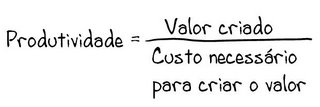
O sublinhado identifica o tema em falta no artigo. É certo que a produtividade aumenta quando se usam menos recursos para fazer a mesma coisa. É o que chamo aqui há milénios de concentração no denominador:
O que o artigo não refere é que o truque é a concentração no numerador:
O que o artigo não refere é que a produtividade cresce muito mais quando se muda o que se faz, o problema é não perceber o pressuposto implícito que influencia tudo o resto, assumir que as saídas de diferentes países, com diferentes níveis de produtividade, são constantes.
"The data suggests that midsized brewers are being squeezed out by their smaller and larger competitors. According to our analysis of Brewers Association data, the average number of barrels produced by midsized craft breweries fell by about 4 percent between 2012 and 2016 — a period in which microbreweries and larger craft breweries posted modest gains, at 1.8 percent and 6.5 percent, respectively."
Em todo o lado esta tendência de polarização.
Cuidado com o meio-termo, cuidado com o querer ser tudo para todos, cuidado com a ausência de uma estratégia.
Desvalorizar o sacrifício de atrasar a gratificação é, talvez, o ataque mais forte à civilização que nos trouxe até aqui:
"When engaging in sacrifice, our forefathers began to act out what would be considered a proposition, if it were stated in words: that something better might be attained in the future by giving up something of value in the present. ... Adam’s waking to the fundamental constraints of his Being— his vulnerability, his eventual death— is equivalent to his discovery of the future. The future: that’s where you go to die (hopefully, not too soon) [Moi ici: Sempre acreditei nisto, não deixamos de ser imortais com Adão e Eva, descobrimos que éramos mortais] . Your demise might be staved off through work; through the sacrifice of the now to gain benefit later. ... There is little difference between sacrifice and work. They are also both uniquely human. ... Prosaically, such sacrifice— work— is delay of gratification, but that’s a very mundane phrase to describe something of such profound significance. The discovery that gratification could be delayed was simultaneously the discovery of time and, with it, causality (at least the causal force of voluntary human action). Long ago, in the dim mists of time, we began to realize that reality was structured as if it could be bargained with. We learned that behaving properly now, in the present— regulating our impulses, considering the plight of others— could bring rewards in the future, in a time and place that did not yet exist. We began to inhibit, control and organize our immediate impulses, so that we could stop interfering with other people and our future selves. Doing so was indistinguishable from organizing society: the discovery of the causal relationship between our efforts today and the quality of tomorrow motivated the social contract— the organization that enables today’s work to be stored, reliably (mostly in the form of promises from others). Understanding is often acted out before it can be articulated ... The act of making a ritual sacrifice to God was an early and sophisticated enactment of the idea of the usefulness of delay. There is a long conceptual journey between merely feasting hungrily and learning to set aside some extra meat, smoked by the fire, for the end of the day, or for someone who isn’t present. It takes a long time to learn to keep anything later for yourself, or to share it with someone else (and those are very much the same thing as, in the former case, you are sharing with your future self). It is much easier and far more likely to selfishly and immediately wolf down everything in sight."
Peterson chama a atenção para o facto de no Génesis, depois da expulsão do paraíso a primeira estória que aparece é uma que fala do sacrifício.
Trechos retirados de "12 Rules for Life: An Antidote to Chaos" de Jordan Peterson.
"O que têm em comum os concursos para a requalificação de uma escola secundária em Barroselas, Viana do Castelo, com um preço de empreitada de 1,6 milhões de euros, o concurso para a construção da sede do teatro da rainha, nas Caldas da Rainha, por 1,73 milhões de euros, ou o concurso para a construção de uma Unidade de Saúde Familiar, em Viseu, por 1,6 milhões de euros? Todos eles ficaram desertos. ... A Câmara de Viseu já teve dois concursos públicos que ficaram desertos, o que atrasa os processos. Teremos de lançar um novo e porventura por preços mais elevados”, ... O presidente da Confederação da Construção e do Imobiliário de Portugal (CPCI), Manuel Reis Campos, não manifesta nenhuma surpresa com estes acontecimentos, pelo contrário. ... O principal problema, admite, “são os preços base irrealistas” e o facto de os seus valores continuarem a ser um tecto máximo, em vez de ser uma mera referência."
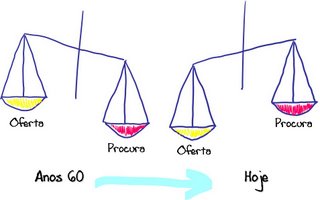
Um pouco por todo o lado, agora até nos sectores da economia não transaccionável, estes sintomas de mudança. Procura maior que a oferta.
Desde o meu primeiro trabalho como consultor/formador, rigorosamente desde o meu primeiro trabalho em 1994, que apresentei um slide que continuo a apresentar:
O modelo baseado na oferta maior que a procura está cada vez mais abalado.
Empresa mostrou-me vários registos de não conformidade, julgo que quatro.
Cada não conformidade estava bem descrita. E para cada não conformidade tinha sido identificada uma causa que fazia sentido e estava claramente descrita. No entanto, senti algum desconforto com essas causas. Por exemplo:
a não conformidade X foi gerada porque o operador A fez uma operação incorrecta;
a não conformidade Y foi gerada porque o operador B se esqueceu de fazer uma operação;
Logo ali, começamos a perguntar o "porquê?": por que é que ele fez uma operação incorrecta? por causa de Z. E por que é que Z aconteceu?
Interessante que em todos os quatro casos a causa-raiz foi falta de formação. Alguém tinha sido colocado a desempenhar uma função sem estar convenientemente preparado para tal.
Recuei aos anos 90 do século passado e ao tempo em que trabalhei com o Juran Institute em projectos de melhoria e usava este vídeo:
É fundamental chegar à causa-raiz.
Sem a bateria de 5 porquês:
as causas apontam para erro humano - afinal o problema é das pessoas e não da organização (recordar os textos de "O Erro em Medicina";
cada não-conformidade parece um caso isolado;
as acções que podemos equacionar para reduzir a probabilidade de recorrência são muito rudimentares
Disseram-me que iam criar um template para "obrigar" quem investiga as não-conformidades a perguntar porquê pelo menos 5 vezes.
Sendo uma empresa com falta de capacidade produtiva para a procura que estão a sentir, comecei logo a pensar em quantas horas de produção perdidas as não conformidades representam, e a traduzir em euros de facturação perdida por semana.
E contei-lhes um caso real desta semana: numa pequena localidade do centro do país, entrei num pequeno café que tem um pão d'avó muito bom para almoçar uma sandes. Reparei que estavam duas mulheres com pinta de ucranianas a falar entre si e a interagir com os telefones. Depois, entra um sr. Alberto que veio para ler o jornal do café, depois entra uma outra mulher para tomar um café e beber um copo de água. De repente os quatro começam a falar sobre as "queridas" da encarregada da fábrica têxtil em frente, que tinham sido seleccionadas para fazer horas-extra no Sábado e que só depois de terem confeccionado 700 peças é que descobriram que as tinham feito mal.
Trabalho na indústria desde Setembro de 1987 e confesso que nunca tinha percebido que a recusa deliberada em cumprir o plano de controlo da qualidade, para evitar fazer 700 peças mal, pode ter uma justificação perfeitamente racional:
estamos pressionados pelo tempo para produzir o mais possível;
cada minuto que eu ocupar com controlo é um minuto que não vou estar a produzir;
como por princípio estou a trabalhar bem não preciso de controlar;
a não conformidade acontece;
o produto não conforme pode, ou não, ser retrabalhado;
acabo por perder mais capacidade produtiva do que se tivesse controlado como deve ser
"Forget all the “retail apocalypse” headlines. The phrase suggests the whole industry is collapsing, consulting firm Deloitte says. In reality, it’s not. . But it is changing in significant and fundamental ways. ... There’s no apocalypse, Deloitte found, but there is a “renaissance” of sorts going on.
At the high and low ends, retail is thriving. It’s in the middle that it’s faltering. ... According to Deloitte, more stores are actually opening than closing. But they’re all on the low and high ends. If you look at the middle only, the situation does look dire.
Os que vêem a ascensão da Amazon acham que o caminho que ela está a seguir é a única via, mas reparem na polarização.
"A reader asked, “Why isn’t pricing more valued in companies?” What a fabulous question. Although I haven’t seen the research, my experience leads me to believe there are three reasons, all huge. . First, many companies don’t know the power of pricing. ... Second, executives may understand the power of pricing but don’t know how to tackle it. ... Third, pricing is risky."
Acredito que muitos estarão com o mesmo modelo mental que me formatava quando eu chamava de burros a Marn e Rosiello quando afinal o burro era eu. Algumas empresas, conhecendo a minha veia para capturar e descrever modelos sistémicos com os esquemas da dinâmica de sistemas, costumam pedir-me para retratar problemas sistémicos, em busca de pontos de alavancagem. Como de alguma forma se pode intuir pelo tema da falta de pessoas para trabalhar, isto anda tudo relacionado com a incapacidade de perceber que existem outras formas de aumentar a rentabilidade para além da cancerosa aposta no aumento da quantidade.
"An earlier, smaller trial in Uganda had suggested that the psychological training was likely to work well. It did: monthly sales rose by 17% compared with the control group, while profits were up by 30%. It also boosted innovation: recipients came up with more new products than the control group. That suggests that entrepreneurship, or at least some mental habits useful for it, can indeed be taught. More surprising was how poorly the conventional training performed: as far as the researchers could tell, it had no effect at all. Budding entrepreneurs might want to avoid the business shelves and make for the psychology section."
Tenho de aceitar esta via como uma tentativa legítima para resolver um problema, tenho de ser fiel ao conselho que dou aos agricultores: a sua missão não é alimentar o mundo é ganhar a sua vida. Neste caso, a missão dos empresários têxteis não é fazer subir o sector na escala de valor, é tratar do seu problema, é satisfazer os clientes que resolveu servir. No entanto, fico com pena de não se aproveitar esta oportunidade para subir na escala de valor e abandonar a via do crescimento canceroso.
"O que se torna evidente é que o “mercado livre de ideias”, que garante a possibilidade de “ideias de toda a espécie terem uma oportunidade de sair a público, de serem explicitadas e argumentadas até ao fim, e não de forma truncada”, está hoje de rastos."
O artigo que encontrei esta manhã no ionline, "Livrarias independentes. A brecha que persiste e a urgência de um leitor ativista", é merecedor de vários comentários relacionados com o pensamento estratégico nas organizações, com a determinação dos clientes-alvo, com o desenho ou a percepção do ecossistema em que se está inserido. No entanto, por agora fico-me só pela frase que destaquei lá em cima.
Acham mesmo que é mais difícil publicar ideias no mundo de hoje? Acham mesmo que as barreiras à publicação são mais altas hoje do que há 10 ou 20 anos?
Agora imaginem o modelo mental de alguém que responde "SIM" a ambas as questões a tentar explicar o encerramento das livrarias independentes.
"This tendency to underestimate the complexity around us is now a well-studied aspect of human psychology and it is underpinned, in part, by the so-called narrative fallacy. ... You see the narrative fallacy in operation when an economist pops up on the early-evening news and explains why the markets moved in a particular direction during the day. His arguments are often immaculately presented. They are intuitive and easy to follow. But they raise a question: Why, if the market movements are so easy to understand, was he unable to predict the market movement in advance? Why is he generally playing catch-up? ... That is the power of the narrative fallacy. We are so eager to impose patterns upon what we see, so hardwired to provide explanations that we are capable of “explaining” opposite outcomes with the same cause without noticing the inconsistency. ... But think about what this means in practice. If we view the world as simple, we are going to expect to understand it without the need for testing and learning. The narrative fallacy, in effect, biases us toward top-down rather than bottom-up. We are going to trust our hunches, our existing knowledge, and the stories that we tell ourselves about the problems we face, rather than testing our assumptions, seeing their flaws, and learning. But this tendency, in turn, changes the psychological dynamic of organizations and systems. The greatest difficulty that many people face, as we have seen, is in admitting to their personal failures, and thus learning from them. We have looked at cognitive dissonance, which becomes so severe that we often reframe, spin, and sometimes even edit out our mistakes. ... But when we are misled into regarding the world as simpler than it really is, we not only resist testing our top-down strategies and assumptions, we also become more defensive when they are challenged by our peers or by the data. After all, if the world is simple, you would have to be pretty stupid not to understand it."
"In some sales positions, the list of target prospects is supplied to the salesperson. However, in the majority of small and midsize companies, that’s not the case. Often, the challenging task of identifying and choosing potential clients is left to the salesperson. And that can be pretty daunting, particularly for a new hire. . I like to use a series of “who” and “why” questions to help identify strategic targets when creating a list:
Who are our best customers (by industry, size, business model, location, etc.)?
Why did they initially become customers? Why do they still buy from us?
Who do we compete against in the marketplace?
Why and when do they beat us? And why do prospects choose us over them?
Who used to be our customers (said differently, who used to buy from us)?
Why did we lose the business?
Who almost became a customer but didn’t (deals where we came close but lost)?
Who has referred business to us in the past?
Who should be referring business to us?
As discussed previously, selecting target prospects is one of our few chances to be strategic. We need answers to these questions in order to create a confidence-inspiring list of smartly chosen prospects and referral sources. I’d go as far as saying that building a great list is easy once we have these answers and just about impossible without them. First and foremost, I want to pursue prospects that look, feel, and smell like our very best clients. We know we bring value to the equation. We have instant credibility. Our story is relevant and we have happy clients to prove it."
Trecho retirado de "New Sales. Simplified" de Mike Weinberg.
Uma vez que as pequenas séries estão para ficar, até que ponto máquinas muito mais pequenas podem fazer o serviço que vemos ser feito por máquinas de corte de grandes dimensões? Até que ponto estas "computer-controlled milling machine that can cut into aluminum, brass, wood, and plastic with incredible precision" pode substituir os cortantes e balancés?
Acerca de 2:
Pode ser uma revolução potenciada por preços, questões ambientais e valores seguidos pelos consumidores.
"A finite target list is essential for a successful new sales attack. Salespeople who succeed in acquiring new business lock in on a finite number of strategic targets. They’re confident these prospects have been chosen for the right reasons, and they methodically work and rework that finite set of accounts. Over time, these successful hunters get noticed, get in, build relationships, and begin gaining traction. This only happens because they have committed to this defined list and are therefore able to penetrate targets with their sales weapons."
Trecho retirado de "New Sales. Simplified" de Mike Weinberg
Aqui no blogue costumo escrever sobre o fuçar, sobre como os práticos da indústria, sem CV na academia, fazem o que os académicos não conseguem encontrar nos seus estudos. Recordo sempre Daniel Bessa e o calçado.
Matthew Syed no livro "Caixa Negra" conta uma estória muito interessante:
"This was a major problem for the company, not just because of maintenance and lost time, but also in terms of the quality of the product. They needed to come up with a superior nozzle. Fast. And so they turned to their crack team of mathematicians. Unilever, even back then, was a rich company, so it could afford the brightest and best. These were not just ordinary mathematicians, but experts in high-pressure systems, fluid dynamics, and other aspects of chemical analysis. They had special grounding in the physics of “phase transition”: the processes governing the transformation of matter from one state (liquid) to another (gas or solid). These mathematicians were what we today might call “intelligent designers.” These are the kind of people we generally turn to when we need to solve problems, whether business, technical, or political: get the right people, with the right training, to come up with the optimal plan. . They delved ever deeper into the problems of phase transition, and derived sophisticated equations. They held meetings and seminars. And, after a long period of study, they came up with a new design. You have probably guessed what is coming: it didn’t work. It kept blocking. The powder granularity remained inconsistent. It was inefficient. Almost in desperation, Unilever turned to its team of biologists. These people had little understanding of fluid dynamics. They would not have known a phase transition if it had jumped up and bitten them. But they had something more valuable: a profound understanding of the relationship between failure and success. They took ten copies of the nozzle and applied small changes to each one, and then subjected them to failure by testing them. “Some nozzles were longer, some shorter, some had a bigger or smaller hole, maybe a few grooves on the inside,” Jones says. “But one of them improved a very small amount on the original, perhaps by just one or two percent.” They then took the “winning” nozzle and created ten slightly different copies, and repeated the process.They then repeated it again, and again. After 45 generations and 449 ‘failures,’ they had a nozzle that was outstanding. It worked “many times better than the original.” Progress had been delivered not through a beautifully constructed master plan (there was no plan), but by rapid interaction with the world. A single, outstanding nozzle was discovered as a consequence of testing, and discarding, 449 failures."
""It's not what you don't know that kills you," Mark Twain famously said, "it's what you know for sure that ain't true" and that's the real innovator's dilemma. Innovation, necessarily, is about the future, but all we can really know is about the past and some of the present. Innovation is always a balancing act of staying true to your vision and re-examining your assumptions.
...
Innovation is always about the future and the future, especially with regard to technology, is often uncertain.
...
Lean startup guru Steve Blank likes to say that "no business plan survives first contact with a customer." It's one of those quotes that's constantly repeated because it's so obviously true to anyone who has ever launched a product. We can analyze surveys till we're blue in the face, but we really don't know what will happen until we see something hit the market.
... If you went to an investor and said you wanted to start a business but did not have any idea about the technology, the customer or the competitive environment, you probably wouldn't get very far. Nevertheless, that's exactly how every business starts. You have some assumptions, many of which will be proven wrong and you will have to adapt. [Moi ici: Por causa disto é que considero de uma imprudência alarmante isto e isto]
... Unfortunately, an idea can never be validated backwards, only forwards, so we have no real way of knowing what's viable until we actually give it a shot. That's why the ones that succeed learn how to test new ideas, see what happens and learn until they find something that really works. Innovation is never about what you know, but what you don't."
Regras para a reunião semanal que uma PME vai começar a fazer amanhã.
Começar às 9h00 de segunda-feira;
Demorar religiosamente não mais de 30 minutos;
Quem pensa o grupo, o todo:
O que temos de entregar esta semana e riscos associados;
O que temos de entregar na próxima semana e riscos associados;
Cada um dos presentes
Problemas que cada um sente ou prevê e pedidos de ajuda.
Por favor, lembrem-se que é meia-hora.
Não venham lavar roupa suja nem venham pedir reflexões filosóficas.
Não venham criticar, para isso haverá outros momentos e tempos e se calhar outras pessoas, aproveitem para comunicar e para facilitarem a vossa vida e a do parceiro tendo em conta o resultado pretendido: o do todo.
"Here’s a straightforward initial idea: rules should not be multiplied beyond necessity. Alternatively stated, bad laws drive out respect for good laws."
Trecho retirado de "12 Rules for Life: An Antidote to Chaos" de Jordan Peterson.
"When charged with acquiring new business, the natural and essential first questions are: “Where is the business going to come from?” and “Who should I be pursuing?” If we are putting together a prospecting and new business development sales attack, we need to know where to go and whom to target. That’s why selecting targets is the first step in the process. Quite simply, we can’t prospect if we don’t know who the prospects are. . Most salespeople spend the majority of their time in reactive mode responding to potential opportunities that come their way. The need for a defined list of target accounts does not register because, honestly, they are not targeting anyone. However, the proactive new business hunter requires a strategically selected list of appropriate target accounts in order to launch the attack. ... Selecting Target Accounts Is a Rare Opportunity to Be Strategic. It’s surprising how often senior executives or even first-line sales managers take for granted that their people are working the right accounts. Choosing our target accounts, which effectively also means choosing how we should be investing our time, is one of the few truly strategic things we do in sales. ... Choosing the accounts on which we’ll focus our proactive energy provides a rare opportunity to step back from the daily grind and ask the important, big-picture questions. . Who are our best customers? What are their common characteristics? What do their businesses “look, smell, and feel” like? Where are they located? Are they a particular size (e.g., in terms of revenue) or in certain vertical markets or niches where we have a higher rate of success? Where can we find potential customers with similar profiles?Does our best chance for new business lie within our current portfolio of existing customers? How should we rank those current accounts and then segment our focus across various types of customers, based on growth potential? How much of our time should be allocated to account penetration, to prospecting, to working referral sources? Are there certain competitor’s accounts that make sense to attack? . These are all highly significant and strategic questions, and I advocate the involvement of senior leadership in the decisions. The sales-person is entitled to input from management to ensure there’s strategic alignment between the business and the sales effort, and management should certainly have a keen interest in how the sales organization is investing its time. ... Even the best talent will fail if too much time is wasted attacking the wrong targets."
Trechos retirados de "New sale. Simplified" de Mike Weinberg.
"The battle between Goliath retailers and independent brands has been underway for a while. But with companies like Amazon and Walmart only expanding their reach, Leavitt predicts indie brands will start to struggle to sell their own products direct-to-consumers."
"We all know the feeling: what matters to us when buying something is not necessarily the same as what our partners, friends, colleagues or even total strangers emphasize when looking for the same product. Customers and consumers are not all alike. What value we get from a product is unique to us. While this is old wisdom, we still see that many businesses still take the same price across all customers.
. If someone is willing to pay more for a product or service, because she gets more value out of than the other person, then why not find a way to charge such a higher price? It is true that in some countries, price discrimination where you charge different prices to different customers for the exact same product is illegal. But charging different prices for products that are also differentiated according to the value they bring, is always legal."
Ontem tive esta conversa numa empresa. Perguntaram-me:
- Agora que nos vai conhecendo, diga-nos sinceramente o que pensa de nós?
Disse-lhes que os achava um diamante em bruto com um potencial muito grande se:
aumentarem a facilidade com que lidam com a complexidade e variedade de produtos que fabricam; e
forem convenientemente remunerados pelo valor que fazem os clientes experienciarem
- Mas às vezes competimos com empresas que fabricam produtos sem marcação CE e, por isso, podem ser mais competitivas no preço.
Disse-lhes o que costumo responder quando um cliente me diz que a sua concorrência está a fazer malandrice para ganhar um negócio. Se o vosso cliente aceita a entrada de máquinas nas suas instalações sem a marcação CE então é porque não é, ainda, o cliente adequado para vocês, ou ainda não chegou lá, ou nunca lá chegará. Ou então, não estão a fazer o trabalho certo de o elucidar sobre como a vossa oferta lhes facilitará a vida.
Depois, a conversa evoluiu para a minha clássica defesa de que cobrar mais porque se faz o cliente ganhar mais não é roubar, não é enganar, é simplesmente uma troca justa.
"É uma constante em toda a União Europeia: são muitos os Estados-membros que registaram em 2017 o maior crescimento da última década. Em Portugal, o marco remonta a 2000. No ano passado todos os países da UE registaram crescimento económico. Uns mais do que outros: a Irlanda e a Roménia lideram a tabela enquanto Grécia e Itália estão no fundo. Portugal foi o nono Estado-membro que menos cresceu, à frente da Alemanha, França ou Reino Unido."
Já agora, há anos que não percebo porque fazem esta comparação:
"Por outro lado, Portugal registou um melhor crescimento económico em 2017 do que as principais economias da União Europeia. Entre essas, a Itália foi a que menos cresceu (1,5%), seguida do Reino Unido (1,7%), França (2%) e Alemanha (2,2%). Portugal ficou também acima de países nórdicos como a Dinamarca (2,1%) ou a Suécia (2,4%)."
As principais economias da União Europeia crescem sempre menos que as economias da Europa de Leste. Assim, vamos paulatinamente sendo ultrapassados na criação de riqueza per capita por esses países, enquanto que por cá, governos de esquerda e de direita se enganam, e enganam-nos, ao compararem o crescimento do PIB com a média da União Europeia.
"As exportações dos vinhos do Alentejo aumentaram quase 12% em valor e 2,3% em quantidade em 2017, enquanto o preço médio cresceu mais de 9%, em comparação com 2016, revelou hoje a Comissão Vitivinícola Regional Alentejana (CVRA)."
"Customers who define narrow, specific needs tend to focus primarily on price because there are often a number of competitors who can meet those needs… so they will treat your offering as a commodity. Your reps have to know how to get the customer to appreciate a bigger picture:[Moi ici: Recordar "resourceness is not an intrinsic characteristic of a resource, but is a socially constructed and institutionalized phenomenon"] the bigger the perceived need, the more urgency the customers will have to buy and the more they will focus on value-drivers, not just price.
...
Customers go through predictable steps when making a buying decision. To sell value, the rep must be able to understand and support that process. What are the steps? What are decision makers typically involved? What role does each type of decision maker play in the process? At what points in the process does each decision maker get involved? And, most importantly, how can the rep make contact with each of these decision makers?
... Value-based selling only occurs when the customer is looking at factors other than price. That means your reps have to become adept at knowing what specific features of your offerings represent strong positive differentiators. On the flipside, they also need to know differentiators where your competitors have the advantage. They must know how to emphasize the former and downplay or counteract the latter."
"If we're committed to proactively going after new business, then we must have a clear picture of the customers we're targeting. It's challenging, to say the least, to pursue something if you do not know in which direction to head. Therefore, selecting targets is the first piece of the puzzle and first aspect of our new business framework. … When attacking targets, it really helps when we're able to create and deploy the necessary weapons. There's an entire arsenal of weapons available to the salesperson. Not only must we be armed, but it's critical that we become proficient firing those weapons at selected targets. … Finally, we come to planning and executing the attack. I like to say that it's all academic unless you actually take the field. Selecting the right targets and possessing the appropriate weapons are meaningless unless we get into action. Remember: SALES IS A VERB. Planning our sales attack forces us to have discipline and to take a hard look at our calendars. We need to declare what weapons we'll be shooting at which targets, and when. And then we must do it, monitoring and measuring our activity along the way. …
Poor target selection or lack of focus on selected targets
Lame sales weapons or lack of proficiency deploying weapons
Inadequate planning or lack of execution of the plan
Truth be told, most sales teams struggle with more than one of these three issues. … However, there are a few critical assumptions that accompany my declaration. Yes, assuming can be dangerous, but in order to help fix a sales problem, we need be assured it's a sales problem. I guarantee that the sales problem lies in one or more of those New Sales Driver categories, assuming:
The business has a clear strategy, a defined place in the market, and there is demand for its offering.
The sales compensation plan is not working against the desired sales effort.
The sales talent would at least qualify as "average."
... Those are not outlandish assumptions. Said simply: The business knows what it is and where it is going; the pricing model makes sense based on the value delivered; the compensation plan is not incenting salespeople not to sell; and the person or people in question would rate as a B- or better."
Trechos retirados de "New sale. Simplified" de Mike Weinberg.
A Parte I aborda situações de falta de ética, no mínimo.
Há algumas semanas terminei uma formação sobre o balanced scorecard numa empresa. Ao construir um balanced scorecard da 3ª geração termino com o desenvolvimento de um conjunto de iniciativas estratégicas com base na metodologia que aprendi com Dettmer.
O dono da empresa não queria acreditar na validade ou na importância dos factos negativos (exemplo):
A argumentação que ele usava era simples:
- A minha empresa está certificada, o que fazemos está validado pela empresa de certificação. Você acha que seríamos certificados se os processos não estivessem a ser seguidos?
Este é outro ponto que me incomoda na ISO 9001. Vender gato por lebre. Lá expliquei ao senhor que a ISO 9001, por exemplo, não está preocupada com a actividade de prospecção, mas sem prospecção que futuro é que uma empresa pode ter? Lá expliquei ao senhor que a ISO 9001 não manda as empresas despedirem clientes, mas por vezes o futuro das empresas começa por aí, pelo despedimento de certo tipo de clientes.
Como consultor gosto de vender projectos de implementação de sistemas de gestão da qualidade concentrados no negócio, na estratégia, no ecossistema da procura. Ao mesmo tempo, acho que isso é uma opção de cada empresa e, por isso, a norma devia voltar a ser de garantia da qualidade. Mais uma vez, como se pode falar em gestão se não se fala de captar novos clientes.
Assim, promove-se a ISO 9001 como uma panaceia e, no entanto, o simples cumprimento da norma não garante a execução de actividades mínimas.
Em várias empresas tenho-me deparado com o resultado de uma cultura e de um passado de centralização, empresas com uma autoridade forte em que uma cabeça pensava e as outras executavam. Era um modelo que funcionava se a cabeça que pensasse fosse uma boa cabeça.
Entretanto, nos tempos que correm, com o advento de Mongo e a sua crescente variedade, com a necessidade de flexibilidade e rapidez, com as pequenas séries, ... temos a mensagem de "Team of Teams", mesmo uma cabeça brilhante não é suficiente. É preciso um esforço de equipa.
"The command-and-control type of management taught in business schools — and how it is subsequently applied when graduates leave to work in companies — has changed little over the past few decades. ... What these and other companies need in today’s environment are models that enable managers to be flexible, delegate decision-making and experiment without fear of failure. This allows companies to be more agile than their competitors and to react quickly to change."
"Sobre a economia partilhada, Lutz Walter, secretário-geral da plataforma ETP da Euratex, trouxe exemplos de gigantes como a Uber e o Airbnb para mostrar que a indústria têxtil não pode escapar a esta tendência. «Por exemplo, a taxa de utilização de um carro é 8%, tal como de uma casa de férias e os sapatos de homem é de 5%. Porque é que temos tantos sapatos? E roupa?», questionou na defesa da eficiência que pauta as escolhas profissionais mas não as pessoais. A resposta parece estar nos serviços de aluguer de vestuário, cada vez mais na crista da onda."
Imaginem o impacte desta evolução nos modelos de negócio de tantas empresas.
O amigo @Peliteiro é um experiente auditor que serve de meu confidente e, a quem conto as peripécias que encontro nas auditorias de certificação a que as empresas minhas clientes, como consultor, são sujeitas. Só no espaço de um mês, por exemplo, tive duas situações bem bizarras e que serão sintomas de algum apodrecimento do negócio das auditorias de certificação.
Caso 1. Empresa certificada ia ter a sua primeira auditoria de acompanhamento. Empresa pede-me apoio para realizar auditoria interna. Descubro que a empresa desde a auditoria de certificação não fez nada, rigorosamente nada. No espaço de um mês fazemos o possível e o impossível para responder às não-conformidades da auditoria interna e, preparar a empresa para minimizar as não conformidade na auditoria de acompanhamento. Depois da auditoria de acompanhamento o tempo passou, e a empresa não me disse nada sobre o apoio na resposta ao relatório da auditoria de acompanhamento... o auditor da empresa de certificação (multinacional por sinal) virou ... consultor da empresa. É legal? Não! É ético? Não!
Caso 2. Empresa certificada há mais de 5 anos. PME séria e organizada, desde sempre recorre a empresa de certificação estrangeira por causa do tipo de clientes que tem. Contaram-me, escandalizados, que auditor@ passou o dia com o telefone ligado e a responder a chamadas para fechar negócios de compra e venda em nome da sua empresa. Como o que vende pode ser matéria-prima para os clientes da empresa auditada, resolve pedir-lhes uma lista de clientes e de contactos. E ainda pediu-lhes que escrevessem um e-mail de apresentação e o enviassem. É ético? Não!
"the paper conceptualizes a resource not as a substance or thing, but rather as an abstraction that describes the function that a substance or idea contributes to achieve a desired end. Hence, to integrate resources, resource-integrating actors must first be able to recognize the resourceness of the potential resources available to him/her. Therefore, the process of affording potential resources their resourceness becomes a prerequisite for resource integration and value cocreation. For this reason, a deeper understanding of resources is critical for the further development of S- D logic and its service ecosystems perspective.
...
The basic argument of the paper is that resourceness is not an intrinsic characteristic of a resource, but is a socially constructed and institutionalized phenomenon
...
S-D logic’s systemic view on value creation posits that for value to emerge, resources from multiple sources must be integrated. Hence, value is cocreated among multiple actors who potentially possess institutional arrangements that differ in terms of the included practices, symbols, and organizing principles that enable and constrain resource integration. Resource integration, therefore, takes place in the complex, multidimensional, and dynamic context of service ecosystems composed of multiple institutional arrangements.
... ‘resourceness’ is inseparable from the complex institutional context in which it arises. When connected to this omnipresent process of potential resources gaining their ‘resourceness,’ the institutional approach demonstrates its applicability to a wide range of social phenomena. This conceptualization reveals the need for more holistic, systemic, and multidisciplinary perspectives on understanding the profound implications of the process of resources ‘becoming’ in value cocreation, innovation, and market evolution."
"In fact, getting an MBA has never been a more popular career path. The number of MBAs graduating from America’s business schools has skyrocketed since the 1980s. But over that time, the health of American business has decreased by many metrics: corporate R&D spending, new business creation, productivity, and the level of public trust in business in general. . There are many reasons for this, but one key factor is that the basic training that future business leaders in this country receive is dictated not by the needs of Main Street but by those of Wall Street. With very few exceptions, MBA education today is basically an education in finance, not business—a major distinction. ... most top MBA programs in the United States still teach standard “markets know best” efficiency theory and preach that share price is the best representation of a firm’s underlying value, glossing over the fact that the markets tend to brutalize firms for long-term investment and reward them for short-term paybacks to investors. ... Business schools by and large teach an extremely limited notion of “value,” and of who corporate stakeholders are. ... “anyone can teach you how to read a P&L [profit-and-loss statement] or value a derivative; those kinds of things have become commoditized.” The bigger challenge is to teach America’s future business leaders how to be curious, humane, and moral; how to think outside the box about problems like funding the research for a new blockbuster drug. And how to be strong enough to stand up to Wall Street when it demands the opposite. ... “The techniques, if you read the Harvard Business School cases, they are all about finding efficiencies, cost optimization, reducing your [product] assortment, buying out competitors, improving logistics, getting rid of too many warehouses, or putting in more warehouses. [Moi ici: CV de encalhado da tríade que anda de braço dado com a mentalidade gringa] It’s all words, and then there’s a sea of numbers, and you read it all and analyze your way through this batch of charts and numbers, and then you figure out the silver bullet: the problem is X. And you’re then considered brilliant.” ... Many of America’s iconic business leaders believe an MBA degree makes you less equipped to run a business well for the long term, particularly in high-growth, innovation-driven industries like pharmaceuticals or technology, which depend on leaders who are willing to invest in the future. . MBAs are everywhere, yet the industries where you find fewer of them tend to be the most successful. ... The bottom line, though, is that far from empowering business, MBA education has fostered the sort of short-term, balance-sheet-oriented thinking that is threatening the economic competitiveness of the country as a whole."
Pois:
The problem with the United States economy is mainly an economy that don't manufacture interesting things anymore, just commodities, perhaps a little bit above cocoa from Liberia but very similar https://t.co/sgSH4T4n0D
O tema da satisfação dos clientes, no âmbito da ISO 9001, é um tema que me persegue há uma série de anos (por exemplo em 2006, em 2009 e em 2010).
Vejo mais trabalho para responder a um requisito e satisfazer o auditor do que genuína intenção de capturar a percepção dos clientes. Caso a caso vou procurando (muddling through) algo que consiga capturar essa tal percepção.
"the starting point of S-D logic is the idea that service is exchanged for service to cocreate value; that is, to increase the wellbeing and viability of an actor or system. Central to this view is the idea that value creation as a process emerges and unfolds over extended periods of time as a multi-actor effort of integrating resources through the exchange of service, either directly or indirectly. Value, as an emergent outcome of this process, is contingent on the integrated resources as well as contextually determined by each actor in a specific instance of the process, making value perception potentially quite unique and asymmetric. ... An important part of the service-centered view is to understand that the nature of resources is contextual. In other words, resources are not, they become. This means that actors’ knowledge and skills - that is, other resources - determine the resourceness of resources."
Como não relacionar estes sublinhados com o salazarismo corporativista que sabe o que é que é melhor para o cliente
"Sales Follows Strategy: Mr. CEO, Please Do Your Job so I Can Do Mine! . One of the non-negotiables for a sales organization to succeed in acquiring new business is clarity. I have yet to see an individual or a sales team have demonstrable success in the marketplace without a crystal-clear picture of their mission. Let me say it another way: Sales is supposed to follow strategy. The sales team’s job is to take a clear strategy and execute it to perfection in the market. Salespeople should not be making it up as they go along. Where I’m from, it’s the chief executive’s job to determine and articulate the company’s strategy. It’s essential to be able to inform the sales team about:
Our reason for existence
The direction the company is headed and why it’s the correct course
What we sell and why we sell it
Which markets to pursue and where we are positioned in those markets
The competitive landscape and how we stack up against competitive offerings, and why we’re better or different
Why our pricing model is appropriate for the value we create in the markets we’re pursuing and against the competition we’re facing
The salesperson or sales organization is entitled to super clear answers for each of the previous bulleted items. Sadly, too often those answers do not come. ... It is not the job of sales to set strategy. It’s our job to execute the clear strategy provided to us. Mr. CEO, please do your job so we can do ours!"
Trechos retirados de "New Sales. Simplified" de Mike Weinberg.
Recordo o desabafo de um licenciado em "Contabilidade" há mais de 10 anos, que protestava contra o facto de "milhares" de recém-licenciados em "Contabilidade" invadirem o mercado de trabalho todos os anos. Ao ouvi-lo, retorqui:
- Então O...! Ao fim de dez anos de experiência profissional acredita que continua a competir de igual para igual com os recém-licenciados? Não aprendeu nada? Não se especializou em nada?
Voltemos ao texto:
"Os concursos públicos aparentam continuar a ser ganhos pelos melhores honorários e não pelo melhor projeto.[Moi ici: As regras são claras e transparentes. O cliente público só valoriza o preço, não engana ninguém]
...
A situação é tal que para além de se praticarem preços muito abaixo de qualquer tabela de referência [Moi ici: Um apelo a barreiras à concorrência? Abençoada UE que nos protege desta mentalidade] que possa ter existido ou vir a existir, não há um cliente que não peça um desconto e não há arquitetos a negar esse desconto.
...
Como é que um ateliê compete com um recém-formado que elabora projetos de moradias a 450 euros em Cascais? Ou projetos de remodelações no Bairro Alto a 400 euros? [Moi ici: Incrível como olho o mundo nas antípodas do articulista. Este acha que o problema é do recém-licenciado. Para mim, o problema é tão claro e está no ateliê!!! O ateliê ou não sabe procurar os seus clientes-alvo ou está muito enganado. O ateliê tem uma estrutura de custos que o torna não competitivo para certos tipos de projectos. Isto é básico para qualquer PME depois de mais de 15 anos do início do choque chinês e não é para um licenciado em Arquitectura e anos de experiência? A qualidade é definida pelo cliente e não por um comité qualquer]
...
Em acrescento, prosseguimos também todos a trabalhar “à chinesa” pois o projeto para além de ser adjudicado ao preço mais barato, também tem cada vez mais que estar pronto para ser entregue antes-de-ontem devido á apressada dinâmica imobiliária. [Moi ici: Tão típico!!! Achar que o cliente, o tipo que paga, é um trouxa que tem de ser educado pelos superiores. Recuo a Julho de 2011 e ao meu uso da palavra atelier como adjectivo para classificar gente que acha que o tempo é uma variável secundária: "Agora isso implica uma outra organização do trabalho, isso implica criativos que estão numa fábrica e não num atelier onde o tempo é secundário"]
.
Tal como Nuno Mateus refere na dita entrevista, é no mínimo leviano pensar que é possível receber o mesmo produto com a mesma qualidade, por apenas metade do preço. [Moi ici: Quer-me parecer que há aqui um grande equívoco: a qualidade é definida pelo cliente e não pelo fornecedor. O meu Skoda ten tanta qualidade quanto um Ferrari em determinadas características que valorizo] Um projeto com qualidade é pensado. [Moi ici: E quem define a qualidade?] Para isso necessita de ser elaborado por bons arquitetos, exigindo muito tempo investido e dedicação. Não surge de um dia para o outro ou através de “uma direta a trabalhar sem dormir”.[Moi ici: Faz-me lembrar os novos-velhos que protestavam contra o design feito por gente sem canudo de designer]"
"At the top of the pyramid are inspirational elements: those that improve the customer’s vision of the future (helping a firm anticipate changes in its markets), provide hope for the future of the organization or the individual buyers (for instance, that they can move to the next generation of technology easily and affordably), or enhance a company’s social responsibility. . Elements at the base of the pyramid have long been easy to measure, and competing on them has been straightforward. The more emotional elements at the middle and upper levels have traditionally been difficult to isolate and quantify and, therefore, harder to implement. But the battle for differentiation is shifting toward these less transactional aspects. For a strategist or a product manager, mastering the intangibles of the customer’s total experience—all the service, support, interactions, and communications wrapped around an offering—is much harder than making an offering faster, cheaper, or more durable.
"the world, as perceived, is maya— appearance or illusion. This means, in part, that people are blinded by their desires (as well as merely incapable of seeing things as they truly are). This is true, in a sense that transcends the metaphorical. Your eyes are tools. They are there to help you get what you want. The price you pay for that utility, that specific, focused direction, is blindness to everything else. ... But all that ignored world presents a truly terrible problem when we’re in crisis, and nothing whatsoever is turning out the way we want it to. ... Happily, however, that problem contains within it the seeds of its own solution. Since you’ve ignored so much, there is plenty of possibility left where you have not yet looked."
Trechos retirados de "12 Rules for Life: An Antidote to Chaos" de Jordan Peterson
"Then they need to consider how they will bridge the divergent interpretations of value. It turns out one reason there’s been such little progress in creating a value-based system is that the stakeholders in the U.S. health care system — patients, providers, hospitals, insurers, employee benefit providers, and policy makers — have no common definition of value and don’t agree on the mix of elements composing it (quality? service? cost? outcomes? access?).
...
We asked more than 5,000 patients, more than 600 physicians, and more than 500 employers who provide medical benefits across the nation how they think about the quality, service, and cost of health care. ... What we discovered is that there are fundamental differences in how they define value in health care and to whom they assign responsibility for achieving it. Value, it seems, has become a buzzword; its meaning is often unclear and shifting, depending on who’s setting the agenda. As a result, health care stakeholders, who for years thought they were driving toward a shared destination, have actually been part of a fragmented rush toward different points of the compass.
...
The most effective thing that stakeholders can do to create a high-value health care system is to pause in their independent pursuits of value to describe to each other exactly what it is they seek.
...
There are several examples of the fundamental value misalignments that could be starting points for these discussions. The first concerns the relative importance of health outcomes. For physicians like me, clinical outcomes are paramount; health improvement and high-quality care are essential components of health care value. And we assume that patients share that perspective. But, it seems, they don’t. When the Utah survey asked patients to identify key characteristics of high-value health care, a plurality (45%) chose “My Out-of-Pocket Costs Are Affordable,” and only 32% chose “My Health Improves.” (In fact, on patients’ list of key value characteristics, “My Health Improves” was slightly below “Staff Are Friendly and Helpful.”) Given the chance to select the five most important value characteristics, 90% of patients chose combinations different from any combination chosen by physicians. In general, cost and service were far more important in determining value for patients than for physicians."
Não percebo a admiração, um dos primeiros casos de balanced scorecard que estudei era sobre um hospital e era interessante perceber que o sucesso do hospital dependia de:
os médicos recomendavam o hospital aos seus doentes por causa do sucesso na melhoria do estado dos doentes;
os doentes valorizavam a relação, a forma como eram tratados;
as companhias de seguros que pagavam ao hospital valorizavam o preço.
"Many salespeople fail to develop new business because they’re wandering aimlessly. Too often, they’re not locked in on a strategically selected, focused list of target customers or prospects.
. Sometimes they fail because they don’t invest the time and brain power to ensure they are calling on the right accounts. Even the best talent will have a hard time succeeding if their efforts are directed in the wrong direction. However, more common than flat-out calling on the wrong list are salespeople who don’t focus on the list they have. Salespeople are famous for lack of discipline and losing focus. They attempt to call on an account (once), but don’t get anywhere. Instead of sharpening their weapons and continuing to attack the same strategically selected targets, they turn and pursue a new set of prospects. This constant change of direction becomes their death knell because they never gain traction against the defined target set.
.
In my personal sales experience and what I’ve seen from other top performers, new business success usually results from a combination of perseverance, creativity, and resilience while staying laser-focused on a well-chosen, finite list of target prospects."
Trecho retirado de "New Sales.Simplified" de Mike Weiberg.
Managers are overconfident about their skills—and the worse they are, the better they think they are.
Dunning-Kruger strikes again. It's time to stop confusing confidence with competence. pic.twitter.com/6chRToI34q
Talvez em certos países seja tão difícil ser empresário que as barreiras psicológicas à entrada têm de ser muito altas. Dessa forma, só mesmo os muito optimistas (ou desesperados?) avançam para arriscar empreender.
Há tempos, alguém genuinamente empenhado no sucesso do actual governo interrogava-se, com um misto de admiração e desânimo, como é que Portugal em 2017, com um crescimento do PIB de 2,7 %. era um dos países europeus que menos tinha crescido. Não tenho resposta certa. No entanto, hoje ao ler "Porto cobra taxa de dois euros para “mitigar pegada turística”" dei comigo a pensar:
Assistimos a esta voracidade impostal e taxal nestes negócios novos e, por isso, são noticiadas. Não será que os negócios "maduros" têm às costas 40 anos de voracidade acumulada?
"It is widely believed that restructuring has boosted productivity by displacing low-skilled workers and creating jobs for the high skilled."Mas, e como isto é profundo:"In essence, creative destruction means that low productivity plants are displaced by high productivity plants." Por favor voltar a trás e reler esta última afirmação. . "Lovaglia’s Law: The more important the outcome of a decision, the more people will resist using evidence to make it."
"If an organisation is too stable it can ossify, but if it is too unstable it can disintegrate. Successful organisations work between these two conditions or states, in what Stacey called ‘the chaos zone’."
"If the customer doesn't care about the price, then the retailer shouldn't care about the cost," “It's not enough that we do our best; sometimes we have to do what's required”. "Das Leben, das uns gegeben ist, ist uns nicht als etwas Fertiges gegeben, sondern wir müssen es uns gestalten, und zwar jeder sein eigenes." "Eine Regierung, die nichts wert ist, kostet am meisten." "Forget trying to persuade them; light their pants on fire." "O futuro é o que importa. O futuro é a base do significado, é de onde vem o projecto que alguém tem para si próprio" "The single biggest problem in communication is the illusion that it has taken place."
“It is not the strongest of the species that survives, nor the most intelligent; it is the one that is most adaptable to change.”
"o Marketing só existe a partir do pensamento estratégico, caso contrário "não resulta"" "It is difficult to get a man to understand something, when his salary depends upon his not understanding it" "Perder diversidade é como arrancar páginas de um livro. Quantas páginas poderemos arrancar até deixar de compreender o enredo?" The great enemy of the truth is very often not the lie – deliberate, contrived and dishonest – but the myth, persistent, persuasive, and unrealistic. Belief in myths allows the comfort of opinion without the discomfort of thought."
"By strategy, I mean a cohesive response to a challenge. A real strategy is neither a document nor a forecast but rather an overall approach based on a diagnosis of a challenge. The most important element of a strategy is a coherent viewpoint about the forces at work, not a plan."
"Un desastre està punt de succeir a Espanya. El malentès de la gravetat de la crisi costarà car als inversors, ja que tindrà profundes conseqüències per a tot el sistema bancari europeu", afirma.
Entre d'altres coses, Mauldin diu que "els inversors estan fumant crack si creuen que els bancs espanyols són entre els més forts d'Europa, ja que estan amagant les seves pèrdues".
“… there are no “sunset” industries condemned to disappear in high wage economies, although there are certainly sunset and condemned strategies, among them building a business on the advantages to be gained by cheap labor”
"o vencedor da vida, o optimista que vive em incesto com o próprio ego, é o traço mais frágil do líder"
"We shall not grow wiser before we learn that much that we have done was very foolish." You may not be able to change the world but can at least get some entertainment & make a living out of the epistemic arrogance of the human race.
"I wanted you to see what real courage is, instead of getting the idea that courage is a man with a gun in his hand. It's when you know you're licked before you begin but you begin anyway and you see it through no matter what. You rarely win, but sometimes you do."
“Trust your guts. But not too much!”
"Customers will try 'low-cost providers,' because the majors have not given them any clear reason not to." "
"Natal é quando as Crianças pedem e os Pais pagam. Défices é quando os Pais pedem e as Crianças pagam."
"A imprevidência dos povos é infinita, a dos governos é legal"
"What a man sees depends both upon what he looks at and also upon what his previous visual-conceptual experience has taught him to see"
“The leaders first task is to be the trumpet that sounds a clear sound”
"lamented the lack of any systematic data on the scale of unfunded IOUs that care-free politicians have handed out like confetti."
"Let them call me rebel and welcome, I feel no concern from it; but I should suffer the misery of devils, were I to make a whore of my soul..."
O problema não é o consumo. O problema é o consumo assente em endividamento."
"There are designations, like "economist", "prostitute", or "consultant" for which additional characterization doesn't add information."
When it becomes more difficult to suffer than change, you will change"
"Hope is not a strategy and a crisis is a terrible thing to waste"
The more you can see of the present, the more you can see of the future"
Yes, You can change the future, but only changing the present"
"Entrepreneurship is 'Having aspirations greater than your resources'"
“The single biggest reason companies fail is they overinvest in what is, as opposed to what might be."
"The first principle is that you must not fool yourself - and you are the easiest person to fool. So you have to be very careful about that"
"A estabilidade é uma ilusão"
"When we create the conditions of possibility, the universe becomes our co-conspirator"
Thinking about doing is not doing. Talking about doing is not doing. Doing is doing."
"'God has created me to do him some definite service. He has committed some work to me which he has not committed to another'.
...
"Each of us has a mission, each of us is called to change the world, to work for a culture of life, a culture forged by love and respect for the dignity of each human person.
"As our Lord tells us in the Gospel we have just heard, our light must shine in the sight of all, so that, seeing our good works, they may give praise to our heavenly Father."
"The future is not there waiting for us. We create it by the power of imagination."
"confusing testosterone with strategy is a bad idea"
"Much consulting involves the application of models to a system, as opposed to getting involved in the system as a positive change agent""
"O Portugal que pára sem orçamento é precisamente aquele que vive dele e que há todo o interesse em parar."
"credibilidade da política financeira e dos seus executores está ao nível da credibilidade de uma barraca das farturas"
"The role of the manager is thought to be reduction of uncertainty rather than the capacity to live creatively in it"
"today an entrepreneur is closer to artists than managers"
"A business without a path to profit isn’t a business, it’s a hobby"
"If no one’s upset by what you’re saying, you’re probably not pushing hard enough. (And you’re probably boring, too.)"
"Storytelling isn’t just how we construct our identities, stories are our identities"
"'He who has a why to live can bear almost any how' "
"They can because they think they can"
"Se há coisa que não suporto é misturar catequese com negócios, é a incapacidade para calçar os sapatos do outro e só pensar na nossa posição de coitadinhos, pobres vítimas indefesas dos maus e que por isso precisamos do Estado todo poderoso para nos proteger e, nem percebem na volta, os juros que o Estado cobra por esse serviço mafioso de protecção que, ainda por cima não resolve nada."
"Empathy is like a universal solvent. Any problem immersed in empathy becomes soluble."
"In victory, do not brag; in defeat, do not weep"
"Value it's a feeling not a calculation"
"An economist is someone who has had a human being described to him, but has never actually seen one."
"Don't finish first--it's not about running a rat race. Start with a better ending in mind."
"If you sit in on a poker game and don’t see a sucker, get up. You’re the sucker.”
"The 'value added' for most any company, tiny or enormous, comes from the Quality of Experience provided."
"Crediting government with the success of entrepreneurs is like crediting the guy who built Bill Gates’ garage with the success of Microsoft."
"I have found that assuming social scientists understand the difference between correlation and causality is not generally a good one."
"Promising never to raise taxes, without reaching a deal on spending, really means a high and rising commitment to future taxes."
"Some things are so foolish that only an intellectual could believe them, for no ordinary man could be such a fool"
"os bancos não financiam a economia, a poupança sim"
"I do not know the key to success, but the key to failure is trying to please everybody"
"Never be afraid to try, remember... Amateurs built the ark. Professionals built the Titanic."
"terms such as 'experiment' and 'observation' cover complex processes containing many strands. 'Facts' come from negotiations between different parties and the final product - the published report - is influenced by physical events, dataprocessors, compromises, exhaustion, lack of money, national pride and so on."
"'science in the making' is 'the consequence of [a] settlement' of 'controversies'."
"If the state wishes to spend more, it can do so only by borrowing your savings or taxing you more. And it's no good thinking someone else will pay, that someone else is you."
"All failures of strategy are rooted in the assumption that outcomes are predictable."
"Doing things like your bigger competitors is how to get killed in the wars out there"
“Uma moeda boa e forte é como a saúde. Só lhe damos verdadeiramente valor quando não a temos.”
"Life’s tough. It’s tougher if you’re stupid"
"O homem de bem exige tudo de si próprio; o homem medíocre espera tudo dos outros"
"Change is a threat when done to me, but an opportunity when done by me."
"As elites foram deixando de falar das exportações à medida que se foi percebendo que o país consegue exportar sem elas"
"Your toughest competition is the little voice inside your head telling you to stop"
"Pain is just weakness leaving your body"
"Built to last" is bad economics. Built to do something great" is the better idea. Think: "Creative destruction."
"the world is an uncertain place no matter how many Greek letter equations you affix to a problem."
"You never change things by fighting existing reality. To change s.th., build a new model making the existing model obsolete"
“No, no, you're not thinking; you're just being logical.”
"Success is not a destination. It's the trail you leave behind you."
"Winners make a habit of manufacturing their own positive expectations in advance of the event."
“You’ve got to start with the customer experience and work back toward the technology – not the other way around”
"Strategy as the "smallest set of - intended or actual - choices and decisions sufficient to guide all other choices and decisions sufficient to guide all other choices and decisions."
"When something is commoditized, an adjacent market becomes valuable"
"nature evolves away from constraints, not toward goals"
"There aren't any textbooks on what to stop doing!"
"With great power comes great irresponsibility "
"Weird things happen when you take price out of the equation for consumers"
"‘It’s so damn complex. If you ever think you have the solution to this, you’re wrong and you’re dangerous.’"
"Saruman believes it is only great power that can hold evil in check, but that is not what I have found. I found it is the small everyday deeds of ordinary folk that keep the darkness at bay. Small acts of kindness and love."
"Increasing stuff that doesn't add value dilutes existing value."
"O federalismo não é a alternativa à troika, é a troika para sempre."
"Never underestimate the difficulty of changing false beliefs by facts"
"Stressors are information"
“If you hear a “prominent” economist using the word ‘equilibrium,’ or ‘normal distribution,’ do not argue with him; just ignore him, or try to put a rat down his shirt.”
"The advantage of experiences over things for most of us is that we can make them seem unique, which = scarce, which = value"
"Pedras no caminho?
Guardo todas, um dia vou construir um castelo"
"Without risk, faith is an impossibility."
"Não posso com quem vive a achar que os outros lhe devem sempre alguma coisa."
"In a world of increasing automation, our ability to perform tasks is not nearly as important as our ability to dream. The questions we need to ask are not ones of action, but ones of meaning"
"Me arrancam tudo a força e depois me chamam de contribuinte."
"Letting people vote for expensive programs that “somebody else” will finance is a good recipe for getting people to vote irresponsibly"
"what's fairness gotta do with pricing based in value?"
"The epic battle of our generation is between the status quo of mass and the never-ceasing tide of weird."
“Price is emotional”
"There will always be a reason why you can't pursue it, until competitors create a reason why you must."
"The most important thing to study is opening theory"
"The greater the contrast, the greater the potential"
“Customers don't care about your solution, they care about their problems.”
"Todos querem conhecer a verdade, mas o que desejam é que lhes contem uma mentira em que não sejam protagonistas."
"Execution efficiency strangles innovation in the crib, but not with malice, by default.”
"Our obsession with scalability is getting in the way of unleashing the potential of the 21st century."
"The system is optimized to mitigate risk, not create value"
"Champions are made when no one is looking"
"Don't bargain on value. Half as expensive is often twice as cheap."
"Customers care about outcomes, not effort, technology, or originality."
" I can't believe it. That is why you fail."
"You don't have to pick between 1) playing the game and 2) not playing the game. You can *change* the game."
""The first principle is that you must not fool yourself and you are the easiest person to fool." "
"Debt may have ended up as a problem, but it always starts out as a solution."






%2006.21.jpeg)