domingo, janeiro 15, 2017

"suppliers can return the favour, it’s about time they did"

A propósito de "Muito para além do ‘glamour’, marcas geram riqueza real". Ao longo dos anos, aqui no blogue, tenho sido muito crítico da Centromarca.

A Centromarca apesar de constituída por marcas, algumas poderosas a nível mundial, apesar do acesso a consultores e marketeers, tem optado por uma estratégia de confronto com a distribuição grande muito semelhante à dos produtores leiteiros. O que, para quem pensa estratégia, para quem pensa primeiro no consumidor e na sua liberdade e qualidade de vida, é uma estratégia que provoca urticária.

Entretanto em "The Great Fragmentation : why the future of business is small" de Steve Sammartino encontro uma mensagem para cada uma das marcas:
"If you make, you retail (big and small)[Moi ici: Mensagem dedicada a empresários que pensam à frente, Por exemplo a troika: P, P, e A] In the past, artisans used to sell what they made directly. The world of retail gave manufacturers, makers and artisans access to a new set of customers who could be from anywhere. The virtues of retail gave suppliers access to wider markets, more sales and bigger financial opportunities. It made sense to hand over part of the profit for access to new customers. Retail reduced the friction of selling by widening the customer base. For large tracts of the industrial era, retail was a specific industry that suppliers couldn’t and didn’t do. Now they can. We’re quickly moving to a ‘we all retail now’ environment and customers want and expect to be able to go direct to brands.
.
Retailing is no longer about those guys over there who sell stuff; it is, and should be, about anyone who makes anything, not only because it’s now possible, but because it can provide improved margin and the direct connections the market rewards. It’s incumbent on those who once supplied to others for selling to know they can do the selling themselves. In an economy where anyone can make anything, having access to the people you sell to becomes a survival necessity. The power is with the distributor. We’ve already seen consumer goods retailers making their own ‘home brand’ goods to compete with their suppliers. Every supermarket in the world has a line of private labels, as do electronics retailers, and even cable television providers are funding programs to fill their channels. Now that suppliers can return the favour, it’s about time they did."

sábado, janeiro 14, 2017

Preparada? (parte III)

"Give President-elect Trump credit for consistency. In his selections of Wilbur Ross as commerce secretary, Peter Navarro as chairman of the National Trade Council, and Robert Lighthizer as U.S. trade representative, Trump has empowered a protectionist triumvirate to deliver on his provocative campaign promises.
.
Among the various ahistorical ideas under consideration is an across-the-board tariff of 10 percent on all imports. Exactly what the intended purpose of such a tax would be remains unclear — To achieve trade balance by reducing imports? To dissuade U.S. companies from outsourcing? To encourage foreign companies to invest in the United States? To show the world who’s boss?"
Como é que a sua empresa está preparada para um mundo mais proteccionista?

Trecho retirado de "Trump’s Import Taxes Could Devastate US Economy"

Preparada? (parte II)

Leia este artigo "Pode o Brexit ser “duro e caótico”? Sim, prevê cronista do Financial Times".
"Martin Wolf alerta empresas de que deverão estar preparadas para abandonar o mercado único europeu. E explica porquê."
O artigo é escrito por um inglês e perspectiva o futuro do ponto de vista das empresas inglesas.

Vejamos o mesmo tema do ponto de vista das empresas portuguesas. Segundo os números disponíveis, relativamente às exportações de bens, as exportações portuguesas para o Reino Unido representaram cerca de 7% do total. As exportações para o Reino Unido cresceram 5,6% em 2016. O Reino Unido  constitui o 4º principal mercado para as exportações portuguesas.

A sua empresa exporta para o Reino Unido?

Como é que a sua empresa se está a preparar para um Brexit duro? Como vai lidar com a mudança do mundo em que opera?

Será que tem de procurar mercados alternativos?

Será que tem de adequar os produtos ou o modelo de negócio a esta nova realidade?

Preparada?

"tal como aconteceu na Índia de Quinhentos e no Brasil de Setecentos, as preocupações de dirigentes, intelectuais e cidadãos passam ao lado. O que interessa nas discussões é a troika, o euro, os políticos, a banca, a Constituição, a justiça, a imprensa, a educação. O essencial é a busca de culpados, não de soluções. Cada um protesta porque o que tem é menos do que lhe foi prometido e do que acha que devia ter. Como nos tempos da pimenta e do ouro, não se pensa se o que se tem é mais ou menos do que aquilo que se produziu.
.
Portugal é semieuropeu, com regras, mecanismos e reivindicações da União, mas sem o correspondente aparelho económico. Esta é a nossa doença: exigir o que não se criou. Nos tempos do império isso foi conseguido indo buscar o que outros povos possuíam. Hoje também. Apesar de semieuropeus, estamos a preparar-nos para pedir de novo ajuda à União, a única hipótese de amenizar o doloroso colapso que aí vem."
A sua empresa depende do mercado interno?

Como é que ela se está a equacionar esta hipótese de "doloroso colapso que aí vem"?
Será que ela está preparada para a eventualidade de um novo 2011?


Trecho retirado de "Semieuropeus"

Para reflexão

Para um país com taxas de crescimento do PIB raquíticas desde há muitos anos "Attack of the zombie firms" dá que pensar:
"WHY has economic growth been so sluggish in the developed world?
...
a higher share of industry capital sunk in zombie firms tends to crowd out the growth—measured in terms of investment and employment—of the typical non-zombie firm.
...
Zombie firms could drag down productivity in three ways. First, just by being inefficient, they drag down the productivity average for the whole economy. Second, they may crowd out investment by non-zombie firms. And third they may prevent efficient resource allocation by preventing more efficient firms from gaining market share.
...
In a sense, the zombie firm phenomenon mirrors the European labour-market problem. Well-intentioned reforms designed to protect workers' rights create a two-tier market; well-paid insiders and unemployed outsiders, with firms reluctant to hire the latter because of the costs of getting rid of them. The developed world may have created an inflexible business market.
.
That makes the sudden enthusiasm for "industrial policy" on both sides of the Atlantic all the more worrying. Governments tend to back existing firms, since they have the power to lobby; small start-ups don't get a hearing. But protecting the interests of corporate insiders may, in the long run, make the whole economy as sluggish as one of the walking dead."

sexta-feira, janeiro 13, 2017

Curiosidade do dia

"a descrição que faz da miséria dos baixos salários é verdadeira, mas os salários não eram melhores com o escudo e não ficaram melhores com as desvalorizações feitas por duas vezes em democracia;
...
não sei se o dr. Carlos Carvalhas acredita que os erros se pagam no outro mundo, mas eu acredito que se pagam apenas neste, se não por nós próprios, pelos nossos filhos e netos, e por isso é bom aprender a não acreditar em facilidades, como é bom aprender a não cometer erros."

Trechos retirados de "O(s) escudo(s) de Carlos Carvalhas"

Um exemplo português

A propósito de "Máquinas da Rico ligadas em 20 países" alguns pontos que gostaria de sublinhar.
.
Primeiro, a importância da especialização:
"nos anos 80 acabou por se especializar em dois tipos de máquinas, quinadeiras e guilhotinas"
Segundo, a lição alemã: percorrer o mundo à procura dos clientes com o mesmo perfil
"Com o virar do século, os donos da empresa chegaram à conclusão que tinham de alterar a estratégia e expandir o número de mercados em que operavam" 
Terceiro, uma empresa portuguesa não tem cultura nem tradição de produzir em grande escala. Assim, deve apostar em subir na escala de valor:
"O principal mercado da Rico, neste momento, é o alemão. "A Alemanha pesa 35% nas nossas vendas e nesse país trabalhamos para o segmento médio alto." 
Quarto, atenção às consequências do reshoring:
"Notámos uma recuperação muito grande no sector da metalomecânica e muitas vezes não temos capacidade de produção", para fazer face aos pedidos"  
Quinto, um sintoma de que a indústria vai ter de repetir o mesmo que se fazia no Porto no final do século XIX no comércio. O sector vai ter de criar a sua própria escola, para formar os seus futuros profissionais, para formar os técnicos que precisa:
""É caricato que exista um problema tão grande de desemprego e as empresas continuem à procura de profissionais." 
A propósito deste esquema:

As ameaças não são internas, logo o problema da competência da empresa será um ponto fraco.
A fata de capacidade de produção referida é outro ponto fraco.
A produção para o mercado da gama média alta na Alemanha é um ponto forte.
Como oportunidades incluiria tendências como Mongo e as pequenas séries e o "é meter código nisso" por exemplo.

"when we listen to our soul"

Aplicável a pessoas e a empresas:
"who we are is a balance of who we want to be and who we need to be right now. Conforming is so easy and in many ways normal. But, it is powerful in that it can keep us from realizing our dreams. Change, innovation, the things that drive us forward, are only possible when we listen to our soul and chase after who we really want to be or what we want to do."
"when we listen to our soul" é de certa forma começar pela nossa identidade, começar pelo concreto:


Trecho retirado de "Experiences are The Core Pillars of Any Brand"

"what makes you different"?

"A product’s position is a “location” in a more abstract space — the space of trade-offs. The decisions you make about which features to build and how to integrate them places you “closer” or “further” from other products.
.
Your position also affects whether you’re in or out of the competitive set when a “hiring” moment arises. That is, when a person reaches for a product to solve their problem, are you the right fit? Which problems are good fits for you and which ones are bad fits?
.
When you know your position, you can say “no.” When you don’t know, you say “yes” out of fear. [Moi ici: Como não recordar "The Most Important Orders"] You build a feature because you’re afraid of what will happen if you don’t. That’s not a strong place to be competitively and it’s not a coherent place to be in terms of your product design."
É mesmo isto:
"trade-offs are both what make them different, what define their competitive sets, and what make them suitable for different hiring moments.
...
The trade-offs you make and the features you integrate position you differently relative to other offerings and hiring situations. With the space of trade-offs in mind, you can visualize how some areas are more attractive than others depending on who else is there.
...
Without a clear point of view on what makes you different, it’s easy to wander. Especially in the software industry. New feature requests come in every day, and if you can’t say “no”, who knows where on the map you’ll land.
Like in real estate, it’s easy to repeat the mantra but hard to make the right bet. If you find it hard to clearly define where you belong in the market, you’re not alone."

Trechos retirados de "Position, Position, Position!"

"You Are What You Charge For"

Uma mensagem importante de Joe Pine:


"You can charge time once you create the right experience and for outcomes when you transform"
E logo esta manhã, no metro até à Póvoa de Varzim, encontro este trecho:
Quem co-proporciona o contexto para uma experiência cobra "tempo".

Trecho retirado de "The Great Fragmentation : why the future of business is small" de Steve Sammartino

quinta-feira, janeiro 12, 2017

Curiosidade do dia

"É natural que os políticos prefiram tomar decisões que agradam aos eleitores e não aos mercados. No entanto, quando estamos endividados ao nível de Portugal, e por isso dependemos em larga medida da disponibilidade do mercado para financiar a nossa atividade, existem fortes restrições ao que podemos considerar. Este Governo, tendo convencido Bruxelas da bondade e viabilidade do seu plano e estratégia, parece-me que está longe de ter tido igual sucesso com os mercados."
Trecho retirado de "As taxas de juro da dívida e o (des)governo de Portugal"

Quando o mundo muda e o locus de controlo

Quando o mundo muda as empresas... as organizações com o locus de controlo no exterior viram-se para o papá-Estado a pedir apoios, a pedir protecção, a pedir arranjinhos, a pedir ... crony capitalism.

Quando o mundo muda as organizações com o locus de controlo no interior fazem perguntas, tomam decisões, avançam e testam:
"Anyone in retail needs to ask themselves a set of important questions that weren’t relevant post–World War II because in that era they were obvious questions. Stepping outside and reconsidering the dynamics of the retail world, these questions include:
.
Price strategy. Do you want to compete on price? If the answer is yes, then it’s going to be increasingly difficult to retail in physical stores. There’s an extra step in the supply chain, and the economics simply don’t make sense. In a market of near-perfect pricing knowledge, price-sensitive buyers gravitate to the cheapest price unless the warehouse and the store are one and the same. ... They are more a bulk warehouse pick-up system than a traditional retailer. In general, online will win the price battle because price leadership is about low-cost infrastructure, and extra links in the retail chain do not make for low cost.
.
Product range strategy. Do you want to have a large or lean product range? Clearly, online will win the large-range battle. It doesn’t have the physical constraints of shelves and the cost of big stores. Online needs fewer places for the actual goods. In this world bricks-and-mortar retail can’t win a product-range battle, it can only win a uniqueness and customised one. It’s only a matter of time before widely distributed product brand owners start competing with retailers.
.
Location strategy: What’s our physical location about? For online players it’s an easy decision: find a location that facilitates effective delivery. For stores it’s much more than that. If the store is merely about acquiring the product, then in a connected world it has no reason to exist. A physical store needs to be a place of entertainment, education, co-creation and socialisation — a maison and experience that satisfies the five senses. Stores need to be events, not re-sellers.[Moi ici: Dedicado a leitora de Aveiro]
.
Attention strategy: Will people use their feet or their fingers to find us? If it’s fingers (online), we have two simple choices: have an über niche audience that loves what we do because it’s unique, or have a kicking SEO (Search Engine Optimisation) strategy that’s first-page worthy. Both of these realities show a clear strategy: survival in retail is about being the cheapest or the nicest. Anything in between can’t compete or will get lost in a world of infinite supply."
Imaginem o tempo perdido com o papá-Estado, que aproveita para dar o seu abraço pedófilo com a impostagem normanda como contrapartida para o suposto apoio, tempo que não pode ser dedicado a reflexão e acção interna.

Trechos retirados de "The Great Fragmentation : why the future of business is small" de Steve Sammartino

Anónimo da província humilha gurus

Pela primeira vez vejo, preto no branco, num artigo publicado pelos media tradicionais, um texto a corroborar a opinião de muitos anos deste blogue: o salientar que afinal são as PME as grandes dinamizadoras das exportações portuguesas. Recordar, por exemplo, o recente Acerca das exportações (parte II) ou a série Acerca das exportações dos primeiros 8 meses de 2016 ou ainda No meu campeonato as exportações do 1º trimestre correram bem!

Em "PME estão mais exportadoras, mas é difícil encontrar clientes" [BTW, mas que raio de título... em que sector é que não é difícil encontrar clientes?] pode ler-se:
"“Sempre que saem as estatísticas das exportações justificamos os números com a Autoeuropa ou com a refinaria da Galp. Mas para perceber se existe aqui uma força transformadora, pareceu-nos mais viável olhar para as PME.” São elas o motor invisível das exportações nacionais, num país onde “um número muito pequeno, cerca de 500, faz a quota de leão das vendas ao exterior – um somatório de muitos micros que fazem o macro”."
Uma coisa que me entristeceu no artigo foi este gráfico:
Pena ainda não aparecer como razão para a internacionalização: a procura de margens superiores para o negócio.

Uma coisa que me fez rir e começar o dia bem disposto foi olhar para este outro gráfico:

Pensem bem no que aqui defendemos ao longo dos anos. Por exemplo, em Outro testemunho, outra prova do tempo, de Fevereiro de 2016 refere textos do blogue de antes da chegada da troika e de 2012 a ridicularizar a ideia tão presente nos discursos de políticos, académicos e comentadores económicos (a tríade) de que exportamos por causa dos nossos custos baixos.

Reparem no último factor deste segundo gráfico: o aumento dos custos de produção é o factor que menos preocupa as PME exportadoras.

Impressionante como este anónimo da província bateu os gurus todos, todos mesmo, nesta cena das exportações. Como não recordar esta mentalidade: Político, socialista e ignorante


Para reflexão

Acerca dos riscos macro em 2017: probabilidade e gravidade
A sua PME precisa de apostar na antifragilidade?

Cuidado com a ideologia fragilista.

Imagem retirada de "The Global Risks Report 2017 12th Edition" publicado pelo World Economic Forum.


quarta-feira, janeiro 11, 2017

Curiosidade

Vergonha alheia!

Como é possível dar estas cambalhotas?
"But running big deficits is no longer harmless, let alone desirable."
Lá se vai o grande referencial de quase todos os políticos, da direita à esquerda, para a orgia orçamental.

Trecho retirado de "Deficits Matter Again"

Ainda acerca do JTBD

"Experiences and Premium Prices
...
identifying and understanding the Job to Be Done is the foundation, it’s only the first step in creating products that you can be sure customers want to hire. Products that they’ll actually pay premium prices for.
.
That involves not only understanding the job, but also the right set of experiences for purchase and use of that product, and then integrating those experiences into a company’s processes. All three layers - Uncovering the Job, Creating the Desired Experiences, and Integrating around the Job - are critical. When a company understands and responds to all three layers of the job depicted here, it will have solved a job in a way that competitors can’t easily copy."
 Trecho retirado de "Competing Against Luck"

Mateus 25:14-30

"Leaders who want to shake things up have to be comfortable with the idea that “failure is an option,” Doyle concludes. In a world of hyper-competition and nonstop disruption, playing it safe is the riskiest course of all. That’s a recipe for reinvention that makes for good pizza and big change."
Como não recordar o delírio dos fragilistas e o aviso de Alicia Juarrero: o fail safe é impossível logo, optar pelo safe fail.

Trecho retirado de "How Domino’s Pizza Reinvented Itself"

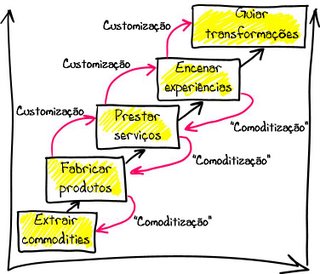
Depois da experiência a transformação


Esta figura, retirada de "Quando o sol se levanta será bom que corras" (Junho de 2006) está em sintonia com "Why “Transformative Travel” Will Be the Travel Trend of 2017":
"“Experiential travel” became the travel trend of 2016. Rather than just visiting far-flung locations, vacationers were looking for ways to tap into native cultures, meaningfully interact with locals, and feel like far more than a tourist. So where does a thoughtful traveler go from there? What’s next?
.
Industry leaders are saying that “transformational travel” is the next evolution. It has similar elements of experiential travel, but taken a step further—it’s travel motivated and defined by a shift in perspective, self-reflection and development, and a deeper communion with nature and culture.
...
the elements of adventure travel that lead to deeper transformations. He identified a three-phase process consisting of the departure, the initiation, and the return—the “hero’s journey”—where travelers venture into the unknown to learn wisdom from cultures and places outside their own, returning home to implement this knowledge, ultimately changing their lives and the lives of others around them. It’s this post-travel action that separates experiential travel from transformational travel. “
...
Many travel companies already see this shift occurring.
...
The shift to transformational travel is reflected in programming, from adventure and artisan travel to luxury lodges and hotels in both natural and urban locales."


Uma novela sobre Mongo (parte XIII)

 Parte Iparte IIparte IIIparte IVparte Vparte VIparte VIIparte VIIIparte IXparte Xparte XI e parte XII.

"Working in retail has never been harder. And I’m not talking about traditional bricks-and-mortar retail, I’m talking about retail in general. It doesn’t matter if we sell online, in a store or via a combination of the two, the change in landscape, which has opened up the market, has made it more competitive. The more competition we have in any market, the harder it is to operate profitably. Again, the first rule in economics is that increased supply results in reduced prices.
.
It’s the most basic economic fact that everyone seems to forget. In a world where choice is increasing exponentially, it presents two simple options for retailers: be the cheapest and quickest, or live deep inside the long tail.
...
Retail was once one of the most simple business models — find a geography, buy a product, sell at margin — while it’s now one of the most complex. What was once a mum-and-pop business possibility is quickly becoming a sophisticated, technology-driven, multi-channel mind warp.[Moi ici: Estão a imaginar o choradinho dos anos 90 do comércio tradicional por causa dos shoppings? Para breve teremos o choradinho shoppings que não souberem adaptar-se ao e-commerce]
.
It’s hardest for the retailers selling what everyone else sells. Selling well-known, widely-distributed products online is simply a race to the bottom, a price war that can only be won by the most efficient operator. It’s quickly turning into a game of logistics more than it is about customer engagement. [Moi ici: Imaginem isto a lidar com uma tribo aguerrida] The world of today is an infinite store, where everything is available at the best price possible to anyone, anywhere.
...
What retail forgot
Retail has always been about bringing the unique from worlds afar; that is, introducing to people items they couldn’t find or get in their corner of the world. From the spice market to the department store to the first iterations of the supermarket, the story of the department store is worth recalling. The traditional department store, which was only born during the nineteenth century, was about curating products from around the world and bringing them home, making available to people amazing items from before the days of travel, let alone global travel.
...
The discount death spiral
Retailers forgot about enlightenment, curation and inspiration and got caught up in a TV-industrial, volume-focused price spiral. Price became the core focus of everything they did. The evidence is in all the communication materials. They even set up what’s known as ‘retail’ communications campaigns, which are entirely focused on price and nothing more. The brand, or what I call ‘reason’, campaigns trailed into the background and were often removed from the corporate retail agenda entirely. They forgot that their job as retailers was to bring the world to their geography. Instead, retailers are a place where you buy cheap stuff and deals where you get two for the price of one. Many traditional retailers have put themselves into a retail price death spiral where all they’ve stood for were cheap prices, so what will they stand for when others sell goods more cheaply online?"


Trechos retirados de "The Great Fragmentation : why the future of business is small" de Steve Sammartino

terça-feira, janeiro 10, 2017

Acerca do JTBD

De "Replacing The User Story With The Job Story" recordo:

Foi desta imagem que me lembrei ao ler "Defining the Customer’s Core Functional Job-to-be-Done":
"Take the customer’s perspective: When defining the core functional job, think about the job from the customer’s perspective, not the company’s.
...
Don’t overcomplicate it: While the Jobs-to-be-Done Needs Framework is multilayered and complex, a functional job statement is not.
...
Leave emotion and other needs out of it: When defining the core functional job make sure it is defined as a functional job, not as a hybrid functional/emotional/social job. A functional job does not have social and emotional dimensions. The emotional and social jobs related to the core functional job are defined in a series of separate emotional job statements.
Also do not include desired outcomes in the functional job statement. They too must be stated separately. So if the job is to “cut a piece of wood in a straight line”, don’t say “accurately, safely and quickly cut a piece of wood in a straight line”. Accurately, safely and quickly vaguely describe outcomes associated with getting the job done.
...
Define the job, not the situation: Do not define the Job-to-be-Done as a situation that a customer finds himself or herself in. Rather define the job around what the customer decides to do in that situation.
...
Define the job statement in the correct format: A job statement always begins with a verb and is followed by the object of the verb (a noun). The statement should also include a contextual clarifier. In the job statement “listen to music while on the go”, the contextual clarification is made by adding “while on the go” to the job statement. Commuters who stop at quick service restaurant on the way to work are trying to “get breakfast while commuting to work” where “while commuting to work” brings needed context to the statement. Keep this format in mind:"
Duas versões diferentes e que merecem reflexão.

"Stretch goals"

Um excelente artigo na HBR de Janeiro de 2017, "The Stretch Goal Paradox". Talvez um dos melhores artigos que li na revista no último ano:
"What executive hasn’t dreamed of transforming an organization by achieving seemingly impossible goals through the sheer force of will? We’re not talking about merely challenging goals. We’re talking about management moon shots—goals that appear unattainable given current practices, skills, and knowledge. In the parlance of the business world, these are often referred to as stretch goals,
...
Stretch goals are often viewed as truly important sources of individual and organizational motivation and achievement.
...
“More often than not, [daring] goals can tend to attract the best people and create the most exciting work environments…stretch goals are the building blocks for remarkable achievements in the long term.”
...
No wonder many executives conclude that stretch goals are a great way to magically resuscitate or transform an ailing innovation strategy.
.
But that’s not the case. Our research, which we first outlined in a 2011 award-winning Academy of Management Review article with Michael Lawless and Andrew Carton, has shown that stretch goals are not only widely misunderstood but widely misused. Organizations that would most benefit from them seldom employ them, and organizations for which stretch goals are probably not a good strategy often turn to them in a desperate attempt to generate breakthroughs. Neither approach is likely to be successful. This is what we call “the stretch goal paradox.”
...
So, before launching stretch goals in sales, production, quality, or any other realm, how can you be confident that your grand aspirations will trigger positive attitudes and actions rather than negative ones? When facing radically out-of-the-box opportunities or threats, you can’t just rely on intuition. You need clear guidelines for assessing and addressing risk. You have to know when stretch goals do and do not make sense, and when to employ them rather than set more achievable objectives.
.
Predicting the Outcome of Stretch Goal Use
.
Two critical factors consistently seem to determine success at meeting stretch goals. Though they appear straightforward, often managers ignore them or don’t appreciate how they’ll affect a firm’s abilities."

Acerca das exportações (parte II)

Na parte I escrevi:
"Um excelente desempenho das PME"
O impacte da redução das exportações de combustíveis e lubrificantes mascara o enorme sucesso das PME. Reparem no que aconteceu em 2016:
Quanto à máscara, reparem como um suposto jornal económico cai na esparrela: "Exportações estagnadas com 2016 quase fechado"

BTW, o futuro prepara-se assim "Recorde português na Heimtextil". Quando é que os ministros percebem que estas feiras são para receber potenciais clientes e fazer negócios. Todo o tempo é escasso, porque o vão lá queimar?

Acerca das exportações (parte I)

O valor mensal das exportações no passado mês de Novembro foi o segundo mais alto de sempre, só ultrapassado pelo recorde de Julho de 2015.

Um excelente desempenho das PME. Quando excluímos as exportações de combustíveis e lubrificantes constatamos que Novembro de 2016 foi recorde absoluto de exportações:
Claro que a maioria dos comentadores e políticos, da oposição e da situação, não sublinham estes recordes para não prejudicar a sua narrativa do país-coitadinho, vítima do euro, que lhes dá munições para o seu capital de queixa e reivindicação perante Bruxelas.

Em Pre-suasion, encontrei uma história deliciosa e ao mesmo tempo preocupante:
"often try to convey to various audiences is that, in contests of persuasion, counterarguments are typically more powerful than arguments. This superiority emerges especially when a counterclaim does more than refute a rival’s claim by showing it to be mistaken or misdirected in the particular instance, but does so instead by showing the rival communicator to be an untrustworthy source of information, generally. Issuing a counterargument demonstrating that an opponent’s argument is not to be believed because its maker is misinformed on the topic will usually succeed on that singular issue. But a counterargument that undermines an opponent’s argument by showing him or her to be dishonest in the matter will normally win that battle plus future battles with the opponent."
Depois disto vamos à história:
"perhaps the most effective marketing decision ever made by the tobacco companies lies buried and almost unknown in the industry’s history: after a three-year slide of 10 percent in tobacco consumption in the United States during the late 1960s, Big Tobacco did something that had the extraordinary effect of ending the decline and boosting consumption while slashing advertising expenditures by a third. What was it?
...
On July 22, 1969, during US congressional hearings, representatives of the major American tobacco companies strongly advocated a proposal to ban all of their own ads from television and radio, even though industry studies showed that the broadcast media provided the most effective routes to new sales.
...
[Moi ici: Cá vai a solução para o mistério] In 1967, the US Federal Communications Commission (FCC) had ruled that its “fairness doctrine” applied to the issue of tobacco advertising. The fairness doctrine required that equal advertising time be granted on radio and television—solely on radio and television—to all sides of important and controversial topics. If one side purchased broadcast time on these media, the opposing side must be given free time to counterargue.
...
That decision had an immediate impact on the landscape of broadcast advertising. For the first time, anti-tobacco forces such as the American Cancer Society could afford to air counterarguments to the tobacco company messages. They did so via counter-ads that disputed the truthfulness of the images displayed in tobacco company commercials. If a tobacco ad featured healthy, attractive, independent characters, the opposing ads would counterargue that, in fact, tobacco use led to diseased health, damaged attractiveness, and slavish dependence.
.
During the three years that they ran, those anti-tobacco spots slashed tobacco consumption in the United States by nearly 10 percent. At first the tobacco companies responded predictably, increasing their advertising budgets to try to meet the challenge. But, by the rules of the fairness doctrine, for each tobacco ad, equal time had to be provided for a counter-ad that would take another bite out of industry profits. When the logic of the situation hit them, the tobacco companies worked politically to ban their own ads, but solely on the air where the fairness doctrine applied—thereby ensuring that the anti-tobacco forces would no longer get free airtime to make their counterargument."
Imaginem o que seria um anónimo como eu confrontar Ferreira do Amaral com números que desmascaram a sua narrativa da falta de competitividade portuguesa com o euro.

segunda-feira, janeiro 09, 2017

Curiosidade do dia

"Daniel Bessa, antigo ministro da economia, defendia em 2015 que “o regime mudou” no dia da “nega redonda” do governo a Ricardo Salgado para a CGD salvar o Grupo Espírito Santo. Em 2017 mantém que só essa decisão “permite que continue a depositar dinheiro na Banca portuguesa”.
.
“A questão da Banca é um tema tão sério quanto o do equilíbrio das contas do estado. O equilíbrio das contas do Estado é um tema muito sério e se há tema com idêntico grau de seriedade é o das contas da banca. E quando estes dois temas se cruzam as coisas tornam-se muito complicadas”, diz Daniel Bessa.
...
Daniel Bessa acentua as críticas. “Isso é muito sério: eu perguntava quem são os portugueses dispostos a emprestar ao Estado português e, qualquer dia, estou a caminho de perguntar quem são os portugueses a depositar dinheiro na Banca portuguesa. Porque se a coisa vai tão longe como, às vezes, parece que vai então nós estamos muito mal”.
.
Para dizer que se Pedro Passos Coelho disse não a Ricardo Salgado em 2014 fez muitíssimo bem. Fez muitíssimo bem. Porque essa é a única razão para eu continuar a emprestar dinheiro à Banca portuguesa e - quem sabe - poder um dia voltar a emprestar dinheiro ao Estado português”, pontua Daniel Bessa."
Trechos retirados de "Álvaro Almeida: “Velho regime económico volta quando se paga a quem investiu 500 mil euros no GES""

BTW, "Nacionalizar o Novo Banco é uma má ideia"

"don’t quit or chase them"

"The reality of sales is that there will always be competition. But if you can keep the foundation of why you do what you do in focus and strategize thoughtfully, the sting of cutthroat competition is lessened. When you face a competitor in your field, don’t quit or chase them. Find your premium offering and wow your customers in an unexpected way."
Como não recordar mais uma vez os Dick Dastardly e os observadores de motards. Como não recordar as empresas mais preocupadas em vigiar e seguir a concorrência do que ter uma vida própria.

Como não recordar Hermann Simon em "Manage for Profit, Not for Market Share: A Guide to Greater Profits in Highly Contested Markets" e aquele segundo capítulo: "Learn to Compete Peacefully"

Trecho retirado de "3 Ways To Win By Competing On Quality, Not Price"

Uma novela sobre Mongo (parte XII)

 Parte Iparte IIparte IIIparte IVparte Vparte VIparte VIIparte VIIIparte IXparte X. e parte XI.

Segue-se outra previsão, de "The Great Fragmentation : why the future of business is small" de Steve Sammartino, que vem ao encontro do que escrevemos aqui no blogue há muitos anos acerca dos prosumers e da tendência para empresas mais pequenas:
"The laptop corporation.
The story of access isn’t limited to production and digital services. This is true for all the major elements that go into the business marketing mix. We also have access to new ways of raising finance, … And we have access to an audience, ... A more accurate and wider view is that we’re all laptop corporations if we want to be. If anyone has access to an entry-level, $500 device and an internet connection, they also have access to a media production facility, a media distribution facility, low-cost labour markets, the world’s manufacturing districts, global banking and payment systems, and even bespoke capital-raising techniques from crowdfunding websites. In real terms, anyone with access to the network has access to all of the important factors of production.
.
Access to technology and information creates access to an everything state.
Information not only changes what we can know and what we can do, it changes where we’ll get it. We’re entering the age of the infinite store, where you, I and everyone else can retail.

What it means for business
Everything a company can do, a person can do now too. Having a large corporate infrastructure is no longer an advantage."
Uma grande vénia ao recentemente falecido Alvin Toffler que escreveu sobre as electronic cottages do futuro no distante ano de 1980:
O meu exemplar, herdado de casa dos meus pais.

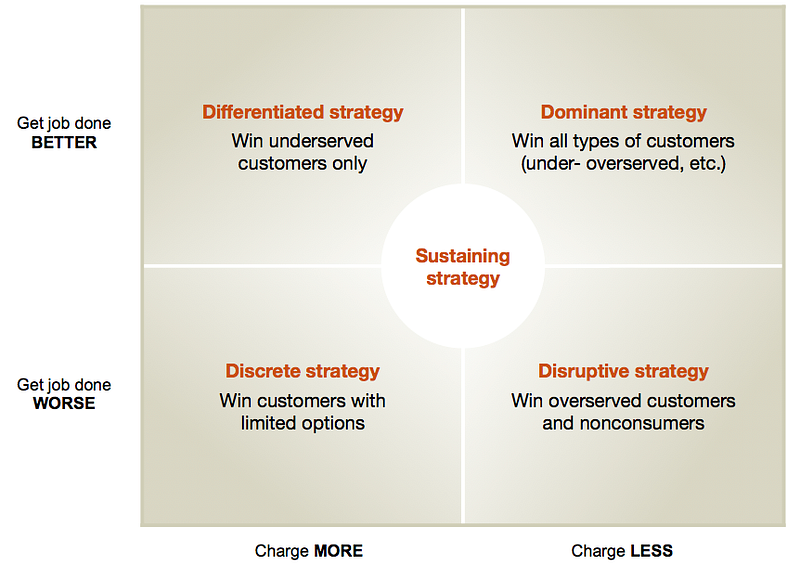
Estratégias ajustadas e desajustadas

A leitura de "The Jobs-to-be-Done Growth Strategy Matrix" fez-me voltar a encontrar esta figura:
Que tinha descoberto e referido em "JTBD e estratégia".

O reencontro com a figura fez-me pensar em várias conversas da semana passada:
Os jornais e os media tradicionais em geral, acossados pelos "chineses" da internet, responderam de forma errada querendo actuar como disruptores quando deviam ter apostado na diferenciação para servir os clientes underserved que continuariam a comprar jornais com melhores conteúdos.

O sector do leite protesta contra as importações de leite. O leite importado para Portugal é mais caro que o leite exportado de Portugal, sinal de que os compradores nacionais desse leite importado não encontram cá certos tipos de leite para o qual o preço não é o mais importante.

Muitas mercearias morreram ao longo das últimas duas décadas porque não se definiram, em vez de competir pelo preço com os "chineses" dos hipermercados, podiam ter optado pela diferenciação e especialização ou pela proximidade e relação.

Já o calçado português, incapaz de competir com os chineses genuínos salvou-se optando por estratégias baseadas na diferenciação (moda por exemplo) ou na proximidade/flexibilidade.

Que outros exemplos acrescentaria?


"There are no pricing problems; only segmentation problems"


"What is the most important thing you can share about pricing?
  • There are no pricing problems; only segmentation problems. [Moi ici: Qual é mesmo a segmentação que a sua empresa faz?]
  • Think about your end-customer first.
  • Value is in the perspective of the person with whom you are talking.
  • The value changes in context as well.
...
How does a price war destroy value?
  • War results in destruction and casualties and price war leads to value destruction. – Dropped Mobile Profits
  • There is a misconception of success when you capture market share.
  • The causation effect is lost in the minds of people during a price war.
  • Market share at any cost is chasing the wrong target.
  • Which comes first, market share or profit?
  • Profit comes first as it creates value for the customer; value comes first."

Trechos retirados de "The Ethics of Price Discrimination with Rags Srinivasan"

domingo, janeiro 08, 2017

Curiosidade do dia

"Não tenhamos, pois, ilusões: 2017 não será o ano em que deixamos o passado lá atrás. A resposta é chutar para a frente. Que não funciona é tão certo como a minha mãe não fazer anos todos os dias. Mas a maioria quer e é o que vamos ter. Assim, o meu desejo limita-se a que, aos com discernimento, lhes seja permitido não contrair mais dívida dos outros; consigam ser responsáveis pelos seus actos, sem que isso seja considerado egoísmo, mas mera justiça. Já seria muito.
.
Para muitos até demais."
Trecho retirado de "A minha mãe não faz anos todos os dias"

Marcas em tempos de saída do armário

"Brands can be a source of comfort, regardless of product or service category. That’s a power I contend we as brand marketers under value, especially in uncertain times. And it’s especially a power that brand skeptics certainly have no appreciation for; it’s pretty difficult to “take comfort” in a generic, no matter how cheap.
.
Why and how does this develop? I contend that when life is uncertain or in crisis, our survival instincts are hard-wired to gravitate toward the “tried and true” versus the unknown. Why take a chance? Brands, by their very nature, are created to be a “known commodity” to their constituency. Being known is the first requirement of trust. With consistency brands become a rock for the customer in very unsatisfying or uncertain circumstances – and can justify a premium for that."
Isto é verdade. Concordo. É mais uma razão para sublinhar "The opposite of unpredictable is strategic"

No entanto, há uma perspectiva que me assaltou logo: os tempos são de incerteza também por causa das pessoas. As pessoas não são estáticas, as pessoas não estão definidas. Cada vez mais as pessoas são projectos em desenvolvimento, são projectos em constante redefinição. Ah! Recordo um congresso de Marketing em Lisboa em 2007... em que ouvi Charles Schewe a falar sobre as "cohorts.

E recordo a empresa de calçado em 2009... as quasi-avós de hoje que nos anos 80 abanaram o capacete a ouvir Nina Hagen no pavilhão do Académico do Porto não terão os mesmos gostos que as suas avós.

E recordo Seth Godin, o mercado de massas não foi uma criação da procura, foi uma criação da oferta.

Os tempos são de incerteza para quem estava habituado a trabalhar para o meio-termo, para a grande massa da maioria estável no Normalistão. Mas as pessoas estão a abandonar por vontade própria o Normalistão estão a sair do armário e a assumir as suas especificidades.

Num mundo em que cada vez mais somos todos weird as marcas vão ter de se definir, vão ter de abandonar o meio-termo.

BTW, esta semana ao descer a Avenida da Boavista numa zona que julgo que ainda é in, Pinheiro Manso, vi uma loja de uma marca que não conhecia: Code. Ontem, sábado, fui a Rio Tinto e entrei num Pingo Doce para levantar dinheiro. E vi uma loja da mesma marca que desconhecia até à passada Terça-feira. A minha mulher informou-me que era uma marca do mesmo grupo que detém o Pingo Doce.

Weird... uma das duas localizações estará errada. Como não entrei não sei qual.

Trecho retirado de "How Brands Become A Source Of Comfort"

Depois, a culpa é do euro.

“I recommend that the Statue of Liberty on the East Coast be supplemented by a Statue of Responsiblity on the West Coast.”
Depois, a culpa é do euro.

Frase atribuída a Viktor Frankl

Narrowing Your Focus

"Narrowing Your Focus
.
What is the most important thing you can share about pricing?
.

  • The foundation of your ability to increase your prices is your ability to deliver more value to your customers.
  • The key to delivering more value is your willingness to restrict or narrow who you serve and what you do for them.
  • Narrowing is difficult because it triggers a survival instinct."

sábado, janeiro 07, 2017

Curiosidade do dia

"of all the bad things that happened to people in hospitals, the one that most preoccupied Redelmeier was clinical misjudgment. Doctors and nurses were human, too. They sometimes failed to see that the information patients offered them was unreliable—for instance, patients often said that they were feeling better, and might indeed believe themselves to be improving, when they had experienced no real change in their condition. Doctors tended to pay attention mainly to what they were asked to pay attention to, and to miss some bigger picture. [Moi ici: Recordar Pre-suasion e a importância desmesurada daquilo a que se chama a atenção] They sometimes failed to notice what they were not directly assigned to notice."

Trecho retirado de "Michael Lewis’ The Undoing Project: How do ER surgeons avoid dumb, deadly mistakes? Ask their doctor."

Mais do que o custo

"Our research into business model innovation in Asia uncovered two distinct, yet overlapping, waves of innovation: one decades old and still going, and one that ... is evolving now.
...
The first wave, as we call it, primarily exploited differences in labor and other input costs between developed and developing markets. By contrast, the second wave is driven primarily by business model innovation and typically leverages new technology. [Moi ici: Em tom quasi irónico direi que apostam em dumping legislativo. Sociedades mais abertas à mudança e com menos direitos adquiridos pelos incumbentes] These companies are characterized by extensive and often radical reconfigurations of the profit formula, resources, processes, and relationships within a broader stakeholder ecosystem.
...
The first wave of innovation from emerging markets in Asia has been predicated on the replication of existing business models at lower cost. As the model has evolved, it has become increasingly sophisticated,
...
Nonetheless, we believe the second wave could be even more disruptive than the first wave was. There are three reasons why, all of which reveal the ability of second-wave companies to achieve scale while remaining nimble.
.
The first reason is that second-wave companies fundamentally reimagine various facets of the business model. The second is that second-wave companies find new, often digitally enabled, ways in which resources and processes can be leveraged, ... The third is that second-wave companies identify creative ways for partners, stakeholders, and customers to be involved in value creation and capture, [Moi ici: Co-criação e ecossistemas]
...
If you want to reimagine your own business model, the first step is challenging the fundamental assumptions about what it means to be a business, employee, partner, or customer."

Trechos retirados de "The Next Wave of Business Models in Asia"

Que acham da capacidade dos humanos? (parte II)

Parte I.

Há anos li um texto, (era capaz de jurar que o li em "Thinking, Fast and Slow" de Daniel Kahneman...mas também poderia tê-lo lido em "Risk Savvy: How To Make Good Decisions" ou em "Gut Feelings: Short Cuts to Better Decision Making" de Gerd Gigerenzer), que ilustrava como duas pessoas observando o mesmo jogo, observando as mesmas imagens, chegavam a conclusões honestas completamente diferentes porque cada uma processava as imagens de forma diferente em função da sua preferência clubística.

Como não recordar as palavras equivocadas do candidato Cavaco Silva:
"dois adultos, (de boa-fé acrescentava eu, perante os mesmos factos chegam às mesmas conclusões"

Assim, foi com um sorriso que encontrei estes trechos em "Pre-suasion":
"Imagine that you are in a café enjoying a cup of coffee. At the table directly in front of you, a man and a woman are deciding which movie to see that evening. After a few minutes, they settle on one of the options and set off to the theater. As they leave, you notice that one of your friends had been sitting at the table behind them. Your friend sees you, joins you, and remarks on the couple’s movie conversation, saying, “It’s always just one person who drives the decision in those kinds of debates, isn’t it?” You laugh and nod because you noticed that too: although the man was trying to be diplomatic about it, he clearly was the one who determined the couple’s movie choice. Your amusement disappears, though, when your friend observes, “She sounded sweet, but she just pushed until she got her way.”
.
Dr. Shelley Taylor, a social psychologist at the University of California at Los Angeles (UCLA), knows why you and your friend could have heard the same conversation but come to opposite judgments about who determined the end result. It was a small accident of seating arrangements: you were positioned to observe the exchange over the shoulder of the woman, making the man more visible and salient, while your friend had the reverse point of view. Taylor and her colleagues conducted a series of experiments in which observers watched and listened to conversations that had been scripted carefully so that neither discussion partner contributed more than the other. Some observers watched from a perspective that allowed them to see the face of one the parties over the shoulder of the other, while other observers saw both faces from the side, equally. All the observers were then asked to judge who had more influence in the discussion, based on tone, content, and direction. The outcomes were always the same: whomever’s face was more visible was judged to be more causal.
...
No matter what they tried, the researchers couldn’t stop observers from presuming that the causal agent in the interaction they’d witnessed was the one whose face was most visible to them. They were astonished to see it appear in “practically unmovable” and “automatic” form, even when the conversation topic was personally important to the observers; even when the observers were distracted by the researchers; even when the observers experienced a long delay before judging the discussants; and even when the observers expected to have to communicate their judgments to other people. What’s more, not only did this pattern emerge whether the judges were male or female, but also it appeared whether the conversations were viewed in person or on videotape."
O que pensar dos programas sobre repetição de imagens de lances polémicos no futebol?

"The opposite of unpredictable is strategic"

Há mais de 15 anos ouvi Robert Kaplan contar a razão porque a Mobil era clara e transparente com a sua estratégia. Só a intervenção dos advogados é que impediu que até as metas na perspectiva financeira fossem publicadas.

Se os trabalhadores não conhecerem a estratégia como a irão executar? Como estarão alinhados com ela? E se os concorrentes a quiserem copiar ... será que ela é a adequada para a sua realidade? Cuidado com os observadores de motards podem ter o mesmo sucesso que Dick Dastardly.

"My clients and students assume that competitors should surprise one another with their strategies. Your competitors, they think, should have no idea what you’re going to do.
.
I predict many of you will say: Of course. Being unpredictable is a competi­tive advantage.
.
Not so fast.
.
Keeping secrets can protect competitive advantage.
.
But secrecy is not the same thing as unpredictability. Secrecy creates an incentive to invest in assets, especially intellectual ones. Unpredictability bluffs, postures, and palters to gain advantage through uncertainty and misdirection. Unpredictability can put another party off-balance. It can confuse them, cloud their thinking, cause them to waste time and effort, and trick them into making a mistake.
.
There are times when, at least in theory, the potential benefits of unpredictability can exceed its costs. But in my experience with competitive strategy in the real world, they aren’t common.
...
In business, the opposite of unpredictable isn’t predictable. The opposite of unpredictable is strategic.
...
becoming un­predictable required abandoning a major opportunity: the opportunity to lead.
...
I mean “lead” in the sense of shaping events, of taking initiative, of showing not-a-chicken commitment. You lead by influencing others, even, maybe especially, if they are not your friends. You may lead well or you may lead badly, but unpredictability does not lead at all.
...
Leadership lets you choose the game to play and shape how you play it. If you don’t, someone else will."
BTW, estratégia e táctica são coisas distintas e imprevisibilidade não é o mesmo que segredo.

Trechos retirados de "Why Being Unpredictable Is a Bad Strategy"

"It’s a human behavior one." (parte II)

Parte I.

E até que ponto fica claro, preto no branco, que comportamentos e porquê devem acontecer?

Uma estratégia ao ser executada traduz-se em:
Resultados que decorrem naturalmente de acções e de comportamentos.

Quem exibe esses comportamentos?

Quem actua além das máquinas e dos algoritmos?

Começamos por relacionar estratégia com processos e identificamos os processos críticos e os de contexto. Depois, identificamos as competências, comportamentos e resultados que as pessoas têm de ter, exibir ou gerar em cada um dos processos que contribuem para a execução da estratégia:
Formular uma estratégia. Perceber que processos são críticos para a sua execução. Perceber que funções em cada processo contribuem para a execução da estratégia e traduzir a estratégia nas actividades elementares e comportamentos evidenciados durante o processo. É preciso ser terra-a-terra e mostrar como se quer que a diferença se faça. Depois, as pessoas arranjarão a forma de chegar a Paris mas primeiro as pessoas têm de perceber que o objectivo é tomar Paris.


sexta-feira, janeiro 06, 2017

Curiosidade do dia

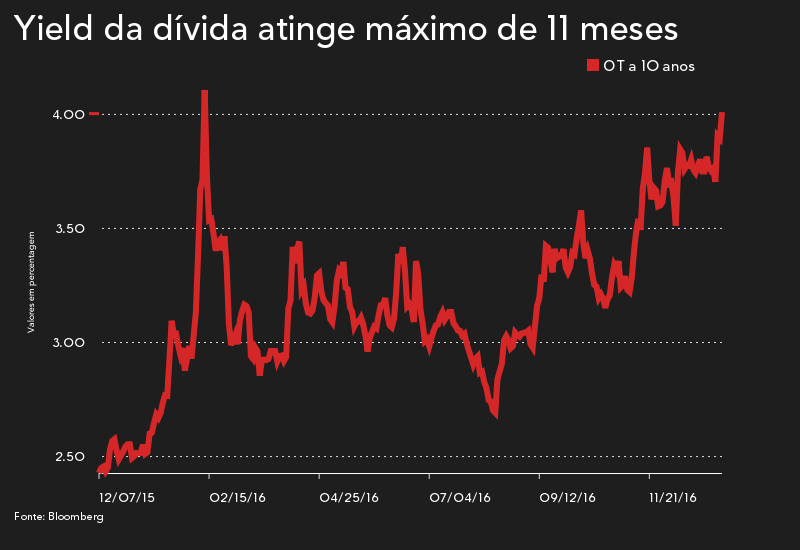
"Os juros da dívida a 10 anos ultrapassaram os 4%. O problema não está num facto como este, que até pode ser isolado e pouco duradouro. A questão está quando se olha para a tendência. E esta não se vê por um dia, uma semana ou mesmo um mês. É um facto que no último ano os juros que os investidores exigem para comprarem dívida pública portuguesa tem subido de forma regular e, aparentemente, sustentada. A subida é generalizada e uniforme na zona euro? Não. E esse é o segundo sinal preocupante para Portugal. O diferencial de juros entre a dívida portuguesa e as alemã e espanhola alargou-se nos últimos meses. Isto significa que mesmo quando uma parte das razões para a subida dos juros vem de fora, o impacto percebido pelos investidores em cada economia é diferenciado. Por exemplo, os efeitos da política económica que se adivinha venha a ser a de Donald Trump serão maiores e mais negativos em Portugal do que noutras economias. Porquê? Porque o país baixou o défice mas não a dívida, porque a economia não sai da anemia e até está a crescer menos do que em 2015, porque o investimento não arranca, porque há muitas políticas que são olhadas com desconfiança e recuos incompreensíveis em algumas medidas. Isto apesar do défice mais baixo da democracia – mas que não deixa de ser um défice e, por isso, gerador de mais dívida
...
Porque 2010 está demasiado vivo na nossa memória, sabemos que o problema começa quando nos tornamos no primeiro sítio de onde os credores querem sair quando o circo começa a arder. É isso que faz de nós o elo mais fraco. E é contra isso que, nesta fase, já pouco podemos fazer. O que será, será."
Trechos retirados de "Era uma vez um país sem custo para os contribuintes…"

Uma novela sobre Mongo (parte XI)

 Parte Iparte IIparte IIIparte IVparte Vparte VIparte VII e parte VIIIparte IXe parte X.

Ontem, numa caminhada matinal li:
"For most of the industrial era the only option for having goods and services was to own them. If we wanted to have anything, we had to buy it. This was also the way industrial society was set up. It moved society away from the traditional ideas of shared resources into consumption silo mode. The industrial era made many things affordable for the first time. The rational choice was to purchase and own, so we accumulated goods and stored them at home for when they were needed. Being able to have everything we needed, and places to store it all (fridges, cupboards, spare rooms and garages), reduced a lot of the friction that existed before industrial communities came into being and resources were shared.
...
Much of the friction of sharing is now coming back out of the commercial system. While vehicles gave us access to vast geography on demand, the internet is giving us access to vast information, entertainment and even physical goods on demand. Many of the things we had no choice but to buy if we wanted access to them are changing the way they come to market. Increasingly, we have an option to buy or to simply access an asset on demand. We are choosing the latter."
Depois, à hora do almoço encontrei "The Original Sharing Economy" e fiquei a pensar no potencial do modelo de negócio da Sharing Depot.

Agora pensem no impacte disto no emprego, na impostagem e no PIB.

Trechos iniciais retirados de "The Great Fragmentation"

Que acham da capacidade dos humanos?

"It is rousing and worrisome (depending on whether you are playing offense or defense) to recognize that these persuasive outcomes can flow from attention- shifting techniques so slight as to go unrecognized as agents of change.
...
[Moi ici: A estória que se segue é deliciosa] Suppose you’ve started an online furniture store that specializes in various types of sofas. Some are attractive to customers because of their comfort and others because of their price. Is there anything you can think to do that would incline visitors to your website to focus on the feature of comfort and, consequently, to prefer to make a sofa purchase that prioritized it over cost?
...
In an article largely overlooked since it was published in 2002, they described how they were able to draw website visitors’ attention to the goal of comfort merely by placing fluffy clouds on the background wallpaper of the site’s landing page. That maneuver led those visitors to assign elevated levels of importance to comfort when asked what they were looking for in a sofa. Those same visitors also became more likely to search the site for information about the comfort features of the sofas in stock and, most notably, to choose a more comfortable (and more costly) sofa as their preferred purchase.
.
To make sure their results were due to the landing page wallpaper and not to some general human preference for comfort, Mandel and Johnson reversed their procedure for other visitors, who saw wallpaper that pulled their attention to the goal of economy by depicting pennies instead of clouds. These visitors assigned greater levels of importance to price, searched the site primarily for cost information, and preferred an inexpensive sofa. Remarkably, despite having their importance ratings, search behavior, and buying preferences all altered pre-suasively by the landing page wallpaper, when questioned afterward, most participants refused to believe that the depicted clouds or pennies had affected them in any way."
Que acham disto?

Que acham da capacidade dos humanos?

Entretanto, ontem à noite ao preparar uma sessão de trabalho numa empresa visitei o seu sítio na internet e encontrei como missão:
"É nossa missão oferecer serviços, a um preço justo e ..."
O primeiro tópico a que chamam a atenção é ... o preço! No entanto, nos testemunhos sobre o que fazem e para quem aparecem nomes ligados ao segmento do luxo.

Trechos retirados de "Pre-suasion"

A vantagem da ignorância

Em "This is The Value of Ignorance to Your Creative Process" encontro algo que logo relaciono com aquilo a que chamo "fuçar":
"Creativity is a surprising process. Left unchecked, too much application of prior knowledge can stifle innovation and hinder creative work. "Not knowing" can be your most important asset if you can use it to your advantage. Without placing importance on not knowing, you run the risk of damaging the integrity of your creative work with your own bias.
...
Real creativity is a revision in progress, always. It proceeds in fits and starts of ignorance. Creative professionals cannot work without knowledge, skills, and experience. It's the basic requirement to thrive in any field. But the only way you can surprise yourself and deliver your most amazing work is to embrace creative ignorance.
.
Start every creative process with fresh eyes and set aside your assumptions.
...
"The only way to be creative over time -- to not be undone by our expertise -- is to experiment with ignorance, to stare at things we don't fully understand."
.
By all means envision and have a plan of action, but adapt and adopt new ideas as you progress.
...
'All you need in this life is ignorance and confidence, and success is sure.' Ignorance is not a barrier to action."
Quando falo da tríade, falo de supostos conhecedores, gurus, sábios que tudo sabem e prevêem que vem aí o diabo e que as PME portuguesas não têm futuro sem o escudo. Afinal não passam de Muggles.
Porque estão presos a modelos concebidos para explicar o passado não conseguem perceber que quando o mundo muda esses modelos ficam obsoletos e é preciso testar novas abordagens.

Quando refiro o fuçar:
BTW, recuar a Abril de ... 2009 e a "Parte VII – Zapatero e os outros."

"It’s a human behavior one." (parte I)

"Which is precisely what he should be worrying about. However hard it is to devise a smart strategy, it’s ten times harder to get people to execute on that strategy. And a poorly executed strategy, no matter how clever, is worthless.
.
In other words, your organization’s biggest strategic challenge isn’t strategic thinking — it’s strategic acting.
...
while strategy development and communication are about knowing something, strategy execution is about doing something. And the gap between what you know and what you do is often huge. Add in the necessity of having everyone acting in alignment with each other, and it gets even huger.
.
The reason strategy execution is often glossed over by even the most astute strategy consultants is because primarily it’s not a strategy challenge. It’s a human behavior one."
E até que ponto fica claro, preto no branco, que comportamentos e porquê devem acontecer?

Onde isto nos vai levar.

Trechos retirados de "Execution Is a People Problem, Not a Strategy Problem"


Continua.

quinta-feira, janeiro 05, 2017

Curiosidade do dia


Fragilistas, nunca enganam: "Juros portugueses atingem máximos de quase um ano acima de 4%"