Belmiro de Azevedo pensa que as empresas não devem suportar nova subida de impostos e justifica.”A Sonae paga rigorosamente, “on time”, os impostos devidos. Não deve pagar mais nem menos, deve pagar tudo. Não faz sentido o Estado andar a pedir esmola ou a fazer favores à custa dos empresários. Já há encargos fiscais enormes”, disse o chairman da Sonae, à margem da apresentação do novo edifico da empresa, o “Sonae Maia Business Center”, evento em que esteve também presente Vieira da Silva."
Quarta-feira, Junho 30, 2010
“Numa empresa dele talvez”
Belmiro de Azevedo pensa que as empresas não devem suportar nova subida de impostos e justifica.”A Sonae paga rigorosamente, “on time”, os impostos devidos. Não deve pagar mais nem menos, deve pagar tudo. Não faz sentido o Estado andar a pedir esmola ou a fazer favores à custa dos empresários. Já há encargos fiscais enormes”, disse o chairman da Sonae, à margem da apresentação do novo edifico da empresa, o “Sonae Maia Business Center”, evento em que esteve também presente Vieira da Silva."
Ainda acerca da Produtividade
.
"If the traditional definition of productivity is output per worker hour, most improvement efforts historically have been focused on the denominator in that equation: worker hours."
...
""Over the past 20 years, manufacturing plants were considered outside the domain of the business itself," says Peter Martin, vice president of strategic ventures at Invensys Process Systems. "Executives viewed plants as necessary evils, and they focused a lot of their productivity improvement activities on headcount reduction."
In the 1970s and 1980s, the investments in new plant floor automation and control systems were most often justified by headcount reductions. Productivity-focused technology investments were calculated primarily to reduce labor costs rather than streamline or reengineer core processes.
.
.
.
.
In order to do that, experts say, manufacturers must leave behind the notion that the plant is a necessary evil, divorced from the rest of the business. Plant-level processes and systems must be integrated with the processes and systems of the extended enterprise such as sales, fulfillment, and procurement, so that business managers and manufacturing operators alike have better, up-to-date visibility into not just how well a machine or production line is operating in isolation, but how well it is contributing overall to profitability, return on assets, and production goals.
With that kind of integrated view, analysts say, the definition of productivity itself will change. Rather than finetuning operations so that they simply pump out the most widgets per hour, manufacturers will be able to optimize, for example, on profitability or the ability to respond quickly to changes in demand."
Reflexões sobre a produtividade
That some producers obtained twice as much output (or more) from the same measured inputs shaped research agendas over the past decade in a number of fields, including macroeconomics, industrial organisation, labour, organisational economics, and trade. Recent research efforts have been directed at trying to understand why these productivity differences exist and are so ubiquitous."
- One includes factors that operate primarily within businesses, be it at the firm, plant, or even production line level. These are potentially under the control of management or other economic actors inside the firm.
- The second set contains elements external to the firm. The impact of these “environmental” factors might not always be direct, but they can affect producers’ willingness and ability to harness factors in the first set. They may also influence the amount of productivity dispersion that is sustainable in equilibrium."
- "Managerial practice/talent
Os jogadores de bilhar amador...
.
Risk-free debt is really risk-free only when the maturity also coincides with terminal repayment. "
Lugar do Senhor dos Perdões (parte IV)
Terça-feira, Junho 29, 2010
Nós também vamos precisar de um corte de cabelo
Primeiro passo para iniciar a mudança
Only if we “reboot and rebuild” the UK economy can the country’s future prosperity be assured, he said."
Somos todos alemães (parte VI)
Está tudo relacionado
.
"Sócrates é recordista europeu da subida dos impostos sobre trabalho"
.
"O tira-teimas de 2011"
.
"Sócrates discute crédito à economia com banqueiros"
Sensory branding (parte II)
O choque chinês num país de moeda forte (parte VI)

The days of the integrated chemical company were coming to an end, with companies abandoning noncore business segments in efforts to boost the creation of shareholder value. The reshaping of the industry had begun in the 1980s, but it was on a small scale compared to that in the 1990s.
The German chemical industry have been doing tremendous job (Landau and Arora, 1999) and continues to do so in development of the global and national economies in terms of employment, investments and value added as reported by the President of the Verband der Chemischen Industrie e.V. (Association of the German Chemical Industry). In past several years, the industry has been downsizing, “right sizing,” and producing new companies through small mergers, megamergers, and spin-offs. The new business reality gives every reason to believe there will be further consolidation and subsequent downsizing in the chemical industry (Millenium Special Report, 1999). This is also confirmed by the data for German chemical industry for 1992–2004 period, which tells us that the average size, defined as the number of employees of the firm, has decreased by about 47% (from 813 to 433).
to survive, and that economical/technological situation has put considerable pressure on smaller firms (Swift, 1999). Then the natural question arises: “Why small is beautiful?”
Authors find, though, that both dowsizers and upsizers increase in productivity and the relationship is quite complex and not clearcut. In their other paper, Baily et al. (2001) try to resolve the debate on cyclical nature of the labor productivity over time. They claim that the productivity of long-term downsizers tends to be quite considerable, much larger than that of long-run upsizers." (Moi ici: A melhoria disruptiva é mais rentável que a melhoria incremental)
...
Bathelt (2000) identifies three types of German chemical firms: (i) semiflexible integrated firms, mainly medium-large and large sized, with main features being high degree of vertical and/or horizontal integration and limited product and process flexibility; (ii) conventionally specialized firms, mostly small and medium sized, which are characterized by a low degree of product and process flexibility; and (iii) flexible specialized firms, which are mostly small and can only be found in the narrow chemical subindustry (pigments, dyes, paints, and varnishes). Except for the third type of firms, which tries to achieve economies of scope to adjust to market-segmentation tendencies, the first two care about economies of scale by various production activities and by producing relatively long-term homogeneous goods."
O jogo do gato e do rato (parte VI)
.
"His basic thesis: it's not an accident that the two "big ones" in American history have both occurred just as inequality reached extreme peaks."
Segunda-feira, Junho 28, 2010
Poupança alheia e paciência
O jogo do gato e do rato (parte V)
In West Germany rising wage inequality has occurred mainly in the lower part of the wage distribution, whereas in East Germany wage inequality predominantly rose in the upper part of the wage distribution."
Domingo, Junho 27, 2010
The Coherence Premium (parte II)
Continuado daqui.
Most companies don’t pass the coherence test because they pay too much attention to external positioning and not enough to internal capabilities. They succumb to intense pressure for top-line growth and chase business in markets where they don’t have the capabilities to sustain success." (Moi ici: Lesson #1: Do not play a strictly dominated strategy)
and processes that enable a company to outexecute rivals on some important measure."
Futurização
Sábado, Junho 26, 2010
"The Coherence Premium" parte I
- identificar claramente os clientes-alvo (quer utilizadores finais quer os donos "das prateleiras", os donos dos canais de distribuição que os servem);
- definir uma proposta de valor a oferecer-lhes.
Mudaria alguma coisa na conversa se o primeiro-ministro fosse outro?
.
Assim, enquanto o discurso, enquanto a conversa se mantiver ao mesmo nível de sempre... não há mudança.
.
Ontem, a esta hora, ouvia no noticiário da Antena 1 a síntese de um discurso do PR que dizia qualquer coisa como:
.
"Vivemos num Estado que não consegue sustentar a Economia".
Poesia "Inventando o futuro"
.
creative.
Recently it has been fashionable for companies to think of themselves as problem-solving organizations. That is actually wrong because, by the time you've discovered the problem and you're solving it, you're already out of date. You have to be ahead of the problem. You have to invent the world. You have to think `second-curve'.
But in order to recreate themselves for the future, organizations must be prepared to let go of the past. Otherwise they'll just get locked into their present curve and sooner or later they will come to an end. The trick is not to let go of the past all at once. You can't abandon the first curve until you have built the second one. So, for a time, the past and the future have to coexist in the present. And that's the pathway through the paradox.
The way you make sense of the future, in organizations and in societies and in your own life, is by taking charge of the future. Not by responding to it.
I wrote a book called The Age of Unreason. The reason I chose that particular title was because George Bernard Shaw once wrote that the reasonable man responds to the world, while the unreasonable man tries to make the world respond to him. Therefore, he said, all progress (and I have to add all the disasters too) comes from the unreasonable person; the person who actually tries to change the world. What that means is that we can't wait for people to offer us secure jobs and long careers. We have to decide what kind of life we want to lead and go out and make it happen."
Onde está a coerência?
Teoria dos jogos (parte II)
.
É esta lição que permite sustentar uma afirmação como:
.
"É insustentável desenvolver um negócio de genéricos em Portugal"
Sexta-feira, Junho 25, 2010
Contrarian... as usual
Passado vs Futuro
Of course the past is important. We need a sense of history. But you can't walk into the future looking over your shoulder. You can't stumble backwards into the future.
.
.
Teoria dos jogos
O jogo do gato e do rato (parte IV)
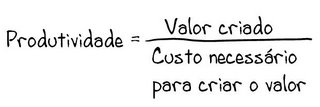
Voltemos à equação da produtividade:
Em que custos podemos mexer?
.
Ou nos custos fixos ou nos custos variáveis.
.
Podemos também tentar aumentar o volume de produção.
.
OK!
.
Se reduzirmos os custos fixos em 1% que retorno é que obtemos a nível de lucro operacional? Um aumento de 2,3%!
.
Se reduzirmos os custos variáveis em 1% que retorno é que obtemos a nível de lucro operacional? Um aumento de 7,8%!
Se aumentarmos o volume produzido que retorno é que obtemos a nível de lucro operacional? Um aumento de 3,3%!
.
Valores retirados daqui.
.
Comparemos estes ganhos de produtividade com aquele trecho de Daniel Gros:
.
“But improvements in productivity are easily overwhelmed by changes in wages. While productivity growth usually is measured in fractions of a percentage point, wage increases have been much larger.”
.
Há um artigo de James March que aborda o jogo, o equilíbrio, que as empresas têm de fazer entre a ‘exploration’ e a ‘exploitation’. Uma empresa que só trabalha no denominador da equação da produtividade só confia na ‘exploitation’ (arrisca-se a que mais tarde ou mais cedo alguém mexa no seu queijo!).
.
Admitamos, então, que uma empresa num ano consegue, à custa do trabalho no denominador, aumentar a sua produtividade em 2,6%.
.
O que vai acontecer?
Falta um pouco de "optimismo não documentado"
Sugestões para elaborar painéis de indicadores por processo (parte II)
Se o tempo de paragem por avaria for muito elevado, para quem toma decisões era importante ter à mão gráficos como, por exemplo:
• Tempo de paragem por avaria por máquina;
• Tempo de paragem por avaria por motivo;
• Distribuição dos tempos de paragem por motivo;
• Tempo de paragem por avaria por turno.
Ou se o custo acumulado com as avarias for muito elevado, para quem toma decisões era importante ter à mão gráficos como, por exemplo:
• Custo das avarias por máquina;
• Custo das avarias por motivo;
• Distribuição dos custos de avaria por motivo
Quinta-feira, Junho 24, 2010
Canário Grego
O jogo do gato e do rato (parte III)
Comecemos pela leitura do artigo “Europe’s Competitiveness Obsession” de Daniel Gros publicado a 4 de Junho de 2010.
.
Salientemos agora alguns trechos que me chamaram a atenção:
.
“The President of the European Central Bank is said to show at each meeting of the European Council a graph depicting the evolution of relative wage costs across the eurozone’s 16 member countries. This chart shows increasing divergences over the last ten years, with the countries now facing difficulties (Greece, Portugal, and Spain) having lost competitiveness by around 20% relative to Germany. In other words, since 1999, wage costs have increased by about 20% less in Germany than in southern Europe.”
.
Depois a receita habitual:
.
“The conclusion seems straightforward. The eurozone’s southern European members must reduce their wage costs to claw back the competitiveness that they have lost since adopting the common currency.”
.
Se nem dentro dum mesmo sector industrial dum mesmo país há homogeneidade quanto à produtividade, como interpretar a simplificação que se segue:
.
“Competitiveness, which is usually measured in terms of unit labor costs, is a relative concept. One country’s gain is another’s loss. Restoring competitiveness in some member countries (Spain, Greece) would require others (Germany in the first instance) to accept deterioration in theirs.”
.
Há neste parágrafo qualquer coisa de estranho… o autor presume que um bloco homogéneo chamado ‘industria espanhola’ vai competir de igual para igual, no mesmo terreno que um outro bloco homogéneo chamado ‘indústria alemã’!!! Faz-lhe falta estudar as experiências de Gause sobre os protozoários.
.
“So is higher productivity the way out? Even assuming that governments could identify and implement structural reforms that yielded quick productivity gains, it is not clear that higher productivity leads to increased competitiveness.
.
In fact, across the EU, the opposite often is true. Some of the countries that achieved the highest growth in labor productivity also lost the most competitiveness (e.g. Ireland).
How is this possible? After all, higher productivity should bring lower unit labor costs. But improvements in productivity are easily overwhelmed by changes in wages. While productivity growth usually is measured in fractions of a percentage point, wage increases have been much larger.”
.
Vamos repetir o pormenor porque é muito importante para o nosso argumento:
.
“How is this possible? After all, higher productivity should bring lower unit labor costs. But improvements in productivity are easily overwhelmed by changes in wages. While productivity growth usually is measured in fractions of a percentage point, wage increases have been much larger.”
.
A génese do título desta série de postais está aqui, o jogo do gato e do rato entre a produtividade e os salários.
.
Por fim a declaração de capitulação do autor:
.
“Structural reforms are always useful, but increasing productivity takes a long time and does not always translate into higher competitiveness. What is needed in southern Europe is acceptance that domestic demand must fall to a level that allows countries to live without further capital inflows. After that, it should be sufficient to allow labor markets to work until the system finds its new equilibrium.”
.
IMHO a Alemanha é, em grande medida um bode expiatório, as empresas dos PIGS não competem directamente com as empresas alemãs, excepto em casos pontuais como a indústria automóvel. As empresas dos PIGS competem directamente com os Low-Cost Manufacturing Countries (LCMC) como a China, a Índia, ou a Europa de Leste.
.
Outro artigo “Germany’s super competitiveness: A helping hand from Eastern Europe” de Dalia Marin bate na mesma tecla:
.
“German industry has boosted the competitiveness of its exports over the past decade by keeping wages flat.
As a result, German wage restraint has led to a real depreciation of Germany’s fixed nominal exchange rate vis-à-vis its Eurozone members, helping Germany to win market shares at the expense of Southern Europe. The numbers give support to this argument. In fact, Germany’s real effective devaluation in terms of relative unit labour costs compared with the EU27 during 1994-2009 is about 20%. This is indeed substantial.”
.
Que produtos é que os europeus compram agora à Alemanha e que há 10 anos compravam internamente ou num outro PIIG? Por causa do preço!
.
Repito: Que produtos é que os europeus compram agora à Alemanha e que há 10 anos compravam internamente ou num outro PIIG? Por causa do preço!
.
Que produtos é que os europeus compram agora fora da Europa e que há 10 anos compravam internamente ou num outro PIIG? Por causa do preço!
.
ADENDA: E como é que o raciocínio de Daniel Gros se conjuga com as conclusões sobre a heterogeneidade intra-sectorial?
Continua
Sugestões para elaborar painéis de indicadores por processo (parte I)
Esse sistema pode ser representado, sempre de forma imperfeita, como um conjunto de processos inter-relacionados e inter-actuantes.
.
.
Assim, podemos propor:
Quando medir? Qual a frequência de cálculo para cada um dos indicadores.
.
.
.
Os três erros mais comuns na apresentação de resultados (segundo Mark G. Brown no livro “Keeping Score - using the right metrics to drive world-class performance”) são:
• Usar tabelas em vez de gráficos;
• Apresentar apenas o último resultado; e
• Não ter um referencial, uma meta, para a tomada de decisões.
.
Ao olhar para esta página percebemos que:
• as reclamações estão a ser respondidas mais rapidamente;
• que a frequência das reclamações se mantêm;
• que o custo das reclamações está a baixar;
• que em 2009 se conseguiu suster a hemorragia de clientes perdidos por causa das reclamações.
Algumas questões que podem surgir a quem olhar para estes gráficos podem ser:
• Quais os principais motivos de reclamação?
• As reclamações recaem sobre o quê? Produtos? Quais? Serviços? Quais?
• Qual a distribuição dos tempos de resposta?
• Há alguma relação entre os tempos de resposta e os motivos de reclamação?
• Há alguma relação entre os tempos de resposta e os bens ou serviços especificamente reclamados?
• Quais os clientes que reclamam mais? Há algum padrão entre quem reclama e quem não reclama?
Estas questões podem ser respondidas por gráficos que podem ser facultados com os anteriores, numa segunda página. No entanto, há uma particularidade nestes gráficos, neles não faz sentido haver metas, são gráficos que retratam a realidade e ajudam a fazer o “drill-down”, o “fine tuning” para a tomada de decisões equacionadas a partir do conjunto inicial de gráficos.
Por exemplo:
Os clientes não querem ouvir desculpas
Para reflexão
Quarta-feira, Junho 23, 2010
O jogo do gato e do rato (parte II)
O jogo do gato e do rato (parte I)
.
“Atentando à dimensão dos custos de trabalho (evolução dos salários e produtividade), temos de introduzir uma dinâmica mais virtuosa nos custos de unidade de trabalho. Temos de melhorar a produtividade do trabalho (com formação, inovações, melhoria na gestão), mas também a disciplina salarial com a fixação dos salários para que acompanhe a produtividade”, resumiu o titular da pasta das Finanças."