quarta-feira, janeiro 04, 2017

Interação, relação e Mongo

Mais uma opinião em sintonia com o que escrevemos e defendemos aqui ao longo dos anos acerca de Mongo e da tendência para empresas mais pequenas, mais ágeis e mais apaixonadas:
"over the next 25 years, will likely mean that more and more large organizations, business models, and even governmental functions will be supplanted, evaded, or made irrelevant by self-organizing groups of individuals, connected ever more seamlessly by robust computer and telecommunications technologies.
...
no matter what your line of work is, and no matter how commanding a position your industry has today, every business still needs to be prepared for the consumer-led disruption of radical decentralization.
...
the best way to prepare for this disruption or nearly any other kind of technological asteroid strike, is to follow one or all of these three strategies:
.
Concentrate on earning the trust of your customers now, by constantly acting in their interests. When the asteroid hits, you need your customers to be on your side, wishing you well;
Deepen the context of your relationships with customers by tailoring each customer’s service to that customer’s individually different needs and preferences; and
Create a more frictionless customer experience by facilitating the disruption, rather than simply trying to resist it. You want to be Uber, the company, coordinating the interactions, and not just the highest-volume Uber driver in the new network."
 Recordar o recente "the relationship is the holy grail" e a ênfase que aqui damos à interacção.

Trechos retirados de "Radical Decentralization: Consumers Are the Ultimate Disruptors"

Tendências que estão a mudar o mundo da moda

Em "No More Athleisure, Brick And Mortar, Made in China? How Fashion Will Change In 2017" algumas notas sobre as tendências que estão a mudar o mundo da moda. Saliento a decadência das marcas do passado e a ascensão de novas marcas nascidas no online.
"These companies are offering something different from the flashy designers of yesterday: the insight into their supply chain and sometimes even a breakdown of their sales margins, providing the customer with a better understanding of the quality they're getting for their money.
.
Over the next year, we'll see how these online brands continue to transform the fashion landscape. We'll see big shifts in brick and mortar stores, fashion supply chains, the athleisure trend, and the idea of value.
...
1. Brick And Mortar Makes A Comeback [Moi ici: Atenção! Estas lojas físicas não são as tradicionais lojas físicas que tentam subornar os clientes com descontos]
...
"Brands are thinking about what the internet cannot give you,"
...
the one thing the internet does not provide is human contact. She predicts that in 2017, customers will increasingly visit stores to get curated experiences from shop representatives. For brands to meet this demand, they need to have well-trained staff who understand products inside and out and can offer personalized advice.
.
We will also see a rise in experiential retail, ... To encourage consumers to spend time in their stores browsing their products, brands will get more creative, adding amenities like bars, coffee shops, and yoga classes. In other words, stores will become more like entertainment spots for people who share similar lifestyles and interests to spend time together. "There will be an emphasis on physical brand experiences that will enable consumers to engage with not just product, but brand ethos and community," she says. "The main objective of this kind of blending will be brand awareness, but the scope and reach will be much more than what’s been traditional. These experiences will be leveraging what is happening with social and taking it offline."
...
3. Value Matters More Than LabelsCustomers are smart and want to know what they are paying for.
...
[Moi ici: E relacionado com o reshoring, com a flexibilidade, rapidez e pequenas séries] Gallardo believes that over the next year, companies that build their business model on making large wholesale margins will struggle to compete with this new flock of brands. Consumers are also losing interest in big discounts since they often come paired with lower-quality products. Gallardo says that brands struggling to survive in this shifting landscape—including J.Crew and the Gap Brands—will need to rethink their entire supply chain so they are making high-quality products with the best materials, then selling them at the best possible prices. This means not only being "direct-to-consumer" but also "direct-to-supplier.
...
4. Made In AmericaMore production is returning home.
...
The majority of U.S. fashion brands have moved production to Asia, where labor costs are lower. But there's been a shift in recent years as a wave of startups have chosen to make products in U.S. factories because it allows them to better monitor quality and take advantage of the most recent manufacturing technology.
...
More and more brands are focusing on smaller, more timeless product lines," he says. "We're not trying to make the cheapest white T-shirt, but the most well-constructed, best-fitting, softest T-shirt, at the absolute best price.""


terça-feira, janeiro 03, 2017

Curiosidade do dia

E é a isto que estamos condenados:
"Saúdam-se as despesas, as reposições, as reversões, e ai de quem venha falar de endividamento, uma pessoa do passado que não sabe que austeridade e dívida são assuntos que não entusiasmam. Pelo contrário, o melhor é entrar no jogo e prometer mais ainda, fazendo dos restantes uns contabilistas que só querem saber de contas e não das pessoas."
Só teremos o que merecemos

Recordar o que é um fragilista

Trecho retirado de "Temos o debate político que merecemos"

"Your higher price makes it easier to sell"

Recordo "Assim, partem já derrotados" antes de:
"You may believe that one of the primary challenges you have when selling is your higher price. Because you invariably get questions around your higher price, and because you are continually compared with your lower-priced competitors, it’s easy to conclude that your higher price makes selling more difficult.
.
This is categorically untrue. Your higher price makes it easier to sell, and a lower price makes it more difficult."
Recomendo vivamente a leitura de "If You Think It’s Hard to Sell with a Higher Price, Try Selling a Low Price" porque o texto é mesmo muito bom!
"It’s easier to sell with a higher price. First, the price itself is an indication of quality. It’s a shortcut that indicates you are investing more in generating better outcomes, whether that be a better product, a better service, or a better solution.[Moi ici: Recordar "Uma das minhas missões" e as "respostas que me satisfariam"]
.
A higher price also means that you are doing something different that makes a difference worth paying for. That difference, that ability to solve your perspective client’s challenge and give them what they really want or need is what is worth paying more to obtain. When you sell at a higher price, you are compared to competitors at all price points, which allows your prospective client to look for differentiation worth paying for.
.
At a higher price, you have something to sell. At a lower price, the only thing you have to sell is a lower price. If delivering greater value at a lower price was easier, more sales organizations would choose that strategy."
"If You Think It’s Hard to Sell with a Higher Price, Try Selling a Low Price"

Uma novela sobre Mongo (parte X)

 Parte Iparte IIparte IIIparte IVparte Vparte VIparte VII e parte VIII e parte IX.

O trecho que se segue é muito interessante, ilustra bem o que é a explosão de tribos, o aumento da diversidade e a vantagem das empresas com gente apaixonada:
"In a type of paradox, cities are becoming more alike and more different at the same time. Let me explain.
...
Cities are experiencing a move to niche, yet global, trends - interest by interest, social group by social group - into a massive subset of connected communities that exists in most geographies. People are self-organising themselves into groups around passions. [Moi ici: Há tantos anos a falar aqui da vantagem de ter gente com paixão... como não recordar "A paixão nas empresas é inversamente proporcional ao seu tamanho"] They can do this now because they can connect easily and find each other, but more importantly because the culture vultures (mass-market tastemakers) have finally left the building. It’s a fragmentation into subcultures that are replicated on a global scale, facilitated by the network connections people have.
...
People are self-organising themselves into groups around passions.
.
There are now more niches in every city maintained by a group itself, not by mass marketers looking for the next pop-culture hit. In fact, niches can now build themselves sustainable micro-economies around their interest. The community itself becomes the designer, producer, promoter and end user. They can do this because the barriers to entry are inconsequential.
...
But at the same time each city has never been more fragmented and differentiated within its walls. Figure 6.1 depicts this fragmentation of cities."

Agora imaginem as empresas grandes, viciadas na produção em massa a tentar interagir com com estas tribos bots e algoritmos, tomando-as por plankton ... tudo para dar errado.

E volto ao:

-Tu não és meu irmão de sangue!

As PME deviam estar a pensar em como fazer batota com esta maré:
"We must redefine strategy not as a means of control, but as a means of understanding control."

A importância do essencial

Ao longo dos anos abordo o tema do retorno da atenção e da estreiteza da nossa largura de banda, se dedicamos a nossa atenção a umas coisas não a podemos dedicar a outras ao mesmo tempo. Recordar O retorno da atenção (Agosto de 2009).

Agora em Pre-suasion encontro:
"In the English language, we are said to “pay” attention, which plainly implies that the process extracts a cost. Research on cognitive functioning shows us the form of the fee: when attention is paid to something, the price is attention lost to something else. Indeed, because the human mind appears able to hold only one thing in conscious awareness at a time, the toll is a momentary loss of focused attention to everything else. Have you ever noticed how difficult it is to experience - genuinely experience - two things at once?
...
my car’s CD player is structured to work like my brain, allowing me but a single track of music at a time. That’s for good reason, as it would be folly to play more than one simultaneously. I’d just hear noise. So it is with human cognition. Even though there are always multiple “tracks” of information available, we consciously select only the one we want to register at that moment. Any other arrangement would leave us overloaded and unable to react to distinct aspects of  the mongrelized input."

Recordar a contagem de passes e o gorila.

Por isto, também por isto, é importante esclarecer o que não é prioritário, o que não é estratégico, para que possamos dedicar mais tempo ao essencial.

Não perca tempo

Já aqui escrevi, mais do que uma vez, que os líderes de uma associação sectorial ou empresarial devem idealmente vir da vanguarda do pensamento estratégico.

Colocar e manter mentes demasiado agarradas ao passado, demasiado confiantes no direito adquirido ao queijo  garantido, em posições de chefia tem tendência a resultar em erro.

Considerando o tema de Pre-suasion, por exemplo aqui e aqui:
"frequently the factor most likely to determine a person’s choice in a situation is not the one that counsels most wisely there; it is one that has been elevated in attention (and, thereby, in privilege) at the time of the decision"
Se quem ocupa uma posição de liderança vê a mudança como uma ameaça, vê um futuro com mais nuvens negras do que oportunidades, então, o mais provável é que todo o sector assuma esse posicionamento e se refugie no papel de vítima, de coitadinho que tem de depender de outros para sobreviver.

Esses "líderes" presos ao passado, quando o mundo muda ficam perdidos e como que esperam ser socorridos. Líderes (sem aspas) virados para o futuro acham-se a si mesmos, encontram um novo lar nesse novo futuro.

Numa pesquisa que fiz aqui no blogue fui parar por acaso, não há acasos todas as coincidências são significativas, a um postal de Julho de 2006 intitulado "O futuro para o têxtil português" onde se podia ler:
""In a fast-paced environment where time-to-market and short-cycle production are powerful levers of competitive advantage, proximity has taken on much greater significance in all but "fashion" items, where once-a-season orders still prevail.
...
The keys to success in an age of product proliferation, the authors found, are no longer economies of scale and cheap labor but an up-to-the-minute knowledge of what sells and what doesn't, flexible manufacturing capabilities that can respond appropriately to demand, lean rather than fat and costly inventories, and the rapid replenishment of stock."
Agora pensem nos anos que o sector têxtil perdeu em Portugal porque em vez de olhar para o futuro pelo lado das oportunidades, em vez de divulgar esse futuro possível, em vez de comunicar os exemplos de sucesso, gastou demasiado tempo a defender o passado, a esperar que tudo voltasse à "normalidade".

Este blogue ganhou vida própria entretanto mas quando começou a ser escrito com regularidade tinha como objectivo ser um prolongamento da minha memória. E ter memória ás vezes é um castigo dos deuses:

Agora imagine que a sua empresa têxtil tinha recorrido aos serviços deste consultor anónimo da província e que tinha feito um gerador de cenários e tinha formulado uma estratégia de trajectória para vir encontrar-se com um futuro mais risonho à custa da batota, comandando em vez de ser comandada, apostando na proximidade, na rapidez, na flexibilidade muito antes dos outros.

Se tiver tempo leia mesmo este postal de ontem "Isto está tudo ligado (parte II)". Consegue sentir como eu o arrepio de descobrir o quão facilmente podemos ser enganados por nós próprios?

E mais uma vez aquela descoberta: sentado num banco no interior do Amoreiras, ao princípio de uma noite de 1998, enquanto aguardava pela minha colega Dores para jantarmos, lia Stephen Covey em “The Seven Habits of Highly Effective People”:
"Não é o que acontece que conta, é o que nós decidimos fazer com o que nos acontece."
E aquela outra mais recente mas igualmente bela proporcionada por Gonzales:
"É como se a nossa economia fosse um conjunto de pessoas que viajava de avião. O avião despenhou-se e, agora, as pessoas encontram-se numa floresta tropical cheia de perigos e riscos. Há uns que querem aventurar-se e procurar a salvação atravessando a floresta, há outros que querem permanecer junto ao avião esperando que ele volte novamente a levantar vôo, há outros que gritam por ajuda e esperam um milagre. O que aprendi com Gonzales, e chocou com o que ouvi de Lobo Xavier, é que os que decidem aventurar-se e procurar a salvação, enfrentando o desconhecido, ao fazerem essa viagem, acabam por se transformarem a eles próprios e o mais interessante é que quando chegam à "civilização", ou quando são encontrados, já não estão perdidos, já se encontraram, já se adaptaram a uma nova realidade." 
Não perca tempo com líderes que fazem do seu sector um coitadinho, procure gente com o locus de controlo no interior.

BTW, se precisar de apoio estamos por aqui.

segunda-feira, janeiro 02, 2017

Curiosidade do dia

Ás vezes aparecem pequenas estrelas brilhantes no meio da noite da burocracia, da noite da regulação, da noite do cronyism, nem acreditamos que estamos em Portugal.

Eis um desses exemplos bons "Docapesca diz que venda direta de pescado antes de entrar em lota é legal".

E sobre isto:
"A empresa reconheceu que “a insatisfação manifestada pelos compradores resulta do facto de os armadores que têm contratos homologados estarem a fazer o escoamento do seu pescado, maioritariamente, através desses contratos, dando origem à escassez de algumas espécies de pescado fresco em leilão”."
Há uma solução fácil. paguem mais aos armadores.

O mundo não é plano

"Thomas Friedman is renowned for claiming that the world is flat, in not one but two best-selling, highly lauded, and widely quoted books— The World is Flat (2005) and Hot, Flat, and Crowded (2008).  Friedman posits that information technology is revolutionary in that all people and countries bear an increasing resemblance; he suggests that borders between countries are becoming increasingly irrelevant. It follows that companies that fail to globalize and capitalize on this convergence trend will be left behind.
.
While advances in information technology are indeed increasing at a rapid rate, and those advances have certainly facilitated the coordination, connectedness, and efficiency of communications across borders, it does not follow that all peoples and countries will converge so as to become nearly indistinct. Despite what business pundits who exhort globalization would have us believe, important differences between countries remain, and information technology simply does not fully bridge the political, economic, and cultural divides between countries.
.
Pankaj Ghemawat and Richard Florida, for example, have demonstrated that the world is not as flat as Friedman purports. There is still substantial difference in the world. People are not the same the world over. Countries vary on a host of dimensions, and the ways in which they differ have important implications for how companies ought to globalize and how globalizing businesses will perform. These differences make it incredibly challenging to manage far-flung global corporations.
.
And therein lies the managerial challenge. It seems that managers of global and globalizing companies have taken Friedman’s words to heart, and as a result they are either unsure or unaware of how differences between countries will impact their business. They therefore make dangerous assumptions, underestimating the extent to which such differences are likely to negatively influence the bottom (or top) line, only to learn through a series of costly and painful lessons that the challenges of globalization are real and complex."
Trechos retirados de "Global Vision: How Companies Can Overcome the Pitfalls of Globalization"

Isto está tudo ligado (parte II)

Parte I.

Impressionante o potencial de manipulação em que caímos facilmente:
"Consider the results of an experiment performed by communication scientists San Bolkan and Peter Andersen, who approached people and made a request for assistance with a survey. We have all experienced something similar when a clipboard-carrying researcher stops us in a shopping mall or supermarket and asks for a few minutes of our time. As is the case for the typical shopping mall requester, these scientists’ success was dismal: only 29 percent of those asked to participate consented. But Bolkan and Andersen thought they could boost compliance without resorting to any of the costly payments that marketers often feel forced to employ. They stopped a second sample of individuals and began the interaction with a pre-suasive opener: “Do you consider yourself a helpful person?” Following brief reflection, nearly everyone answered yes. In that privileged moment—after subjects had confirmed privately and affirmed publicly their helpful natures—the researchers pounced, requesting help with their survey. Now 77.3 percent volunteered.
...
frequently the factor most likely to determine a person’s choice in a situation is not the one that counsels most wisely there; it is one that has been elevated in attention (and, thereby, in privilege) at the time of the decision.
...
In a companion study, the two scientists found that it was similarly possible to increase willingness to try an unfamiliar consumer product by beginning with a comparable but differently customized pre-suasive opener—this time asking people if they considered themselves adventurous. The consumer product was a new soft drink, and individuals had to agree to supply an email address so they could be sent instructions on how to get a free sample. Half were stopped and asked if they wanted to provide their addresses for this purpose. Most were reluctant—only 33 percent volunteered their contact information. The other subjects were asked initially, “Do you consider yourself to be somebody who is adventurous and likes to try new things?” Almost all said yes—following which, 75.7 percent gave their email addresses.
.
Two features of these findings strike me as remarkable. First, of the subjects who were asked if they counted themselves adventurous, 97 percent (seventy out of seventy-two) responded affirmatively. The idea that nearly everybody qualifies as an adventurous type is ludicrous. Yet when asked the single-chute question of whether they fit this category, people nominate themselves almost invariably. Such is the power of positive test strategy and the blinkered perspective it creates. The evidence shows that this process can significantly increase the percentage of individuals who brand themselves as adventurous or helpful or even unhappy. Moreover, the narrowed perspective, though temporary, is anything but inconsequential. For a persuasively privileged moment, it renders these individuals highly vulnerable to aligned requests—as the data of research scientists and the practices of cult recruiters attest.
.
The other noteworthy feature of the soft-drink experiment is not that a simple question could shunt so many people into a particular choice but that it could shunt so many of them into a potentially dangerous choice."
Dou por mim a recordar os discursos de Brutus primeiro e Marco António depois e a volubilidade da multidão, na peça de Shakespeare sobre Júlio César.

Trecho retirado de "Pre-Suasion: A Revolutionary Way to Influence and Persuade"

O futuro da estratégia

"Traditional strategy thinking is about making long-term commitments that will result in competitive advantage. The problem is we can’t predict the future very well, competitive advantage is rare and temporary, and companies are unable to keep up with the pace of adaptation in their markets.
...
Complex adaptive systems teach us that the only norm is perpetual novelty. Traditional strategic planning was predicated on being able to somewhat successfully plot the future. We should be planning for multiple versions of the future, some that will actually co-exist at the same time.[Moi ici: Gosto desta ideia de múltiplas versões do futuro que co-existirão durante algum tempo]
.
While the last twenty years have been marked by leaders in pursuit of the elimination of variance, [Moi ici: Foi aqui que eu comecei. Daí o nome Redsigma, daí a aposta na reengenharia na década de 90 do século passado, daí a abordagem por processos, daí o sucesso dos japoneses, daí o paradigma que os construtores automóveis criaram baseado na eliminação da variância] the next 20 years will be marked by leaders who create variance while maintaining a sense of stability. [Moi ici: Daí o perigo da cristalização. Deixem-me corrigir o autor. O futuro não passa pela criação de mais variância ou mais variabilidade, o futuro passa pela criação de mais variedade. Variância e variedade são coisas diferentes] Tomorrow’s most effective leaders will embrace this new, chaotic world. Planning will be replaced by intelligent reaction. They will proactively anticipate where the next disruption may come from and prepare for multiple scenarios. Instead of relying on proven static methods and processes, leaders will focus on building a learning capability, being comfortable with ambiguity, continually working within a changing landscape and anticipating and reacting to it with agility.[Moi ici: Conseguem imaginar como isto vai ser difícil para quem conta com os direitos adquiridos assegurados por intervenção divina?]
...
We must redefine strategy not as a means of control, but as a means of understanding control. All of this isn’t to say that organizations won’t have control, it’s control and chaos.[Moi ici: Profundo!!! Interessante!!! Faz-me pensar no que escrevi sobre a criação de cenários para as PME. Uma PME é uma casca de noz no oceano, não pode mandar nas correntes... mas pode procurar tirar partido delas e aproveitar a sua vantagem de rapidez, localização e flexibilidade potencial]
Trechos retirados de "Chaos Learning: The Key To Mastering Uncertainty"

Uma novela sobre Mongo (parte IX)

 Parte Iparte IIparte IIIparte IVparte Vparte VIparte VII e parte VIII.

Uns trechos sobre a explosão de diversidade, sobre a explosão de tribos, sobre o fim da massa uniformizadora.
"The curious thing about demographics is that they were actually shaped by the media, rather than the media reacting to what the demographics liked and believed in. The media loved the idea of demographics so much that they invented pet names for different groups to define them in neat, saleable clusters: the baby boomers, Generation X, Generation Y, the sea changers. They were all designed to simplify the selling process. The media shaped the demographics itself according to what it chose to expose the demographic to.
...
The probability of aggregating an audience was higher at that time because the media was part of the shaping process itself. The choice of what any demographic group would see was determined by a very thin line-up of media. They all aired the same types of program at roughly the same time. They all ran the same advertisements for the products they thought a demographic may buy, and the retailers would choose to only put those products with national advertising support on their shelves. The limited choice created the profile more than the attitude and desires of the people inside the profiles. It was also hard to escape the ‘norm’. [Moi ici: Recordar que foi a produção em massa que criou o mercado de massas e não o contrário] We all worked and went to school at normal and predictable hours. It was hard work just escaping the message. For want of a better term, people got brainwashed into fitting into their pre-defined demographic behavioural pattern. But this system is breaking down, and beyond age and a few limited geographic constraints, demographics is totally finished as a useful marketing tool."
O trecho que se segue é bem exemplificativo da realidade actual:
"How similar are teenagers who live in the same suburb, go to the same school, with the same ethnic origin profile, with the same average income who are also these different things: goths,[Moi ici: Nuno, era este grupo que nos falhou na conversa durante a viagem, os góticos]  punks, surfers, skaters, geeks, ravers, jocks, musicians, hipsters, preps, emos, gamers [insert your preferred teenager genre here]?
.
Would any of these groups listen to the same music, wear the same clothes, hang out in the same places, eat the same food, read the same books or watch the same movies … let alone like the same brands?" 

domingo, janeiro 01, 2017

Curiosidade do dia

Isto cheira-me logo a trabalho encomendado. São capazes de imaginar o que teria sido a evolução da inflação em Portugal se tivéssemos mantido o escudo? São capazes de imaginar Sócrates com a impressora por sua conta?

Sou capaz de imaginar governos de esquerda e de direita pressurosamente a baixar a cotação do escudo para que as empresas portuguesas pudessem competir com a China ao longo da década passada, por exemplo. O euro foi uma ajuda dos céus para impedir a venezuelização acelerada do país.
"O euro foi um fator de destruição para a economia portuguesa, que deixou de ter instrumentos próprios para resolver as suas crises", considera Francisco Louçã, professor universitário. Para o ex-líder do Bloco de Esquerda, o euro foi benéfico para economias fortes, como a alemã, mas se mantiver o modelo atual, "é insustentável e não sobreviverá a outro crash financeiro".
Claro que este senhor preferia enganar os portugueses com a treta da ilusão monetária. O euro torna mais claros os erros que os governantes cometem.

BTW, acreditar que sem o euro a gasolina e o tabaco aumentariam menos é um filme que vai no Batalha.

Trecho retirado de "Custo de vida dos portugueses subiu mais do que os salários"

"learn the “art of questioning"

"Great strategists—and great business leaders—have to learn the “art of questioning.”
.
The right questions should be neither too broad (“How do we save the world?”) nor too narrow (“How do we price the next new product?”). Rather, they should help managers stretch their thinking beyond the current boundaries of their day-to-day activities. Good practices abound. One is to have the leadership team engage in a strategic workshop to articulate and prioritize—but not debate—the key questions that the company will have to answer in the next three to five years. Another good approach is to ask the leaders of the business units to identify the most important questions that the center should be asking them—being clear that the business unit leaders will be judged on the quality of the questions that they propose. It’s important to limit the number of questions to two or three per business unit or department.
.
Once the right questions are selected, the leadership team can let go, knowing that the teams are working on the right issues. The teams will design novel relevant analyses, amass new knowledge, and develop new recommendations. Question-driven strategic dialogue is inherently an iterative process—even when it occurs on an annual basis. One highly effective approach is known as the “W-shaped model,” and it begins with the center communicating the critical questions for the year to divisional and functional managers, who are charged to return with the answers, along with an update on progress against plan and a series of ideas—some bold and disruptive—for consideration. (See the left side of Exhibit 2.) After a constructive dialogue (shown at the middle of the W in the exhibit), the leadership team selects from among the options and sends management back to develop detailed plans, which are then discussed and approved in a second meeting."

Recordar o recente "Um exemplo de miopia na vida real" como exemplo do resultado de perguntas demasiado "estreitas".

Trecho retirado de "Four Best Practices for Strategic Planning"

Uma das minhas missões


Uma das minhas missões profissionais passa por pregar o Evangelho do Valor aos líderes das empresas.

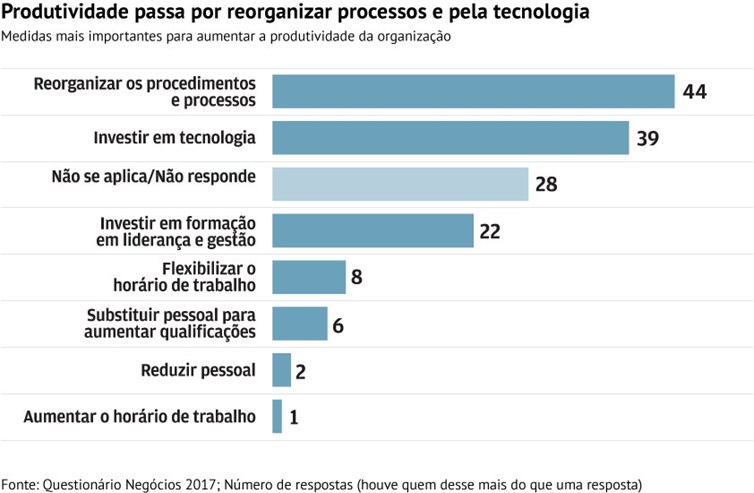
A figura mostra o quanto essa missão é necessária e urgente.

Como se mede a produtividade?
Nota: A figura é de 2006 e hoje usaria outra linguagem. Uma empresa não produz valor. Uma empresa produz valor potencial. Valor é criado pelos clientes quando experienciam progresso na sua vida.

As respostas denunciam uma visão incompleta da produtividade. A produtividade de que os economistas e os engenheiros falam é uma herdada da Revolução Industrial e atingiu o seu apogeu no século XX, com a produção em massa, com a vantagem baseada na escala e crença na eficiência acima de tudo.

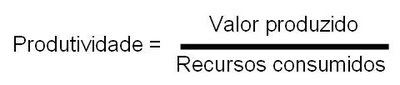
Nessa visão a produtividade resume-se a isto:

E como é que se aumenta a produtividade, como é que se aumenta a eficiência (nesta visão as palavras são sinónimas)?

  • reduzindo a burocracia e a ineficiência, simplificando procedimentos e processos. E voltamos aos anos 90 e à reengenharia e voltamos à Redsigma;
  • automatizando, para reduzir trabalhadores e/ou reduzir o tempo de ciclo;
Quando as empresas reconhecem que não têm competências internas para desenvolver as duas medidas anteriores, muitas recorrem à terceira:
  • investir em formação em liderança e gestão
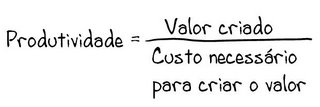
Qual o risco deste investimento? O dessa formação ser dada por membros da tríade, gente com a cabeça no século XX. Basta recordar os profetas da desgraça que diziam em 2011 que as PME portuguesas só poderiam aumentar a sua competitividade se os salários baixassem. Outra designação que dou a essa gente é a de Muggles, gente que só conhece o poder das folhas de cálculo e que sonha com custos e não sabe nem pressente que existe a magia do valor. Gente que está tão concentrada naquele denominador da equação que nem percebe que a solução é o numerador:
Gente que não percebe que o truque, quando não se conseguem vender sapatos a 20€ por serem muito caros, é produzir outro tipo de sapatos e vendê-los a 230€ para outro tipo de clientes noutros tipos de canais ou com outros modelos de negócio.

Reparem se o modelo de aumento da produtividade for concentrado nos custos, no denominador, cada euro poupado terá de ser regateado para aumento de salários. No entanto, se o modelo de aumento da produtividade for concentrado no valor, no numerador, e tendo em conta o Evangelho do Valor, deixa de haver essa guerra do gato e do rato entre produtividade e salários.

Assim, respostas que me satisfariam passariam por exemplo por:
  • aumentar preços por subida na escala do valor;
  • desenvolver novos produtos/serviços;
  • desenvolver novos modelos de negócio;
  • aumentar a diferenciação;
  • ...
As respostas do artigo do jornal passam por manter constantes as saídas e alterar a forma de as produzir. A minha pregação convida os líderes a alterarem as saídas ou a mudarem a proposta de valor vendendo o mesmo produto noutros mercados.


Imagem retirada de "O que dizem os líderes sobre a economia, o Governo e as suas empresas"

Qual é a missão?

"When he was a high school student, one of his science teachers declared to the class, "Life is nothing more than a combustion process, a process of oxidation." Frankl jumped out of his chair and responded, "Sir, if this is so, then what can be the meaning of life?"
.
As he saw in the camps, those who found meaning even in the most horrendous circumstances were far more resilient to suffering than those who did not. "Everything can be taken from a man but one thing," Frankl wrote in Man's Search for Meaning, "the last of the human freedoms — to choose one's attitude in any given set of circumstances, to choose one's own way."
...
Now, over twenty years later, the book's ethos — its emphasis on meaning, the value of suffering, and responsibility to something greater than the self — seems to be at odds with our culture, which is more interested in the pursuit of individual happiness than in the search for meaning. ... But happiness cannot be pursued; it must ensue. One must have a reason to 'be happy.'"[Moi ici: Outra vez o tema da obliquidade. Outra vez o confundir objectivo com consequência]
...
On the other hand, according to the  Center for Disease Control , about 4 out of 10 Americans have not discovered a satisfying life purpose. Forty percent either do not think their lives have a clear sense of purpose or are neutral about whether their lives have purpose. Nearly a quarter of Americans feel neutral or do not have a strong sense of what makes their lives meaningful.
.
Research has shown that having purpose and meaning in life increases overall well-being and life satisfaction, improves mental and physical health, enhances resiliency, enhances self-esteem, and decreases the chances of depression. On top of that, the single-minded pursuit of happiness is ironically leaving people less happy, according to  recent research . "It is the very pursuit of happiness," Frankl knew, "that thwarts happiness."
Válido para pessoas e para empresas. Qual é a sua missão? Qual é a sua razão de ser?


Trechos retirados de "A Psychiatrist Who Survived The Holocaust Explains Why Meaningfulness Matters More Than Happiness"

Desafio


Objectivo para 2016 não alcançado.

Em 2014 foram 3892 Km
Em 2015 foram 4270 Km
Em 2016 foram 3416 Km

Apontemos então para 3900 km em 2017.

sábado, dezembro 31, 2016

Votos de um Bom Ano 2017

Faço votos de um Bom Ano de 2017 para todos.

Li uma vez um ditado francês que dizia mais ou menos isto: É bom que o marinheiro reze mas também convém que reme. Aprendi ainda no século passado que não é o que nos acontece que conta, é o que nós fazemos com o que nos acontece. Por isso, aconteça o que acontecer, espero que consigam apanhar o melhor lado da estória que se pode construir a partir daí.

E animem-se, os dias já estão a crescer.

E na sua empresa, alguém pensa em estratégia?

"Strategic planning is one of the least-loved organizational processes. Executives at most companies criticize it as overly bureaucratic, insufficiently insightful, and ill suited for today’s rapidly changing markets. Some even argue that strategic planning is a relic that should be relegated to the past and that organizations seeking to prosper in turbulent times should instead invest in market intelligence and agility.
.
Although the diagnosis is largely right, the prescription is wrong.
More than ever, companies need to devote time to strategy. Nearly one-tenth of public companies disappear each year—a fourfold increase in mortality since 1965. And the life span of the average company has halved since 1970."
E na sua empresa, alguém pensa em estratégia?
Alguém a comunica?
Alguém monitoriza a evolução?

Hoje li este texto de Seth Godin "Shared Reality, Shared Goals".

Sem estratégia vamos andando e vamos indo. Sem estratégia não temos caminho, sem caminho não temos objectivos, não fazemos a mudança somos arrastados pelos eventos. Sem estratégia não temos caminhada comum.

Podemos ajudar?

Trecho retirado de "Four Best Practices for Strategic Planning"

Isto está tudo ligado

"If I inquired whether you were unhappy in, let’s say, the social arena, your natural tendency to hunt for confirmations rather than for disconfirmations of the possibility would lead you to find more proof of discontent than if I asked whether you were happy there. This was the outcome when members of a sample of Canadians were asked either if they were unhappy or happy with their social lives. Those asked if they were unhappy were far more likely to encounter dissatisfactions as they thought about it and, consequently, were 375 percent more likely to declare themselves unhappy.
.
There are multiple lessons to draw from this finding. First, if a pollster wants to know only whether you are dissatisfied with something—it could be a consumer product or an elected representative or a government policy—watch out. Be suspicious as well of the one who asks only if you are satisfied. Single-chute  questions of this sort can get you both to mistake and misstate your position. I’d recommend declining to participate in surveys that employ this biased form of questioning."
Isto está tudo ligado.

Por que será que António José Teixeira e Ana Lourenço e um rol de comentadores transitaram para a RTP?

Trecho retirado de "Pre-Suasion: A Revolutionary Way to Influence and Persuade"