quarta-feira, agosto 23, 2017

"the emerging organizational form for the 21st century"

Ao ler "Creating the competitive edge: A new relationship between operations management and industrial policy" publicado por Journal of Operations Management 49-51 (2017), encontro outro trecho em sintonia com Normann e Ramirez:
"The theoretical underpinning of manufacturing strategy has moved from process choice to a resource-based view, reflecting the growing importance of learning, innovation and idiosyncratic firm- and network-level capabilities.
...
The unit of analysis in manufacturing strategy has shifted from the plant or firm to the supply network, with supply chain management growing as a domain of OM research from the mid-1990s to the late 2000s
...
Operations are now seen by some as fundamentally inter-organizational. Furthermore, whereas plant-level manufacturing strategy approaches and, to some extent, supply chain management sought to design and control the whole system directly, fragmented networks are perhaps better understood as complex adaptive systems in which any one firm has only local and partial control... the emerging organizational form for the 21st century, rather than the multi-firm network, is the ‘collaborative community’. As such, the ‘institutional architecture’ in which such adaptive systems and communities operate becomes an increasingly important ingredient in manufacturing firms' business landscape."
 Richard Normann e Rafael Martinez em "Designing Interactive Strategy" escrevem:
"strategy is the way a company defines its business and links together the only two resources that really matter in today’s economy: knowledge and relationships or an organization’s competencies and customers.
.
But in a fast-changing competitive environment, the fundamental logic of value creation is also changing and in a way that makes clear strategic thinking simultaneously more important and more difficult. Our traditional thinking about value is grounded in the assumptions and the models of an industrial economy. According to this view, every company occupies a position on a value chain. Upstream, suppliers provide inputs. The company then adds value to these inputs, before passing them downstream to the next actor in the chain, the customer (whether another business or the final consumer). Seen from this perspective, strategy is primarily the art of positioning a company in the right place on the value chain—the right business, the right products and market segments, the right value-adding activities.
.
Today, however, this understanding of value is as outmoded as the old assembly line that it resembles and so is the view of strategy that goes with it. Global competition, changing markets, and new technologies are opening up qualitatively new ways of creating value."
E repito a citação de ontem:
"In so volatile a competitive environment, strategy is no longer a matter of positioning a fixed set of activities along a value chain. Increasingly, successful companies do not just add value, they reinvent it. Their focus of strategic analysis is not the company or even the industry but the value-creating system itself, within which different economic actors—suppliers, business partners, allies, customers—work together to co-produce value. Their key strategic task is the reconfiguration of roles and relationships among this constellation of actors in order to mobilize the creation of value in new forms and by new players. And their underlying strategic goal is to create an ever-improving fit between competencies and customers." 

Acordar para o potencial deste mercado

Neste artigo, "The Future of the German Discount Fitness Market", saliento:
"the market segmented into four price categories:
  • Discount: 20 EUR/month
  • Premium discount: 39 EUR/month
  • Health-related: 60 EUR/month
  • Premium: >60 EUR/month"
 E sublinho: "Health-related: 60 EUR/month"

Recordando este postal recente, "Idade e consumo", acredito que muita gente em Portugal ainda não acordou para o potencial deste mercado. Recordar o mundo das doenças crónicas.


O contexto tem muita força

Há dias que volta e meia me vem ao pensamento o facto de muitas empresas desaparecerem não porque foram mal geridas, não porque tiveram uma gestão criminosa, não porque não se importavam com os seus clientes, não porque os seus clientes não gostavam delas mas simplesmente porque o mundo mudou demasiado depressa e sem aviso prévio.

O exemplo das fábricas de calçado portuguesas que trabalhavam para o mercado nacional, para as sapatarias de rua, quando os centros comerciais apareceram e liquidaram as sapatarias de rua as fábricas de calçado não tiveram hipótese.

O exemplo de tantas e tantas empresas portuguesas que trabalhavam para o sector não-transaccionável e que chocaram com estrondo contra uma parede, quando uma sociedade viciada em dívida viu as fontes de endividamento subitamente secarem.

O exemplo das empresas portuguesas que tinham uma actividade interessante a exportar fruta para o mercado russo e que em 2014, subitamente, ficaram impossibilitadas de o continuar a fazer na sequência das sanções da UE à Rússia por causa da situação na Ucrânia.

O exemplo de um empresário que tinha montado um negócio com sucesso numa cidade do interior, a vender veículos todo o terreno, e que subitamente viu o mercado desaparecer quando o ministro Pina Moura (?) alterou a fiscalidade desses veículos (o choque foi tão grande que acabou por emigrar para o Canadá).


terça-feira, agosto 22, 2017

Densidade e ecossistemas

Ao ler "Creating the competitive edge: A new relationship between operations management and industrial policy" publicado por Journal of Operations Management 49-51 (2017), encontro uma citação de uma velha conhecida minha, Suzanne Berger:
“rich and diverse set of complementary capabilities in the industrial ecosystem: suppliers, trade associations, industrial collective research consortia, industrial research centers, Fraunhofer Institutes, university-industry collaborative, technical advisory committees. It's impossible to understand the different fates of manufacturing in the United States and Germany without comparing the density and richness of the resources available in the industrial ecosystem across much of Germany to the thin and shrinking resources available to U.S. manufacturers across much of our country” 
Ao ver o termo ecossistema, (palavra usada com especial carinho neste blogue), ao ver o desfilar de actores que povoam os meus esquemas sobre ecossistemas da procura (Malta da ISO 9001:2015, estão a ver porque aprecio a cláusula 4.2 da norma? E como a aprecio!) associados à palavra densidade não pude deixar de imediatamente recordar dois nomes: Richard Normann e Rafael Martinez e o seu "Reframing Business: When the Map Changes the Landscape". Bastou uma pesquisa no Google para chegar a "Designing Interactive Strategy":
"In so volatile a competitive environment, strategy is no longer a matter of positioning a fixed set of activities along a value chain. Increasingly, successful companies do not just add value, they reinvent it. Their focus of strategic analysis is not the company or even the industry but the value-creating system itself, within which different economic actors—suppliers, business partners, allies, customers—work together to co-produce value. Their key strategic task is the reconfiguration of roles and relationships among this constellation of actors in order to mobilize the creation of value in new forms and by new players. And their underlying strategic goal is to create an ever-improving fit between competencies and customers.
...
The result is an integrated business system that invents value by matching the various capabilities of participants more efficiently and effectively than was ever the case in the past.
.
What is so different about this new kind of value? One useful way to describe it is that value has become more dense. Think of density as a measure of the amount of information, knowledge, and other resources that an economic actor has at hand at any moment in time to leverage his or her own value creation. Value has become more dense in that more and more opportunities for value creation are packed into any particular offering."
E as suas ideias acerca das constelações:
"IKEA is more than a link on a value chain. It is the center of a constellation of services, goods, and design.
.
The image of a value chain fails to capture the complexity of roles and relationships in the IKEA business system. IKEA did not position itself to add value at any one point in a predetermined sequence of activities. Rather, IKEA set out systematically to reinvent value and the business system that delivers it for an entire cast of economic actors. The work-sharing, co-productive arrangements the company offers to customers and suppliers alike force both to think about value in a new way—one in which customers are also suppliers (of time, labor, information, and transportation), suppliers are also customers (of IKEA’s business and technical services), and IKEA itself is not so much a retailer as the central star in a constellation of services, goods, design, management, support, and even entertainment. The result: IKEA has succeeded, arguably, in creating more value per person (customer, supplier, and employee) and in securing greater total profit from and for its financial and human resources than all but a handful of other companies in any consumer industry."

Evolução mensal do desemprego 07-17

Tendo em conta os números do IEFP relativos ao passado mês de Julho, foi possível construir estes gráficos da evolução mensal do desemprego para 9 sectores de actividade da economia portuguesa:


Os números mostram que o desemprego continua a baixar mas agora em clara desaceleração face ao ritmo homólogo de 2016. Apenas no fabrico de automóveis a quebra está mais forte.

Na maioria dos sectores a desaceleração começou em Maio e continuou por Junho e Julho. Algo que parece conciliar-se com a evolução do PIB no 2º trimestre.

segunda-feira, agosto 21, 2017

Co-criação de valor - uma fonte

Quando escrevo sobre Mongo, sobre um mundo de artesãos, um mundo de mais proximidade, um mundo de mais customização, um mundo de menos vómito industrial, um mundo de mais significados, penso no aumento da co-criação e penso que esta pode ser realmente uma vantagem competitiva que as PME podem usar para viverem e terem sucesso. Acredito mesmo nisto:
"Value cocreation has long been praised as the next source of competitive advantage for service providers in the 21st century. The value of focusing on value cocreation as a source of competitive advantage lies in the interactions service providers develop with their customers and their potential to generate value for their customers. These interactions present a certain level of intimacy with the service provider’s customers, ensuring that they are difficult to replicate for competitors, and can yield long-term benefits such as customer loyalty and high lifetime share of wallet"
Por isso, recomendo vivamente a leitura de "Value cocreation in service interactions: Dimensions and antecedents" de Carmen Neghina, Marjolein C. J. Caniëls e Josée M. M. Bloemer, publicado por Marketing Theory, Volume: 15 issue: 2, page(s): 221-242, 2015. 

Uma boa fonte de informação sobre o "estado da arte"


"mainstream economics treats capital as a homogenous glob"

Percebo melhor porque é que alguns políticos, comentadores económicos e académicos, a tríade, faz propostas que considero absurdas: "mainstream economics treats capital as a homogenous glob"
"You can combine capital goods in only a limited number of ways within a particular plan. Capital goods then aren’t perfect substitutes for one another. Capital is heterogeneous.
.
Now, mainstream economics treats capital as a homogenous glob.
...
First, according to Mises, heterogeneity means that, “All capital goods have a more or less specific character.” A capital good can’t be used for just any purpose: A hammer generally can’t be used as a harbor. Second, to make a capital good productive a person needs to combine it with other capital goods in ways that are complementary within her plan: Hammers and harbors could be used together to help repair a boat. And third, heterogeneity means that capital goods have no common unit of measurement, which poses a problem if you want to add up how much capital you have: One tractor plus two computers plus three nails doesn’t give you “six units” of capital.
...
physical heterogeneity is not the point, but rather heterogeneity in use.
...
what practical difference does it make whether we treat capital as heterogeneous or homogenous? Here, briefly, are a few consequences.
...
if capital goods are heterogeneous, then whether or not you earn an income from them depends crucially on what kinds of capital goods you buy and exactly how you combine them, and in turn how that combination has to complement the combinations that others have put together.
...
modern Keynesians, such as Paul Krugman, want to cure recessions by government “stimulus” spending, without much or any regard to what it is spent on, whether hammers or harbors. But the solution to a recession is not to indiscriminately increase overall spending. The solution is to enable people to use their local knowledge to invest in capital goods that complement existing capital combinations, within what Lachmann calls the capital structure, in a way that will satisfy actual demand. (That is why economist Robert Higgs emphasizes “real net private business investment” as an important indicator of economic activity.) The government doesn’t know what those combinations are, only local entrepreneurs know, but its spending patterns certainly can and do prevent the right capital structures from emerging."

Como não recordar "Outro arrepio... e revolta."

Quando os socialistas de todos partidos, da esquerda até à direita, descobrem a heterogeneidade do capital ... avançam para o seu desporto favorito: picking winners (como em Mira e em Sines, por exemplo)

Trechos retirados de "Heterogeneity: A Capital Idea!"

domingo, agosto 20, 2017

"going to help them make progress"

"Customers come to your website or read the label on your package because they want to know if your product is going to help them make progress against the situation they are in. That’s a big part of what’s going on in the customer’s brain:
.
“Will this product fix the problem I have,
and will it get me to where I want to be?”  

.
Focusing on customers’ situations and how they can make progress is what Jobs-to-be-Done thinking is all about. It’s different from more traditional product and marketing thinking that focuses on customer attributes and abstract goals (e.g., personas) or product categories (e.g., we make drills, so we compete with other drill companies).
...
To create kick ass products and copy, we need to understand moments of struggle that have led our customers to hire our product or a competing product.
...
We want enough detail so we can film a documentary about our customer as they struggle with the situation our product is going to solve."

Trechos retirados de "And You Thought “Jobs to Be Done” Was Just for Product Development…"

“price for profits, innovate for growth”

"For pricing to be “strategic” it must first be focused on achieving an objective. The problem is that many firms often have multiple and conflicting objectives. I remember one CEO standing in front of a sales force saying he wanted to grow revenue, profits, and market share. This company was in a highly-competitive mature business, and here’s the point: you can’t do all three with price alone. It was no wonder they weren’t making a profit. The first action is to make the objective reasonable, given customer and market conditions. Focus pricing on one thing, hence my mantra: “price for profits, innovate for growth.”
.
The basis for pricing to be “strategic” requires a good understanding of:
  • how the products and associated services differ from competitors
  • what that difference is worth to customers
  • how competitors are likely to react
  • the products and services costs
  • the ability to return profits to a company"

Trecho retirado de "The Actions for Strategic Pricing"

sábado, agosto 19, 2017

Idade e consumo

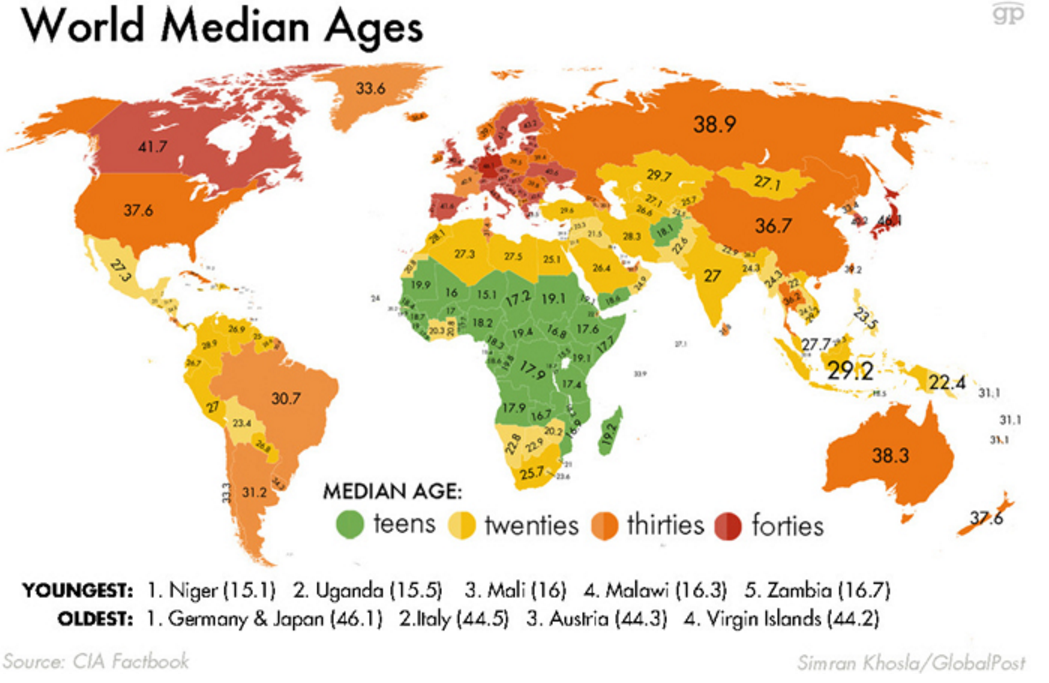
Primeiro comparar a mediana da idade da população dos Estados Unidos com as de vários países europeus:

Segundo, comparar a mediana da idade da população portuguesa com as de vários países europeus:
Por fim, ler "Seniors Lead the Slowdown in Local Consumer Commerce":
"The economic decisions made by older consumers are increasingly important given the aging of the consumer base throughout the US. The US Census Bureau projects that more than 20 percent of the US population will be 65 or older by 2030, up from 13 percent in 2010. To better understand the economic and policy consequences of this demographic shift, the Institute explored the components of the decline in spending growth from older Americans.
.
The analysis employs the Local Consumer Commerce (LCC) data asset, which encompasses over 19 billion de-identified credit and debit card transactions from over 59 million consumers in 15 major metropolitan areas. The LCC Index, built on the LCC asset, captures year-over-year growth in everyday spending across a range of consumer and merchant groups."

Acerca da banca do futuro (parte III)

Parte II.

Há dias no Twitter comentei:


Assim, na mesma linha, prevejo que muitos florêncios virão a terreiro para defender a antral dos bancos, "Vem aí o fim da Banca".

Como é costume dizer-se no âmbito da metodologia "job to be done":
"Jobs Remain while Solutions Come and Go"
Único senão: "An expert called Lindy"


"It's not the euro, stupid! (parte VI)"

"But something else happened in the global economy right around 2000 as well: China entered the World Trade Organization and massively ramped up production. And it was this, not automation, that really devastated American manufacturing. A recent paper by the economists Daron Acemoglu and Pascual Restrepo—titled, fittingly, “Robots and Jobs”—got a lot of attention for its claim that industrial automation has been responsible for the loss of up to 670,000 jobs since 1990. But just in the period between 1999 and 2011, trade with China was responsible for the loss of 2.4 million jobs: almost four times as many. “If you want to know what happened to manufacturing after 2000, the answer is very clearly not automation, it’s China,”"

Recordar:

Anónimo da província mas muito à frente dos Sarumans da academia tuga.

sexta-feira, agosto 18, 2017

Para não dar um salto no escuro

Excelente texto, "How Gatorade Invented New Products by Revisiting Old Ones".
"First, reconnect with your core customers, and understand what gets in the way of them getting value from your product. Follow them through their acquisition, preparation, use, and disposal of your product, and watch for frustrations, challenges, or other barriers they face.
.
Then, challenge your team to innovate around your customer’s value chain, not yours. What can you do to remove the barriers that prevent your customers from getting value from your products? These represent opportunities for complementary products.
.
And finally, be humble about your ability to deliver those products. No matter how big or how capable your company is, there will almost certainly be another company who is better positioned to deliver at least some of the complementary products that you’d like to provide."
Ou de outra forma:
"it’s not a “clean sheet” approach. It focuses on innovating around an existing product for an existing customer segment in a way that makes that product more appealing and valuable. Second, it’s not just a diversification approach – it’s not a search for random products that will appeal to the same customer segment. Instead, it focuses on developing a family of diverse innovations that are all focused on delivering a single business promise; ... Finally, this family of diverse innovations is not an “ecosystem” – it’s not an uncoordinated set of competing and collaborating entities in a single industry. Rather, this family of innovations is centrally managed and carefully controlled to deliver on a single business promise."
Como não pensar em "Não é impunemente que se muda"

Para reflexão

Os indignados referidos em, "os indignados de turno estão outra vez a apontar ao alvo errado", associam gentrificação e turismo.

Recordo esta "Curiosidade do dia" que referia a Web Summit e o desejo de fazer de Lisboa um hub do startup europeu ao ler "El día que las empresas tecnológicas expulsaron a la gente de sus hogares".

quinta-feira, agosto 17, 2017

Um outro olhar para as importações YTD (06/17)

05/17

Nos primeiros 6 meses de 2017 Portugal importou mais 4330 milhões de euros do que em 2016. De onde veio esse crescimento? Cerca de 62% do aumento das importações é motivado por 6 itens:
Importações ligadas a produção e investimento. Nada de alarmar!

Já depois de escrever isto pensei noutra perspectiva: quantidade total de cada item e evolução ao longo de mais anos:
O perfil das importações, mais ligado a investimento, este ano está melhor que em 2016 e pior que nos outros anos. No entanto, tenho de concluir que os meus cálculos são muito simplistas. No grupo de itens escolhido, apesar do impacte de 60% no crescimento das importações, um único item, Combustíveis, tem um impacte muito grande. E se o retirarmos?
Um panorama completamente diferente.

BTW, 2016 a nível de importação de "veículos automóveis, tratores e outros veículos terrestres e suas partes e acessórios" representou um recorde. Para trás ficaram os anos da troika e não só:
Isto não é tudo consumo. Gostava de saber qual a fatia adquirida por companhias de aluguer de automóveis, muito influenciadas pelo turismo. Li algures que em 2015 as empresas de rent-a-car representavam cerca de 30% da compra de automóveis ligeiros em Portugal.

Após pesquisa breve:
"(o turismo já representa cerca de 70% da atividade das empresas de rent-a-car em Portugal)" (fonte)
"As compras do rent-a-car em julho de 2017 valeram 37% das vendas totais de ligeiros de passageiros, num total de 6.488 unidades, revela a ARAC.
.
Recorde-se que o mercado português de veículos ligeiros de passageiros encerrou o mês de julho com um volume de vendas de 17.544 unidades, mais 12,2% do que no mesmo mês do ano anterior."(fonte)


Estratégia em todo o lado

Há anos especulei:

Deixar os Golias moribundos para os gringos e a sua estratégia do século XX e canalizar o dinheiro fresco para as empresas de Mongo.

Foi disto que me lembrei ao ler:
Outro texto facilmente relacionável com o que por aqui se costuma escrever é, "General Motors is getting smaller but more profitable". Não esquecer: Volume is Vanity, Profit is Sanity.

Ainda mais um texto, "An Israeli pharma champion sickens":
"That prosperity came chiefly thanks to the firm’s most popular proprietary drug, a bestselling medication for multiple sclerosis called Copaxone. Over the past two decades its sales paid for a global spree of buying generic-drugs competitors. Last year Teva completed its most ambitious purchase, of Actavis Generics, an American generics manufacturer, for $40.5bn; financing the deal took its debt to $35bn. But Teva’s transformation into the world’s largest supplier of generic medicines turned out to be ill-fated. The mood has turned in recent months as American pharmacies and wholesalers have squeezed the prices of generic drugs."
Uma empresa que ganhou notoriedade e sucesso com um modelo de negócio e, depois, enveredou por outro modelo de negócio completamente diferente.

É por isto que gosto de olhar para a realidade e encontrar estratégia um pouco por todo o lado.


quarta-feira, agosto 16, 2017

O Portugal que faz magia

A leitura de "As máquinas da Porsche são feitas nesta fábrica de Braga", em especial este trecho:
"O principal cliente da ITEC é mesmo a Bosch, empresa internacional fixada no concelho e que corresponde a 50% das receitas da companhia. A exposição àquela empresa é assumida por Carlos Rodrigues, e vista com bons olhos: “A ITEC foi uma empresa que foi crescendo sempre identificada com os princípios, com as exigências Bosch. Bebemos muito da cultura Bosch em termos de qualidade, e em conceitos. E isso ajudou-nos a crescer e fez de nós, hoje, penso que o maior fornecedor português da Bosch na área da automação industrial e robótica.”"
Fez-me sorrir e recordar a estratégia de uma empresa fabricante de máquinas com que comecei a trabalhar em 2009 e outra do mesmo sector com que comecei a trabalhar este ano.

Trabalhar com clientes nacionais e aproveitar a proximidade, a interacção e co-criação para desenvolver produtos que os clientes precisam e não encontram no mercado. Depois, aproveitar os melhores produtos para tentar a sua exportação com base no binómio preço-diferenciação.

Neste exemplo, o modelo que querem seguir é o mesmo mas têm uma vantagem adicional. O cliente de proximidade é uma multinacional, o que abre portas para outras empresas do género a nível mundial.

O exemplo da cerveja

Um texto, mais um, desta feita de Richard Florida, sobre o exemplo da evolução das cervejas artesanais nos Estados Unidos, "Can Craft Breweries Transform America's Post-Industrial Neighborhoods?".

Democratização da produção, diferenciação e um "live and let live" (empresas do mesmo sector, lado a lado geograficamente, mas que verdadeiramente não se consideram concorrentes, não é um jogo de soma nula, quanto mais o ecossistema criar valor mais todos ganham), regresso da indústria às cidades (um tema recorrente no que vou pensando e encontrando).

BTW, este é um outro exemplo da ascensão de artesãos do futuro:
"the craft beer revolution, ... is highly clustered. The good news is that many of these clusters are taking shape in places that have been subject to disinvestment and deindustrialization.
.
Craft breweries find it beneficial to locate near one another so they can sell each other excess grain and hops, share equipment, and even train one another’s staff. The smallest breweries, in particular, garner large proportions of their revenue from their taprooms. Locating in a thriving brewery district can drive up foot traffic and attract beer tourists.
...
While craft breweries do in fact compete against one another in these brewery districts, their products tend to be much more differentiated than those of the big brewers, making competition less direct.
...
The rise of craft brewing also tracks with a desire, most pronounced among millennial consumers, for “adventure” and “variety” in the products they choose, according to the study.
...
Even more importantly, brewpubs and microbreweries provide their neighborhoods with community gathering places, while craft beer brands convey a sense of pride and identity to places that could use a morale boost. And unlike traditional bars, taprooms and brewpubs tend to be family (and sometimes even dog) friendly."

terça-feira, agosto 15, 2017

Não é impunemente que se muda

Este texto "Applebee’s is done trying to win over millennials" julgo que pode ser usado como exemplo do dilema que as empresas grandes vão enfrentar com cada vez mais frequência à medida que o número de tribos e de nichos aumenta e que os seus membros se vão "radicalizando" nas suas escolhas, a tal assimetria que Nassim Taleb refere e recolhi em "Mongo e escolhas assimétricas".

Uma empresa grande procura servir a maior fatia do mercado. Por isso, aponta ao centro, aponta à caixa dos clientes/consumidores normais:
À medida que a dimensão, a quota desse mercado do "centrão" vai encolhendo, aumenta o interesse em servir nichos adjacentes. E ao procurar servir essas outras fatias de mercado acabam por descurar os clientes/consumidores onde anteriormente ainda tinham algum sucesso.

É destas barreiras informais, informais porque só existem na mente do potencial comprador, que falo quando digo: Promotor da concorrência imperfeita e dos monopólios informais

Não é impunemente que se procura mudar de um grupo de clientes-alvo para outro grupo de clientes-alvo.

Empresas com dinheiro o melhor que podem fazer é criar/comprar marcas que sirvam esses nichos adjacentes. Usar uma marca "histórica" forte para passar a servir outra tribo é muito arriscado, há muita bagagem atrelada.

Artesãos do futuro

Ao folhear muitos postais deste blogue é fácil relacionar entre si algumas palavras-chave:
  • Mongo;
  • tribos;
  • diferenciação;
  • paixão;
  • artesãos;
  • autenticidade.
Por exemplo, há dias escrevi:
"Em paralelo a esta evolução, que vai sugar os mais apaixonados para uma nova Idade de Ouro de artesãos do século XXI"
No caderno de Economia deste fim de semana encontrei um texto que relaciona estas mesmas palavras-chave, "À procura de artesãos no tempo dos ecrãs táteis":
"No entanto, quem aposta com visão em segmentos como o têxtil, a carpintaria, a latoaria, a joalharia, a encadernação, a cerâmica, os bordados, o restauro ou a cestaria pode ter um futuro promissor pela frente,
...
outra área de forte procura: o trabalho artesanal em madeira. “Todos os dias chegam pedidos de marceneiros, profissionais de serralharia artística.” São cada vez mais, também, os casos de sucesso de novos negócios, sempre de nicho, que começam no risco, chegam à autossustentabilidade e culminam na exportação.
...
Ao contrário do preconceito que possa persistir, de que o trabalho do artesão é pesado, sujo e moroso e de que a produção não se adaptou ao consumidor contemporâneo, “o artesanato não ficou estagnado”, sublinha Luís Rocha. O sector está a rejuvenescer e a qualificar-se.
...
a formação superior conjugada com a técnica adquirida nos cursos profissionais resulta na evolução criativa que tem dinamizado o sector. Ao mesmo tempo, “a procura [de produções artesanais] tem aumentado porque o mercado está cansado do produto massificado e quer, cada vez mais, objetos com forte cariz cultural, identitários e diferenciadores”. Cabe ao artesão “ganhar essa oportunidade”, analisa o diretor, que defende o investimento em marcas culturais com design de luxo.
...
Se nos domínios da carpintaria, marcenaria e costura, encontrar emprego por contra de outrem é relativamente comum, nos nichos da cerâmica artística, vidro ou bordados, muitos não esperam que o mercado chame por eles e criam diretamente oportunidades, uma situação que se terá acentuado nos últimos seis anos. “O desemprego fomentou o empreendedorismo e isso foi muito importante para dinamizar o sector”"
E na linha do que tenho reflectido aqui sobre o seru e a não-necessidade de máquinas-monumento , sobre o impacte de Mongo na dimensão das empresas, sobre o impacte da digitalização na redução da fricção de que falava Coase, na ascensão do DIY e dos makers, é interessante a referência aos ecrãs tácteis no título. Acredito que os artesãos do futuro trabalharão cada vez com mais tecnologia e mais valor acrescentado.


BTW, ontem fui a Rio Tinto com 4 moradas de lojas e fábricas de candeeiros. Ao chegar a uma delas, com todo o aspecto de oficina artesanal, deparei-me com caixas com marcas de renome e referências a feiras italianas. Fui recebido com atenção e simpatia mas comunicaram-me que tinham deixado de trabalhar para o público e começado a trabalhar para marcas portuguesas do segmento médio-alto e focadas na exportação.