- só os ocidentais é que podem ter carro;
- só os ocidentais podem comer carne;
- só pode viajar quem nós decidirmos que pode
Interrogo-me se o critério da quantidade de dinheiro gasto é válido, ou superior a outros.
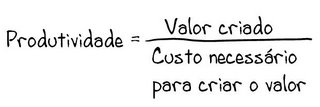
"A questão da medição da produtividade é, de resto, a área mais relevante. Aquilo que não é medido não pode ser avaliado. A questão é saber medir o que realmente interessa medir (algo que nem sempre acontece). Em geral, os empresários têm uma boa noção das suas receitas e dos seus custos. Todavia, frequentemente, estes mesmos empresários não sabem se estão a ganhar ou a perder dinheiro. Pode parecer paradoxal que um empresário conheça os seus proveitos e os seus custos, e que não saiba se está a perder ou a ganhar dinheiro. Porém, não é invulgar. Uma empresa cria valor se a rentabilidade operacional dos capitais investidos for superior ao custo médio ponderado do capital."À tarde, numa empresa, perguntei ao contabilista se era possível fazer uma análise cliente a cliente para saber com quem uma empresa perdia dinheiro:
- Nem pense nisso!Tudo isto se encaixa com uma série de postais: "Tecto de vidro? Uma hipótese de explicação (parte XVIII)" e também joga bem com o postal de quinta-feira, "Especulação perigosa".
"nature evolves away from constraints, not toward goals"Querem salários altos?
"The number and importance of projects are increasing steadily. Projects are being used to deliver innovative products and services, to perform change and transformation and – in general – get things done in organisations.Trechos retirados de "Will project-based organisations be the new normal?"
...
A project based organisation (PBO) is ... one in which the project is the primary unit for performing certain tasks.
...
Processes in a PBO are organised from the client to the client, a value stream of activities, orchestrated by a project manager, using agile or traditional methods, tools and techniques. The culture of a PBO is clearly project-friendly, client-centric and oriented towards “doing the right things right”, which means combining effectiveness and efficiency.
...
A PBO may comprise several firms, for example a project consortium or network organisation, and thus is temporarily organised, flexible and adaptable to the specific circumstances of the project, its context and partners.
...
The more we see a change from products to services, from mass production to individualisation, from single organisations performing projects to a co-creative network of partners, the more we´ll see PBO as a role model. So PBOs are a trend which will change the way of organising, and the transformation of many organisations prove that this process is already taking place. We need to see this from an economic perspective, identify the drivers for this change and the impact it may have for traditional organisations."
"It is widely believed that restructuring has boosted productivity by displacing low-skilled workers and creating jobs for the high skilled."Por fim, Maliranta confirmado por Nassim Taleb:
Mas, e como isto é profundo:
"In essence, creative destruction means that low productivity plants are displaced by high productivity plants."
"Systems don’t learn because people learn individually –that’s the myth of modernity. Systems learn at the collective level by the mechanism of selection: by eliminating those elements that reduce the fitness of the whole, provided these have skin in the game"Estão a ver onde isto nos leva? O que aconteceria se o SMN fosse aumentado para 1000 euros/mês? Teríamos uma mortandade tremenda a nível de empresas, teríamos um crescimento em flecha do desemprego. O que aconteceria à produtividade? Aumentaria! Depois do choque, as novas empresas que apareceriam teriam de ser muito mais produtivas.
"From the moment you arrive, your Disney World experience is carefully thought out. The most minute details are covered from the design of the rides to ease of transportation.
.
By mapping out any possible scenario a guest may find themselves in, Disney World eliminates the need to overanalyze. This gives way for people to truly soak in and enjoy their time on the property.
.
When is the last time you analyzed what your customers or clients experience when working with your company? Most likely, the answer is "not often."
.
Evaluate the experience your customers have with your brand. The more you can create a memorable and enjoyable experience the likelihood of them returning as customers, again and again, goes through the roof."
"“What I see in this store, and I hope you do too, is the most experiential and immersive expression of the Nike brand,”
...
“This is basically all about inspiration, and this will be version 1.0, call it, of what we’re doing through the personalization and customization experience,”"
"In the spirits room, whiskies from Scotland, Ireland, England and Japan are grouped by style rather than region – “fresh fruit”, “oak spice”, “smoke” – to encourage experimentation.
...
“You can buy so many things these days ust sitting at home on the couch, so we differentiate ourselves from online by focusing on the experience,”"
"Step one is to recognize your dependencies, i.e. your key stakeholders. [Moi ici: Qual é o ecossistema?]
...
The trick is to identify stakeholder roles. The same group of stakeholders can occupy more than one role.
...
An essential second step, and one that I’ve been guilty of not stressing enough with clients, comes with the word “target.” It’s vitally important to identify your “target customer” before moving forward. [Moi ici: Não é miudagem, são os clientes-alvo, é olhar olhos nos olhos]
...
Isolating the target customer has massive implications, including in other stakeholder groups. ... Your strategic plan can’t be all things to all customers. So, take your time here to clearly define your target customer.
...
The third step requires you to work out what your organization wants from each key stakeholder group for your organization to prosper. [Moi ici: O que procuramos e valorizamos e o que temos de dar aos outros, porque procuram e valorizam - win-win]
...
The fourth step is to identify what these stakeholder groups want from you. These are the key decision-making criteria that stakeholders use when interacting with your business. For example, these might include the factors influencing the decision to purchase from you (customers), work for you (employees), supply to you (suppliers) or invest in you (shareholders).
.
It’s essential that you know how each stakeholder group thinks about these — that you focus on their point of view, not your own.
...
Strategy design, your fifth step, involves deciding what your organization’s positions will be on the identified strategic factors for each key stakeholder group. This is shaped by the objectives you’ve set for your organization and the knowledge you’ve gleaned about your stakeholders’ current and future needs on strategic factors. This is where “focus” again delivers in spades.
...
The sixth step is continuous improvement. Recognize that no matter what you decide, there is no certainty in the result once you embark on implementation via an action plan and scorecard."
"The age-old distinction between the heart and the head is completely wrong.E agora, relacionar este trecho:
...
Emotions and feelings [Moi ici: As emoções e sentimentos] are often regarded as evolutionary relics handed down to us from an ancestral “reptilian brain”—mere physiological responses that cloud our ability to think rationally. According to Damasio, however, we underestimate the importance of feelings in our lives—and for civilization itself."
"Organisms strive for pleasant feelings and emotions that promote well-being, rather than unpleasant ones, which can be detrimental to health. In other words, homeostatic mechanisms not only maintain order within single cells but also play the critical role of “life regulation,” tipping the balance toward positive feelings and emotions. And emotions, combined with creative intelligence, led to what we call culture: art, music, and poetry were developed because of their positive affect, and medicine emerged out of the need to alleviate pain and suffering."Com este artigo "This researcher studied 400,000 knitters and discovered what turns a hobby into a business" e:
"She found that even on one of the Internet’s great niche social networks, offline encouragement and feedback helped most talented hobbyists recognize their ability and take the first steps toward monetizing it. Success on the Internet was propelled by real-life interactions.Mongo e o fim do "Orange": talvez a maior mudança na minha visão do mundo desde os meus 20 anos - afinal a racionalidade não é tudo no mundo dos negócios.
...
To better understand what transforms pattern users into pattern sellers, Kim reviewed 99 interviews with knitters on a niche newsletter and three blogs. The most common answer, by far, was that they’d been encouraged by people they knew, such as husbands and friends. Many had already been modifying patterns and designing their own yarn gnomes and cat costumes, but until they heard from others, they lacked the confidence to step out on their own."
"ESBZ is a grade 7-13 school in Berlin, Germany, that is extraordinary on many counts. Students self-manage their learning to a large degree. Teachers self-manage too (the school is structured in “mini-schools” of three classes and six teachers), and so do the parents who contribute three hours per month to the school in self-managing teams. Students and teachers credit one practice as particularly defining for the school’s extraordinary spirit of learning, collaboration, and maturity: the “praise” meeting (which is entirely prepared and run by students). Every Friday afternoon, the school’s big hall is packed with three hundred children, teachers, and administrators.
.
Every praise is essentially a miniature story that reveals something about two people— the storyteller and the person being praised or thanked—in their struggles and in their glories."
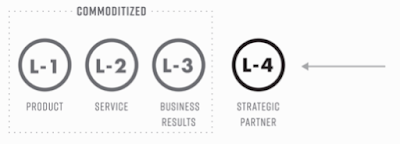
“The concept of levels of value describes the way markets are being pulled in two different directions. Where no real value creation is necessary, where what is being purchased is a true commodity, prices are being reduced to the lowest point possible. Companies are competing by being super transactional, removing the friction of buying and lowering costs. This is the strategy of Level 1 and Level 2 value providers. It is important to note that when a company makes this decision, it is a strategic decision. Super transactional does not simply mean discounting or making pricing concessions. This is how these companies consistently compete.Qual é a direcção da sua empresa?
.
The opposite strategy is super relational. This is high trust, high value, high caring. This approach is the very opposite of super transactional, placing greater value on providing results, being proactive, developing customer intimacy, and having deep knowledge and expertise.
.
When decisions are complex, with many factors at play and many possible paths forward, relationships of value matter a great deal. This is the strategy of Levels 3 and 4, and because most B2B sales organizations have been creating Level 3, selling the tangible return on investment and solving their client’s existing problems to the point of its being a commodity, success in creating opportunities and acquiring and retaining clients requires Level 4. Level 4 is disruptive in that it allows you to compel change.
.
If you behave like you are super transactional, intentionally or unintentionally, you will be treated like a commodity. You will be an attractive alternative only to prospects who care mostly about price, even if they do so to their detriment. This is to be a vendor or supplier (two words that you should be horrified to ever hear your client utter when referring to you), not a trusted adviser (words that produce the sweetest “sound to your ears).
.
Alternatively, if you are super relational, you will attract companies and people who want better results. You will be interesting to people who are growth oriented and people who want to address their systemic challenges and threats and move their companies forward. Being super relational is what makes you a trusted adviser.”
"The other kind of marketing, the effective kind, is about understanding our customers’ worldview and desires so we can connect with them. It’s focused on being missed when you’re gone, on bringing more than people expect to those who trust us. It seeks volunteers, not victims."No tempo da internet, no tempo de Mongo, não adianta vomitar algo e depois tentar vender. Agora a ordem tem de ser outra:
"It doesn’t make any sense to make a key and then run around looking for a lock to open.Excerto de: Seth Godin. “This Is Marketing”. Apple Books.
The only productive solution is to find a lock and then fashion a key.
It’s easier to make products and services for the customers you seek to serve than it is to find customers for your products and services.”
"“O envolvimento dos vários stakeholders da cadeia de internacionalização faz com que as empresas aumentem a sua quota no mercado externo e o sucesso passa por agilizar processos, mais do que reduzir custos ou outros aspetos que se mantém relevantes”"Afinal, o que é que pregamos neste blogue desde 2005 ou 2006?
"afirmou Jorge Rocha de Matos, presidente da Fundação AIP,"Rocha de Matos? Ainda não se reformou? Ah! Arranjaram-lhe uma prateleira de onde continua a controlar. Como é que alguém se mantém tanto tempo à frente de organizações privadas?
"This article is based primarily on feedback from Orion Registrar’s U.S. staff and auditors regarding clients who were certified to older versions of ISO 9001, prior to their certification to ISO 9001:2015....What “Bad” Have You Seen in ISO 9001:2015 Implementation?.The most common responses to this question involved shortcomings in implementation, including the failure to:...Retain documented information that is required by ISO 9001:2015, both that which was formally referred to as records and also that which is necessary for the effectiveness of the management system. Some clients view the reduced requirements for documented procedures as a reduction in the requirements, without understanding that the focus is on the processes and improving them, and on being more data driven in their approach, rather than just following a procedure."Ao longo dos anos tenho encontrado empresas que "agarram" a ideia de apostar no uso de indicadores para monitorizar e tomar decisões, e quase sempre têm evoluções tremendas. Também tenho encontrado outras empresas que resistem à ideia de usar dados, que preferem usar o instinto, que preferem navegar à vista... e quase sempre não saem da cepa torta.
"On the continuum of value creation, we put Level 1 value on the left end, and the farthest point at the other end is Level 4, strategic partner. This is what we mean when we say, “Enter the conversation from the right.” It means that we start with the highest level of value.
.
Levels 1 through 3 are not advice. The features and benefits of a product won’t help you understand why you can no longer generate the results you need in a world of constant, accelerating, disruptive change. The services and support that create the experience of being easy to do business with don’t help you achieve your longer-term strategic goals and outcomes. The fact that you produce tangible business results, while being critically important, doesn’t help me understand what I need to do to deal with a future that will require me to make changes I haven’t yet considered. A long-term strategic partnership now requires someone who can occupy the role of trusted adviser and offer good counsel. This requires playing at Level 4.
Level 4 means that you have the business acumen and situational knowledge (in other words, the experience) that allow you to create a strategic level of value. It means you understand and can explain the dissonance your dream client is experiencing; you can explain why they are struggling to produce the results they need and are challenged by their current circumstances. .
You can explain to the client why and how they need to change before they need to make that change. This is the “advice” part of “trusted adviser.
...
To remove your competitor from your dream client’s account, you need to create value that is strategic. This is the kind of value that provides them with a competitive advantage. It’s built on insight and ideas. It’s made up of your ability to help guide their business to a better future state. It also requires the ability to develop the relationships necessary to make change inside their company.
For our purposes here, we will use this operating philosophy: All things being equal, relationships win. All things being unequal, relationships still win. Your job is to make all things unequal [Moi ici: Numa empresa, o objectivo é trabalhar para desnivelar o terreno, para criar a concorrência imperfeita, para desenvolver uma vantagem competitiva] by creating greater value by creating trusted relationships, the kind that allow you to deliver your advice—and have that advice taken. ”
"people’s attachment to a specific brand name varies a lot from person to person. Some people will only buy their sheets from luxury bedding maker Frette, but don’t care whether their leather bag has a fancy logo on it, as long as it is durable. Another person will drop $4,000 on a Celine bag, but will buy drugstore aisle makeup as long as it looks good. Cai’s goal is to provide a wide variety of products so that there’s something on the site for every kind of consumer.
.
While there’s been a resurgence of logomania over the last few years, with brands like Gucci and Louis Vuitton plastering logos on products, a 2015 report by Goldman Sachs found that millennials prefer clothing without logos and branding. Italic is a direct response to this trend. “We’re cutting out the brand, which is the largest middleman of all,” Cai says."
"As compras de vestuário e calçado através de retalhistas que estão apenas na internet deverão aumentar 67,4% nos próximos cinco anos no Reino Unido, atingindo 7,5 mil milhões de libras (aproximadamente 8,6 mil milhões de euros) em 2023, representando mais de um terço das compras online de vestuário e calçado. O estudo da empresa de análise de dados GlobalData revela ainda que o crescimento das vendas de players puros online inovadores vai ultrapassar as do sector online (antecipa-se que seja de 40,3%), uma vez que os retalhistas multicanal têm dificuldade em manter-se a par das rápidas mudanças. De acordo com o estudo “Online pureplayers in UK clothing & footwear 2018-2023”, o futuro será negro para os atores da moda que não têm ainda uma forte penetração no canal digital. «Embora os retalhistas multicanal dominem o consumo online em vestuário e calçado, estão sob ameaça dos atores puramente online que estão continuamente a desenvolver a sua proposta para oferecer a melhor experiência de compra»"
"Osiris (center) | is the god of tradition & culture—a pillar—he’s an abstraction of the patriarchal force that stands behind tradition. “Tradition” is a way of behaving and cooperating with one another, which is a pattern of behaviors.Depois, fui buscar um texto lido ao fim da tarde, "Why Companies Should Blow Up Best Practices":
...
Order (Osiris) and Chaos (Isis) | They are wedded together. Humans cannot exist without a frame of reference, a solid structure that allows them to navigate their way through life. On the other hand, there will always be unknowns that could arise suddenly that we can’t cope with. (e.g. you’re in a solid relationship with someone and then they tell you they’ve been having an affair the entire time. This crosses the border between what you thought you knew (order) into the great unknown (chaos)…
Horus (left) | Order and chaos can unite and create a third thing, the god of attention. Horus is depicted with the head of a falcon, because of the animal’s superior sight. They fly over everything in the sky, and they can see everything. Horus is alert, with his eyes open. (See also, the Egyptian eye). For example, if everything is going well (too much order), you might get bored or lazy, and fail to pay attention to potential warning signals that chaos is imminent. You need just the right amount of chaos to keep you alert and push yourself, but not so much that will paralyze you."
"Relying on best practices does not guarantee future success. Today’s accelerated speed of change means that business leaders need to ditch old habits and bring a fresh perspective to their operations if they want to get to the top and stay there.
...
Many people or companies assume that best practices are good for a firm. Can you explain why that’s not always the case?
.
Geoff Tuff: No, it isn’t. There’s a good reason why best practices exist. For many, many years, people learned the lessons of their forebearers as the way to operate their businesses, whether they were generally in an industry or within any specific company. When things don’t change that quickly, when things change on a linear basis and you can predict the way that things are likely to turn out in the future, that’s completely fine. Doing the things that people have done before actually is a good way of being successful.
.
However, when change accelerates and we can no longer rely on the lessons of the past to do things well, that’s where best practices become really dangerous. [Moi ici: Recordar Zapatero e os outros] The great fallacy about best practices is that they can somehow create some competitive advantage. But if everyone is following best practices, there is no advantage there. Best practices don’t become best, they become average.
...
The No. 1 attribute is curiosity. The notion of beginner’s mind, which is something that’s spoken about in a lot of business circles these days, comes originally from Zen Buddhism. There’s a famous quote in Zen Mind, Beginner’s Mind by Shunryu Suzuki that’s something along the lines of, “In the beginner’s mind, there are many options. In the expert’s mind, there are few.” What we’re challenging companies to do today is not to bring an expert’s mind to the table, not to presume that we know the way things will operate, we know the way our markets will unfold, we know the way our competitors will react if we do certain things. Instead, look at things afresh, which is exactly what entrepreneurs do when they try to bring a new, disruptive business model to an industry."
“Finally, you need to let go of beliefs about your competitors that get in your way when it comes to selling effectively. Believing that your competitors lie and that their approach or pricing model is responsible for your losses is unhealthy. It is disempowering because it absolves you of the responsibility of knowing how to position yourself, your company, and your solution as creating the kind of differentiated, compelling value that would have beaten them. [Moi ici: Recordam o choradinho dos que se queixavam dos centros comerciais? E o choradinho dos que se queixavam dos chineses? E o choradinho dos que se queixavam dos ... ] It’s your job to get the client to perceive the value you create, and it is that perception that allows you to win. If you hold yourself responsible for a loss, you can change your approach and improve. If you blame your competitors, you absolve yourself of responsibility—and you continue to lose. [Moi ici: Locus de controlo no interior!!! ]
You cannot do anything about your competitor. Nothing you say or do will make them change their behavior, their approach, or their pricing. Even when you start to win their clients by creating greater value, your competitors are likely to respond by doubling down on their existing practices, so your focus has to shift to improving how you sell.”
"Most of us work in mature industries that are overcrowded, where we are perceived as commodities (even when we are not), and where competition is ferocious. We work in industries where growth requires capturing market share from our competitors, and in many cases requires that we take their clients from them while they attempt to take our clients from us. How else do you grow by 12 percent in an industry that is growing by 2.7 percent annually?...
Your company goes out into the market to win new clients. You believe that what you sell—and how you sell it—is better than what your competitors sell. Your intention is to better serve those companies and customers that are not getting what they really want or need.
...
You don’t win by focusing on your competition. What makes you a dangerous competitor is how you play the game. Let’s start by eliminating the things that your competitors routinely do in an attempt to cause you problems and take your business, the things that make them weak competitors.
Some of your competitors compete on price alone, offering a poorer service than you do at a lower price point, while falsely promising the same results you can offer. They will win the most price-sensitive customers in the market, many of whom will live with their shortcomings for much longer than you might imagine. While these competitors usually win clients who perceive only the lowest price as value, they will occasionally win good clients, clients who will stick with them until you find a way to displace them. Know that you cannot do anything about a competitor with an irrational pricing structure. It doesn’t change your pricing model or strategy, so your only response should be to compete in a way that allows you to win with a higher price."
"It is widely believed that restructuring has boosted productivity by displacing low-skilled workers and creating jobs for the high skilled."Mas, e como isto é profundo:"In essence, creative destruction means that low productivity plants are displaced by high productivity plants." Por favor voltar a trás e reler esta última afirmação.
.
"Lovaglia’s Law: The more important the outcome of a decision, the more people will resist using evidence to make it."
"If an organisation is too stable it can ossify, but if it is too unstable it can disintegrate. Successful organisations work between these two conditions or states, in what Stacey called ‘the chaos zone’."
"If the customer doesn't care about the price, then the retailer shouldn't care about the cost,"
“It's not enough that we do our best; sometimes we have to do what's required”.
"Das Leben, das uns gegeben ist, ist uns nicht als etwas Fertiges gegeben, sondern wir müssen es uns gestalten, und zwar jeder sein eigenes."
"Eine Regierung, die nichts wert ist, kostet am meisten."
"Forget trying to persuade them; light their pants on fire."
"O futuro é o que importa. O futuro é a base do significado, é de onde vem o projecto que alguém tem para si próprio"
"The single biggest problem in communication is the illusion that it has taken place."
“It is not the strongest of the species that survives, nor the most intelligent; it is the one that is most adaptable to change.”
"o Marketing só existe a partir do pensamento estratégico, caso contrário "não resulta""
"It is difficult to get a man to understand something, when his salary depends upon his not understanding it"
"Perder diversidade é como arrancar páginas de um livro. Quantas páginas poderemos arrancar até deixar de compreender o enredo?"
The great enemy of the truth is very often not the lie – deliberate, contrived and dishonest – but the myth, persistent, persuasive, and unrealistic. Belief in myths allows the comfort of opinion without the discomfort of thought."
"By strategy, I mean a cohesive response to a challenge. A real strategy is neither a document nor a forecast but rather an overall approach based on a diagnosis of a challenge. The most important element of a strategy is a coherent viewpoint about the forces at work, not a plan."
"Un desastre està punt de succeir a Espanya. El malentès de la gravetat de la crisi costarà car als inversors, ja que tindrà profundes conseqüències per a tot el sistema bancari europeu", afirma.
Entre d'altres coses, Mauldin diu que "els inversors estan fumant crack si creuen que els bancs espanyols són entre els més forts d'Europa, ja que estan amagant les seves pèrdues".
“… there are no “sunset” industries condemned to disappear in high wage economies, although there are certainly sunset and condemned strategies, among them building a business on the advantages to be gained by cheap labor”
"o vencedor da vida, o optimista que vive em incesto com o próprio ego, é o traço mais frágil do líder"
"We shall not grow wiser before we learn that much
that we have done was very foolish."
You may not be able to change the world but can at least get some entertainment & make a living out of the epistemic arrogance of the human race.
"I wanted you to see what real courage is, instead of getting the idea that courage is a man with a gun in his hand. It's when you know you're licked before you begin but you begin anyway and you see it through no matter what. You rarely win, but sometimes you do."
“Trust your guts. But not too much!”
"Customers will try 'low-cost providers,' because the majors have not given them any clear reason not to." "
"Natal é quando as Crianças pedem e os Pais pagam. Défices é quando os Pais pedem e as Crianças pagam."
"A imprevidência dos povos é infinita, a dos governos é legal"
"What a man sees depends both upon what he looks at and also upon what his previous visual-conceptual experience has taught him to see"
“The leaders first task is to be the trumpet that sounds a clear sound”
"lamented the lack of any systematic data on the scale of unfunded IOUs that care-free politicians have handed out like confetti."
"Let them call me rebel and welcome, I feel no concern from it; but I should suffer the misery of devils, were I to make a whore of my soul..."
O problema não é o consumo. O problema é o consumo assente em endividamento."
"There are designations, like "economist", "prostitute", or "consultant" for which additional characterization doesn't add information."
When it becomes more difficult to suffer than change, you will change"
"Hope is not a strategy and a crisis is a terrible thing to waste"
The more you can see of the present, the more you can see of the future"
Yes, You can change the future, but only changing the present"
"Entrepreneurship is 'Having aspirations greater than your resources'"
“The single biggest reason companies fail is they overinvest in what is, as opposed to what might be."
"The first principle is that you must not fool yourself - and you are the easiest person to fool. So you have to be very careful about that"
"A estabilidade é uma ilusão"
"When we create the conditions of possibility, the universe becomes our co-conspirator"
Thinking about doing is not doing. Talking about doing is not doing. Doing is doing."
"'God has created me to do him some definite service. He has committed some work to me which he has not committed to another'.
...
"Each of us has a mission, each of us is called to change the world, to work for a culture of life, a culture forged by love and respect for the dignity of each human person.
"As our Lord tells us in the Gospel we have just heard, our light must shine in the sight of all, so that, seeing our good works, they may give praise to our heavenly Father."
"The future is not there waiting for us. We create it by the power of imagination."
"confusing testosterone with strategy is a bad idea"
"Much consulting involves the application of models to a system, as opposed to getting involved in the system as a positive change agent""
"O Portugal que pára sem orçamento é precisamente aquele que vive dele e que há todo o interesse em parar."
"credibilidade da política financeira e dos seus executores está ao nível da credibilidade de uma barraca das farturas"
"The role of the manager is thought to be reduction of uncertainty rather than the capacity to live creatively in it"
"today an entrepreneur is closer to artists than managers"
"A business without a path to profit isn’t a business, it’s a hobby"
"If no one’s upset by what you’re saying, you’re probably not pushing hard enough. (And you’re probably boring, too.)"
"Storytelling isn’t just how we construct our identities, stories are our identities"
"'He who has a why to live can bear almost any how' "
"They can because they think they can"
"Se há coisa que não suporto é misturar catequese com negócios, é a incapacidade para calçar os sapatos do outro e só pensar na nossa posição de coitadinhos, pobres vítimas indefesas dos maus e que por isso precisamos do Estado todo poderoso para nos proteger e, nem percebem na volta, os juros que o Estado cobra por esse serviço mafioso de protecção que, ainda por cima não resolve nada."
"Empathy is like a universal solvent. Any problem immersed in empathy becomes soluble."
"In victory, do not brag; in defeat, do not weep"
"Value it's a feeling not a calculation"
"An economist is someone who has had a human being described to him, but has never actually seen one."
"Don't finish first--it's not about running a rat race. Start with a better ending in mind."
"If you sit in on a poker game and don’t see a sucker, get up. You’re the sucker.”
"The 'value added' for most any company, tiny or enormous, comes from the Quality of Experience provided."
"Crediting government with the success of entrepreneurs is like crediting the guy who built Bill Gates’ garage with the success of Microsoft."
"I have found that assuming social scientists understand the difference between correlation and causality is not generally a good one."
"Promising never to raise taxes, without reaching a deal on spending, really means a high and rising commitment to future taxes."
"Some things are so foolish that only an intellectual could believe them, for no ordinary man could be such a fool"
"os bancos não financiam a economia, a poupança sim"
"I do not know the key to success, but the key to failure is trying to please everybody"
"Never be afraid to try, remember... Amateurs built the ark. Professionals built the Titanic."
"terms such as 'experiment' and 'observation' cover complex processes containing many strands. 'Facts' come from negotiations between different parties and the final product - the published report - is influenced by physical events, dataprocessors, compromises, exhaustion, lack of money, national pride and so on."
"'science in the making' is 'the consequence of [a] settlement' of 'controversies'."
"If the state wishes to spend more, it can do so only by borrowing your savings or taxing you more. And it's no good thinking someone else will pay, that someone else is you."
"All failures of strategy are rooted in the assumption that outcomes are predictable."
"Doing things like your bigger competitors is how to get killed in the wars out there"
“Uma moeda boa e forte é como a saúde. Só lhe damos verdadeiramente valor quando não a temos.”
"Life’s tough. It’s tougher if you’re stupid"
"O homem de bem exige tudo de si próprio; o homem medíocre espera tudo dos outros"
"Change is a threat when done to me, but an opportunity when done by me."
"As elites foram deixando de falar das exportações à medida que se foi percebendo que o país consegue exportar sem elas"
"Your toughest competition is the little voice inside your head telling you to stop"
"Pain is just weakness leaving your body"
"Built to last" is bad economics. Built to do something great" is the better idea. Think: "Creative destruction."
"the world is an uncertain place no matter how many Greek letter equations you affix to a problem."
"You never change things by fighting existing reality. To change s.th., build a new model making the existing model obsolete"
“No, no, you're not thinking; you're just being logical.”
"Success is not a destination. It's the trail you leave behind you."
"Winners make a habit of manufacturing their own positive expectations in advance of the event."
“You’ve got to start with the customer experience and work back toward the technology – not the other way around”
"Strategy as the "smallest set of - intended or actual - choices and decisions sufficient to guide all other choices and decisions sufficient to guide all other choices and decisions."
"When something is commoditized, an adjacent market becomes valuable"
"nature evolves away from constraints, not toward goals"
"There aren't any textbooks on what to stop doing!"
"With great power comes great irresponsibility "
"Weird things happen when you take price out of the equation for consumers"
"‘It’s so damn complex. If you ever think you have the solution to this, you’re wrong and you’re dangerous.’"
"Saruman believes it is only great power that can hold evil in check, but that is not what I have found. I found it is the small everyday deeds of ordinary folk that keep the darkness at bay. Small acts of kindness and love."
"Increasing stuff that doesn't add value dilutes existing value."
"O federalismo não é a alternativa à troika, é a troika para sempre."
"Never underestimate the difficulty of changing false beliefs by facts"
"Stressors are information"
“If you hear a “prominent” economist using the word ‘equilibrium,’ or ‘normal distribution,’ do not argue with him; just ignore him, or try to put a rat down his shirt.”
"The advantage of experiences over things for most of us is that we can make them seem unique, which = scarce, which = value"
"Pedras no caminho?
Guardo todas, um dia vou construir um castelo"
"Without risk, faith is an impossibility."
"Não posso com quem vive a achar que os outros lhe devem sempre alguma coisa."
"In a world of increasing automation, our ability to perform tasks is not nearly as important as our ability to dream. The questions we need to ask are not ones of action, but ones of meaning"
"Me arrancam tudo a força e depois me chamam de contribuinte."
"Letting people vote for expensive programs that “somebody else” will finance is a good recipe for getting people to vote irresponsibly"
"what's fairness gotta do with pricing based in value?"
"The epic battle of our generation is between the status quo of mass and the never-ceasing tide of weird."
“Price is emotional”
"There will always be a reason why you can't pursue it, until competitors create a reason why you must."
"The most important thing to study is opening theory"
"The greater the contrast, the greater the potential"
“Customers don't care about your solution, they care about their problems.”
"Todos querem conhecer a verdade, mas o que desejam é que lhes contem uma mentira em que não sejam protagonistas."
"Execution efficiency strangles innovation in the crib, but not with malice, by default.”
"Our obsession with scalability is getting in the way of unleashing the potential of the 21st century."
"The system is optimized to mitigate risk, not create value"
"Champions are made when no one is looking"
"Don't bargain on value. Half as expensive is often twice as cheap."
"Customers care about outcomes, not effort, technology, or originality."
"
"You don't have to pick between 1) playing the game and 2) not playing the game. You can *change* the game."
""The first principle is that you must not fool yourself and you are the easiest person to fool." "