sexta-feira, julho 20, 2012

Como aproveitar a proximidade entre a produção e o consumo?

Primeiro, alguns títulos do dia de hoje sobre o esforço dos que não querem ser mais um peso para os contribuintes líquidos do OE:

Segundo, para os proteccionistas que são incapazes de ver o mundo pelos olhos do outro, este artigo "'Made in China' Olympic Uniforms Are a Win for the U.S.":
.
"Garment manufacturing is a low-cost commodity business.(Moi ici: Como costumo dizer aos empresários - Produzir é o mais fácil) Most of the value in the apparel industry comes from design, technology, sales, marketing, and distribution—not manufacturing.

...
These companies are winning globally by out-designing, out-innovating, and out-marketing the competition."
.
Ainda esta semana, em conjunto com a gerência de uma PME, desenhamos em conjunto o mar em que navegam as PMEs, para aproveitar a maré... 
... não é produzir, produzir é possível em qualquer lugar.
.
A maré favorável é a que aproveita a flexibilidade; a rapidez; as pequenas séries; a proximidade entre a produção e o consumo... se a isto se juntar uma marca própria e design, ou inovação técnica.
.
Neste outro artigo muito interessante "Is Nike's Flyknit the Swoosh of the Future?" (vou abdicar de falar na vertente da inovação tecnológica e concentrar-me no problema que tantas vezes aqui refiro e que na figura acima é representado pelo factor com mais pontos de chegada):
.
"Nike makes 96 percent of its shoes in Vietnam, China, and Indonesia, where labor costs are low. The downside is the time it takes for shoes to reach markets such as the U.S., says SportsOneSource analyst Matt Powell. “One of the critical issues our industry hasn’t figured out is how to get products to market more quickly,” he says. “The biggest time in the life cycle of getting a shoe to the U.S. is the time it spends on a boat coming from Asia. If you could eliminate that, that’s a huge chunk out of the time line.”"
.
A sua PME conhece o oceano onde está a trabalhar? Sabe que marés, correntes e ventos pode aproveitar? Produzir não chega, isso qualquer um faz. Como pode aproveitar a proximidade entre a produção e o consumo? Como pode aproveitar a rapidez e a flexibilidade?

Produtividade, eficácia e desemprego

Na semana passada, neste postal "Produtividade e desemprego", comentei algo que nunca tinha visto, a afirmação: "cuidado com o aumento da produtividade porque provoca desemprego".
.
Segunda-feira passada, com espanto, descobri neste artigo "The Incredible Bain Jobs Machine" o mesmo racional. Parece que um dos argumentos para atacar o candidato Romney é que ele, como consultor, apoiou empresas, como a Staples, a destruir milhares de postos de trabalho em pequenas papelarias...
.
O autor do artigo desmascara muito bem o problema desta argumentação de que mais produtividade significa mais desemprego e, para meu contentamento muito pessoal, recorre a terminologia que é comum neste blogue:
.
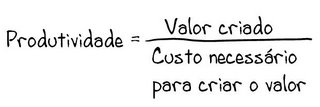
"It seems like no one remembers how an economy creates jobs anymore. The right answer, in fact the only answer, for jobs and better living standards, is productivity.
.
Economists define productivity as output per worker hour. (Moi ici: A tal visão arcaica da produtividade que parte do princípio que os atributos do output se mantêm constantesBut ramping up the output (Moi ici: Eheheh! Parece traduzido aqui do blogue)  of trolleys or 8-track tapes won't increase living standards. (Moi ici: Preparem-se para o que vão ler a seguir... respirar fundo)  It is not just technical efficiency that matters, it is also effectiveness—that is, producing what the economy really needs and consumers will pay for."  (Moi ici: A linguagem que tantas vezes usamos aqui, a eficácia é mais importante que a eficiência. Os economistas, a tríade só pensa na eficiência... de que vale ser muito eficiente a produzir algo que o mercado não quer?)
.
No seguimento da minha exortação "Amanhem-se!!!" esta linguagem que anda tão arredada do pensamento económico, tão habituado a direitos adquiridos:
.
"The productive use of capital is not an automatic process, of course. It is all about constant experimentation. And it is never permanent: Railroads were once tremendously productive, so were steamships and even Kodachrome. It takes work, year in and year out—update, test, tweak, kill off. Staples is under fire from Amazon and other productive online retailers. Its stock has halved since its 2010 peak and is almost at a 10-year low. So be it."
...
O que se segue alinha com a minha visão libertária:
.
"My theory is that productivity is always happening but swims upstream against those that fight it. Unions, regulations and a bizarre tax code that locks in the status quo.
.
In good times, no one notices. But in slow-growth economies, especially in the last 10 years, regulations and hiring rules and employer mandates and environmental anchors have had a cumulative dampening effect on productivity.
.
 (Moi ici: O que se segue podia ter sido escrito neste blogueHow can government do the right thing to help productivity and the employment it fosters? Get out of the way."

quinta-feira, julho 19, 2012

Adequar produtos aos clientes-alvo

Um produto não serve para toda a gente...
.
Cartoon retirado daqui.

A estratégia é a história (parte IV)

"Guber tells us that stories can also function as Trojan Horses. The audience accepts the story because, for a human, a good story always seems like a gift. But the story is actually just a delivery system for the teller’s agenda. A story is a trick for sneaking a message into the fortified citadel of the human mind.
.
Guber’s book is relentlessly optimistic about the power of story to persuade. But as the bloody metaphor of the Trojan Horse suggests, story is a tool that can be used for good or ill. Like fire, it can be used to warm a city or to burn it down."
.
Um perigo muito real!!!
.
Talvez questionando e investigando qual a intenção, qual o propósito, qual a razão de ser que move quem conta a história... se possa minimizar o risco de um contador de histórias mal intencionado.
.
Recordo que há muitos anos num programa na TV italiana, durante a primeira parte passou uma reportagem  que demonstrava, que no referendo a seguir à Segunda Guerra Mundial, tinha havido uma marosca e falsificação dos resultados eleitorais no referendo em que os italianos tinham optado pela república em detrimento da monarquia.
.
O número de telefonemas que invadiu a RAI foi monumental, era um escândalo, como tinha sido possível permitir que tal tivesse acontecido. Quando a emoção estava ao rubro... intervalo.
.
No arranque da segunda parte do programa, o animador do mesmo apareceu a revelar que tudo o que tinha sido apresentado na primeira parte tinha sido uma farsa, para demonstrar a facilidade com que a televisão, nesse tempo muito mais do que agora, podia enganar as pessoas.
.
.
Continua ainda com algo mais sobre o poder das histórias e a manipulação.

O mundo da Realidade Aumentada

Há dias vi uma notícia sobre barris de cerveja com um chip que dava indicação da temperatura, localização e volume.
.
Vemos, cada vez com mais frequência, QR codes associados a folhetos publicitários e a newsletters.
.
Compramos uns sapatos de corrida e podemos ver na internet o percurso que fizemos, quanto tempo demoramos, quantas calorias queimamos e ...
.
Agora mais um exemplo "Footwear for the blind - Bluetooth shoes"
.
O futuro também passa por aqui.

Há sempre uma alternativa

Outro tema já clássico neste blogue, como é que as lojas físicas podem fazer frente ao avanço do online?
.
Qual tem sido a recomendação?
.
Exclusividade e... experiência!!!
.
Saborear um pouco da batota da experiência em "Malls’ New Pitch: Come for the Experience":
.
"While a Scottsdale shopper can buy clothes on the Web, “she can’t go out to lunch with her girlfriends and have a glass of wine and a salad online,” said Michael P. Glimcher, chairman and chief executive. “She can’t get her hair done online. She can’t go and make pottery or soap or a cake online.”
.
Just about every mall owner in America is looking for ways to compete with the Internet. R. J. Milligan, a real estate analyst for Raymond James, said that developers were slowly adding more service-oriented elements to malls — for instance, dividing a closed Sears anchor store into multiple cafes.
.
But Glimcher is pushing the envelope even further than the standard model of restaurants and expanded food courts, he said, with tenants like Make Meaning (a membership store where people make crafts, cakes and other things) and Drybar (a salon with no scissors, just stylists with blow-dryers).
...
They can also take advantage of in-person-only opportunities at standard retailers, like the so-called booty cam at Industrie Denim, a jeans store, that lets women study their rear view. A Restoration Hardware scheduled to open soon will offer fresh flowers and cups of tea for sale.
.
“We want to be a place that people go to frequently, more than one time a week,” said Mr. Glimcher, so the emphasis is on classes and other hands-on experiences.
.
Scottsdale Quarter opened in 2009 without a bang. Consumers were pulling back on spending and real estate was troubled. Only a handful of the stores were leased.
.
Glimcher soon realized that traditional retailing would not work by itself, and leasing agents began collecting intelligence on game-changing candidates.
...
At its Polaris Fashion Place in Columbus, Ohio, for instance, it recently replaced a Gap with an Apple store. At River Valley Mall in Ohio, it replaced a Dollar Tree with Ulta Beauty, a test-it-and-buy-it cosmetics store.
.
At a New Jersey outlet mall, Jersey Gardens in Elizabeth, it ousted a Benetton and brought in a Lego store, which offers Lego-construction classes.

“It’s retail Darwinism,” Mr. Glimcher said.

Rick J. Caruso, the chief executive of Caruso Affiliated, developer of The Grove, an outdoor mall in Los Angeles, said the shift had shoppers rethinking what a mall could be."
.
Dá para pensar... há sempre uma alternativa que tem de ser desenvolvida quando o mundo muda.

quarta-feira, julho 18, 2012

Coisas que mereciam melhor investigação

Há coisas que precisavam de ser mais bem explicadas. Em "Maiores produtores de mobiliário lideram subida de desemprego" encontro:
.
"Paços de Ferreira e Paredes, concelhos líderes na produção de mobiliário em Portugal, registaram, nos últimos seis meses, as maiores subidas no número de desempregados no Tâmega e Sousa, afetando 22.331 pessoas no conjunto dos dois municípios.
.
Segundo dados do Instituto de Emprego e Formação Profissional (IEFP), o desemprego aumentou nestes dois territórios industrializados, em igual período, 15,76 por cento, afetando mais 1.631 pessoas do que em dezembro de 2011.
.
Em Paços de Ferreira, aonde a componente comercial do mobiliário é mais intensa, a subida foi maior do que em Paredes, em que predominam as empresas de maiores dimensões.
.
As dificuldades do setor têm sido explicadas, pelas associações empresariais dos dois concelhos, pela forte queda das vendas no mercado interno, muito superiores aos ganhos dos últimos meses nos mercados internacionais."
.
O título quer dizer o quê? São os maiores produtores de mobiliário (empresas) que lideram a subida de desemprego? Ou são os concelhos (geografia) onde há mais produtores de mobiliário que lideram a subida de desemprego?
.
Depois, no  Quadro VII do Relatório mensal do IEFP Junho de 2012, constato que em termos homólogos o novo emprego cresceu +27,6% e, em comparação com o mês anterior o novo emprego cresceu +1,5%, na categoria "Fab. de mobiliário, repar. instal. máq. e equip. e outras ind. transformadoras".

Monopólios, eu gosto muito deles

Um intervalo permitiu-me visitar o twitter. A tempo de apanhar este tweet de Tom Peters:
"Re de facto monopolies: "Be the best; it's the only market that's not crowded." (George Whalin)"
Ele chama-lhe monopólios de facto. Realmente já usei essa terminologia uma vez aqui no blogue. Contudo, prefiro a terminologia "monopólios informais"
.
Isto deve trocar as voltas aos "expertos" que só conhecem o custo/preço como variável competitiva e que acham que um monopólio é sempre mau.
.
Monopólios, se forem informais, se forem, de facto, são um elogio dos clientes.

Artesãos e finesse

“Our philosophy is very simple. Dedication. Determination. Focus and Finesse. You dedicate yourself to the craft. You’re determined to be the best. You focus everyday to be the best, and finesse will get you there
...
You must create like a god, command like a king, and work like a slave. Those are three very powerful sayings. Create everyday like there’s no tomorrow. Command like a king – you know if you look at any real leader throughout history, they’re always in the trenches with their staff, and their team, and their soldiers. That is very much worth the effort. And work like a slave – work hard and you determine to finish and be the best. There’s no stopping.”
.
Conhecem algum robô com "finesse"?
.
"Finesse" é compatível com produção em massa?
.

Em tempos de incerteza...

"the only way to set strategy effectively during uncertain times was to bring together, much more frequently, the members of the top team, who were uniquely positioned to surface critical issues early, debate their implications, and make timely decisions."
E a sua empresa? Com que frequência analisa criticamente os temas associados à estratégia? A frequência actual é diferente da frequência de há três anos?
.
Imagina que uma empresa com um sistema de gestão da qualidade alinhado com a estratégia para o negócio, se entretém e contenta com uma revisão anual do sistema?
.
Quantos minutos dedica à estratégia nas suas revisões do sistema?
.
Mais, Quantos minutos dedica por mês a discutir temas relacionados com a estratégia?
.
Em tempos de incerteza a maioria acredita em mais controlo, acredito que não, acredito em mais firmeza estratégica e, muito mais, fluidez táctica.

Trecho retirado de "Managing The Strategy Journey"

O Futuro é Local, Não a China

Os recortes que se seguem podiam ter sido retirados deste blogue, há anos que descrevo o advento de Mongo e o seu impacte naquilo a que chamamos, ou  nos habituamos a ver como manufactura.
.
"Seduced by government subsidies, cheap labor, lax regulations, and a rigged currency, U.S. industry has rushed to China in recent decades, with millions of American jobs lost.
...
the larger trends show that the tide has turned, and it is China's turn to worry.
...
What is going to accelerate the trend isn't, as people believe, the rising cost of Chinese labor or a rising yuan. The real threat to China comes from technology. Technical advances will soon lead to the same hollowing out of China's manufacturing industry that they have to U.S industry over the past two decades.
...
He predicts a "creator economy" in which mass production is replaced by personalized production, with people customizing designs they download from the Internet or develop themselves.
.
How will we turn these designs into products? By "printing" them at home or at modern-day Kinko's -- shared public manufacturing facilities such as TechShop, (Moi ici: E esta, caro António?) a membership-based manufacturing workshop, using new manufacturing technologies that are now on the horizon.
...
It is entirely conceivable that, in the next decade, manufacturing will again become a local industry and it will be possible to 3D print electronics and use giant 3D printing scaffolds to print entire buildings. Why would we ship raw materials all the way to China and then ship completed products back to the United States when they can be manufactured more cheaply locally, on demand?
...
It's a near certainty that robotics, AI, and 3D-printing technologies will advance rapidly and converge."
.
Tenho reflectido e escrito sobre isto: sobre o refluxo da deslocalização para a China; sobre o aparecimento da sociedade de "fazedores", de "prosumers", de "makers", sobre o impacte da sociedade e cultura DIY.
.
Até aqui o artigo acompanha-me. Onde o artigo e eu nos separamos é aqui:
.
"American companies are already finding the rising cost of labor, shipping costs and time lags, and intellectual-property protection to be major issues in doing business in China." (Moi ici: De acordo, tenho escrito sobre isto)
.
As "American companies" vão sofrer tal qual as empresas chinesas, a convergência da robótica, da inteligência artificial e das impressoras 3D, não vai dar vantagem às empresas americanas. A convergência vai promover a cultura DIY. As empresas, tal como as conhecemos, um avatar do século XX, vão tornar-se uma raridade, vão dar origem a redes de artesãos que vão dar um outro significado à frase "economia local". Será um golpe final na standardização, desde a escola até à colecta de impostos.
.
Mongo tem o potencial para criar uma sociedade muito mais livre, muito mais "weird", muito mais diversa, muito mais "alinear".
.
Trechos retirado de "The Future of Manufacturing Is in America, Not China", por mim o título seria "The Future of Manufacturing Is Local, Not China"

terça-feira, julho 17, 2012

Eheheh com que então não percebem...

Vale a pena continuar à espera?
.
Aqui "Portugal: Fourth Review Under the Extended Arrangement and Request for a Waiver of Applicability of End-June Performance Criteria—Staff Report; Press Release on the Executive Board Discussion; and Statement by the Executive Director for Portugal.", pode ler-se esta pérola:
"46. Nevertheless, the challenges facing Portugal remain formidable, and the reform effort should not be allowed to wane. While the “flow imbalance” may be attenuating, some adjustment still lies ahead. In particular, with improvements in competitiveness indicators to date very limited, the factors behind the narrowing of the external current account deficit remain unclear. Further declines in the current account deficit could prove elusive, necessitating deeper structural reforms to improve competitiveness. More daunting still is the large “debt imbalance” faced by both the public and private sectors. The appropriate solution to this is sustainable economic growth, which is best facilitated through an enduring and comprehensive reform effort."
 Ehehe com que então não percebem...
.
Aprenderam na escola, no tempo em que a oferta era menor que a procura, que o custo, a eficiência era fundamental para ganhar dinheiro e sustentar as empresas. Por isso, não conseguem perceber que hoje, quando a procura é menor que a oferta, não basta ser eficiente e ter baixos custos, é preciso seduzir clientes oferecendo-lhes experiências diferenciadoras que não passam, necessariamente, pelo custo mais baixo.
.
O sucesso do nosso calçado, a recuperação do nosso têxtil e vestuário, o crescimento do mobiliário e maquinaria, ... tudo, eloquentes exemplos de que a "competitividade" não passa pela receita da troika.
"48. Recent labor market reforms should help attenuate further increases in unemployment. Some of the increase in unemployment is unavoidable as domestic demand is affected by ongoing fiscal adjustment and resources shift towards the tradable sector. But the rise has also been exacerbated by long-standing labor market rigidities."
Ás vezes penso que eles escrevem estas coisas para não nos envergonhar perante o resto mundo... ainda ontem ouvi o Dr. Alexandre Patrício Gouveia na TVI24, com o Dr. Medina Carreira, a quantificar algo que digo aqui no blog há muito tempo. Os políticos, para embelezar as estatísticas, andaram mais de 10 anos a torrar dinheiro no betão, a mascarar os números do desemprego. Segundo ele, sem a "torrefacção" de impostos em betão o nosso desemprego hoje seria cerca de 33% mais baixo. Segundo ele, só no espaço de um ano e só do sector da construção vieram 230 mil desempregados. Como é que uma legislação laboral mais flexível evitaria isto? Não estou contra a sua liberalização, estou é contra estas justificações.... é a mesma conversa da TSU.

Chicotadas psicológicas não são solução

Ontem de manhã escrevemos "Consequências da mudança em curso".
.
À noite encontramos esta notícia sobre uma chicotada psicológica "M&S renueva el equipo de diseño de mujer tras los errores de los últimos trimestres", abanei a cabeça em sinal de reprovação... como se fosse um problema de pessoas.
.
Hoje encontro este texto "9 Trends That Are Transforming The Retail World"...
.
Talvez fizesse algum sentido pensar nestas tendências antes de começar a arranjar bodes expiatórios.
.
.
.
Apesar de sócio fundador, abandonei a Quercus, ainda no seu tempo de amadores amantes da Natureza, antes da invasão dos profissionais, por causa da incapacidade da organização pensar para lá das pessoas. Quando três ou quatro direcções consecutivas se demitem, não faz sentido eleger a quarta ou quinta sem primeiro perceber o que é que se está a passar.
.
Quando o mundo muda, pode fazer sentido mudar pessoas para recomeçar sem palas e sem limites auto-impostos pela experiência. Agora mudar as pessoas para manter o mesmo sistema... não vai resultar.

Um trabalho sempre a recomeçar

Por que o mundo muda, o tal meio abiótico, e faz com que os vales se transformem em atraentes picos e os antigos picos se afundem em vales venenosos e, por isso, as estratégias que resultavam no passado ficam obsoletas - ou lentamente, como uma suave erosão que se traduz numa enganadora estabilidade, ou com estrondosa e súbita rapidez. E, por que uma estratégia pode sempre ser aperfeiçoada, novas interligações no mosaico podem ser criadas...
 "they say, they thought about strategy as a set of problems to be solved - the way it is so often approached in both practice and in school. Now, however, they’re thinking about strategy as a way of life for themselves as a leader, a set of questions to be lived."
Pensar a estratégia de uma empresa nunca é um assunto fechado, nunca está terminada, há sempre algo a fazer, algo a melhorar, algo a mudar...
.
A sua empresa tem uma estratégia?
.
Continua actualizada e ajustada à realidade?
.
Há quanto tempo não a revê? Não precisa de ser afinada?
.
Há quanto tempo não a discute com os seus colegas? E eles conhecem-na? Estão na mesma onda?
.
Trecho retirado de "The Strategist" de Cynthia Montgomery

... we severely limit our options

Depois de terminar o último postal, onde prestei a minha homenagem a Stephen Covey, senti-me tentado a rever e tocar o meu exemplar de "The Seven Habits of Highly Effective People".
.
Detenho-me nm dos primeiros sublinhados que fiz no livro:
"Our most important financial asset is our own capacity to earn. If we don't continually invest in improving our own production capability, we severely limit our options. We're locked into our present situation, running scared of our corporation or our boss's opinion of us, economically dependent and defensive."
Depois de ler estas linhas... a minha mente voou para este artigo que li há minutos:
"O Banco de Portugal vai acabar com as bolsas de doutoramento e mestrado para os seus trabalhadores. Este corte nas despesas com formação é uma das medidas adoptadas pela administração de Carlos Costa com o objectivo de conseguir poupanças que compensem o facto da instituição não ter cortado os 13º e 14º meses aos seus funcionários."

RIP Stephen Covey

Há uma altura na nossa vida, e na vida das empresas, em que sentimos que temos de abandonar a cabotagem segura e rumar para o alto-mar desconhecido.
.
Mas o medo da novidade, o medo dos dragões e outras bestas que povoam a Terra Incognita, aprisiona-nos tempo demais no status-quo que nos mói, que nos faz revoltados, que nos faz coitadinhos. Sabemos que temos de mudar mas não sabemos como, ou não temos coragem para dar o primeiro passo.
.
Então, na minha vida, surgiu um livro que me deu a coragem para iniciar a expedição... uma frase que nunca esqueço:
"Não é o que acontece que conta, é o que nós decidimos fazer com o que nos acontece."
Nunca esquecerei as sessões de terapia que ele me proporcionou... e que me ajudaram a iniciar o caminho que ainda hoje trilho.
.
Por isso, foi com tristeza, respeito e gratidão que soube da morte de Stephen Covey o autor de "The Seven Habits of Highly Effective People"

segunda-feira, julho 16, 2012

Quanto tempo investe?

"Based on a service-dominant logic, a market offering is attractive if it captures the value-in-context for a customer. Therefore, the focus is not on the offering per se but on the customers’ value creation process, through which value for customers emerges. Vargo et al. (2009) claimed that value is not created until the customer integrates and applies the resources of the service provider with other resources in their own context. Value is always contextually specific and determined by the customer or the beneficiary. Furthermore, Kotler (1977) argued that the importance of the market offering lies not so much in owning the products themselves as obtaining the services they render."
O foco não deve estar na oferta, no que produzimos, mas na vida dos clientes-alvo. Quais os processos na vida dos clientes-alvo em que emerge a percepção de valor ao integrar os recursos que fornecemos?
.
Por isso, nas reflexões estratégicas que animo é fundamental perceber quem são os clientes-alvo e como é que emerge a percepção de valor.
.
O valor não emerge da cumprimento dos prazos de entrega pelo fornecedor, o valor emerge do que o cumprimento dos prazos de entrega permite a um cliente fazer ou viver: a paz de espírito; a gestão do capital circulante; ...
.
Quanto tempo investe a perceber quem são os seus clientes-alvo e quais são os processos através do quaç o valor emerge e é percepcionado?
.
Trecho retirado de "Customer co-creation in service innovation: a matter of communication?" de  Anders Gustafsson, Per Kristensson e Lars Witell.

Mongo e a Medicina

"Chapter Two, titled “The Orientation of Medicine Today,” describes how today’s “evidence-based” medicine is designed to treat large populations instead of individuals, which is incredibly ineffective and wasteful.
...
Chapter Ten, “Rebooting the Life Science Industry,” describes how this industry, which includes pharmaceutical companies, biotechnology, medical devices, and diagnostics, needs to shift from its business model of getting the FDA to approve drugs and services that are designed to fit general populations instead of specific individuals.
.
Chapter Eleven, “Homo Digitus and the Individual,” concludes the book by explaining how all of the converging innovations will enable medicine (a) to shift its focus from populations to individuals and (b) toward promoting prevention and precision. Author Topol sees a steady demise of hospitals and clinics, much like the bricks and motor bookstores. He also warns that there will be an adverse reaction from those who insist on the old ways, like reading a paper newspaper. But like the doctor’s house call in antebellum days, that way will be “gone with the wind.”"
.
Mongo está em todo o lado, chega a todo o lado.
.
Os eficientistas e as corporações apreciam o fenómeno da concentração da medicina em mega-instituições... tão ao jeito do século XX:


Trechos retirados de "The Creative Destruction of Medicine" via André Cruz


À atenção dos que pedem mais uma semana, mais um mês, mais um ano, mais uma década

"The Problem of Procrastination and Self-Control - Why We Can't Make Ourselves Do What We Want to Do", título do capítulo VI de "Predictably Irrational" de Dan Ariely (BTW, no final do capítulo V o autor discorre sobre a tomada de decisões num estado cool e num estado excitado... Dr. Jekill e Mr Hide, até compara respostas entre agentes num "estado normal" e num "estado de excitação sexual". Excitados, tomamos decisões contrárias ao que defendemos em modo cool. Gastar dinheiro também excita muita gente, sobretudo se for com dinheiro de outros).
.

"As a university professor, I'm all too familiar with procrastinationAt the beginning of every semester my students make heroic promises to themselves—vowing to read their assignments on time, submit their papers on time, and in general, stay on top of things. And every semester I've watched as temptation takes them out on a date, over to the student union for a meeting, and off on a ski trip in the mountains—while their workload falls farther and farther behind. In the end, they wind up impressing me, not with their punctuality, but with their creativity—inventing stories, excuses, and family tragedies to explain their tardiness.
...

After I'd been teaching at MIT for a few years, my colleague Klaus Wertenbroch (a professor at INSEAD, a business school with campuses in France and Singapore) and I decided to work up a few studies that might get to the root of the problem, and just maybe offer a fix for this common human weakness. Our guinea pigs this time would be the delightful students in my class on consumer behavior.
...

"Here's the deal," I explained. "By the end of the week, you must commit to a deadline date for each paper. Once you set your deadlines, they can't be changed." Late papers, I added, would be penalized at the rate of one percent off the grade for each day late.
...

I went to my other two classes—with markedly different deals. In the second class, I told the students that they would have no deadlines at all during the semester. They merely needed to submit their papers by the end of the last class. They could turn the papers in early, of course, but there was no grade benefit to doing so. I suppose they should have been happy: I had given them complete flexibility and freedom of choice. Not only that, but they also had the lowest risk of being penalized for missing an intermediate deadline. 
The third class received what might be called a dictatorial treatment: I dictated three deadlines for the three papers, set at the fourth, eighth, and twelfth weeks. These were my marching orders, and they left no room for choice or flexibility.
Of these three classes, which do you think achieved the best final grades?
...
We found that the students in the class with the three firm deadlines got the best grades; the class in which I set no deadlines at all (except for the final deadline) had the worst grades; and the class in which Gaurav and his classmates were allowed to choose their own three deadlines (but with penalties for failing to meet them) finished in the middle, in terms of their grades for the three papers and their final grade.
What do these results suggest? First, that students do procrastinat (big news); and second, that tightly restricting their freedom (equally spaced deadlines, imposed from above) is the best cure for procrastination."


Consequências da mudança em curso

Leio estas linhas "No sparks - M&S is struggling to catch up with changing fashions" e fico com a sensação que a M&S ainda não viu a luz, que ainda não percebeu como se tem de actuar em Mongo.
.
"M&S has been left behind by two changes. The first is the rise of cut-price clothes. In the year to April 15th around 35% of all clothing and footwear sold in Britain was discounted, up by more than a tenth on the previous year. Grocers and cut-price retailers are grabbing more of the market.
...
The second change is a move to more efficient supply chains and shorter lead times. The standard bearer for this is Inditex, which runs Zara. Inditex can get clothes from designer’s table to store in 14 days, says Isabel Cavill of Planet Retail, a research firm. Other retailers have followed suit: Sweden’s H&M manages it in three weeks. This allows them to respond to the market’s taste rather than betting on what customers might want. M&S, which only recently introduced a six-week lead time on its more regular items, has suffered from shortages. Earlier this year stores ran out of knitwear and printed tops.
...
Marc Bolland, the group’s chief executive, is trying to catch up with the competition. He is reducing the number of distribution centres from around 100 to four. (Moi ici: E o que vão fazer para responder ao que os clientes preferem, em vez de tentarem adivinhar com 9 meses de adianto o que eles vão gostar? Esse é o ponto-chave. Flexibilidade e proximidade são fundamentais. Quando aumenta a incerteza, a solução não é o aumento do controlo) He is also taking control of the M&S website, which is currently operated by Amazon.  (Moi ici: Já tinha lido umas coisas sobre outras marcas de renome que fizeram isto, que se puseram na mão da Amazon... deram à Amazon o acesso a informação preciosa, a base de dados dos clientes, os gostos e preferências, ... que leviandade!!!)  But if the firm is to retain its place in British fashion—and in middle-class British hearts—Mr Bolland will need to have some more tricks up his sleeve."
.
Mr Bolland, um conselho: