domingo, novembro 15, 2015

No entretanto (parte III)

Parte I e parte II.
.
Mais um exemplo do tema em "If You Haven’t Bet on a Market, You Have No Business":

"A symptom of weak market definition is calling yourself as “a platform play,” as so many startups do: doing anything for everybody, without doing something truly important for someone specific.[Moi ici: Pensei logo nisto]
...
Picking one or two markets is one of the toughest bets a startup can make because by picking one market you’re giving up others.
...
Who wants to exclude potential customers?
.
To really solve a problem and build your company means making a tough choice.
...
So picking the right market — and ensuring you do get it right — should be at the top of your business launch to-do list."

Mongo decorre desta evolução natural

 Imagem retirada de "The Countries With The Most Craft Breweries"
"there are two separate types of firms operating: generalists and specialists.
...
Generalists are able to attract resources or consumers from the wide range of competitive dimension whereas specialists attract only a limited range. Although competing firms operate in the same market, there can be significant differences between consumers within this market. Consider the example of the market for beer: beer drinkers are distributed amongst age and social status, with a majority of consumers being of a middle social status and are middle aged. Generalists can (and do) target this mass market. Specialists may however target a particular part of the market, for example providing products that are attractive to older or younger consumers or provide specific products that appeal to lower or higher status consumers. These differences matter, in that ‘niches’ emerge where there exists an opportunity for a specialist to enter the market and gain market share from the incumbent firms.
...
In early competition, generalists enter the market and tend to compete at the center of the market, without necessarily competing head-to-head.
...
In further competition, the market may not be able to support two generalists, and one may be selected, forming a niche where the customers of the second firm are no longer served. This periphery of the market becomes unserved and exposed meaning that specialists are able to enter the market in these locations. These niches are often ‘legitimated’ by the entry of more specialists, and movement barriers may persist based on the difficulty for consumers to return to a generalist product.
.
Finally, these niches take away customers from the incumbents, meaning that the generalist firm has fewer customers. Since the distribution of customers moves towards the niche supplier, these niche locations become ‘legitimated’.
.
Therefore, as concentration of the industry increases it may mean superficially that it is an unattractive industry, and that the generalist firm is not satisfying the needs of peripheral customers. Rather than considering this as an unattractive industry, this can be an ideal breeding ground for specialist firms willing to offer a product closer to the needs of these peripheral customers."
Mongo decorre desta evolução natural.
.
Trechos retirados de "The Dynamics of Strategy - Mastering Strategic Landscapes of the Firm" de Duncan Robertson e Adrián Caldart.

sábado, novembro 14, 2015

Pensamento do dia


Para reflexão

A merecer reflexão profunda por parte dos intervenientes no ecossistema. Por um lado, "Retail Stocks Rocked Amid Broad Market Downturn, Was Wal-Mart The Canary In The Coal Mine?":
"The luxury retailer was hit particularly hard but shopping destinations of all stripes have struggled this earnings season."
Por outro, "Moda de massas a preços de luxo":
"Nos últimos anos, os preços praticados no segmento chamado “fast fashion” têm aumentado de forma descarada. Quando os casacos de caxemira e os vestidos de couro apareceram nas lojas frequentadas pelo comum dos mortais, Cartner-Morley assumiu que se tratavam de produtos de quase adorno para as montras das lojas, produzidos em quantidades reduzidas, com o objetivo de elevar as marcas do quotidiano a algo desejável e, portanto, convencer os clientes a gastar. «Eu não sabia que as pessoas compravam, efetivamente, este material. Bem, claramente, estava errada», sustenta.
...
Atualmente, a moda disponibilizada pelas cadeias de retalho dirigidas às massas é, por vezes, tão desejável como as peças desfiladas nas passerelles mundiais. A evolução da tecnologia de tecidos tem permitido eliminar a maior parte dos materiais de pouca qualidade. E, ao invés de um segmento repleto de ideias copiadas, as marcas destinadas ao mercado de massas têm, agora, a capacidade de atrair talentos de design e os estúdios de design são capazes de produzir coleções que são tão convincentes como as peças desenvolvidas pelas marcas de luxo."

Acerca do calçado em 2015

Entre os dez sectores da economia portuguesa (nomenclatura combinada), que exportaram mais de mil milhões de euros nos primeiros 9 meses de 2015, o do calçado foi o único a evidenciar uma retracção, segundo os dados do INE.
.
Gostava de ver o Boletim de Conjuntura para ter uma melhor percepção da situação. No ano passado, durante o melhor ano de sempre, no final do segundo trimestre, relativamente à utilização da capacidade produtiva tínhamos:
"Apesar do forte crescimento da produção, as empresas que dizem que a utilização da capacidade produtiva está abaixo do habitual para a época do ano excedem ainda em 6 p.p. as que dizem o contrário. Quase dois terços dos inquiridos afirmam, no entanto, que a situação se encontra dentro de padrões de normalidade."[Acerca do calçado em 2015]


TAP: Por onde começar?

Espero que estes títulos "TAP vai concorrer com as "low cost"" e "TAP. David Neeleman quer que a companhia concorra com as low cost" resultem de uma má interpretação por parte dos jornalistas.
.
A TAP não pode concorrer com as "low cost"!
"O novo dono da TAP David Neeleman defendeu esta sexta-feira que as companhias 'low cost' são o maior desafio, revelando que o plano é ter tarifas baixas para "quem quiser viajar atrás e mais apertado".
.
"Talvez o maior desafio sejam as companhias aéreas 'low cost'. Passei pelo Porto no outro dia e fiquei assustado com oito aeronaves da Ryanair e mais quatro da easyJet. Não podemos desistir. Temos que nos tornar mais competitivos", afirmou o empresário num encontro com trabalhadores da TAP, a decorrer nas instalações da empresa em Lisboa.
.
Segundo o empresário, o plano é segmentar: "Vamos ter uma tarifa de 39 euros, mas o passageiro vai sentar-se atrás e pagar pela bagagem", isto é, "vai ser Ryanair com uma frequência de cinco vezes por dia, em vez de uma".
.
"Assim a TAP serve a todos: aos que querem pagar pouco e aos que não se importam de pagar mais, porque preferem viajar com melhores condições", acrescentou." [Moi ici: Quem lê este blogue e conhece o meu trabalho sabe como considero isto uma receita para o insucesso, querer servir todo o mundo]
Qual é a estrutura de custos da TAP e como se compara com a das 'low cost'?
.
Em que é que a TAP se diferencia?
Em que é que a TAP pode criar/aproveitar vantagens competitivas?
Em que é que a TAP pode fazer batota?
.
BTW, de certeza que o futuro tem de passar por
uma renovação (renewal), recordar "Your Strategy Needs a Strategy: How to Choose and Execute the Right Approach".
.
Talvez fosse importante, ao tomar as rédeas da liderança de uma empresa no estado da TAP, começar por dizer ao que vai a empresa renunciar, o que vai recusar, o que vai deixar de fazer... talvez mais importante do que começar por dizer o que vai fazer.


sexta-feira, novembro 13, 2015

Curiosidade do dia

Ao começo da manhã lia "Analistas: Instabilidade política não compromete crescimento português de 1,6% em 2015":
"a instabilidade política não deverá prejudicar o ritmo de crescimento no último trimestre,"
À hora de almoço lia "PIB cresce 1,4% no terceiro trimestre, menos do que o esperado":
"Segundo o INE, o contributo positivo da procura interna diminuiu no terceiro trimestre, refletindo a desaceleração do Investimento e, em menor grau, do consumo privado."
Recordo:
 Pelos vistos o travão já tinha começado no 3º trimestre.

Acerca da democratização da produção

"the crisis in the music industry.
.
Attali now says manufacturing will be hit by an identical crisis - this time caused by 3D printing. Apparently some spare parts have already started to appear on pirate websites. Thus instead of paying the manufacturer for a spare part, you might be able to download and print it yourself. Given that many manufacturers sell their products at low margin, in order to make money from spare parts and maintenance, [Moi ici: Servitization] this could seriously disrupt the economics of manufacturing."
Trecho retirado de "The New Economics of Manufacturing"

"The challenge"

"Often, organizations don't realize that they're falling down the abyss until extraordinary efforts are required to make a difference. But it's always easier to fix it today than it will be tomorrow.
And here's the hard part: You don't fall down the abyss all at once. You compromise, you cut corners, you don't bring as much to your work, and nothing bad happens (at first). So the feedback loop is broken.
Working your way back out works the same way: You work harder, you raise your standards, you invest, and nothing good happens (at first).
The challenge is to have the guts to care even when you're not apparently rewarded for caring."
Trecho retirado de "Falling down the quality abyss"

Acerca da heterogeneidade

"This situation raises the crucial question of why firms pursuing unsuccessful strategies do not change to more successful strategies, including possibly imitating the winners. Another way of stating this question is in terms of firm heterogeneity: why do firm differences persist once strategic and organizational recipes for success become known?
.
The first point to recognize is that heterogeneity does not always persist. In some industries, imitation is relatively easy and firms simply follow the leaders. In others, selection processes are so severe and rapid that unsuccessful firms are eliminated before their managers can figure out what is going on. This appears to be the case especially in industries driven by strong economies of scale, such as beer brewing, where thousands of firms have gone under in a relatively short period, reducing heterogeneity enormously. In many instances, however, firm heterogeneity persists for long periods."
Um tema que sempre me fez espécie, tanta gente que olha para um sector económico como um todo homogéneo. Recordar o Senhor dos Perdões.
.
Trecho retirado de "A Sociological View On Why Firms Differ" de Glenn R. Carroll e publicado no
Strategic Management Journal, Volume 14, Issue 4 (May, 1993), 237-249.

Assim, é fácil para outsiders

Enquanto lia "Look at This Crap Cheerios Is Trying to Pull" lembrei-me logo da minha surpresa, naquela viagem matinal de comboio para Famalicão, quando conheci pela primeira vez a Chobani e percebi como uma marca de iogurtes podia começar do zero, com um outsider ao leme, e em 4 anos apenas chegar a número 3 em vendas, na sua categoria, nos Estados Unidos.
.
Hoje, por todo o lado, assistimos a um crescendo de uma campanha contra o excesso de açúcar na alimentação humana, sobretudo das crianças. O que faz um gigante dos cereais? Lança um novo produto, porque também está na moda o aumento das proteínas na alimentação humana e, o que faz com os açúcares?
Que rede interna e externa de cumplicidades, de amizades, de inércias conspira até inconscientemente para produzir estes resultados?
.
Fornecedores, compradores, equipamentos, comerciais, ...
.
Assim, é fácil para outsiders com alguma ingenuidade inteligente subverter as regras do jogo.

quinta-feira, novembro 12, 2015

Curiosidade do dia


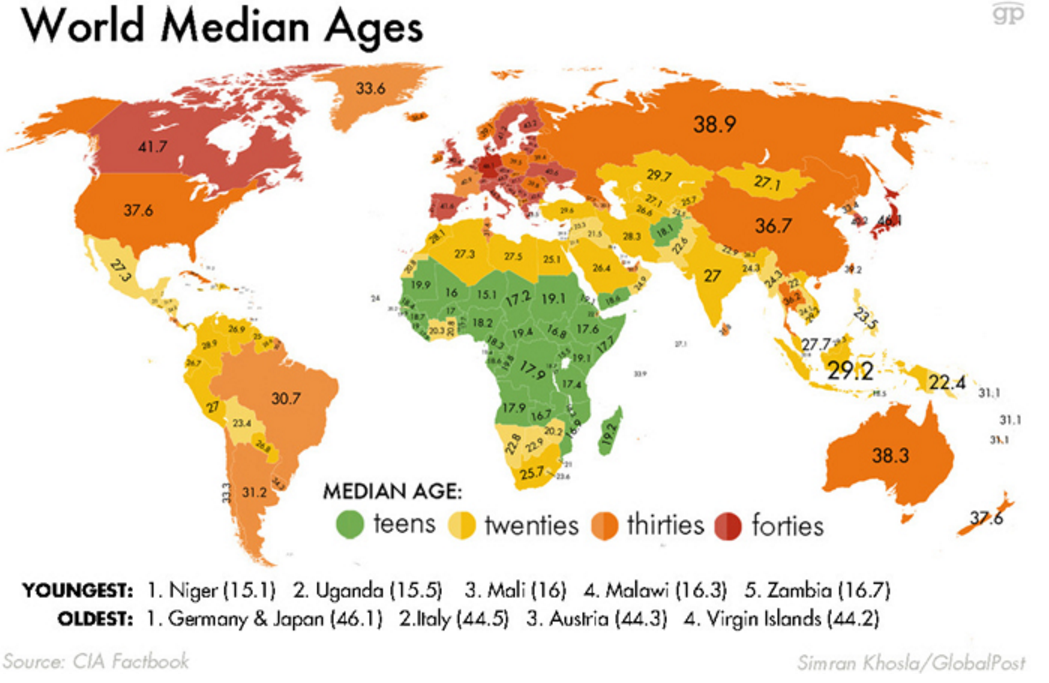
Fonte das imagens "These 8 maps show the median age of every country on Earth"
.
Rever também "Australia ranks highly now for Gen Y on global index - but future less bright"

Uma dúvida

Acerca da evolução das exportações do têxtil e vestuário houve um facto que me ficou na retina:
"Em termos de mercados, «Espanha e Estados Unidos continuam a ser os mercados que assinalam maior crescimento absoluto, respetivamente com um acréscimo de 99 e 49 milhões de euros, seguidos pela Alemanha com um aumento de 10 milhões de euros», aponta o diretor-geral da ATP."(1)
E:
"Em termos geográficos, Espanha continua a destacar-se entre os principais mercados das exportações portuguesas de vestuário, com uma quota de 42,1%, tendo registado uma subida de 9,2%, para 907,6 milhões de euros, entre janeiro e setembro de 2015.
.
Nos principais mercados, sobressaem ainda pela positiva a Alemanha (+1,5%, para 194,28 milhões de euros) e os Países Baixos (+3,3%, para 79,5 milhões de euros), assim como os EUA, que registaram um aumento de 38,5% das exportações nos primeiros nove meses do ano, para 57,1 milhões de euros."(2)
Como não estou a trabalhar com o sector não tenho informação em primeira mão. Por isso, gostava de perceber o que se está a passar no sector em termos macro. Por um lado temos o crescimento das exportações para Espanha, certamente muito influenciadas pelo fenómeno Inditex e pelo universo do fast-fashion. Por outro lado, temos o forte crescimento da procura norte-americana que tem de vir de outro tipo de procura, que assenta necessariamente num outro modelo de negócio.
.
Se é fácil perceber as vantagens competitivas da produção nacional para fazer parte do modelo fast-fashion, não tenho certezas sobre quais as vantagens competitivas responsáveis pelo crescimento das exportações para os Estados Unidos. Há um único modelo, ou são vários modelos que contribuem para os quase 39%?


Trecho 1 retirado de "Sem perder o ritmo"
Trecho 2 retirado de "Exportações em ascensão"
 

Apesar das boas intenções

Encontrei um texto do final dos anos 80 onde o autor (o Spender que tanto gostei de ler em "Business Strategy") entrevistou os gerentes/gestores de 19 empresas de fundição em Inglaterra. Com base nessas entrevistas identificou um conjunto de 15 ideias acerca do negócio. Depois, com base na partilha dessas ideias:
Organizou as fundições em clusters:
Destacam-se dois clusters os A e os B.
.
No cluster A estão as fundições que encontraram uma via para o futuro apostando em produtos especializados, em mais tecnologia na produção e no desenvolvimento de relações especiais com clientes com exigências tecnológicas elevadas e boas perspectivas de futuro.
.
O cluster A dedica-se a nichos e não está preocupado com a evolução global do mercado.
.
O cluster B está sobretudo preocupado com a evolução global do mercado, preocupado com a falta de pessoal interessado em trabalhar no sector e com a progressiva mecanização dos processos tradicionais. Saliento:
"the B-group firms sampled are reasonably satisfied with their financial performance. Although they know there is trouble in their market, they feel they can survive. Few have been able to earn sufficient to increase their capital base, do research or replace their worn-out equipment. Perhaps they should switch while they still breathe. But it is the same for all of us. Grim facts are ignored until they stare us in the face. Only then do we get down to the serious strategic business of changing our personal recipe, our habitual way of doing things. These managers know plenty about the A-group, and they know its recipe does not ensure success or even survival. For many B-group firms, the risks of change still far outweigh the risks of staying put."
E agora a cereja em cima do bolo:
"At the time of this research, NEDO researchers were thinking out a plan of government intervention designed to save the industry. Over £80 million had been committed to foundries as capital grants covering 25 per cent of the cost of new capital equipment, particularly the fume scrubbers required by the Glean Air legislation. In most cases, these funds were going to B-group type foundries, so supporting the declining part of the industry. Many of the A-group firms had actually ignored these grants. They were generally doing so well that they had installed all the capital equipment forced on them before the grants appeared. By and large, the inability to distinguish the A and B groups rendered these grants socially counter-productive. The funds flowed selectively into the least viable part of the industry, preventing change, and subsidized competition with the A-group, so slowing its growth."
Acredito que muitos subsídios são gastos assim. Apesar das boas intenções, o dinheiro vai para empresas que até podem renovar máquinas, mas que não vão renovar estratégias e abordagens, teimando nas receitas tornadas obsoletas e prejudicando as empresas que satisfazem o mercado mas não dominam os biombos e corredores do "poder". (Estou a lembrar-me da Gráfica Mirandela... e da maior rotativa do mundo num país pequeno, periférico e com uma língua esquisita)

Trechos retirados de "Industry Recipes"

Shit Happens! (parte III)

Parte I e parte II.
.
Neste blogue defende-se a concorrência imperfeita. Ou seja, recordando daqui:
"Thus, in Sraffa, abandonment of the hypothesis of perfect competition means abandoning a particular theory; that is, a theory that sees competition as a situation in which expansion of firms is halted by rising costs. Far from being restricted to very special circumstances, the hypothesis that firms should be regarded as single monopolies functions better than perfect competition, [Moi ici: A hipótese da concorrência imperfeita] in accounting for the evidence; that is, that the expansion of firms is halted not by raising costs but by the limitation of demand. Sraffa's insight, "by showing how limited is the domain of applicability of perfect competition, and by breaking the spell, so to speak of the perfectly elastic demand that faces the perfect competitor"
Que sectores e empresas se aproximam mais da hipótese da concorrência perfeita?
.
Os que trabalham e competem com o preço como principal variável competitiva. Os que trabalham como price takers e não como price makers.
.
Por exemplo, as empresas que trabalham para a indústria automóvel vivem sob contratos leoninos que são atribuídos ao fornecedor com o preço mais baixo e, que prevêem abaixamento desse preço a cada x meses, em virtude da aprendizagem e aumento de eficiência por efeito de optimização de processos.
.
Assim, não admira que a primeira reacção organizada venha daqui, "Associação de Fabricantes para a Indústria Automóvel contra aumento do salário mínimo nacional".

Workshop Balanced Scorecard Porto - (Parte IV)

Parte I, parte II e parte III.

3. Seleccionar os clientes-alvo e outros parceiros

A partir da intenção estratégica, da vantagem competitiva escolhida, temos de equacionar uma história:

Conseguimos reunir um conjunto de personagens (clientes, prescritores, influenciadores, reguladores, compradores, decisores, clientes dos clientes, ...), com as suas motivações próprias e unidos por um enredo que promova relações ganhar-ganhar-ganhar?
.
Quem são os clientes-alvo? O que procuram? O que valorizam? Do que fogem?
.
Onde compram, em que prateleiras procuram?
.
Que outras personagens têm interesses relacionados? O que procuram e valorizam? O que lhes causa "dor"?
.
Como se relacionam todas num ecossistema?

quarta-feira, novembro 11, 2015

Curiosidade do dia

"News reports continue to obsess over the idea that China and other countries might run out of people if they don't increase their birth rates. The implication is that countries won't have enough people to do the necessary work to support a larger population of retirees. (It's worth noting that many of these same people worry about robots taking all the jobs. If it's not obvious that these concerns are 180 degrees opposite then think about it until it is.)
...
On net, the more rapid population growth could certainly have a negative impact on living standards in 2050, especially if we consider distribution (a greater supply of labor could mean lower wages). However, even before factoring in the negatives, the potential benefits of a larger ratio of workers to retirees are swamped by the impact of economic growth."
Trechos retirados de "Demographics and Productivity"

No entretanto (parte II)

Parte I.
"“I do think you’ll see some dead unicorns this year”
...
“There are a considerable number of unicorns that will become extinct.”
...
The most likely scenario is the thing that has been driving growth (and valuations) for these companies ultimately comes home  to roost. And that is negative gross margins.
...
And so most of the companies out there who are growing like weeds using a negative gross margin strategy are going to find that the capital markets will ultimately lose patience with this strategy and force them to get to positive gross margins, which will in turn cut into growth and what we will be left with is a ton of flatlined zero gross margin businesses carrying billion dollar plus valuations."
Trechos retirados de "Negative Gross Margins"

Shit Happens! (parte II)

Parte I.
"Hutchinson formalized naturalistic images of the niche of biotic populations and defined the fundamental niche of a population as the hypervolume of environmental space formed by the set of points for which the population's growth rate (fitness) is nonnegative. In other words, the fundamental niche consists of the set of all environmental conditions in which the population can grow or at least sustain its numbers. By extension, the fundamental niche of an organizational form consists of the social, economic, and political conditions that can sustain the functioning of organizations that embody the form.
...
If two organizational populations rely on completely different kinds of resources and depend on different kinds of social and political institutions, then their fundamental niches do not intersect. Otherwise, they do intersect, and so it makes sense to measure their similarity in terms of the degree of intersection or overlap.3 Intersection in fundamental niches might be thought of as potential competition. In general, the potential for two populations to compete is proportional to the intersection of their fundamental niches. It follows that two populations compete if and only if their fundamental niches intersect.
When two or more populations with intersecting fundamental niches occupy the same system, the expansion of one population changes the conditions of the others' existence. In the case of competition, the presence of the competing population reduces the hypervolume of environmental space in which another population can sustain itself. Hutchinson coined the term realized niche to refer to the restricted environmental space in which a population's growth rate is nonnegative in the presence of competitors. The realized niche is a subset of the fundamental niche and in most realistic cases it is substantially smaller than the fundamental niche.
Except in the highly unusual case of a population isolated from all competitors, all that can be observed in any empirical setting is the realized niche. Suppose that a pair of populations compete for a resource and that one of them can exclude the other from the full range of overlap of their fundamental niches. In this case, the realized niche of the stronger competitor coincides with the fundamental niche, but the realized niche of the weaker competitor is smaller than its fundamental niche. Interestingly, the two realized niches do not intersect in such cases. It follows from the general principles that the absence of an observed niche intersection does not imply the absence of competition in other portions of fundamental niches."
Continua com os price takers, Sraffa e salário mínimo.
.
Trechos retirados de "Dynamics of Organizational Populations - Density, Legitimation, and Competition" de Michael Hannan e Glenn Carroll.

Acerca da criação de valor

"Value is created by the buyer not the seller.
...
If buyers rely on their own experiences, then how can any salesperson create value?
...
What top sales performers do, almost instinctively, is they connect to the value drivers (some of which may have been un-articulated) of their ideal customers.
...
By believing in value creation by salespeople may lead those hungry salespeople down the wrong path especially for small businesses where their sales team is also their marketing team.  Possibly the best lesson from this marketing and consequently sales research is to just listen to what is being said instead of presuming you as the salesperson already know what your sales prospect needs or wants."
Conhece os value drivers dos seus clientes-alvo?
.
.
.
E sabe quem são os seus clientes-alvo?
.
.
.
Qual é a sua proposta de valor para eles?
.
Trechos retirados de "Value Creation – The Truth Leaks Out"