- "Trouble looms in Internet-of-Things"
- "The Internet of Things Is Wildly Insecure — And Often Unpatchable"
- "Smart TVs, smart fridges, smart washing machines? Disaster waiting to happen"
Vertentes importantes a ter em conta no processo evolutivo.

"O governo de Pequim reclama o título de maior comerciante de bens do mundo, destronando os EUA nesse campeonato, depois de as importações no país terem disparado em Dezembro pelo quinto mês consecutivo."Trecho retirado de "China já é líder mundial no comércio de bens"
"It’s being called the “Sharing Economy,” “Mesh Economy,” “Collaborative Consumption,” and now the “Collaborative Economy.”
...
Access is being made affordable to those who previously could not pay for hotel rooms, a rented car, a vacation yacht, one-of-a-kind jewelry, a gourmet meal served in a private room, or industrial or commercial space for a nascent company. In all these cases sharing or collaboration is involved. So is modern technology such as mobile, social media, sensor, data and location.
.
Perhaps it’s all a temporary phenomenon, festered by the lingering remnants of the most persistent economic downturn in 65 years; perhaps it is representative of a permanent new way of doing business. The evidence seems to be pointing toward the latter, and many experts see it as sufficiently significant as to be defined as a new economy, one likely to disrupt many aspects of the old one.
...
While people have been bartering, forming collectives, helping each other for centuries, there is something new and different going on today. Back in simpler times, these acts of sharing and collaboration all took place on the community level, where people knew each other by reputation and knew who to trust in business or confidences. Now it can go global and work in real time."
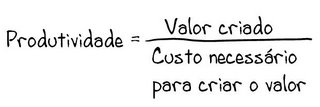
"Pelo que recordo, da nossa conversa telefónica, existem grandes disparidades de produtividade entre turnos. Parece-me que não é tanto uma questão técnica mas mais uma questão de investigação lógica: o que é que se faz de forma diferente entre os vários turnos? Porquê?E o comentário que a empresa me deu, deixou-me desconcertado:
.
Não sou um especialista em produtividade laboral, limitar-me-ia a essa pesquisa lógica de identificação de diferenças."
"O problema é mesmo esse é que o trabalho é exactamente o mesmo nos 3 turnos, e as produções variam muito! Daí pensarmos mesmo que a questão que seja mesmo de sensibilização."Come on!
"Instead of mapping workflow in detail with “boxes and arrows,” managers should focus on the “diamonds and arrows” of decision flows. In our transformed information economy, improving the decisions of knowledge workers can have a much higher impact on business performance than fixing daily workflow inefficiencies."Por isso, é uma pena que se associe falta de produtividade a uma questão de vontade, de sensibilização.
" a DIY Internet revolution that could upend chains everywhere" (Moi ici: Parece que a minha mensagem/visão está a generalizar-se...)
...
(Moi ici: Isto é delicioso, isto é belo, isto é poético) a trend that has been getting a lot of attention lately. Some refer to it as the DIY - for do it yourself - movement. Venture capitalist Hemant Taneja, looking at it from a different angle, calls it "unscaling." Chesky uses the term "decentralized production." Marc Andreessen hit on the concept in a manifesto entitled "Why Software Is Eating the World."
.
It all points to the same idea: Information technology is eroding the power of large-scale mass production. We're instead moving toward a world of massive numbers of small producers offering unique stuff - and of consumers who reject mass-produced stuff. The Internet, software, 3D printing, social networks, cloud computing and other technologies are making this economically feasible - in fact, desirable.
...
the underlying story of Airbnb, information and the major hotels will get replayed in lots of industries in the next few years. Mass production and sameness mean safety when information, intimacy and trust don't exist. As information, delivered globally and cheaply over the Internet, brings back intimacy and trust, the advantage of uniformity at scale slips away.
.
"These new economies of unscale will be good for job growth, because they open up thousands of new market niches for exploitation,(Moi ici: "thousands of new market niches for exploitation", ou seja, uma outra forma de dizer Mongo!!! Bingo!!!)
...
"To succeed, though, first we have to unlearn what we have been taught about business. We have to think in an unscaled mind-set, where the emphasis is on a greater number of specialized products sold to customers who know exactly what they need." (Moi ici: Por isto, é que me passo quando leio os figurões todos cá da terrinha e descubro que o anónimo engenheiro da província vê mais à frente)
...
“In the last 15 years, bits and bytes have been revolutionized,” he notes. “The next 15 years, I think you will see things, atoms, physical industry, services – things in the real world – starting to be changed. All that stuff will change.”"

"The essential question is, why do states form? Would that all young economists interested in development put their effort toward such grand questions! The old Rousseauian idea you learned your first year of college, where individuals come together voluntarily for mutual benefit, seems contrary to lots of historical evidence. Instead, war appears to be a prime mover for state formation; armed groups establish a so-called “monopoly on violence” in an area for a variety of reasons, and proto-state institutions evolve. This basic idea is widespread in the literature, but it is still not clear which conditions within an area lead armed groups to settle rather than to pillage.Os estados não apareceram para nos defender, apareceram para nos pastorear e ordenhar.
...
What is the difference between pillaging and sustained state-like forms? The pillager can only extract assets on its way through, while the proto-state can establish “taxes”."
"Red Lobster got its start bringing fresh seafood to landlocked parts of the US. It developed an outstanding supply chain for fish and became a dining out routine for millions of Americans, especially on its famous “endless shrimp” days."Ao sucesso inicial segue-se o crescimento, depois, ao fim de algum tempo, começam as cópias e perde-se a vantagem competitiva:
"But in recent years, as cold chains became more prevalent, almost all restaurants now serve fish, and Red Lobster’s comparative advantage has dwindled."Então, muda-se de gerência e procura-se uma nova orientação estratégica:
"In response, Red Lobster undertook a renovation of its restaurants and of its brand. Now there is a “fresh” menu and a grill master standing ready to cook to order. The gleaming wood and softer lighting is designed to attract “experientials”: people looking for a fun night out, rather than an opportunity to stock up on affordable protein""É quase sempre assim, há um padrão:
"Successful retail concepts always peak at some point. They saturate their market, expand to all possible geographies, watch copycats invade their space. Then what? Like Red Lobster they often get brand envy: if only we could get some better customers while not alienating our existing customers. The problem is as old as infidelity, with similar results. You can be satisfied with what you have, or switch (with unpredictable results), but you can rarely have both."E este é um dos problemas do crescimento rápido, um dos riscos do calçado português passa por aqui, também, querer ir a todas, querer servir toda a gente, aumentar o volume... e perder a vantagem competitiva e diluir-se sem a noção de quem são os clientes-alvo:
"The value of a brand is twofold: it communicates about the product offering: the category (shoes), quality (middling), service (none), price (affordable), but in addition it also stands for the target market it serves. “What to Whom” as I call it. It’s easier to change the “what” than it is to change the “whom”. Revamping the stores, changing the prices, advertising during the Super Bowl, all it takes is money and commitment. But the point of a brand is to create an indelible image in the minds of consumers of what you stand for. To change it is to throw it away. The traditional Red Lobster customer arrives with her family of five for endless shrimp only to discover a fancy fresh fish menu and soft lighting. The new target market of experiential thirty-year-olds get to sit next to a disgruntled family of five."Portanto, da próxima vez que na sua empresa se pensar em alargar o âmbito dos clientes-alvo, talvez seja de pensar nisto:
"So what’s to be done if you have brand envy? Step one is to put those thoughts on hold and think more about how to serve your existing customers as well as possible within the bounds of profitability. Step two is to ask if there is a way to attract the more profitable customers without detracting from the experience of the existing customers. If step two is not possible, maybe you need a new brand, not a stretched one."

"Coca-Cola Co. found that a can of soda sold in the sportswear aisle of Wal-Mart, alongside clothing, can command a higher price than if it’s positioned in the beverage aisle near its rivals."
“Acontece que o abandono progressivo das actividades com baixo valor acrescentado (têxteis, calçado) é uma estrada sem regresso possível e sem alternativa. Vai doer, mas só assim o país ficará mais forte e competitivo.”Porque metia sectores inteiros no mesmo saco e, voltei a usar a frase que aprendi com Suzanne Berger:
“… there are no “sunset” industries condemned to disappear in high wage economies, although there are certainly sunset and condemned strategies, among them building a business on the advantages to be gained by cheap labor”Portugal tinha de acabar com esses sectores para ser um país de futuro... a Dinamarca parece que não se importa de apostar na produção de carne de porco e de leite de vaca...
"Denmark is a tiny country, with 5.6m people and wallet-draining labour costs. But it is an agricultural giant, home to 30m pigs and a quiverful of global brands. In 2011 farm products made up 20% of its goods exports. The value of food exports grew from €4 billion ($5.5 billion) in 2001 to €16.1 billion in 2011. The government expects it to rise by a further €6.7 billion by 2020.O problema nunca é o sector onde trabalhamos, o problema é, quase sempre, a estratégia seguida. Como é que um sector tão antigo como a agricultura pode suportar salários tão altos? (BTW, não existe salário mínimo nacional na Islândia, Noruega, Finlândia, Suécia e Dinamarca)
.
Why, in a post-industrial economy, is the food industry still thriving? Much of the answer lies in a cluster in the central region of the country. Policymakers everywhere are obsessed by creating their own Silicon Valleys. But Denmark’s example suggests that the logic of clustering can be applied as well to ancient industries as to new ones. (Moi ici: Parece que alguém relacionou os macacos de Hausmann com os clusters de Porter... Ah! Se nos anos 90 tivéssemos tido quem nos apontasse este caminho...) In central Denmark just as in California, innovation is in the air, improving productivity is a way of life, and the whole is much greater than the sum of the parts. Entrepreneurs see the future in meat and milk."
"The word on everyone’s lips is “innovation”"Subir na escala de valor.
"the Danish Crown slaughterhouse organises regular tours for visitors, including schoolchildren, with views of the killing line."
"Nesses primeiros meses, Carlos passou muito tempo a observar o restaurante (Moi ici: Observar, ver como fazem os melhores, ver o que sai fora da norma, aproveitar a positive deviance) Carnegie Deli, que conseguia ver da sua casa na Sétima Avenida. "Tinha sempre uma fila enorme de pessoas", lembra. O empresário comeu no restaurante e achou que "era semelhante a centenas de outros delis." Perguntou, então, a outro cliente porque o espaço estava sempre cheio. "Porque criou fama já há muitos anos", responderam-lhe. E Carlos decidiu: "É disso que eu preciso." (Moi ici: Quase diria que é o momento do clique... é mais do que juntar os ingredientes, é preciso o intangível)
.
"A partir desse dia, trabalhei apenas com esse objetivo. Sou muito teimoso. Nunca pensei no tempo que ia demorar, apenas qual seria o destino", (Moi ici: Aqui recordo o começar pelo fim. O viajar ao futuro para definir o ponto de chegada e voltar ao presente para o transformar) explica. O empresário percebeu que os americanos que compravam sapatos baratos continuariam a fazê-lo (Moi ici: Percebeu que certo tipo de clientes não mudariam e, por isso, não faria sentido tentar servi-los) - os seus clientes era quem investia em calcado de luxo. (Moi ici: Identificou os clientes-alvo que queria servir, tendo em conta o seu ADN) Percebeu também que tinha de esquecer os outros serviços e concentrar-se nos sapatos, (Moi ici: Concentrou a sua atenção e recursos naquilo em que podia fazer a diferença) mas insistiu em tudo o resto: insistiu em manter a loja, com a renda caríssima, no mesmo local; insistiu que o funcionário colocasse a gravata todos os dias; insistiu que a qualidade do serviço fosse a melhor, mesmo que tivesse de perdesse dinheiro. Ao mesmo tempo, combatia as saudades da mulher, francesa, e dos dois filhos, que esperavam em França para se juntar ao pai.
"Foi uma luta. Não quis sair deste sítio. Queria estar no centro, na rua principal, queria que os meus clientes fossem pessoas ricas, dispostas a pagar o serviço que queria vender. Tive de investir o tempo necessário, dediquei muito tempo a este negócio. Não se cria um negócio, para o qual quase não haviam clientes, de um dia para o outro." Passado algum tempo, no entanto, começou a resultar. "Demorou talvez uns 18 meses." Alguns anos depois, mudou-se para um espaço maior na mesma rua.Faz bem a ponte para o livro de Calloway, "Becoming a Category of One".
.
A loja chamava-se Shoe Service Plus, mas o nome começou a criar problemas. "Queria registar a marca e não podia por que era um nome muito comum." Mudou para Leather Spa e aproveitou para refinar a imagem. (Moi ici: Brilhante!!!) Forrou as paredes a cabedal, comprou balcões e prateleiras de madeira escura, com puxadores dourados, e acentuou tudo como pormenores num tom exato de cor-de-laranja, que escolheu depois de muita hesitação. Com a nova identidade, veio a gama de produtos Leather Spa: atacadores, ceras, palmilhas, cremes. Carlos admite que "foi um risco muito grande, um grande investimento", mas diz que compensou. "Deu me uma identidade que não tinha."
...
Quando os clientes de lojas de luxo como Manolo Blahnik, Christian Louboutin, Jimmy Choo, Chanel, Gucci, Fendi, Fendi ou Salvatore Ferragamo querem reparar ou personalizar os seus sapatos, também é na Leather Spa que confiam. Todo o negocio está voltado para este mercado de luxo, cada pormenor, como as solas de um vermelho muito específico, que o português mandou fazer em vários países do mundo, para ser exatamente igual ao da marca Louboutin, e que apenas os chineses conseguiram imitar."
"A venda de mercadorias ao exterior voltou a acelerar em Novembro, ao registar uma variação homóloga de 7,2%, superior à subida de 4,5% registada em Outubro. É a quarta taxa mensal homóloga mais elevada do ano de 2013. É também o sexto mês em que o valor das exportações supera a fasquia mensal de 4 mil milhões de euros, ao elevar-se a 4,2 mil milhões de euros."Trecho retirado de "Crescimento das exportações volta a acelerar em Novembro para 7,2%"
"The cost of providing your product or service tells you the lowest price you can charge, but it does not tell you the right price.
...
Do not be tempted to take your costs and simply add a percentage for profit. You will be leaving money on the table but, more importantly, you will be sending the wrong signals to your customers.
.
If all you value about your product is the ingredients that go into it, you will signal to your customers that there is little reason to buy from you, except to save themselves the trouble of putting the ingredients together on their own. To give your customers something to believe in, a reason to buy from you as well as a reason to pay attention to the experience of consuming your product or service - and to make a profit that is worth the time and passion you put into your business - you must find a way to charge a price based on the value you give to your customer, and not the cost you incur in doing it."
"Os privados recusam doentes do SNS para a colonoscopia, é que o Estado paga 200 euros por exame que no privado custa 400.Lindo...
Mas claro, o Estado garante milhares de exames"
"In order to progress, modern society should be treating ruined entrepreneurs in the same way we honor dead soldiers, perhaps not with as much honor, but using exactly the same logic (the entrepreneur is still alive, though perhaps morally broken and socially stigmatized, particularly if he lives in Japan). For there is no such thing as a failed soldier, dead or alive (unless he acted in a cowardly manner)—likewise, there is no such thing as a failed entrepreneur or failed scientific researcher, any more than there is a successful babbler, philosophaster, commentator, consultant, lobbyist, or business school professor who does not take personal risks."Contudo, em "Duas culturas bem diferentes" sublinhei o trecho que se lhe segue:
"My dream—the solution—is that we would have a National Entrepreneur Day, with the following message:Ontem, via Twiiter, já não sei como, cheguei a isto "National Failure Day Celebrated Today"...
.
Most of you will fail, disrespected, impoverished, but we are grateful for the risks you are taking and the sacrifices you are making for the sake of the economic growth of the planet and pulling others out of poverty. You are at the source of our antifragility. Our nation thanks you."


"Occasionally, I’ll talk with people who tell me that in their type of business, it’s all about price. They will say that their buyers look strictly for the lowest price and that there’s nothing else that will really influence them. If that is really true, then you quite literally have only two choices. You have to figure out a way to have the lowest price and still make a profit, or the game is over for you.Trecho retirado de Joe Calloway em "Becoming a Category of One"
.
If, in fact, the business you’re in is all about price, either figure out how to have the lowest price and still make a profit or find something else to do. However, what’s more likely true is that you’re just taking the easy way out and blaming your failure to differentiate on your mistaken belief that your customers only consider price, which is seldom reality. Buyers of anything are looking for value. They are looking for a way to solve problems or create opportunities. No matter what the buyer says, price is never the only consideration. Value always has and always will be the primary buying factor.
...
It’s funny, isn’t it? People want to know what they can do to be innovative, to transcend commodity, and to differentiate from their competition. But my experience has been that when you suggest something to them that might just do the trick, they too often say, “But that’s not done in this business.” And that’s why you’re a commodity."
%2006.21.jpeg)