terça-feira, março 19, 2019
"selling projects rather than products" (parte III)
Parte I e parte II.
Como são as coisas... não há coincidências, todos os acasos são significativos.
Ontem à tarde, estive numa reunião de exploração estratégica numa empresa num sector tradicional da economia.
Empresa desenvolveu um produto a pedido dum cliente-fabricante. Entretanto, esse cliente chegou junto da marca e resolveu declinar o convite para produzir.
Marca, com produto na gama média-alta, resolveu avançar com a produção em Itália. Empresa resolveu fazer algo que nunca tinha feito antes, entrou em contacto com a marca, apresentou-se e ofereceu-se para continuar a fornecer a produção.
A internet ajudou-os a resolver o problema da distância (engraçado que antes da reunião ouvi este texto, "The Problem For Small-Town Banks: Technology Has Redefined Community" e, durante a reunião recordei "O fim da barreira geográfica")
Ou seja, a empresa está a considerar entrar no mundo da venda de projectos, em vez da venda de produtos, ou de soluções.
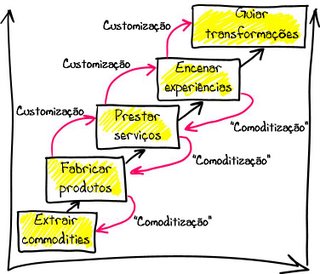
Também ando a pensar na relação da venda de projectos com o último nível desta cadeia:
Como são as coisas... não há coincidências, todos os acasos são significativos.
Ontem à tarde, estive numa reunião de exploração estratégica numa empresa num sector tradicional da economia.
Empresa desenvolveu um produto a pedido dum cliente-fabricante. Entretanto, esse cliente chegou junto da marca e resolveu declinar o convite para produzir.
Marca, com produto na gama média-alta, resolveu avançar com a produção em Itália. Empresa resolveu fazer algo que nunca tinha feito antes, entrou em contacto com a marca, apresentou-se e ofereceu-se para continuar a fornecer a produção.
A internet ajudou-os a resolver o problema da distância (engraçado que antes da reunião ouvi este texto, "The Problem For Small-Town Banks: Technology Has Redefined Community" e, durante a reunião recordei "O fim da barreira geográfica")
Ou seja, a empresa está a considerar entrar no mundo da venda de projectos, em vez da venda de produtos, ou de soluções.
Também ando a pensar na relação da venda de projectos com o último nível desta cadeia:
segunda-feira, março 18, 2019
Uma pregação em prol da ... concorrência imperfeita
Continuo a minha leitura matinal de "Fundamentals of Business-to-Business Marketing - Mastering Business Markets" editado por Michael Kleinaltenkamp, Wulff Plinke, Ian Wilkinson e Ingmar Geiger.
Estão a ver o choradinho e a falta de noção deste senhor, "Boas notícias, Portugal a ser abandonado pelo negócio do preço (parte II)"?
Imaginem o que diria desta linguagem:
Sabem o que vem aí?
Uma pregação em prol da ... concorrência imperfeita.
Estão a ver o choradinho e a falta de noção deste senhor, "Boas notícias, Portugal a ser abandonado pelo negócio do preço (parte II)"?
Imaginem o que diria desta linguagem:
"We have come to understand the market process as a never-ending process of learning for all involved, a process that is kept running by the entrepreneur who detects profit opportunities. Entrepreneurs sense differences in the market, they discover the possibility to sell something at a higher price than they can buy it for, and they disperse this knowledge—voluntarily or involuntarily—to other market participants. This process is a competitive one that rewards the capable and punishes the less able. Competition among sellers, therefore, has a selection function that creates better problem solutions for the buyer.Depois, o livro apresenta esta figura:
The Austrian economist Ludwig von Mises described the situation in the following way: “The entrepreneur can only act a step ahead of his competitors if he strives toward serving the market more cheaply and better. More cheaply means richer supply; better means supply with products not yet in the market”"
Sabem o que vem aí?
Uma pregação em prol da ... concorrência imperfeita.
"Homogeneity: The offers in a market are homogeneous if they resemble each other in all aspects, so that the buyer perceives no difference among them. Offers are heterogeneous if they differ either objectively or as perceived by the buyer.
• Knowledge: Buyers have complete market knowledge if they know without delay about all offers in the market.
• Barriers: Barriers hinder free market entry: new sellers cannot enter the market without entry costs or constraints, and sellers already in the market cannot imitate the characteristics and behavior of other sellers.
...
Information shortages and quality differences that initially exist will tend to disappear, and the temporary profits of cases 2–4 will disappear, shifting the situation to case 1.
.
Cases 5 and 6 differ from cases 1 to 4 because barriers exist. Barriers act as an obstacle to competition for new entrants as well as for those already in the market. Market entry barriers are always disadvantageous for new entrants compared to incumbent sellers, because the latter can approach buyers more easily than new entrants. And if a seller has a first mover advantage compared to its competitors then others cannot catch up—either because they are unable to (the advantage is too great) or because they do not want to (e.g., they are afraid of the first movers’ response).
...
Hence, barriers are, among other things, the reason for sellers earning profits significantly higher than competitors.
...
The picture of competition created in cases 5 and 6 provides the basis for an analysis of competitive advantage. Dynamic seller competition means that sellers are permanently searching for and experimenting with new products or services in order to find or create ones that distinguish themselves from those of other sellers, in terms of value to the buyer and/or the costs they incur. If a competitor succeeds in operating with lower costs than its competitors, then it can offer lower prices to buyers, which can increase its market share and profits. If a seller succeeds in offering a better product or service without higher costs, then it can increase prices and earn higher profits. This never-ending search and experimentation has only one aim: By differentiation, the seller wants to avoid being substitutable. Furthermore, a seller strives to establish a difference that is sustainable; it wants to avoid being imitated."
"selling projects rather than products" (parte II)
Na Parte I Antonio Nieto-Rodriguez deu o exemplo da Philips sobre como deixar de vender produtos e passar a vender projectos. Fez-me lembrar o fabuloso livro de Ramirez & Manervik e os seus ecossistemas da procura:
E a propósito de ecossistemas da procura, a minha primeira experiência, em 2004, de transformar a venda de produtos em projectos para "Subir na escala de valor". O mesmo "truque" usado pela Jofebar:
- Um sistema de gestão que começa no negócio (Novembro de 2015)
- A mensagem de quem sabe quem são os seus alvos (Setembro de 2016)
- Não esquecer (Dezembro de 2016)
Interessante que o sector da pedra tenha apostado na mesma estratégia (Portugal exportou mais 10,5% de pedra natural em 2018):
"Há uma inversão da exportação do material em bruto para uma tendência para o material transformado”E volto a "Selling Products Is Good. Selling Projects Can Be Even Better":
...
“Há quatro anos tínhamos a China como principal mercado”, pelo que “o setor exportava sobretudo bloco”. Agora, é França o principal mercado, com um crescimento superior a 5%, sendo que este país “consome sobretudo produto acabado”.
...
As associadas da Assimagra estão, neste contexto, “a fornecer sobretudo obra à medida”, aumentando o valor acrescentado face à venda mais indiferenciada de blocos de pedra. “Hoje o setor consegue estar nos principais projetos mundiais, disputá-los e vencê-los”, adiantou Miguel Goulão."
"Clearly, the shift to becoming a project-driven organization and selling projects rather than products or services presents sizeable challenges to corporations and their business models. Working in projects throughout my career, I have identified these as the important ones:
.
Revenue streams. Revenues will be generated progressively over long periods of time, instead of right after the sale of a product. This will affect the way revenues are recognized, as well as accounting policies and the overall company valuation.
.
Pricing model. New pricing models will need to be developed. It is easier to price a product, for which most of the fixed and variable costs are known, than a project, which is influenced by many external factors.
.
Quality control. Delivering quality products will not be enough to meet customer expectations. Implementation and post-implementation services will also have to be of the highest possible quality to ensure that clients continue to buy projects.
.
Branding and marketing. Traditional marketing has focused on short-term immediate benefits. Marketing teams will need to promote the long-term benefits of the projects sold by the organization.[Moi ici: Estou constantemente a dizer isto às empresas, fujam do preço da troca, calculem o custo do ciclo de vida do produto/serviço. Ajudem "get the customer to appreciate a bigger picture"]
.
Sales force. The buyer of the project will no longer be the procurement department of an organization. Sales will be pitched to leaders of the business, so the sales force and sales skills will have to be upgraded with strategy and project management competencies.
.
Stop for a moment and consider what your organization is selling. Is it a project? Increasingly, the answer is clear and affirmative. If not, beware, your products might soon become part of a project sold by someone else."
domingo, março 17, 2019
"selling projects rather than products"
Outro texto delicioso e em sintonia com Mongo, "Selling Products Is Good. Selling Projects Can Be Even Better":
Continua.
BTW, confesso que me estou a tornar num fan de Antonio Nieto-Rodriguez.
"In the beginning companies sold products. And then they sold services. In recent years, the fashionable suggestion has been that companies sell experiences and solutions, solving the needs and aspirations of customers.Há tempos a trabalhar num projecto de reflexão estratégica para exactamente fazer esta transição de empresa de produtos para empresa de projectos, fui surpreendido no inicio pelo pedido para fazer uma análise Value Stream Mapping ao seu ciclo produtivo. Entretanto, com o andar do projecto passei a mensagem que se quisessem aplicar a análise Value Stream Mapping o fizessem à utilização do produto durante o ciclo de vida do utilizador final, como naquele "running and the maintenance of the new center".
.
Companies, indeed, do all of these things. But increasingly, what companies sell are projects. To understand the difference, think of an athletic shoe company, such as Nike or Adidas. A focus on products means a focus on selling running shoes. A focus on experiences might mean they sell you a membership to a local running club. A focus on solutions might mean they figure out how to help you reach your goal weight. While these clearly offer more value than simply selling you a pair of shoes, they also have limitations. Selling products limits the revenues you can make from clients: Unless you are innovating and continually updating your product offering, customer attrition tends to be high, and incentivizing repurchases can be hard. Selling experiences provides intangible benefits that are hard to quantify and measure, often focusing on meeting the needs of one single customer, preventing any mass production. Selling solutions became popular in the early 2000s when customers didn’t know how to solve their problems. But today, in the internet age, people can do their own research and define the solutions for themselves.
.
A focus on selling projects would mean helping someone do something more specific, such as running the Boston Marathon.
...
The project would have a clear goal (finish the marathon) and a clear start and end date.
.
And that is just one type of project. More so than products, the possibilities with projects are endless. [Moi ici: Como não recordar - as pessoas e as empresas não compram o que compram, mas o que vão conseguir, processando o que compraram]
...
Soon after launch, products are copied by the competition, which means they must be priced more cheaply. Soon, they become a commodity. This removes any opportunity for steady, high margins over the long term. Philips has experienced this even with its high-end health care products. Shifting its emphasis to selling projects rather than products was a strategic response to this problem.
.
For example, Philips sells high-tech medical devices. In the past it sold them simply as products (and it still does). But now Philips seeks out the projects in which its products will be used. If a new health care center is being considered, Philips will seek to become a partner from the very beginning of the project, including the running and the maintenance of the new center."
Continua.
BTW, confesso que me estou a tornar num fan de Antonio Nieto-Rodriguez.
A fábrica do futuro
Mais um texto que parece retirado deste blogue, um texto sobre Mongo e muito diferente do que o mainstream escreve, normalmente, encadeado pelas luzes da automatização. Recomendo pois a leitura de "The manufacturing job of the future: clean, urban, and better paid":
"A thick stack of fabric lies on a long machine waiting to be compressed and cut into shapes. “It can automate a lot,” says Gregg Thompson cofounder of combat wear company Crye Precision, “but the volume has to be there.” Machines are not so great at design iteration, he says. A man standing next to the machine slices sheets of fabric by hand. He’s faster, says Thompson, and he can execute multiple designs without needing to be reprogrammed.
.
A shift is happening in manufacturing, bringing humans and machines closer together and making production more responsive to changing needs. The change is coming from companies that need flexible processes that allow their products to evolve with the needs of their customers. They also want their facilities not in industrial suburbs, but in amenity rich neighborhoods, so they can attract star talent. [Moi ici: Quase que não se pode pedir começo mais promissor do que este reforçar da esperança num lugar para o humano na produção em Mongo]
...
BNYDC’s grand vision is to create a campus that seamlessly integrates small and medium manufacturing operations with white collar offices, production studios, restaurants, coffee roasteries and shops, distilleries, grocery stores, bakeries, and rooftop gardens with edible greens.
...
The workflow will look something like this: a customer will call and ask for something, a designer will mock up a solution in its upstairs offices, that drawing will travel downstairs to production, once the part is made it will fly under the purview of a solutions architect who will vet whether the product actually suits the described need. Essentially, the company can iterate on customer needs much faster–in a single day. Previously, the company would have had to send parts back and forth between its manufacturing facility in Los Angeles and main headquarters in New York, a process that takes days if not weeks.
...
Factory workers are no longer just doing mindless production line work. The new manufacturing requires interacting with complicated robots and fixing computer systems. [Moi ici: Clubes de leitura e as ironias automação] “The manufacturing is smaller and cleaner and more sustainable and doesn’t pollute as much,”
...
The Navy Yard also recently opened its own high school [Moi ici: Até a escola que conhecemos, formatada para a revolução industrial e o Normalistão tem os dias contados] on campus called the Brooklyn Science Technology Engineering Arts and Mathematics Center (The STEAM Center for short). The school, developed in partnership with the Department of Education, gives qualifying junior and senior high school students from eight area schools the opportunity to spend half their day learning curriculum influenced by the equipment, jobs, and working cultures on display at the Navy Yard."
sábado, março 16, 2019
O senhor eurodeputado precisa de conhecer Mongo e ...
O mundo muda, mas muitas pessoas não se apercebem e, por isso, continuam apegadas aos mitos do paradigma onde nasceram e foram enformados.
Tudo sintomas previstos aqui no blogue há muito, muito tempo.
O senhor eurodeputado precisa de conhecer Mongo e mergulhar no Estranhistão, precisa desta epifania:
BTW, comparem a primeira frase do vídeo com o discurso do feike niús.
Recordo aqui no blogue muitas vezes uma frase de Napoleão:
Nesse mundo o crescimento era possível ao estilo canceroso, por isso uso a metáfora de Metropolis ou de Magnitograd, ou Magnitogorsk.
Para quem está prisioneiro do paradigma do século XX a falta de pessoal para trabalhar é medonha. Porque ainda não chegaram ao fim deste postal, "Coisa de loucos", porque nunca leram esta série "Como aumentar a facturação quando não se pode aumentar a produção por falta de pessoas?", continuam focados na última guerra, que já acabou, e fazem figuras tristes: "José Manuel Fernandes diz que é necessário "aumentar a natalidade""
A juntar a "10 profissões tradicionais onde há falta de gente" e a:
"Por outro lado, grande parte dos profissionais que dominam este ofício trabalha por conta própria, mostrando pouca disponibilidade para aceitar desafios por conta de outrem que embora estejam hoje mais valorizados monetariamente, continuam a não ser suficientemente aliciantes."Encontro agora "As profissões sem 'canudo' que oferecem salários acima da média".
Tudo sintomas previstos aqui no blogue há muito, muito tempo.
O senhor eurodeputado precisa de conhecer Mongo e mergulhar no Estranhistão, precisa desta epifania:
BTW, comparem a primeira frase do vídeo com o discurso do feike niús.
sexta-feira, março 15, 2019
Curiosidade do dia
Acham isto "Brazil Dam Disaster Highlights Dangers of “Softgrading” and Falsifying Audit Nonconformities" estranho?
Eu acho tão ou mais estranho a CP continuar certificada.
Eu acho muito estranho os hospitais do estado continuarem certificados. Penso na cláusula 7.1.2 da ISO 9001:2015 e fico sem perceber como é que os auditores não levantam essa não-conformidade.
O que eu teria para contar...
Eu acho tão ou mais estranho a CP continuar certificada.
Eu acho muito estranho os hospitais do estado continuarem certificados. Penso na cláusula 7.1.2 da ISO 9001:2015 e fico sem perceber como é que os auditores não levantam essa não-conformidade.
O que eu teria para contar...
“Hierarchy of Purpose”
Simplesmente muito bom, "How to Prioritize Your Company’s Projects":
"We had more than 100 large projects (each worth over 500,000 euros) under way. No one had a clear view of the status of those investments, or even the anticipated benefits. The bank was using a project management tool, but the lack of discipline in keeping it up to date made it largely fruitless. Capacity, not strategy, was determining which projects launched and when. If people were available, the project was launched. If not, it stalled or was killed.
.
Prioritization at a strategic and operational level is often the difference between success and failure. But many organizations do it badly.
...
Of course, sometimes leaders simply make the wrong decisions; they prioritize the wrong thing. But in my 20 years as an executive, the problem I see more often is that leaders don’t make decisions at all. They don’t clearly signal their intent about what matters. In short, they don’t prioritize.
...
The number of priorities admitted to by an organization is revealing. It is notable that if the risk appetite of a senior executive team is very low (or if they are not able or inclined to make the tough choices), they will tend to have a generous portfolio of priorities; they don’t want to take the risk of not being compliant, missing a market opportunity, not having the latest technologies, and so on. But in my experience, the most successful executives tend to be more risk taking and have a laser-like focus on a small number of priorities. These executives know what matters today and tomorrow. At the extreme, this might mean simply having a single priority. The more focus, the better.
...
In that time, I have developed a simple framework that I call the “Hierarchy of Purpose.” It is a tool that executive teams can use to help them prioritize strategic initiatives and projects:
.
Purpose. What is the purpose of the organization and how is that purpose best pursued? What is the strategic vision supporting this purpose?
Priorities. Given the stated purpose and vision, what matters most to the organization now and in the future? What are its priorities now and over the next two to five years?
Projects. Based on the answers to the first two points, which projects are the most strategic and should be resourced to the hilt? Which projects align with the purpose, vision, and priorities, and which should be stopped or scrapped?
People. Now that there is clarity around the strategic priorities and the projects that matter most, who are the best people to execute on those projects?
Performance. Traditionally, project performance indicators are tied to inputs (e.g., scope, cost, and time). They are much easier to track than outputs (such as benefits, impact, and goals). However, despite the difficulty companies have in tracking outputs, it’s the outputs that really matter. What are the precise outcome-related targets that will measure real performance and value creation? Reduce your attention to inputs and focus on those instead."
Mais sanitas (parte II)
Parte I.
O meu colega das conversas oxigenadoras sempre me disse que a Industria 4.0 requer gente com um grande espírito crítico. Recordo de Março e Fevereiro do ano passado "E as pessoas para a Indústria 4.0?" e "Está tudo relacionado".
Ontem, li "The ironies of automation":
O meu colega das conversas oxigenadoras sempre me disse que a Industria 4.0 requer gente com um grande espírito crítico. Recordo de Março e Fevereiro do ano passado "E as pessoas para a Indústria 4.0?" e "Está tudo relacionado".
Ontem, li "The ironies of automation":
"Some think this isn't a problem. One airline executive recently told the WSJ that pilots don’t need to know how underlying systems are built because, “they’re not engineers and their job is to fly the aircraft.” But this perception overlooks a seldom discussed irony: the more automated the system, the more crucial the human operator becomes. That’s because automation doesn’t purge demand for human labour, instead it changes the type of labour needed.
...
technology, while addressing one set of problems, often creates others. Decades later, that observation still rings true. Automation enthusiasts would be wise to temper expectations accordingly. Particularly in company boardrooms, where automation is increasingly seen as a panacea, and a way to reduce costs, rather than a tool."
quinta-feira, março 14, 2019
Ainda a batota
"The problem, experts say, is that a lot of companies don’t set clear objectives for the experiences they create. “You have to figure out what people need,” said Sarah Hall, co-founder and partner of experiential marketing firm Harley & Company. “Then you have to decide if you want to create a deep emotional connection or push them towards a transaction.”Trechos retirados de "The Pitfalls of Investing in Experiential Retail"
.
Many brands run into trouble by mimicking competitors’ strategies instead of figuring out which experiences make the most sense — and sales — for them. A café is only worth operating if its regulars are also purchasing margin-driving products. A successful restaurant won’t save a struggling department store chain unless diners hit the shoe floor afterwards. An in-store panel discussion will only create goodwill if the mission of the panel meets the mission of the brand.
.
“It's about questioning and redesigning every aspect of how the store works and how it sells what it sells,” said retail industry futurist Doug Stephens. “It's an intensive process that begins by breaking down the entire customer journey into its smallest micro-moments and then, within each of those moments, designing experiences that are surprising, unique, personalised, engaging and, most importantly, repeatable.”[Moi ici: E recuar a 2008 e ao primeiro e ao segundo texto sobre a batota]
.
Remaking the in-store experience often means a significant (and expensive) overhaul.
...
Experts underscore that good experiences are only worthwhile if they are accompanied by good products."
Boas notícias, Portugal a ser abandonado pelo negócio do preço (parte II)
Parte I.
Ontem no Jornal de Notícias, "Associações anunciam nova crise do têxtil", com pérolas extraordinárias:
Prefiro a evolução deste senhor, quem o lia há 10 anos e quem o lê hoje:
Há os que apesar de empresários nunca deixarão de ser funcionários e há os outros.
Ontem no Jornal de Notícias, "Associações anunciam nova crise do têxtil", com pérolas extraordinárias:
"Ontem, em Guimarães, os dirigente da Confederação Portuguesa da Micro, Pequenas e Médias Empresas (CPPME), António Monteiro, pôs o dedo na ferida: "A situação é de tal ordem preocupante que há muita gente em desespero. Prevejo o encerramento de dezenas de empresas nos próximos dias"Que falta de noção!!!
...
Entre as medidas a tornar, António Monteiro defende a criação de um fundo de segurança à subcontratação para compensar desistências de encomendas, a criação de um contrato obrigatório entre multinacionais e subcontratados, a criação de uma comissão arbitral para a resolução de conflitos e a criação de um fundo de formação profissional para a formação de costureiras."
Prefiro a evolução deste senhor, quem o lia há 10 anos e quem o lê hoje:
"Não é pelos preços que iremos encontrar a nossa competitividade e o que está a acontecer com a Inditex poderá ser pedagógico para muitas empresas, que se acomodaram, e um sinal importante para a nossa indústria de que o preço não é a resposta", afirmou o diretor-geral da Associação Têxtil e Vestuário de Portugal (ATP) em declarações à agência Lusa.ADENDA: Vão ver como começou a primeira loja Zara... um subcontratado a quem não desistiram de colocar encomendas, mas desistiram de comprar encomenda produzida. O homem teve de minimizar o prejuízo. Alugou um espaço em La Coruña, e começou a vender ... e nunca mais parou.
...
"A grande questão é que as empresas aprendam de vez a lição de nunca ficarem com excesso de dependência relativamente a um cliente ou a um mercado em particular. Mais uma vez, a história repetiu-se com algumas delas, sobretudo as mais pequenas, que tiveram de encerrar, mas a minha convicção é que não é isso que vai afetar de uma forma violenta, ou pelo menos dramática, um setor que hoje em dia tem outros argumentos, alternativas e mercados e outra forma de reagir na procura de outros clientes", considera.
.
Quanto às exportações para Espanha, Paulo Vaz acredita que "têm ainda potencial para crescer", até porque este mercado "está a ser berço de um conjunto de novas marcas muito orientadas para a sustentabilidade", em oposição ao "excesso de homogeneização que se encontrou em modelos de 'fast fashion' como a Inditex"."
Há os que apesar de empresários nunca deixarão de ser funcionários e há os outros.
quarta-feira, março 13, 2019
Curiosidade do dia
Num único subcapítulo do livro, "The Market Process" de Wulff Plinke e Ian Wilkinson, capítulo incluído no livro "Fundamentals of Business-to-Business Marketing - Mastering Business Markets" editado por Michael Kleinaltenkamp, Wulff Plinke, Ian Wilkinson e Ingmar Geiger, um festival de liberalismo económico:
"The market process can be viewed as a search process that never stops for any participant. Since all market participants are engaged in this search process, the market in effect creates the knowledge needed by buyers and sellers to act: “. . . the whole organization of a market mainly serves the distribution of information according to which the buyer has to act” (Hayek)
...
Kirzner developed a helpful way of describing the market mechanism
...
The market process is driven by entrepreneurs’ continuous search for profit opportunities. “The necessity to realize profits compels an entrepreneur to adapt as quickly and completely as possible to the desires of buyers (on the goods market) and sellers (on the resource market)” (Mises).
...
The result is what Schumpeter calls a process of “creative destruction” in the economy in which entrepreneurial activity leads to the continual supplanting of existing patterns of production by new ones."
Um mundo novo
"Ecommerce in Greece is expected to be worth 4 billion euros at the end of this year. That would be an increase of over 8 percent, compared to the 3.7 billion euros the Greek ecommerce industry was worth last year.Ontem voltaram a repetir-me uma afirmação:
...
ecommerce in Greece is gaining ground, with 85 percent of internet users in this Southeastern European country making regular purchases online. For comparison: this figure was at 65 percent in 2016.
...
Currently, 85 percent of online shoppers in Greece make a major part (80 percent) of their purchases at domestic online stores.
...
The most popular payment method in Greece seems to be cash on delivery, as this makes up for 54 percent of online payments.
.
Nowadays, over 7,000 businesses in Greece have digital outlets."
- Os 10 maiores clientes da DHL não existiam em 2008
Trechos retirados de "Ecommerce in Greece: €4 billion in 2019"
Mongo é esta capacidade de aprendizagem colaborativa
Mongo é esta capacidade de aprendizagem colaborativa, é esta predisposição para o DIY referida em "The backyard mechanic who is taking on Tesla":
"It was the ultimate DIY project, with no guidance from Tesla.
...
He is preparing to open the first repair shop on the East Coast dedicated to electric vehicles, with the goal of servicing vehicles while teaching owners how to care for the cars themselves."
terça-feira, março 12, 2019
"Ecosystems require a shaping strategy"
"Ecosystems are attractive partly because of the new possibilities they create for products and services spanning traditional boundaries — often using digital platforms, APIs, internet of things technology, and new tools for data gathering and analysis.
...
The essential characteristics of business ecosystems are the following: They are multi-entity, made up of groups of companies not belonging to a single organization. They involve networks of shifting, semipermanent relationships, linked by flows of data, services, and money. The relationships combine aspects of competition and collaboration, often involving complementarity between different products and capabilities (for instance, smartphones and apps). Finally, in ecosystems, players coevolve as they redefine their capabilities and relations to others over time.
...
In order to make use of ecosystems, organizations need to shift from using a traditional, static, company-centric perspective, and instead apply new ways of thinking about strategy from an ecosystems perspective. This perspective is distinctive in multiple ways:
.
Dynamic: Based on a coevolutionary rather than a static view of relationships and capacities.
Collaborative: Driven by crafting novel product combinations drawing on complementary offerings.
Influence based: Shaped by partial influence rather than full ownership or control.
Indirect: Profits from system transactions or involves cross-subsidies, as often monetization occurs indirectly.
Emergent: Generates and embraces unanticipated shifts, reversals, and unintended consequences.
Network oriented: Involves overlapping networks, rather than discrete, linear value chains.
Externally focused: Focuses strongly on activities beyond individual company borders.
...
Ecosystems require a shaping strategy, which refers to collaborating with others using indirect influence (including being influenced by others), being responsive to unpredictable changes, and evolving the ecosystem for mutual benefit. Enacting such a strategy can feel counterintuitive, as we are likely much more familiar and adept with the practices of a classical “plan and execute” strategy.
...
The shift to ecosystems thinking challenges the very idea of “industry” that we inherited from the industrial revolution — a discrete set of broadly similar players competing to produce a common end product in a vertically integrated fashion. The coming decades will likely see the further spread of ecosystems, with companies coevolving in temporary clusters of semifluid relationships, spanning traditional industry boundaries. We should therefore be wary of inadvertently applying assumptions from more classical environments or overgeneralizing from a handful of well-known precedents. Instead, we should adopt an ecosystems perspective and consider the specific strategic choices we face, based on our particular situation, aspirations, and capacities."
Trechos retirados de "The Myths and Realities of Business Ecosystems"
O actor, o seu problema e o valor (parte III)
Parte I e Parte II.
"For the buyer and seller an exchange contains several sources of potential benefits and costs:
• The sales contract or agreement describes the performance requirements for each party and is therefore a source of benefits and costs for each side. We will refer to them as the benefits and costs of the contract.
• The negotiation and carrying out of a transaction is not without costs. We refer to these as transaction costs.
...
• A transaction is not carried out in isolation from other transactions and processes in the environment. Almost every transaction has external effects of one sort or another. Hence we distinguish between the benefits and cost that arise directly from the exchange, and side effects that only become apparent in other exchanges. We refer to these side effects as side benefits and side costs from the perspective of the parties involved in the focal exchange.
...
The Buyer’s PerspectiveIf a product or service is provided as contractually specified, the buyer receives the contract benefits. These are the benefits the product provided contribute to solving a particular problem ... The meaning of the term “Product” in this context has to be interpreted in the broadest sense as a means of producing value, of solving problems: it comprises all the elements defined in the agreement including hardware, software, services, and ownership and usage rights. From the buyer’s perspective, a product is not a physical object but a means of solving a problem, with the associated perceived benefits. It is not the machine that constitutes the product but the availability of manufacturing capacity; the consulting process is not the product but the resulting ability of the buyer to deal with a problem in a better way.
...
The potential transaction benefits for a buyer arise independent of the emergence of an agreement during the buying process. One example is the know-how the buyer may gain from the seller as a result of their interactions, which may assist the buyer in later use of the product. Another is the positive experience the buyer has during the exchange process, from their own activities or those of the seller. The seller’s efforts to facilitate the buyer’s decision making, such as consulting advice, comparisons of alternatives, advertising, inspection tours, and test operations are yet another potential source of benefits that can increase the buyer’s trust in the seller and hence lower its transaction costs."
Trechos retirados de "The Market Process" de Wulff Plinke e Ian Wilkinson, capítulo incluído no livro "Fundamentals of Business-to-Business Marketing - Mastering Business Markets" editado por Michael Kleinaltenkamp, Wulff Plinke, Ian Wilkinson e Ingmar Geiger
segunda-feira, março 11, 2019
Não há receitas (parte II)
Parte I.
Kevin O'Leary com as suas ideias tem tido muito mais sucessos que insucessos. Só quero sublinhar que não acredito que a maioria das PMEs possa ter sucesso seguindo estas ideias.
Kevin O'Leary segue as ideias do Normalistão, segue as ideias do século XX, trabalha para criar gigantes.
Trabalhar em Mongo é trabalhar num outro mundo, é trabalhar para ganhar clientes, não para esmagar concorrentes.
Kevin O'Leary com as suas ideias tem tido muito mais sucessos que insucessos. Só quero sublinhar que não acredito que a maioria das PMEs possa ter sucesso seguindo estas ideias.
Kevin O'Leary segue as ideias do Normalistão, segue as ideias do século XX, trabalha para criar gigantes.
Trabalhar em Mongo é trabalhar num outro mundo, é trabalhar para ganhar clientes, não para esmagar concorrentes.
O actor, o seu problema e o valor (parte II)
Parte I.
A motivação de um potencial cliente por uma interacção será tanto mais forte quanto mais forte for a pressão para resolver o seu problema. Três factores podem afectar essa pressão:
"The consequence of success or failureThe pressure to solve a problem will vary according to the perceived importance of fulfilling a task. If the execution of a task promises significant contributions to goal achievement, the exchange partner will try harder to solve the problem. ... The more important are the anticipated consequences of failing to solve the problem, the greater is the pressure for solution.
...
Complexity of the task and the availability of means of solution
The more complex the task is perceived to be, the greater the pressure and effort required to find a solution.
...
Limits on the resources available, financial or human, also increase the difficulty and pressure involved in finding a problem solution. This is because compromises have to be made with respect to budgets or the quality of the problem solution.
...
Time pressure
The shorter the time available to solve a problem, the greater the pressure to find a solution. Time pressure may mean some options are not available, as when the time to submit a tender expires due to unexpected technical problems in tender preparation, or when costs will increase significantly if overtime rates have to be paid to extend working hour to complete a job on time."
Recentemente num projecto balanced scorecard onde a estratégia passa por subir na escala de valor trabalhando a interacção com um decisor vários níveis acima do cliente no ecossistema da procura, apareceu um tema como relevante para cativar esse decisor: "Prazos curtos".
O tema ainda não está resolvido, mas deixa-me cheio de dúvidas... associo prazos curtos a produtos padronizados. Produtos padronizados são um negócio de preço, prazos curtos não são compatíveis com tempo para interagir e criar algo novo. Também podemos estar a falar de "prazos curtos" não no sentido literal, mas curto no sentido de rapidez na criação de algo novo.
Trechos retirados de "The Market Process" de Wulff Plinke e Ian Wilkinson, capítulo incluído no livro "Fundamentals of Business-to-Business Marketing - Mastering Business Markets" editado por Michael Kleinaltenkamp, Wulff Plinke, Ian Wilkinson e Ingmar Geiger
domingo, março 10, 2019
O actor, o seu problema e o valor
"The value of something depends on its potential to make a positive or negative contribution to the solution of a particular actor’s problems. Thus, value depends upon the relationship between the good and an actor and their problems. Theoretically, perceived value is defined as the difference between the situations of a person without the good compared to the situation of a person with the good. The amount of value depends on the perceived difference in goal achievement resulting from the acquisition or disposal of the good, service, or resource in question.
...
The nature of any exchange is determined by certain driving forces. These stem from the interests and motives of the parties involved, who, through exchange, try to solve their problems. But problems cannot be solved in any old way. Instead, a solution needs to be perceived as more favorable and better than alternatives.
...
(1) In the search for problem solutions the parties are self-interested, and they seek advantages for themselves through exchange; (2) The pursuit of advantages is a particular feature of problem solving behavior; (3) When people search for solutions to their problems, they try to avoid or reduce risk and uncertainty.
Basically, the search for problem solutions is the major driving force behind exchange and the excess of benefits over costs, as well as the reduction of uncertainty, determine the extent of problem solution.
...
Exchange is motivated by expectations that it will bring about an appropriate solution to a problem. Each exchange partner sees the exchange as means for the accomplishment of a particular task or the achievement of a particular goal. But what really is a ‘problem’?
Each potential exchange partner is in a state they perceive as unsatisfactory or incomplete. It is their intention to change their state of affairs from a less to more preferred situation with the help of exchange. If this were not so they would not engage in exchange. The discrepancy between the current and less satisfactory state and the desired future state is referred to as the “problem” if the following condition applies: the transformation of an initial state into a desired final state requires a process of search, selection, and implementation of appropriate means promising a possible problem solution. Figure 1.5 depicts the structure of a problem.
A gap between starting and target conditions, with as yet unknown means of reaching the target, creates a condition of stress or disequilibrium.
we can describe a problem as a task combined with the perceived pressure to find a solution."Trechos retirados de "The Market Process" de Wulff Plinke e Ian Wilkinson, capítulo incluído no livro "Fundamentals of Business-to-Business Marketing - Mastering Business Markets" editado por Michael Kleinaltenkamp, Wulff Plinke, Ian Wilkinson e Ingmar Geiger
Subscrever:
Comentários (Atom)