segunda-feira, abril 24, 2017

A ascensão do artesão e da arte na produção

"Craft skills have been embraced by the fashion world in recent years as the boundaries between art and fashion blur. Today, artists collaborate on designer collections, while fashion brands sponsor art fairs. Increasingly, labels are exploring artisanal craft through clothes
...
And designers are creating artisanal-minded homeware
...
 the old notion of faceless, mechanised luxury is dead. He believes fashion brands today must be borne out of craftsmanship skills that recognise the value of the human hand. “Craft is our bread and butter at Loewe,” says the 32-year-old designer."
Em alinhamento completo com o que escrevemos aqui há milhares de anos sobre Mongo (Estranhistão), sobre a importância da arte na democratização da produção contra o vómito industrial, sobre a ascensão do artesão. E a reforçar o que penso será o futuro da impressão 3D, não na casa de cada um mas no artesão dos ciber-bairros que frequentaremos.
"Sildávia!!!
.
Não arrisquei escrever Albânia como símbolo de país pobre e atrasado, porque desconfio que nos hão-de ultrapassar enquanto tivermos estas políticas chavistas-de-gravata-à-europeia.
.
Qual a alternativa?
.
Ainda e sempre a ARTE!!!
.
Mentes algemadas olham para a fotografia da realidade e desesperam... e enterram a cabeça entre as mãos e prolongam a espiral viciada que há-de levar ao fim "at some stage".
.
Quem aposta na arte, faz como os artistas, em vez de ver nos obstáculos algo a derrubar, tenta tirar partido da situação, procurando uma pedra angular de onde possa começar a construir uma diferença.
.
Se o pintor usa uma tela, usa pincéis, tintas e luz para criar a obra de arte, o que as empresas devem fazer é reunir o equivalente a esses materiais:"
E recordo este slide daqui (12:36):

Trechos retirados de "Why fashion is turning to craft"

Já depois de escrever o texto acima encontrei "The Crafting Organisation":
"What if we were to evolve craftsmanship as a true practice for all of us? What if we talked about the ‘Crafting Organisation’, a business operating from a position of deep self-belief, always in beta, curious and confident to face the future? The Crafting Organisation is elegant in everything it does. Seeing the potential of creating beautiful outcomes in the most unusual ways.
...
Is this not a more beautiful way to describe business which not only embraces our humanity, but celebrates it? Tim Smit founder of the Eden Project likes to say that beauty will be the most important word we use over the next 15 years. I would also argue that craft is not far behind."

domingo, abril 23, 2017

Curiosidade do dia

"For the 55 million Americans who make their living as freelance workers, tax day is more than just a headache. It’s an annual fleecing.
.
Freelancers now constitute a third of the American workforce, and over the past decade, 94% of new jobs added to the U.S. economy were created in the so-called gig economy. Yet freelancers must retrofit themselves into an archaic system designed for the industrial era, one that taxes independent workers disproportionately even as they benefit less from the social safety net.
...
But the real rub is that freelancers are paying taxes toward a social safety net to which they have little access. Many pay both employer and employee contributions to Social Security, yet are ineligible for unemployment benefits and workers’ compensation.
.
Freelancers who make just enough to receive little or no subsidy for their health insurance are arguably the most penalized. Though they usually live in expensive urban areas, they may bring in only $35,000 or $40,000 a year, and are often subject to unpredictable swings in income that make them highly susceptible to debt."
Por cá é a mesma coisa, ou pior.

Trechos retirados de "Why tax day is a nightmare for freelancers"

"Entretanto, no retalho físico a mortandade continua" (parte II)

Parte I.
"In the first four months of 2017, retailers have announced a total of 2,880 store closures, and some financial services firm Credit Suisse predicts that around 8,600 stores will close this year. That’s more than closed during the financial crisis in 2008, and twice the number that closed in 2016.
...
The convenience of online shopping is a big reason for declining store sales, but retailers also misread the markets in the past few years, opening more stores than their businesses could sustain."
A sua PME está a par disto? Tem um plano B?


Trechos retirados de "Nearly Ten Thousand Stores Could Close This Year As Retail ‘Bubble’ Bursts"

Produtividade para o século XXI (parte II)

Parte I.
"What is meant by productivity?The productivity of an operation is related to how effectively input resources in a process (manufacturing process, service process) are transformed into economic results for the service provider and value for its customers. As a consequence of high productivity, a favorable profit impact should be achieved for the service provider and good value created for the customers. This productivity concept is normally stated in a simplified form as the effective transformation of input resources into outputs, the quality of which is unchanged (a constant quality assumption). In services, especially for two reasons, it has turned out to be difficult to use such a productivity concept. First of all, it is seldom possible to clearly define ‘‘one unit of a service.’’ Because of this, productivity measurements in services are normally only partial measurements, such as how many customers are served per period by one waiter in a restaurant or how many phone calls are dispatched by one employee in a call centre.
...
However, cost-cutting changes in the resources used may equally well have the opposite effect. They may create a servicescape and service process where the perceived quality deteriorates, and customers become dissatisfied with the value they get and start to look for other options. In that case, as less value for customers than before is created in the service process, the service provider’s revenue-generating capability declines. Using a traditional productivity concept, Anderson et al.  studied the relationship between customer satisfaction, productivity and profits in manufacturing and service industries, respectively. [Moi ici: É pensar no hara-kiri em curso dos bancos, por exemplo] They found that in services a high level of either customer satisfaction with quality or productivity measured in a traditional way was associated with higher profit, but not both simultaneously. In manufacturing higher customer satisfaction and productivity levels were found to be associated with improved profits.
In manufacturing, productivity is a concept related to production efficiency. However, the problem with being an effective service organization is that productivity and perceived quality are inseparable phenomena. Improving productivity may have a neutral or positive impact on quality, but equally well it may reduce perceived quality. If the latter happens, satisfaction with quality declines, customer value goes down, and the risk that the firm will lose customers increases. Revenues go down and this may have a negative effect on the economic result, in spite of the fact that costs may have been reduced as well."
Pois, e se tudo for serviço?

Continua.

"Push the envelope in a stable market, but focus on efficiency in an uncertain one"

Esta semana ao ler "If You're in a Dogfight, Become a Cat!: Strategies for Long-Term Growth" achei interessante o autor reforçar esta mensagem:
Sempre que a Apple foi first-mover deu barraca.

Ontem li ouvi este interessante artigo "Sometimes, Less Innovation Is Better":
"in certain situations, more innovation led to poorer performance. Their conclusion: sometimes, less innovation is better.
...
A time of turbulence is mainly defined by three factors. One: the magnitude of change. How much is the industry changing compared with other times? Two: the frequency of change. How often are changes coming at you? And three: predictability. Can you see changes coming? The most important of these is predictability. You can absorb almost any change you can see coming. But if predictability is low, and either frequency is high or magnitude is large, you should scale back innovation until things get more stable. Certainly if all three are working against you, you should innovate less.
...
anytime exogenous forces or shocks to the system happen in their markets—for instance, a new set of regulations or a major political shift—innovators tend to lose. Sudden changes create instability that seem to beg for innovation, but it’s probably better to sit tight and focus on execution and efficiency.
...
Push the envelope in a stable market, but focus on efficiency in an uncertain one."


Almas gémeas!

Ontem de manhã o @joaops chamou-me a atenção para este texto de Nassim Taleb "On Interventionistas and their Mental Defects". Quando ao final da manhã, durante uma caminhada, o ouvia não pude deixar de ficar surpreendido.

Primeiro, Nassim Taleb conta a história de Anteu,  muito forte quando estava em contacto com o chão (ou a Terra, a sua mãe), e muito fraco se fosse levantado ao ar:
"like Antaeus, you cannot separate knowledge from contact with the ground. Actually, you cannot separate anything from contact with the ground. And the contact with the real world is done via skin in the game –have an exposure to the real world, and pay a price for its consequences, good or bad. Most things that we believe were “invented” by universities were actually discovered by tinkering and later legitimized by some type of formalization."
Não pude deixar de relacionar esta estória de Anteu com o tema das sanitas da passada sexta-feira.

Segundo, Nassim Taleb martela nos neocons usando aquilo que há anos chamo aqui de amadores a jogar bilhar:
"O que acontece é que os políticos tomam as decisões, como eu jogo bilhar… quando jogo bilhar só consigo jogar a pensar naquela jogada. Um profissional do bilhar quando pensa na jogada que vai fazer, equaciona e prepara já o terreno para as jogadas seguintes."
Versus:
"these interventionistas not only lack practical sense, and never learn from history, but they even make mistakes at the pure reasoning level, which they drown in some form of semi-abstract discourse. The first flaw is that they are incapable in thinking in second steps and unaware of the need for it –and about every peasant in Mongolia, every waiter in Madrid, and every car service operator in San Francisco knows that real life happens to have second, third, fourth, nth steps." 
Terceiro, algo que me fez lembrar o que aprendi com Deming com o jogo/experiência do funil:
"And when a blow up happens, they invoke uncertainty, something called a Black Swan, not realizing that one should not mess with a system if the results are fraught with uncertainty, or, more generally, avoid engaging in an action if you have no idea of the outcomes."
Almas gémeas!

sábado, abril 22, 2017

Curiosidade do dia

Há dias tivemos:

Não admira que tenhamos "Economia paliativa":
"Apesar de tudo isto, persiste o mesmo problema que condenou o feito de Teixeira dos Santos e, mais cedo ou mais tarde, destruirá o de 2016: os cortes e apertos orçamentais foram importantes, e difíceis de conseguir, mas nunca passaram de ajustamentos superficiais, longe do cerne estrutural da dificuldade. A qual, em certas dimensões, está pior do que em 2008. Em ambos os casos, a política é meramente "paliativa", usando analgésicos e esteroides para conseguir exames positivos, sem extirpar o cancro que rói o doente. De novo, iremos de vitória em vitória até à derrota final."

Para assentar ideias

Relativamente a esta imagem

e ao uso do termo "realidade aumentada" em "Do you know what your strategy is?", assentemos algumas ideias.

Existe uma realidade. A moça da figura por trás daqueles adereços virtuais existe mesmo. Só que com a ajuda de uma aplicação num smartphone ela modificou-se e criou uma realidade aumentada.

A minha ideia é pegar nisso e aplicar ao dia a dia. Todos nós, fruto da nossa experiência de vida em curso, vamos como que criando e usando aplicações que influenciam a nossa capacidade de perceber o mundo que nos rodeia. Essas aplicações são tão boas que nem nos apercebemos que elas existem e, por isso, pensamos que os outros humanos vêem a mesma realidade que nós. Só que os outros, porque têm outro "cadastro de vida" têm outras aplicações a funcionar. Assim, enquanto eu vejo a moça da direita da figura, estou a comentar a sua aparência com alguém que olha e vê a moça do centro da figura. Pensamos ambos que estamos a falar da mesma moça mas estamos a falar de uma moça diferente apesar de ser a mesma. Agora imaginem que em vez da moça estamos a falar de produtividade, défice, austeridade... estou a lembrar-me duma personagem do Twitter, super-dragão  deste governo, em sentido figurado; que defende, sem se rir, que acabou a austeridade.


"making customers better makes better customers"

Um texto que gostava que fosse lido por alguns empresários com que trabalhei ao longo dos anos e que tiveram muita dificuldade em abandonar o ADN pré-China. Tinham a estratégia preço tão bem entranhada e ela já lhes era tão instintiva que sentiram muita dificuldade na transição que tiveram de fazer para reordenar as suas empresas para um mundo onde não podiam ser os chineses europeus antes de haver China.
"making customers better makes better customers. While delighting customers and meeting their needs remain important, they’re not enough for a lifetime. Innovation must be seen as an investment in the human capital and capabilities of customers."
O primeiro pensamento que lhes vem à cabeça, a reacção instintiva, é a que critico no texto da subdirectora do DN em "TRETA!"

A tentação é continuar a aumentar o que fazemos, quando talvez haja tanto ou mais valor em acompanhar o "crescimento do cliente, a sua evolução, o seu progresso" (recordar o JTBD) e ir alterando/acrescentando oferta em função dessa evolução.

Produtividade para o século XXI (parte I)

Li este artigo, "Service productivity Towards a conceptualization of the transformation of inputs into economic results in services", em Guimarães, à porta de uma fábrica, em Agosto de 2011.

Na altura fiquei contente por encontrar, finalmente, corroboração alheia para as ideias que defendia e aplicava no meu trabalho e que usava para explicar a evolução da economia transaccionável do país.
"Productivity is a concept used to manage production efficiency in manufacturing. In services, for example, due to the nature of service production processes as open systems and the participation of customers in those processes, such a productivity concept is too limited. Normally, only measure- ments of partial productivity are obtained and no control of the global productivity and its effects on the economic results of the service provider and on customer value is exercised.
...
In the present article, the problems of using a traditional productivity concept in services are discussed and a productivity concept which is geared towards the nature of services and service production processes is developed.
...
It is concluded that measuring productivity as an efficiency issue may be less appropriate in services and that it for measurement purposes may be more appropriate to view service productivity as a profitability concept."
Só nesta introdução há logo duas mensagens que considero importantes.

Primeira: pode parecer, segundo estes trechos, que se pode manter a metodologia de medição da produtividade da produção de produtos e só se precisa de mudar quando estivermos a falar de serviços.

Só que depois de ter descoberto a service-dominant logic e de ter agarrado a ideia de Dave Gray, por exemplo em "Tudo é serviço - Uma história sobre como Mongo se torna inevitável": Tudo é serviço. E os produtos não passam de um avatar dum serviço.

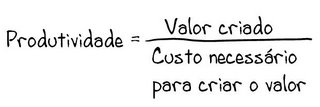
Segunda: a minha clássica luta para medir a produtividade não pela quantidade pura e dura mas pela margem alcançada.

Continua.

As 5 questões

"Great strategies answer five critical questions (“the strategic five”) in ways that are unique to your company: (1) What business or businesses should your company be in? (2) How should you add value to your businesses? (3) Who should be the target customers for your businesses? (4) What should be your value propositions to those target customers? (5) What capabilities should differentiate your ability to add value to your businesses and deliver their value propositions?
.
You won’t find the answers to these questions in most strategy concepts."
O mesmo se passa com a ISO 9001. Ela não só não fornece estas respostas como nem chega a colocar estas questões. A grande vantagem do balanced scorecard é ajudar a lidar com pelo menos quatro daquelas perguntas de forma muito pão pão queijo queijo.
"Instead of asking “Should we adopt TQM?” leaders should ask “How can TQM improve our answers to the strategic five?” A company such as Danaher, which actively seeks to add operational value to each business in its portfolio, would have an answer very different from those of Berkshire Hathaway or IKEA, because the three companies have different strategies for adding value to their businesses. Furthermore, because these companies can answer each of the strategic five questions with precision, they can be disciplined about whether they use TQM and, if so, how. In other words, their strategies are not just unique and specific, but also complete. This enables them to get the most out of strategy concepts without becoming hostage to them."[Moi ici: Como não recordar a diferença entre a caneta e o escrevedor]
Por isso, há uns anos mudei o nome deste blogue. Gosto de trabalhar com o balanced scorecard. Se pudesse só trabalhava sobre o balanced scorecard. No entanto, não passa de uma ferramenta, mais importante é perceber ao serviço de que projecto está.

Trechos retirados de "Why Popular Strategies Always Fade"

sexta-feira, abril 21, 2017

Mais sanitas - Curiosidade do dia

Esta semana num almoço com um empresário, ele fez-me ver a importância de uma reunião que tinha tida nessa manhã com os trabalhadores por causa de problemas com as sanitas do balneário fabril.

- Sanitas há em todo o lado. Todos em casa temos uma ou mais.

O problema com as sanitas foi visto por ele como um bom território para exercitar a capacidade crítica dos seus trabalhadores. Ele quer que eles sejam actores cada vez mais críticos, cada vez mais humanos na acepção mais nobre da palavra, cada vez mais capazes de não seguirem as ordens que chegam ao chão de fábrica porque têm uma alternativa melhor.

Como é que se atinge esse nirvana? Não é com um estalido dos dedos! É uma caminhada longa.

Lembrei-me disto ontem ao ouvir as intervenções numa tertúlia nocturna. E recordei o que escrevi recentemente sobre o bispo Berkeley. Penso que foi ele o criador da frase "Se uma árvore cair no meio de uma floresta e não estiver lá ninguém para ouvir, a queda não produzirá som".

O que a vida cada vez mais me leva a concluir é que a realidade existe. No entanto, nós humanos nunca vemos a realidade. Nós só conseguimos percepcionar uma espécie de realidade aumentada
E o que percepcionamos está fortemente influenciado pelas experiências de vida que nos vão acontecendo e que nos vão construindo permanentemente.

O empresário lá de cima, há meses que criou um clube leitura na empresa porque, explicou-me então:

- Como posso aspirar a ter gente com espírito crítico se as pessoas não lêem.

E depois, o desafio seguinte foi libertar as pessoas para a possibilidade de criticar, de não concordar com o que estava escrito.

- Sabe Carlos, para quem não está habituado a ler o que está escrito tem uma aura de sagrado, de não criticável.

O empresário usou a sanita. Eu costumo falar de um programa de televisão que nunca vi com a mesma intenção: "Benvindo a Beirais"


Ou estas Curiosidades do dia (esta e esta)

E cansado, não sou coruja, não tive espírito para me levantar e dizer naquela tertúlia o que tento agora ao almoço transmitir com estas linhas.

Talvez precisemos todos de falar de mais sanitas, de recorrermos menos a abstracções e mais a referências a coisas que as pessoas percepcionam melhor e relacionam com a sua vida... como o filme da "comprativa" que queria apoderar-se da enxada do trabalhador e nisso ele não foi.

BTW, que melhor exemplo:
Conversa que a maioria das pessoas não entende...

Uma banda desenhada, um sketch e uma plataforma de divulgação seria muito mais real para os tais tansos que arriscam:
"Qualquer reestruturação da dívida a envolver um “haircut” afecta os aforradores portugueses, que em Dezembro detinham 41% do seu montante total."
Imaginem um sketch em que os super-vilões Jerónimo & Martins num comício defendem a reestruturação da dívida e são aplaudidos por todos. Então, surge uma espécie de Batman e pergunta aos presentes quantos são aforradores de dívida portuguesa. E muitas pessoas levantam a mão. Então, com uma paciência andragógica, ao estilo de um Cristo e as suas parábolas, ou de um Sócrates (grego) e as suas perguntas, leva as pessoas a perceberem as consequências para a sua carteira do que estavam a apoiar. No fim, os super-vilões carregados de alcatrão e penas são observados por um Lucky Luke.

"Do you know what your strategy is?"

"Does your company (or the one you want to build) have a compelling and clearly articulated North Star? This refers to a company's stated purpose, values, and priorities. The logical extension of this question is explored here: Do you know what your strategy is?
...
Corporate executives often struggle with strategy formulation and communication. In such cases, the problem often starts with an inability to define genuine North Star corporate goals that can be translated into specific, measurable, achievable, relevant, and time-dependent objectives. This often leads to strategic inertia, undermining the ability to effectively respond to the accelerating pace of marketplace shifts. Ask any CEO, and you'll undoubtedly hear this: "Of course we know our strategy!" If this were the case, one should also get the same response from each of the company's key constituencies: the board of directors, employees, business partners, customers, and investors. But the reality is, far too often, companies can't or don't express their strategy in terms that are clearly understood and embraced by their stakeholders. Or there is a serious disconnect between what senior executives say their business strategy and priorities are, and how employees are actually managed and incentivized."
A maior ilusão da comunicação é crer que ela teve lugar, é crer que o conteúdo comunicado é uma realidade objectiva.

O que a vida cada vez mais me leva a concluir é que a realidade existe. No entanto, nós humanos nunca vemos a realidade. Nós só conseguimos percepcionar uma espécie de realidade aumentada
E o que percepcionamos está fortemente influenciado pelas experiências de vida que nos vão acontecendo e que nos vão construindo permanentemente.

Acreditar que um texto escrito ou uma comunicação verbal é objectiva é uma ilusão tremenda.

Trechos retirados de "If You're in a Dogfight, Become a Cat!: Strategies for Long-Term Growth"

"driver of productivity differences"

Um dos temas que mais gosto de estudar é o da heterogeneidade das empresas de um mesmo sector de actividade que operam num mesmo país, com as mesmas leis, com a mesma população e com o mesmo clima.

Ainda recentemente escrevi:

Por isso, não podia deixar de referir este artigo publicado ontem pela HBR "Good Management Predicts a Firm’s Success Better Than IT, R&D, or Even Employee Skills":
"“…no potential driver of productivity differences has seen a higher ratio of speculation to actual empirical study” than management.
...
Our survey was nationally representative but limited to manufacturing, covering small and large firms across every state in America. With a response rate of almost 80%, it covered plants that account for more than half of all U.S. manufacturing employment, and so is genuinely representative of U.S. management practices. In total, we got data from over 35,000 manufacturing plants in a massive national survey.
.
What does the first-ever management survey at this scale tell us?
.
Management Matters, a LotWe found that only one-fifth of plants use three-quarters or more of the performance-oriented management techniques that we asked about, but that these plants had dramatically better performance than their competitors. The plants that have adopted these monitoring and incentives-based management practices were far more productive, innovative, and profitable. Every 10% increase in a plant’s management index was associated with an impressive 14% increase in labor productivity, meaning the higher value added per worker. And it wasn’t just that already successful firms were more likely to be well-run; plants that switched to performance-oriented practices tended to become significantly more productive, suggesting that better management was driving better performance. Companies with higher management scores were also more likely to expand and less likely to go out of business."

"Entretanto, no retalho físico a mortandade continua"

A evolução do retalho é um tema que me interessa porque é super importante para as PME com que trabalho. A maioria das PME portuguesas não tem marca própria relevante. Ou produzem para marcas de outros ou produzem componentes que serão incorporados nas marcas de outros (B2B2C ou B2B2B2C).

Assim, o seu futuro depende em larga escala, segundo o modelo de negócio actual, do sucesso da última interacção da cadeia, aquele ...B2C. Se esta última interacção falhar, tal como falharam em massa as sapatarias de rua quando chegaram os centros comerciais, as nossas PME terão um problema em mãos.

Ainda recentemente escrevi:
Não deixa de ser interessante, depois do Isto não vai resultar perceber que a Amazon avança nesta onda "Amazon has patented an automated on-demand clothing factory". Pensem no que escrevo aqui há anos sobre o advento de Mongo e a sua relação com pequenas séries e rapidez. 

Não é líquido que o desafio que a Toyota e Mercedes não conseguiram resolver tenha sido ultrapassado mas é uma pedra no caminho de Mongo. A dúvida maior não é sobre a capacidade de produzir, a dúvida maior reside na capacidade de criar procura... Mongo é também o mundo das tribos e das marcas com valores. Recordar o recente "Conciliação possível?"


Marks & Spencer era, antes da China, um cliente de topo da TMG portuguesa onde trabalhei entre 1987 e 1989.

BTW, este texto "The Amazon.com Effect: Retailers Say They’re Not Selling, but Consumers Report They Are Buying" (também relacionado com o tema da obsolescência dos indicadores do século XX para apoio à tomada de decisões no século XXI, este postal que ontem fez exactamente 5 anos: "Os indicadores também ficam obsoletos")

Treta!

Ontem, durante uma caminhada, ouvi este artigo "This Swedish Scientist's Transparent Wood Could Transform Architecture" .
.
Depois, durante o almoço, ao consultar o Twitter, fui encaminhado para este outro artigo "Crescer acima das possibilidades" onde li:
"o mercado português, ainda que importante, é demasiado pequeno quando se quer construir valor acrescentado."
E murmurei:
- TRETA!

Então, subitamente surgiu uma relação muito clara entre os dois artigos.

Quando acabei de ouvir o primeiro artigo, ao empurrar a porta lateral do centro comercial onde ia almoçar, pensei logo: este sueco seguiu o caminho menos percorrido. As muito grandes e rentáveis empresas de papel e pasta em Portugal em vez de subirem na escala de valor para continuarem a crescer, só conhecem uma forma de crescimento: aumentar a produção, aumentar a eficiência, aumentar a velocidade de produção. Por isso, é que infestaram o país de eucaliptos. Por isso, é que avançaram para outros países para continuar a infestação. Por isso, é que manobram governos de direita e de esquerda para que continue a crescer a área plantada em Portugal.

Conseguem ver a relação com o artigo da subdirectora do DN? Para gente do século XX só se aumenta a rentabilidade com produtividades superiores baseadas no denominador, baseadas na quantidade.

Agora imaginem o potencial de valor acrescentado que pode estar associado a futuras aplicações de madeira transparente.

E já agora, nunca se interrogam como é que um país tão pequeno consegue ser líder na produção de papel e pasta? Será que nos outros países as suas papeleiras conseguiriam fazer o que por cá se fez e se continua a querer fazer a nível da floresta?


BTW, um pouco de tragicomédia - imaginem aplicar o discurso da subdirectora ao seu próprio jornal... pois.

quinta-feira, abril 20, 2017

Curiosidade do dia


Quando as TV, as rádios e demais maioria de media tradicionais estão ao serviço da situação, ou da oposição, antes da procura da verdade.

Mais gente com skin-in-the-game.

"traced to factors under management control"

"In 87 percent of the cases [of stalled growth], the cause could be traced to factors under management control, like management complacency, failure to maintain product innovation, premature abandonment of a viable core business, or a failed major acquisition. In only 13 percent of the cases was management believed to be the unfortunate victim of external factors outside of its control, like major regulatory reform or geopolitical asset seizure."
Trecho retirado de "If You're in a Dogfight, Become a Cat!: Strategies for Long-Term Growth"

Flexibilidade e rapidez a alimentar o reshoring

Em "Small U.S. Manufacturers Struggle to Bring Jobs Back Home" encontro vários tópicos que elenco há anos para justificar o reshoring: Mongo, a flexibilidade e a rapidez. (recuar a 2007)
"began moving operations back to the U.S. from Germany three years ago to hold on to customers frustrated by long lead times and shipping delays.
...
For smaller firms, a “Made in the U.S.A.” label can add marketing cachet and strengthen ties to suppliers and customers as demands for quick delivery escalate.
.
But small firms also face particular hurdles. They typically operate with modest cash reserves and can’t always attract top talent or find U.S. suppliers that meet their specifications. Reshoring challenges are especially pronounced for small businesses in sectors where the U.S. ecosystem of manufacturers, suppliers and skilled workers has largely disappeared.
...
Still, the number of firms taking a look at reshoring is growing. Nearly 70 percent of U.S. and European manufacturing and distribution companies said that they were considering moving production closer to their homes, according to a 2016 survey by the consulting firm
.
AlixPartners LLP. That is up from 40 percent in 2015, according to the survey, which included responses from 107 small, midsize and large companies."

"the clarity of thought"

"One clue that someone doesn't understand a problem is that they need a large number of variables and factors to explain it.
.
On the other hand, turning a complex situation into something overly simple is an even more common way of demonstrating ignorance of how the system works.
.
What we're looking for isn't the number of countable variables. It's the clarity of thought. The coherence of the explanation. The ability to have that explanation hold water even if small inputs change. The explanation might be long, but it makes sense."

Trecho retirado de "Complicated problems rarely require magical explanations"