terça-feira, dezembro 13, 2016

Analógico e inteligência emocional

Por um lado, How Streaming Is Changing Music (Again) - Harvard Business Review.

Por outro,  Vinil ultrapassou pela primeira vez a música digital no Reino Unido ...

Ao longo dos anos temos relatado esta evolução do vinil mas cada vez surgem mais exemplos de uma segunda vida para o analógico.

Por isso, "‘The Revenge of Analog’: See It. Feel It. Touch It. (Don’t Click)":
"In an increasingly digital world where physical objects and experiences are being replaced by virtual ones, Mr. Sax concludes, “analog gives us the joy of creating and possessing real, tangible things”: the hectic scratch of a fountain pen on the smooth, lined pages of a notebook; the slow magic of a Polaroid photo developing in front of our eyes; the satisfying snap of a newspaper page being turned and folded back; the moment of silence as the arm of an old turntable descends toward a shiny new vinyl disk and the music begins to play.
In reporting this book, Mr. Sax says he found that it was less a case of older generations reaching back to familiar formats from their youth than teenagers and 20-somethings discovering turntables and LPs, paperback novels and film cameras. “The younger someone was, the more digitally exposed their generation was,” he writes near the end of this book, “the less I found them enamored by digital technology, and the more they were wary of its effects.” These kids were falling in love with analog."
A propósito de:
"A growing number of artists have noticed that music made on old tape machines and vintage studio equipment sounds different — “more heartfelt, raw, and organic,” in Mr. Sax’s words — than music made with the latest, most sophisticated technology. Listeners, too, as the musician Jack White has observed, find that vinyl has a romance, a magic that doesn’t come with the click of a mouse: “With vinyl, you’re on your knees.” He continued: “You’re at the mercy of the needle. You watch the record spin and it’s like you’re sitting around a campfire. It’s hypnotic.”" [Moi ici: Há uma frase que li há cerca de um mês e que não me tem saída da cabeça. Neste artigo li "this just feeds into Amazon's biggest problem: its reputation as a company that lacks emotional intelligence.". Agora, num contexto completamente diferente, é como se ao digital faltasse alguma "inteligência emocional", algo que decorre de ter falhas, de ser imperfeito, de ser contextual. Tudo coisas que acrescentam imprevisto e, por isso, magia. Mongo também passa por esta irracionalidade que algumas tribos partilham pela ausência de código]

Como é que a sua empresa se está a preparar

Primeiro as tendências:
"According to a U.S. Census Bureau report, within the next 15 years, the world will have close to a billion people over the age of 65, and for the first time in human history, people aged 65 and over will outnumber children under age 5 sometime before 2020."
Depois:
"os idosos representarão mais de 30% da população à distância de uma geração,
...
[Moi ici: E algo a fazer pensar no JTBDProximidade › Transporte Com constrangimentos de mobilidade, consumidores seniores escolhem fazer compras perto de casa. Até pelas dificuldades com pesos. Preços › Quantidade Constrangimentos financeiros e a menor dimensão dos agregados explicam a opção por menores gastos. Vão mais vezes às compras, mas compram em pouca quantidade e à medida das necessidades Socialização › Personalização Lojas de cidade, de menor dimensão e com maior personalização funcionam melhor junto dos mais idosos."
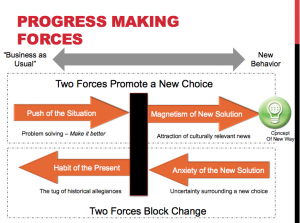
Como é que a sua empresa se está a preparar para este novo mundo?  Recordar "Push + pull + habit + anxiety" e "O que afasta os clientes".

Trechos retirados de "Idosos são consumidores fiéis e as promoções não os fazem mudar de lojas"

BTW, o texto é algo confuso: começa a sublinhar a relação dos idosos com as marcas brancas e acaba a sublinhar a relação dos idosos com as marcas próprias.

"to create an appropriate model of customer motivation "

"“Solutions come and go, but Jobs largely stay the same.”
...
the main intention of JTBD is to explain what the customer feels like they need to do to make their lives better. Zooming out reveals a more timeless struggle, but it’s vague, while zooming in is a little more granular and actionable, but also a lot more prone to modernization.
.
But the solutions we choose to help us get our jobs done come and go and vary depending on our situation.
...
JTBD is not about an individual. JTBD is about a market opportunity. ... But if there’s a market with that struggle today, it’s a pretty good bet there’s a market of people with that struggle tomorrow and a couple of years from now.
...
when we’re doing our research when we’re trying to apply the theory to innovation, we’re trying to build what I call a vector of progress. The whole idea is that we have to create an appropriate model of customer motivation that helps us predict what customers will buy in the future.
.
This thinking helps us understand what kind of data we need to gather, but also how we should model those data. Once we model those data, we can then figure out how to change the systems customers belong to. Not only that, but  we need a model that helps us change those systems in an evolutionary way. What I mean by that, is that if you don’t think in this evolutionary way, you can get too far ahead of your customers. This is what we call “out innovating” or building products that are ahead of their time."
Trechos retirados de "The North Star of an Enduring Business"

Acerca da maldição dos descontos

"said department stores have fallen back on sales promotions whenever business begins to slow.
.
Sale[s] cannot be the only driver, it has to be a part of it. But product, presentation, excitement in the stores, the salespeople in terms of servicing the customer” all need to be part of the value proposition for department stores to succeed, he said.
...
“The dilemma all department stores face is that, while they would like to wean themselves from the heavy use of promotions, they run the risk of losing their customer base as long as their competitors continue to emphasize sales promotions,” Mr. Montgomery said. “Can it be done? The answer is yes, but to do so would require repositioning themselves in the marketplace.
...
Stores fall back on discounts because discounts are simple and tend to meet short-term KPIs for the executives,” said Doug Garnett, founder and CEO of Atomic Direct. “It’s too bad because these other values [product, presentation, excitement in the stores, the salespeople …] build long-term success.”
...
“As it turns out, our recent data tells us that retailers are being run by Generation X, for Generation X,” Paula Rosenblum, managing partner at RSR Research. “So Millennials are turning out to be something like the weather — everyone talks about them, but there isn’t much anyone (besides the fast fashion guys) is doing about them.”
.
Most department stores have thrown Boomers under the bus and have expected us to respond to endless coupons and trim-fit shirts with abandon,” said Bob Phibbs, president and CEO of The Retail Doctor. “You have to earn our business — we’re not rats to the Velveeta cheese of discounts. We’re hungry for something better.”"
BTW, esta altura do ano é terrível para apanharmos o lado negro do retalho. Ontem à hora do almoço com cerca de 80 € de livros na mão desisti. A fila para pagar não era grande mas era apenas uma funcionária que fazia os embrulhos e tratava do pagamento. Para cúmulo, outra funcionária estava nas traseiras a arrumar não sei o quê. Já no feriado, numa loja Zippy estive uns 3 minutos na fila sem funcionário junto ao balcão de pagamento. Depois, lá apareceu uma funcionária muito lenta e que teve de refazer um embrulho duas vezes e tratar do pagamento. Entretanto, outra caixa estava fechada porque a outra funcionária "namorava" com amiga que estava na fila atrás de mim. Tanto esforço para atrair clientes e, depois, morrer na praia...

Trechos retirados de "Can Department Stores End Their Addiction To Discounting"

segunda-feira, dezembro 12, 2016

Curiosidade do dia


Nada que não esperássemos, os fragilistas são fáceis de perceber.
"Os juros associados às obrigações nacionais a 10 anos aproximaram-se de forma muito, muito próxima da fasquia psicológica dos 4% na sessão desta segunda-feira (tocaram nos 3,957%), estando a negociar há momentos nos 3,839%. Mas as yields nacionais subiam na generalidade dos prazos. Isto quer dizer que os investidores estão a exigir um retorno maior para deter dívida portuguesa. Mantendo-se a tendência de agravamento, da próxima vez que o Governo português for aos mercados vai pagar mais para vender a sua dívida.
.
A barreira dos 4% dos juros tinha sido identificada inicialmente como zona desconfortável para a DBRS, a agência norte-americana que mantém Portugal qualificado para o programa do BCE."


Trecho retirado de "Juros a 10 anos já estiveram resvés 4%"

O que afasta os clientes

A propósito desta figura:
Este texto "With Uber and Lyft Nearby, Rental Cars May Be Ripe for a Comeuppance" ilustra muito bem a quantidade de situações que criam ansiedade e podem afastar um cliente.
"Every time I’ve traveled since Lyft and Uber achieved near ubiquity — whether for work or pleasure, trips long or short — I’ve tried my level best to avoid renting a car. And there’s no better way to explain why than to catalog every negative feeling the industry inspires on any given itinerary."

Como é que a sua empresa se diferencia?

Recordando o exemplo do estudo sobre as PME exportadoras eslovenas e os conselhos habituais deste anónimo da província.

A diferenciação:
"A diretora de exportação da empresa [Herdmar] enaltece a atenção dedicada ao design, conseguindo que os seus produtos não sejam somente algo de corriqueiro e primem pela diferença e pelo arrojo: “O talher deixou de ser um mero utensílio para as pessoas comerem e passou a ser um objeto decorativo. Esse é um ponto diferenciador em relação aos nossos concorrentes quer nacionais, quer estrangeiros e tem sido muito apreciado. O nosso propósito foi transformar os talheres num complemento de moda na mesa”." [Moi ici: A aposta na diferenciação e subida na escala de valor para vender artigos com maior valor acrescentado potencial]
A diversificação de mercados e para mercados exigentes:
"Nos anos 80, passámos a participar em feiras internacionais e foi aí que se deu a grande entrada no campo das vendas para o exterior”.
.
Hoje, as exportações assumem uma preponderância central, sendo “em Espanha, Inglaterra, Estados Unidos ou Austrália que estão alguns dos principais parceiros”, refere Maria José Marques. No total, são 65 as nações que acolhem os produtos da Herdmar e que representam 90% do seu volume de negócios anual."
Como é que a sua empresa se diferencia? Se não se diferencia ... é pelo preço? E pode?

Trechos retirados de "Líderes nacionais na cutelaria vestem as mesas em 65 países"

"deviam aprender com estes casos da vida real"

Ontem o Aranha ligou-me a dizer que tinha de ver um programa que estava a dar no canal Travel. Na altura não podia ver televisão e, depois, confirmei que não tenho acesso ao canal Travel.

No entanto o Aranha tinha-me deixado com as coordenadas. Program "Hotel Impossible", temporada 4, episódio 12. Após uma breve pesquisa no youtube encontrei uma versão pirata aqui (perto do minuto 30).

Ao fim de pouco tempo percebi o porquê da insistência do Aranha. O episódio é sobre o caso de um hotel num bom local, um hotel arrumado e limpo, um hotel com trabalhadores dedicados ... mas um hotel que perdia dinheiro.

Uma das grandes lições que o consultor não se cansa de martelar na cabeça do gerente é: a importância do revenue management.

Outras lições que sublinho:

  • a importância do ecossistema de parceiros. Desde o catering até à rede de gente capaz de criar experiências que valorizem o hotel como destino. Como se o hotel funcionasse como uma plataforma.
  • a importância dos eventos. Uma outra forma de fazer do hotel uma plataforma, uma outra forma de aumentar a rentabilidade do hotel ainda que fugindo da função tradicional de um hotel. O que levanta a necessidade de desenvolver parcerias com entidades que possam fazer com que o hotel entre em novos ecossistemas.
Em lado nenhum se fala na necessidade de reduzir pessoal, de cortar nos custos, de aumentar a eficiência. Por todo o lado se aborda o tema do aumento da produtividade pela actuação no numerador.

Muitos académicos, jornalistas e comentadores económicos deviam aprender com estes casos da vida real.


BTW, lembram-se dos descontos nas portagens? OMG! Qual era o meu conselho em 2008?
"Como podem tornar a experiência da estadia memorável?"
Ah! Desconfio que no Algarve não havia na altura o tal ecossistema de parceiros em potência... e volto a recordar Theodor Levitte:
"Lembram-se do que Theodore Levitt  escreveu na HBR em 1960 sobre os gestores de caminhos de ferro? Pode ser dito o mesmo hoje sobre os da hotelaria."


Acerca do pricing

Um excelente apanhado de técnicas de pricing para empresas com modelo de negócio baseado na subscrição em "Improve Pricing and Revenue through Irrational Customer Behavior".

Gostei sobretudo de:
"Whenever a provider contacts customers about their current offer, customers “wake up” and think about what they are getting in return for their money. Inevitably, some customers will choose to leave, or “churn,” even if prices don’t rise. In fact, the wake-up effect is often the single largest contributor to churn—and sometimes it occurs even when prices go down or product value goes up. So if a price increase is too low, the incremental revenue from remaining customers can be insufficient to offset the loss of customers who have been “ [Moi ici: Até porque esta semana fui contactado pela Vodafone e é nesta altura que nos lembramos que o tempo de fidelização está a terminar]
E de:
"“turning the other cheek” may not seem like an effective response in a highly competitive market. It takes courage. But sometimes it is the least of all evils." 
Talvez a sua empresa possa reflectir sobre estas técnicas.

domingo, dezembro 11, 2016

Curiosidade do dia

A propósito deste texto de António Barreto, "Causas do não crescimento...", como alguém escreveu no Twitter pode ser dividido em duas partes. Uma segunda parte que sublinhamos e amplificamos aqui:
"O crescimento permanente do Estado, da respectiva despesa e em especial das despesas sociais criou mais défice e aumentou o endividamento. Para que o Estado cresça sem travão, é necessária uma fiscalidade sem abrandamento. Tudo leva a crer que esta tenha chegado a níveis insuportáveis, incompatíveis com a expansão do investimento.
...
O colossal endividamento português é o lugar geométrico das políticas públicas erradas, do crescimento ilimitado do consumo e das prestações sociais e da debilidade do capitalismo português."
E uma primeira parte que este blogue está sempre a demonstrar, com números, que é factualmente incorrecta e que não resiste a um confronto com as estatísticas. Deixemos esta primeira parte para outra altura.

Para reflexão

Resultados interessantes sobre o sucesso e o insucesso de PME exportadores eslovenas ao longo de 6 anos, sobre características de umas e outras:
"Successful exporters tend to export higher values of exports altogether and per market, and more value intensive products than unsuccessful new exporters. Unsuccessful new exporters do not change their export intensities in time, implying their lack of export intensity is one of the reasons for not being successful in the long term. Without adding new markets they were not be able to increase the value of exports per product and without broadening their product portfolio (product varieties) they were not able to increase exports per market and total exports.
...
Variety of specifications confirmed that both market as well as product differentiation have a positive and significant impact on the performance of new exporters. Market differentiation showed an even greater impact on performance.
...
Firms are heterogeneous and so are their strategies for value creation and international growth.
...
Detailed analysis of new exporters revealed that diversification has proven to be a demanding but an effective way of value creation. Taken separately, both geographical as well as product diversification are positively related to the performance of new exporters, though with diminishing returns. Next, a complex strategy with simultaneous market and product diversification is also positively related to performance. Contrary to traditional approaches that focus on a single product in a single market and slow, gradual growth, based on our observations we suggest that this strategy brings risks to creating value."

Trechos retirados de "Growth and Value Creation Through Diversified Exporting" de Andreja Jaklič, Anže Burger, Aljaž Kunčič e Desislava Dikova

Uma novela sobre Mongo (parte III)

Parte I e parte II.

Porque Mongo é tão estranho e mete medo a muita gente:
"the ability to create products that enable us to own the tools is where the economy is headed.
It’s what technology wants. It fragments down to the micro level and becomes personal. The job of the corporate hero of tomorrow is to provide a platform for customer independence.
.
The reason why it’s hard for companies to cope with this shift to micro businesses, is that it’s a multi-generational shift. Given that the dawn of the industrial revolution was in the late 1700s, and if we use 30 as an average age for a new parent (it used to be much lower), we’re living through a nine-times generational shift in lifestyle and economic understanding. This is a significant amount of indoctrination handed down from parents and employers of how things should be done and what works in this world. It’s pretty hard to unlearn all of this, especially when most of it has been proven empirically. [Moi ici: O modelo do emprego do século XX não é necessariamente a última Coca-Cola no meio do deserto, foi uma criação bem sucedida e ajustada a um certo tempo e desenvolvimento técnico-cultural. Muito provavelmente dará lugar a modelos mais assentes no empreendedorismo.]
...
The problem is that our business environment is changing quickly and the habits of large organisations are not [Moi ici: E não são só elas, é também o Estado habituado a esse modelo e todas as suas funções que dele dependem. Imaginem o impacte de algo deste tipo nas escolas, por exemplo, sem a protecção do Estado]. They prefer all replacement staff to have the same industry experience, the same education, the same previous job title, the same customer experience, and experience in the same channels of distribution, which is essentially a risk-reduction strategy for the hiring manager if things turn out badly rather than a growth strategy for the organisation. It’s not surprising, given that the primary role in large organisations is to protect against the financial downside rather than chase a revenue upside. This course of action works as long as the business and technology environments remain stable. The problem is that our business environment is changing quickly and the habits of large organisations are not."


Trechos retirados de "The Great Fragmentation : why the future of business is small" de Steve Sammartino.

"já não precisamos da vossa ajuda"

A propósito de "China’s rust belt faces exodus of young talent" talvez alguns possam finalmente deixar de pensar nos trabalhadores chineses como escravos.

A propósito de "The Experience Economy with Chinese Characteristics" talvez alguns possam finalmente deixar de pensar no comércio internacional como um jogo de soma nula.
"The number of affluent Chinese consumers is set to grow. According to McKinsey, by 2022 over 700 million Chinese urbanites will have a middle-class purchasing power similar to that of the Italian middle-class consumer. These new consumers will continue to search overseas for the authentic shopping experiences their income stratum desires."
Faz-me uma confusão que tanta e tanta gente tenha estado calada enquanto a China foi uma concorrente directa das nossas PME, elegendo o euro como o culpado e, agora que já estamos a um outro nível do jogo e a China é, cada vez mais um mercado cliente do que um concorrente, é que aparecem uns cromos muito preocupados com os postos de trabalho na indústria.

Obrigado pela preocupação, já não precisamos da vossa ajuda. Voltem para os vossos gabinetes e não atrapalhem.

Para reflexão

"Was increased trade with China really pushing U.S. companies to become more innovative? For manufacturers, at least, they found that the answer was no. In fact, the relationship went in the opposite direction: U.S. manufacturers exposed to competition from Chinese imports became far less innovative."
Agora imaginem a frase aplicada às PME portuguesas em sectores tradicionais fortemente afectados pela entrada da China no mercado:
"Was increased trade with China really pushing Portuguese companies to become more innovative? For manufacturers, at least, they found that the answer was yes. In fact, the relationship went in that direction: Portuguese manufacturers exposed to competition from Chinese imports became far more innovative."
Um tipo lê as conclusões destes papers:
"The first takeaway from this paper is that more competition, from trade or otherwise, doesn’t necessarily lead to more innovation. While competition can force firms to innovate to fend off rivals, it can also cut profit margins, leaving companies with less to invest in research and development." 
E fica a pensar seriamente na experiência destes autores...  só devem estudar estatísticas, não devem sair das suas torres de marfim.

Voltando a Portugal, basta pensar no calçado ... lembram-se da empresa que deixou de conseguir vender sapatos a 20 euros e passou a vende-los a 230 euros?

Recordando a Austrália e a introdução de raposas para caçar os coelhos que tinham sido introduzidos anteriormente e eram uma praga sem predadores.

Trechos retirados de "Did Trade with China Make U.S. Manufacturing Less Innovative?"

sábado, dezembro 10, 2016

Curiosidade do dia

No twitter:
É isto, não saímos disto:
"O que se pede não é uma nova oportunidade para passar a fazer as coisas bem feitas. O que se quer é um esquema para perpetuar a nossa estranha forma de vida: os outros que paguem a nossa dívida e os encargos com os nossos públicos eleitorais.
...
A discussão sobre a sustentabilidade e eventual reestruturação da nossa dívida faz lembrar a história do jovem que mata os pais e depois vai a tribunal pedir clemência pelo facto de ser órfão.
...
O que tristemente não se vê, da parte dos mais acérrimos defensores da reestruturação da dívida, é a mínima vontade de tornar o Estado sustentável para que não se voltem a fazer novas dívidas."

Trechos retirados de "A dívida como modo de vida"

Um anónimo da província fica todo inchado (parte II)

Parte I.

Depois da leitura de "Everything we thought we knew about free trade is wrong" fica algum desapontamento.

Um longo texto que podia ser assinado por Francisco Louçã, passa 96% do tempo a culpar o comércio livre pelos problemas da economia americana para, no fim, rematar com:
"So does that mean that Trump is right in his anti-free trade crusade? No, says Dani Rodrik, economist at Harvard University.
.
“Trump is correct about the malaise that lower and middle class voters feel, but I cannot think of a single trade policy of his that I agree with. He is deluded in thinking that he can bring manufacturing jobs back to the US by changing trade policies,” Rodrik says. “And his belligerent, unilateralist tone on trade policy will do more harm than good.”
.
In this sense, Ricardian analysis is right: The jobs America lost in the last half-century would inevitably have been shed due to comparative advantage, as US productivity climbed. To bring them back now would cost the US economy enormously."
Outra incoerência ou falha do texto e que choca com a minha interpretação para o fenómeno, descrita na parte I, é esta:
"“What Ricardo imagined was you could easily move the capital from one country to another, and you simply can’t do it,” Keen says. “You can’t take a spinning jenny and wave a Harry Potter wand over it and get a wine press out of it. It’s simply nonsense.”" 
 Mas é isso precisamente o que acontece, é isso que provoca o desaparecimento das indústrias e impede a subida na escala de valor. Foi o capital chinês e os empresários chineses que criaram a "fábrica do mundo"? Nope!
A China tinha o ambiente e a mão-de-obra, o capital fluiu livre e facilmente dos EUA para a China. Capital e atenção empatado na China não tinha nem tempo nem necessidade de pensar em subir na escala de valor para fazer face à China porque a China era dos donos do capital. Apetece dizer Duh!!!

É como se no exemplo inicial de Ricardo, os detentores de capital inglês tivesse abandonado Inglaterra e viajado para Portugal para produzir vinhos e tecidos.

Onde é que a autora podia ter feito uma investigação mais cuidada?

Depois de escrever:
"Comparative advantage offers a great description of how the market will shift around countries’ finite resources as they respond to the cheapening of production abroad. But, says Keen, it tells us very little about what economies must do to keep growing. And as Baker points out, next to nothing about how to actually improve people’s living standards."
Devia estudar exemplos como o alemão, como o português e até americanos como o da Marlin, para perceber como sectores tradicionais conseguem subir na escala de valor.

A mentalidade da tríade, que só acredita no eficientismo, é mais culpada pela situação americana do que o comércio livre.


BTW, as acusações de manipulação do câmbio são de rir. Quem estiver inocente que atire a primeira pedra.


"como antropólogo invisível"

Quem acompanha este blogue sabe o que leio, reflicto e escrevo sobre temas como: jobs to be done, service-dominant logic, interacção, co-criação e customer-centric, só para nomear alguns temas.

Estudo-os, penso neles e tento aplicar o que posso e julgo fazer sentido nas empresas com que trabalho. Faço-o porque acredito que são mais do que mambo-jambo de consultor para enganar empresas.

Confesso que fico algo chocado quando, como antropólogo invisível, entro num bar repleto de comerciais e marketeiros honestos e trabalhadores e a trabalhar em empresas com nome e só oiço uma coisa: empurrar, empurrar, empurrar os produtos que produzimos.

"Align Prices with Value by Segment"

"Narrow your customer groups as tightly as possible. Segment them by how profitable they are now, by their willingness to pay, for the extras they request and more. Each transaction represents a different buying situation and therefore a different value proposition. Group these customers by the deal elements they value, and then dedicate a monetary price to these value propositions. Consider shipping rates, support fees, discounts, and allowances as potential value drivers.
.
During this process, you’ll find plenty of opportunities to raise prices for a handful of your smaller segments.
...
If (and let’s be honest when) customers balk at your effort to raise prices, your sales team won’t persuade them to pay up by just listing your product or service features. They need to explain why your customers need the products and/or services and what they get out of them. They have to sell on value.
.
You already know what your customers value from segmenting them during the pricing strategy process. It’s time to put that knowledge to good use during the sales process. As value propositions resonate different from customer to customer, so should your sales strategy."[Moi ici: Na sequência de uma auditoria recente a um departamento comercial fiquei a matutar nas eventuais vantagens e problemas da empresa ter comerciais não por áreas geográficas mas por segmentos de clientes]
Trechos retirados de "3 Ways to Raise Prices: The Grand Slam of Your Pricing Strategy"

Imaginem que o PS estava na oposição (parte II)

Parte I.

Mantendo a coerência da minha análise, o que me apraz dizer sobre as exportações de bens do ano até Outubro:

Vamos ao meu critério:
Outubro foi realmente pior para as PME apesar de 2016 continuar a ser um bom ano em termos de exportações de bens pelas empresas anónimas deste país e menos dependentes do Estado e das suas elites de tanga.

Um retrato do crescimento de alguns sectores:
Impressionante o crescimento agrícola, os produtos farmacêuticos, o vestuário de malha e as máquinas. Lá estão os F16 também.


sexta-feira, dezembro 09, 2016

Curiosidade do dia

"A política não é só a arte do possível, também é a arte de usar a evidência do impossível para reconduzir as sociedades e os sistemas políticos ao reconhecimento do possível. Quando os sistemas políticos ficam confrontados com um abismo que se abriu subitamente à sua frente - porque é disso que se trata quando o poder hegemónico que estruturava a ordem mundial existente renuncia à sua responsabilidade -, terão de se servir do impossível para tentar voltar ao possível."
Trecho retirado de "2016 - Fim de uma estrutura de ordem"