"Repainting your house the same color it already was feels like a waste. It's a lot of effort merely to keep things as they are.Trecho retirado de "The unfairness (and wisdom) of paint"
.
But if you don't do it, time and entropy kick in and the house starts to fade.
.
The same can be said for 1,000 elements of your organization, including your relationships with customers, staff, suppliers and technology. The way you approach your market, the skill you bring to your craft, the culture in your organization—it constantly needs another coat of paint.
.
Rust never sleeps."
segunda-feira, maio 01, 2017
Para reflexão

"nenhum treinador é pau para toda a obra"
Há tempos tive esta troca de tweets:
Que recordei ao acabar de ler "As virtudes do trabalho integrado":
Só encostadas à parede é que algumas empresas, só algumas mesmo assim, se libertam dos hábitos antigos e constroem uma nova hipótese de trabalho.
Por isto, é sinal de alguma ignorância aparecer e afirmar em abstracto que o futuro de uma empresa passa pela inovação e valor acrescentado sem ter em conta o seu passado.
@agodinholuz há uma frase venenosa no texto. Frase q ilustra q o q reina é a quantidade ñ o valor acrescentado. Pena pq têm potencial para mais pic.twitter.com/Ot70qHAt7b— Carlos P da Cruz (@ccz1) April 24, 2017
@agodinholuz novos comerciais, enfim, novo modelo de negócio. têm dificuldade em mergulhar no novo mundo do valor— Carlos P da Cruz (@ccz1) April 24, 2017
Que recordei ao acabar de ler "As virtudes do trabalho integrado":
"Mas o que os dirigentes têm de entender é que nenhum treinador é pau para toda a obra, que as hipóteses de sucesso crescem sempre que um clube pensa o seu futebol de uma forma integrada, na qual as ideias de uns coincidem com as ideias dos outros e as práticas têm que ver com as ideias de ambos. Quando isso acontece, tudo fica mais simples."Por isto, é muito difícil uma empresa fazer a transição, o abandono de um modelo que resultou mas se tornou obsoleto.
Só encostadas à parede é que algumas empresas, só algumas mesmo assim, se libertam dos hábitos antigos e constroem uma nova hipótese de trabalho.
Por isto, é sinal de alguma ignorância aparecer e afirmar em abstracto que o futuro de uma empresa passa pela inovação e valor acrescentado sem ter em conta o seu passado.
domingo, abril 30, 2017


Antes da proposta de valor
"Before focusing on the value proposition and the other elements of a business model, it is very important to get a deep insight and holistic understanding of the customers' world, their contexts, activities and experiences. In this block, the customers' explicit and latent reasons for buying and the benefits that the customer desires are analyzed. The questions to be answered include:E volto à figura do ovo e da galinha...
- How do we get a deep insight and holistic understanding of the customer's world, their future strategies, and their own customers' world?
- Why does the customer buy?
- What kind of benefits (functional, economic, emotional, social, ethical, environmental, symbolic) does the customer desire?"

Também proponho às PME que comecem por identificar os clientes-alvo antes de pensar na proposta de valor. No entanto, antes de identificar os clientes-alvo recomendo que se faça o recenseamento do que se tem. Uma PME tem de partir daquilo que tem, daquilo que pode funcionar como um ponto forte, daquilo que pode servir de alicerce para a construção de um modelo de negócio.
Trecho inicial retirado daqui.
Ecossistemas de serviço
"As one zooms out from dyadic interactions and discreet transactions, the first thing noticed is that these dyadic interactions do not take place in isolation, but rather within networks of actors, of which the dyad is just a part. These networks can be seen at various levels of aggregation (e.g., macro, meso, micro). Structurally then, these networks reflect what S-D logic captures axiomatically in the resource-integration specification of Axiom 3 [All social and economic actors are resource integrators]. Likewise, they emphasize that the benefit (value) realized by a beneficiary (e.g., a “customer”) does not occur in isolation either, but rather through integration of the resources from many sources, [Moi ici: Recordar o objectivo de maximizar a criação de valor a nível do ecossistema, "The market is a goal collective"] thus best understood as holistic experiences (FP9/Axiom3 and FP10/Axiom4).[Value is always uniquely and phenomenologically determined by the beneficiary]
At first glance, it might appear that there is little new here, just the acknowledgement that service provision, value cocreation and value realization take place in networks, ... However, the S-D logic framework adds several key characteristics that are not in all cases typical of these network conceptualizations. Most obvious among these is that the connections represent service-for-service exchange, rather than just connections of resources, people, or product flows; thus, in S-D logic, network actors are linked by common, dynamic processes (service provision). Second, the actors are defined not only in terms of this service provision (resources applied for benefit) but also in terms of the resource-integration activities that the service exchange affords. Finally, the network has a purpose, not in the sense of collective intent but rather in the sense of individual survival/wellbeing, as a partial function of collective wellbeing."
Trecho retirado de "Service-dominant logic 2025"
Qual é a distribuição?
Uma forma interessante de analisar um setor de actividade e a sua cadeia de fornecimento (ecossistema):
 Quem é que emergiu e teve uma década seguinte de sonho?
E na cadeia de fornecimento em que a sua empresa participa, qual é a distribuição?
Imagem retirada de "If You're in a Dogfight, Become a Cat!: Strategies for Long-Term Growth"

E na cadeia de fornecimento em que a sua empresa participa, qual é a distribuição?
Imagem retirada de "If You're in a Dogfight, Become a Cat!: Strategies for Long-Term Growth"
Pensa que só acontece aos outros?
"Aon's 2107 Global Risk Management survey has revealed a host of daunting challenges driven by today’s divisive and yet interdependent environment. The report focuses on the elected Top 10 risks for detailed discussion, one of the perennial highlights:

...
cyber risk stands out as another illustration of the influence of news events on risk perception.
...
cyber crimes have evolved from stealing personal information and credit cards to staging coordinated attacks on critical infrastructures. ... Cyber threat has now joined a long roster of traditional causes—such as fire, flood and strikes that can trigger business interruptions because cyber attacks cause electric outages, shut down assembly lines, block customers from placing orders, and break the equipment that companies rely on to run their businesses."
Nem de propósito, este exemplo, "Hacker rouba série da Netflix: “Ou pagam o resgate ou ponho tudo na Internet”":
"A empresa já reagiu e reconheceu que uma pequena produtora com sede em Los Gatos, na Califórnia, que trabalha com vários dos grandes estúdios de televisão, foi alvo de um ataque cibernético. De acordo com o serviço de streaming, o FBI e outras autoridades já estarão a investigar o caso."Pensa que só acontece aos outros?
sábado, abril 29, 2017
Curiosidade do dia
"Os portugueses não são avessos à liberdade por desconhecerem os respectivos benefícios. Os portugueses são avessos à liberdade por conhecerem as respectivas desvantagens – e as vantagens da atitude oposta. Na medida em que deposita o destino nas mãos de cada um, a liberdade implica responsabilidade, risco e uma trabalheira desgraçada, em suma exactamente aquilo que o português evita, ou procura evitar, ao roçar-se diligentemente no Estado."Trecho retirado de "Não me levem a mal, mas não haverá revolução liberal"
"when we have these resources in excess, we don’t become efficient"
Em "Expose Your Constraints Before Chasing Additional Resources" encontro um excelente texto não só aplicável a startups mas também a empresas em sectores tradicionais.
Numa outra onda, recordo o empresário que recentemente defendeu que é tempo da sua empresa deixar de estar viciada em stress e começar a investir em recursos humanos e não só.
E como não recordar os keynesianos e outros degenerados que defendem que a produção cria a sua própria procura...
"We all hustle, struggle, and fight to acquire more resources for our projects. But ironically, when we have these resources in excess, we don’t become efficient. We become wasteful.Como não pensar na moda corrente de dinheiro público ser despejado em ideias que ainda andam à procura de product-market fit.
.
Much has been written about how by limiting choices, constraints force the requisite creativity needed to innovate.
...
Constraints force the requisite focus needed to innovate."
Numa outra onda, recordo o empresário que recentemente defendeu que é tempo da sua empresa deixar de estar viciada em stress e começar a investir em recursos humanos e não só.
E como não recordar os keynesianos e outros degenerados que defendem que a produção cria a sua própria procura...
"Harness Immediate Benefits to Increase Your Persistence"
"The importance of delaying gratification is universally recognized. Being able to forgo immediate benefits in order to achieve larger goals in the future is viewed as a key skill.Algo que me faz recuar ao final do século passado e à descoberta em 1992 na HBR, no mesmo número que apresentou o primeiro artigo sobre o balanced scorecard, do autor Robert Schaffer:
...
But wouldn’t immediate benefits also help us follow through on our long-term goals?
...
We found that enjoyment predicted people’s goal persistence two months after setting the goal far more than how important they rated their goal to be.
.
Yet people overestimated how much delayed benefits influenced their goal persistence. When we asked people what would help them stick with their goal in the upcoming months, they believed both immediate and delayed benefits—enjoyment and importance—mattered for their success. In actuality, delayed benefits had less influence on persistence; they mainly played a role in setting the goal in the first place.
.
We found this pattern—immediate benefits are a stronger predictor of persistence than delayed benefits—across a range of goals, in areas including fitness, nutrition, and education.
...
Harness Immediate Benefits to Increase Your Persistence
...
First, factor in enjoyment when choosing which activity to pursue to achieve your goals.
...
Second, give yourself more immediate benefits as you pursue long-term goals.
...
Third, reflect on the immediate benefits you get while working toward your goal."
- A dança da chuva e outros rituais (Julho de 2006)
- Small Wins (Junho de 2009)
- Uma sucessão de pequenos projectos que produzem resultados rapidamente (Dezembro de 2012)
Escolher desafios relevantes e alinhados com a estratégia e desdobrá-los em vários projectos mais pequenos que não só reduzem o tempo para obter resultados como o tempo para obter feedback.
Trechos retirados de "What Separates Goals We Achieve from Goals We Don’t"
O típico para as nossas PME
O típico para as nossas PME:
Segundo trecho retirados de "A revolução das malhas na TMG"
"Conhecida pela marca ROQ, a empresa constrói máquinas customizadas e de alta performance e precisão para a indústria têxtil, com recurso a tecnologia de ponta, nas áreas do corte a laser e da quinagem."E ainda:
"Aqui conseguimos fazer amostras no tempo que eles pretendem – às vezes temos de fazer amostras em três, quatro dias e em malhas não é fácil. Mas é a amostra que vai trazer o cliente e isso diferencia-nos»"Primeiro trecho retirado de "ROQ reforça liderança mundial e cria mais 31 empregos em Famalicão"
Segundo trecho retirados de "A revolução das malhas na TMG"
sexta-feira, abril 28, 2017
Curiosidade do dia
Excelentes noticias: O desemprego já está abaixo dos 10% (@pt_INE). Quem esteve contra a reforma laboral de 2012 deve estar arrependido pic.twitter.com/OdIg7K5AVI— Alvaro SantosPereira (@santospereira_a) April 28, 2017
Volume is vanity, Profit is sanity
"Market leadership is even more precarious. The percentage of companies falling out of the top three rankings in their industry increased from 2% in 1960 to 14% in 2008. What’s more, market leadership is proving to be an increasingly dubious prize: The once strong correlation between profitability and industry share is now almost nonexistent in some sectors. According to our calculation, the probability that the market share leader is also the profitability leader declined from 34% in 1950 to just 7% in 2007. And it has become virtually impossible for some executives even to clearly identify in what industry and with which companies they’re competing."
Como não recordar o clássico "Manage For Profit, Not For Market Share: A Guide to Greater Profits In Highly Contested Markets"
Trecho retirado de "Adaptability: The New Competitive Advantage"
"People buy products for one reason only"
This simple principle has changed the way I view product design: pic.twitter.com/HxNgZNgKFf— Justin Jackson (@mijustin) April 26, 2017
Produtividade para o século XXI (parte V)
Parte I, parte II, parte III e parte IV


O artigo é de 2004, descobri-o em 2011.
Continua.
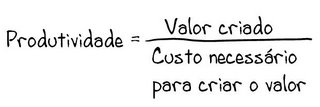
"the only theoretically correct and practically relevant approach to measuring service productivity seems to be to base productivity calculations on financial measures. In principle, the correct way of measuring service productivity as a function of cost effects of internal efficiency, revenue effects of external efficiency and cost and revenue effects of capacity efficiency is, therefore, the following measure:

As a global productivity measure of the operations of a service provider, the following measure can be used:

the productivity of service processes can be measured as the ratio between revenues and costs. This is a true measurement of service productivity. If revenues increase more than costs, productivity goes up. On the other hand, if a cost reduction leads to lost revenues, but the decline in revenues is less than the cost savings that have been achieved, productivity still improves. However, this may be a less recommendable strategy because in the long run it may lead to a negative image and unfavorable word of mouth, which can have a further negative effect on revenues. Thus, cost reductions may lead to a bigger drop in revenues than the savings on the cost side. If this is the case, in the long run service productivity declines."A equação que uso há anos, talvez desde 2007.
O artigo é de 2004, descobri-o em 2011.
Continua.
Onde trabalhar?
Excelente figura:

Valor é criado quando uma empresa consegue criar uma oferta em que a willingness to pay (WTP) supera o cost to serve (CTS). A diferença entre o WTP e o CTS define a dimensão do valor criado. valor esse que terá de ser dividido entre o cliente e o produtor.
Tal como na figura, a vantagem competitiva de uma empresa pode ser uma função de conseguir fornecer o mercado com custos mais baixos, ou uma WTP superior ou uma mistura de ambas.
Infelizmente, muitas PME contentam-se em trabalhar na zona A muito mais do que na zona B (se soubessem o que aprendi com Marn e Rosiello naquele mês de Janeiro de 1992, na verdade só aprendi mais tarde - nunca é tarde para aprender, ás vezes é demasiado cedo)

Continua.
Trecho e imagem retirada de "If You're in a Dogfight, Become a Cat!: Strategies for Long-Term Growth"

Valor é criado quando uma empresa consegue criar uma oferta em que a willingness to pay (WTP) supera o cost to serve (CTS). A diferença entre o WTP e o CTS define a dimensão do valor criado. valor esse que terá de ser dividido entre o cliente e o produtor.
Tal como na figura, a vantagem competitiva de uma empresa pode ser uma função de conseguir fornecer o mercado com custos mais baixos, ou uma WTP superior ou uma mistura de ambas.
Infelizmente, muitas PME contentam-se em trabalhar na zona A muito mais do que na zona B (se soubessem o que aprendi com Marn e Rosiello naquele mês de Janeiro de 1992, na verdade só aprendi mais tarde - nunca é tarde para aprender, ás vezes é demasiado cedo)

"Where does price fit in? As shown in the right-hand panel of figure 5.2, companies can choose to price their products anywhere between WTP and CTS. This is a strategic decision that reflects how a company wants to divide the product value between itself and its customers. Consumers benefit from lower prices by enjoying a higher consumer surplus, the difference between what a consumer is willing to pay for a product and the actual price charged. High consumer surpluses spur sales, increasing growth and customer satisfaction. Producer surplus is an equivalent concept from the opposite perspective—the difference between the price a company charges and its unit cost. Obviously, companies that enjoy a competitive advantage in the marketplace have more pricing flexibility when choosing how to allocate value between the company and consumers."A não ser que uma empresa queira ser o fornecedor com o custo mais baixo o truque é trabalhar para aumentar o WTP, trabalhar na zona B.
Continua.
Trecho e imagem retirada de "If You're in a Dogfight, Become a Cat!: Strategies for Long-Term Growth"
quinta-feira, abril 27, 2017
Curiosidade do dia
A 5 de Abril de 2017 escrevi:
Hoje, 27 de Abril o mesmo governo volta a aparecer na capa do Público com:

E Santana Lopes é que fazia trapalhadas...
Como não recordar o 1º Princípio de Deming:
"Ontem ao ler "Costa garante: Malparado não vai fazer “nascer um banco mau”" lembrei-me logo de "Costa quer tirar 'lixo' dos bancos. E passá-lo para um 'banco mau'"".
Hoje, 27 de Abril o mesmo governo volta a aparecer na capa do Público com:

E Santana Lopes é que fazia trapalhadas...
Como não recordar o 1º Princípio de Deming:
Constância de propósito
"Pricing is a game"

"Pricing is a game – one with asymmetric and imperfect information. So what does this mean for you? Basically, you’re very unlikely to nail pricing the first time. And even if you do come close, you’ll have to adjust as your product and market mature.Trechos e imagem retirados de "Want to Nail Pricing? Understand Market Dynamics First."
...
Price elasticity of demand is the basic economic insight that price influences demand and that in most cases (with the exception of certain luxury goods) demand will increase as the price goes down.
...
Cross-price elasticity is the tendency of customers to switch vendors (or products from the same vendor) in response to price changes. In some markets, there are well understood alternatives and when the price of one increases some customers will abandon it for the alternative."
Clareza estratégica
"To put the issue of strategic clarity in context, let's start by defining terms. Figure 5.1 illustrates the four hierarchical elements required to formulate and execute effective business strategy. The starting point is a set of overarching goals that establish a company's long-run intent and management priorities. ... A company's stated goals identify the broad boundaries of business scope and the areas of business activity and performance of greatest concern to management, e.g., consumer satisfaction, employee safety and welfare, shareholder value, and sustainable business practices.

...Pessoalmente trabalho com outra versão daquela hierarquia:
A company's strategy describes how it plans to meet its stated objectives. Strategy is all about making choices, and a company's strategy guides which market opportunities to pursue, which products to create, which distribution channels to exploit, and which business partnerships to form. Strategic choices to ignore certain opportunities are just as important as actionable commitments."


Trechos e imagem retirados de "If You're in a Dogfight, Become a Cat!: Strategies for Long-Term Growth"
Subscrever:
Mensagens (Atom)
%2006.21.jpeg)