“I recommend that the Statue of Liberty on the East Coast be supplemented by a Statue of Responsiblity on the West Coast.”Depois, a culpa é do euro.
Frase atribuída a Viktor Frankl

“I recommend that the Statue of Liberty on the East Coast be supplemented by a Statue of Responsiblity on the West Coast.”Depois, a culpa é do euro.
"of all the bad things that happened to people in hospitals, the one that most preoccupied Redelmeier was clinical misjudgment. Doctors and nurses were human, too. They sometimes failed to see that the information patients offered them was unreliable—for instance, patients often said that they were feeling better, and might indeed believe themselves to be improving, when they had experienced no real change in their condition. Doctors tended to pay attention mainly to what they were asked to pay attention to, and to miss some bigger picture. [Moi ici: Recordar Pre-suasion e a importância desmesurada daquilo a que se chama a atenção] They sometimes failed to notice what they were not directly assigned to notice."
"Our research into business model innovation in Asia uncovered two distinct, yet overlapping, waves of innovation: one decades old and still going, and one that ... is evolving now.
...
The first wave, as we call it, primarily exploited differences in labor and other input costs between developed and developing markets. By contrast, the second wave is driven primarily by business model innovation and typically leverages new technology. [Moi ici: Em tom quasi irónico direi que apostam em dumping legislativo. Sociedades mais abertas à mudança e com menos direitos adquiridos pelos incumbentes] These companies are characterized by extensive and often radical reconfigurations of the profit formula, resources, processes, and relationships within a broader stakeholder ecosystem.
...
The first wave of innovation from emerging markets in Asia has been predicated on the replication of existing business models at lower cost. As the model has evolved, it has become increasingly sophisticated,
...
Nonetheless, we believe the second wave could be even more disruptive than the first wave was. There are three reasons why, all of which reveal the ability of second-wave companies to achieve scale while remaining nimble.
.
The first reason is that second-wave companies fundamentally reimagine various facets of the business model. The second is that second-wave companies find new, often digitally enabled, ways in which resources and processes can be leveraged, ... The third is that second-wave companies identify creative ways for partners, stakeholders, and customers to be involved in value creation and capture, [Moi ici: Co-criação e ecossistemas]
...
If you want to reimagine your own business model, the first step is challenging the fundamental assumptions about what it means to be a business, employee, partner, or customer."
"dois adultos, (de boa-fé acrescentava eu, perante os mesmos factos chegam às mesmas conclusões"

"Imagine that you are in a café enjoying a cup of coffee. At the table directly in front of you, a man and a woman are deciding which movie to see that evening. After a few minutes, they settle on one of the options and set off to the theater. As they leave, you notice that one of your friends had been sitting at the table behind them. Your friend sees you, joins you, and remarks on the couple’s movie conversation, saying, “It’s always just one person who drives the decision in those kinds of debates, isn’t it?” You laugh and nod because you noticed that too: although the man was trying to be diplomatic about it, he clearly was the one who determined the couple’s movie choice. Your amusement disappears, though, when your friend observes, “She sounded sweet, but she just pushed until she got her way.”O que pensar dos programas sobre repetição de imagens de lances polémicos no futebol?
.
Dr. Shelley Taylor, a social psychologist at the University of California at Los Angeles (UCLA), knows why you and your friend could have heard the same conversation but come to opposite judgments about who determined the end result. It was a small accident of seating arrangements: you were positioned to observe the exchange over the shoulder of the woman, making the man more visible and salient, while your friend had the reverse point of view. Taylor and her colleagues conducted a series of experiments in which observers watched and listened to conversations that had been scripted carefully so that neither discussion partner contributed more than the other. Some observers watched from a perspective that allowed them to see the face of one the parties over the shoulder of the other, while other observers saw both faces from the side, equally. All the observers were then asked to judge who had more influence in the discussion, based on tone, content, and direction. The outcomes were always the same: whomever’s face was more visible was judged to be more causal.
...
No matter what they tried, the researchers couldn’t stop observers from presuming that the causal agent in the interaction they’d witnessed was the one whose face was most visible to them. They were astonished to see it appear in “practically unmovable” and “automatic” form, even when the conversation topic was personally important to the observers; even when the observers were distracted by the researchers; even when the observers experienced a long delay before judging the discussants; and even when the observers expected to have to communicate their judgments to other people. What’s more, not only did this pattern emerge whether the judges were male or female, but also it appeared whether the conversations were viewed in person or on videotape."

"My clients and students assume that competitors should surprise one another with their strategies. Your competitors, they think, should have no idea what you’re going to do.BTW, estratégia e táctica são coisas distintas e imprevisibilidade não é o mesmo que segredo.
.
I predict many of you will say: Of course. Being unpredictable is a competitive advantage.
.
Not so fast.
.
Keeping secrets can protect competitive advantage.
.
But secrecy is not the same thing as unpredictability. Secrecy creates an incentive to invest in assets, especially intellectual ones. Unpredictability bluffs, postures, and palters to gain advantage through uncertainty and misdirection. Unpredictability can put another party off-balance. It can confuse them, cloud their thinking, cause them to waste time and effort, and trick them into making a mistake.
.
There are times when, at least in theory, the potential benefits of unpredictability can exceed its costs. But in my experience with competitive strategy in the real world, they aren’t common.
...
In business, the opposite of unpredictable isn’t predictable. The opposite of unpredictable is strategic.
...
becoming unpredictable required abandoning a major opportunity: the opportunity to lead.
...
I mean “lead” in the sense of shaping events, of taking initiative, of showing not-a-chicken commitment. You lead by influencing others, even, maybe especially, if they are not your friends. You may lead well or you may lead badly, but unpredictability does not lead at all.
...
Leadership lets you choose the game to play and shape how you play it. If you don’t, someone else will."

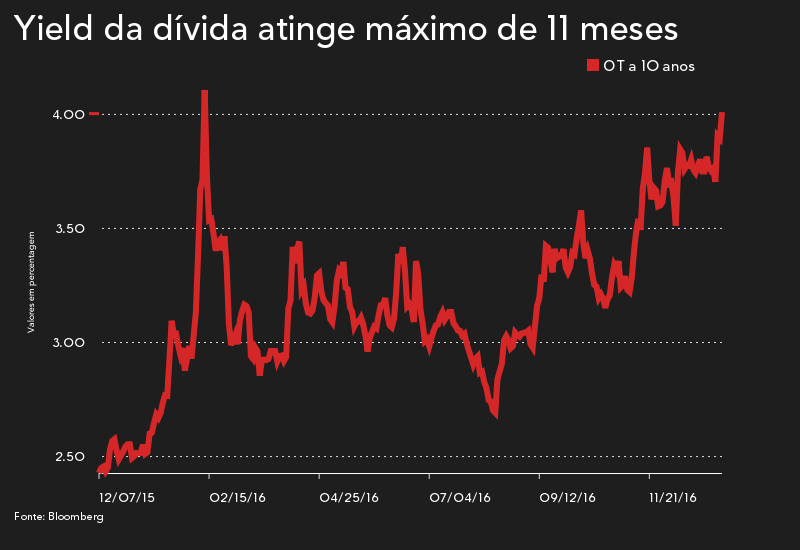
"Os juros da dívida a 10 anos ultrapassaram os 4%. O problema não está num facto como este, que até pode ser isolado e pouco duradouro. A questão está quando se olha para a tendência. E esta não se vê por um dia, uma semana ou mesmo um mês. É um facto que no último ano os juros que os investidores exigem para comprarem dívida pública portuguesa tem subido de forma regular e, aparentemente, sustentada. A subida é generalizada e uniforme na zona euro? Não. E esse é o segundo sinal preocupante para Portugal. O diferencial de juros entre a dívida portuguesa e as alemã e espanhola alargou-se nos últimos meses. Isto significa que mesmo quando uma parte das razões para a subida dos juros vem de fora, o impacto percebido pelos investidores em cada economia é diferenciado. Por exemplo, os efeitos da política económica que se adivinha venha a ser a de Donald Trump serão maiores e mais negativos em Portugal do que noutras economias. Porquê? Porque o país baixou o défice mas não a dívida, porque a economia não sai da anemia e até está a crescer menos do que em 2015, porque o investimento não arranca, porque há muitas políticas que são olhadas com desconfiança e recuos incompreensíveis em algumas medidas. Isto apesar do défice mais baixo da democracia – mas que não deixa de ser um défice e, por isso, gerador de mais dívidaTrechos retirados de "Era uma vez um país sem custo para os contribuintes…"
...
Porque 2010 está demasiado vivo na nossa memória, sabemos que o problema começa quando nos tornamos no primeiro sítio de onde os credores querem sair quando o circo começa a arder. É isso que faz de nós o elo mais fraco. E é contra isso que, nesta fase, já pouco podemos fazer. O que será, será."
"For most of the industrial era the only option for having goods and services was to own them. If we wanted to have anything, we had to buy it. This was also the way industrial society was set up. It moved society away from the traditional ideas of shared resources into consumption silo mode. The industrial era made many things affordable for the first time. The rational choice was to purchase and own, so we accumulated goods and stored them at home for when they were needed. Being able to have everything we needed, and places to store it all (fridges, cupboards, spare rooms and garages), reduced a lot of the friction that existed before industrial communities came into being and resources were shared.Depois, à hora do almoço encontrei "The Original Sharing Economy" e fiquei a pensar no potencial do modelo de negócio da Sharing Depot.
...
Much of the friction of sharing is now coming back out of the commercial system. While vehicles gave us access to vast geography on demand, the internet is giving us access to vast information, entertainment and even physical goods on demand. Many of the things we had no choice but to buy if we wanted access to them are changing the way they come to market. Increasingly, we have an option to buy or to simply access an asset on demand. We are choosing the latter."

"It is rousing and worrisome (depending on whether you are playing offense or defense) to recognize that these persuasive outcomes can flow from attention- shifting techniques so slight as to go unrecognized as agents of change.Que acham disto?
...
[Moi ici: A estória que se segue é deliciosa] Suppose you’ve started an online furniture store that specializes in various types of sofas. Some are attractive to customers because of their comfort and others because of their price. Is there anything you can think to do that would incline visitors to your website to focus on the feature of comfort and, consequently, to prefer to make a sofa purchase that prioritized it over cost?
...
In an article largely overlooked since it was published in 2002, they described how they were able to draw website visitors’ attention to the goal of comfort merely by placing fluffy clouds on the background wallpaper of the site’s landing page. That maneuver led those visitors to assign elevated levels of importance to comfort when asked what they were looking for in a sofa. Those same visitors also became more likely to search the site for information about the comfort features of the sofas in stock and, most notably, to choose a more comfortable (and more costly) sofa as their preferred purchase.
.
To make sure their results were due to the landing page wallpaper and not to some general human preference for comfort, Mandel and Johnson reversed their procedure for other visitors, who saw wallpaper that pulled their attention to the goal of economy by depicting pennies instead of clouds. These visitors assigned greater levels of importance to price, searched the site primarily for cost information, and preferred an inexpensive sofa. Remarkably, despite having their importance ratings, search behavior, and buying preferences all altered pre-suasively by the landing page wallpaper, when questioned afterward, most participants refused to believe that the depicted clouds or pennies had affected them in any way."
"É nossa missão oferecer serviços, a um preço justo e ..."O primeiro tópico a que chamam a atenção é ... o preço! No entanto, nos testemunhos sobre o que fazem e para quem aparecem nomes ligados ao segmento do luxo.
"Creativity is a surprising process. Left unchecked, too much application of prior knowledge can stifle innovation and hinder creative work. "Not knowing" can be your most important asset if you can use it to your advantage. Without placing importance on not knowing, you run the risk of damaging the integrity of your creative work with your own bias.Quando falo da tríade, falo de supostos conhecedores, gurus, sábios que tudo sabem e prevêem que vem aí o diabo e que as PME portuguesas não têm futuro sem o escudo. Afinal não passam de Muggles.
...
Real creativity is a revision in progress, always. It proceeds in fits and starts of ignorance. Creative professionals cannot work without knowledge, skills, and experience. It's the basic requirement to thrive in any field. But the only way you can surprise yourself and deliver your most amazing work is to embrace creative ignorance.
.
Start every creative process with fresh eyes and set aside your assumptions.
...
"The only way to be creative over time -- to not be undone by our expertise -- is to experiment with ignorance, to stare at things we don't fully understand."
.
By all means envision and have a plan of action, but adapt and adopt new ideas as you progress.
...
'All you need in this life is ignorance and confidence, and success is sure.' Ignorance is not a barrier to action."
"Which is precisely what he should be worrying about. However hard it is to devise a smart strategy, it’s ten times harder to get people to execute on that strategy. And a poorly executed strategy, no matter how clever, is worthless.E até que ponto fica claro, preto no branco, que comportamentos e porquê devem acontecer?
.
In other words, your organization’s biggest strategic challenge isn’t strategic thinking — it’s strategic acting.
...
while strategy development and communication are about knowing something, strategy execution is about doing something. And the gap between what you know and what you do is often huge. Add in the necessity of having everyone acting in alignment with each other, and it gets even huger.
.
The reason strategy execution is often glossed over by even the most astute strategy consultants is because primarily it’s not a strategy challenge. It’s a human behavior one."

2009 é o novo 2016. Esta manhã em Estarreja, caixas multibanco do Novo Banco e da CGD sem dinheiro, pelas 12h— Carlos P da Cruz (@ccz1) December 23, 2016

"Time for a new advantage. It might be your network, the connections that trust you. And it might be your expertise. But most of all, I'm betting it's your attitude."Recordando Weick e o poder de um mapa, ainda que errado, em que acreditamos, "Estratégia, mapas errados e self-fulfilling prophecies".
“Life is never made unbearable by circumstances, but only by lack of meaning and purpose.”Encontro este texto de Seth Godin, "The choice":
"Attitude is the most important choice any of us will make. We made it yesterday and we get another choice to make it today. And then again tomorrow.
.
The choice to participate.
.
To be optimistic.
.
To intentionally bring out the best in other people.
.
We make the choice to inquire, to be curious, to challenge the status quo.
.
To give people the benefit of the doubt.
.
To find hope instead of fear in the face of uncertainty.
.
Of course these are attitudes. What else could they be?
.
And of course, they are a choice. No one does these things to us. We choose them and do the work (and find the benefits) that come with them."
"The Importance of Attention . . . Is Importance...Em linha com o aviso que faço aos líderes das PME quando acreditam que o que os media relatam acerca das empresas grandes é aplicável e desejável nas suas empresas.
WHAT’S SALIENT IS IMPORTANT
...
anything that draws focused attention to itself can lead observers to overestimate its importance.
...
“Nothing in life is as important as you think it is while you are thinking about it.”
...
a communicator who gets an audience to focus on a key element of a message pre-loads it with importance. [Moi ici: Quase que jurava que as redes sociais minam esta possibilidade daí que os agenda-setters não gostem] This form of pre-suasion accounts for what many see as the principle role (labeled agenda setting) that the news media play in influencing public opinion. The central tenet of agenda-setting theory is that the media rarely produce change directly, by presenting compelling evidence that sweeps an audience to new positions; they are much more likely to persuade indirectly, by giving selected issues and facts better coverage than other issues and facts. [Moi ici: Lembrei-me do nome Alberto Gonçalves. Por que será?] It’s this coverage that leads audience members—by virtue of the greater attention they devote to certain topics—to decide that these are the most important to be taken into consideration when adopting a position.
...
This sensible system of focusing our limited attentional resources on what does indeed possess special import has an imperfection, though: we can be brought to the mistaken belief that something is important merely because we have been led by some irrelevant factor to give it our narrowed attention. All too often, people believe that if they have paid attention to an idea or event or group, it must be important enough to warrant the consideration.
...
Thus, the persuader who artfully draws outsize attention to the most favorable feature of an offer becomes a successful pre-suader."
"After I made my BMX Pinterest board, I sent a tweet out saying how excited I was about my new project to build the ultimate retro BMX powered by the connections the internet makes possible. I already had a few posts of bikes for sale on eBay and links to old-school BMX forums. The tweet had a link pointing to the Pinterest board. After I got back from lunch I checked my Twitter feed to find someone had sent me a reply tweet about the BMX project. It was from a local BMX store. They informed me they had an old-school BMX section in their store for big kids like me. The way they did it was really cool. The tweet said, ‘Cool project Steve. Here’s a link to the best forum for Old School BMX … If you wanna reminisce, pop in some day’.[Moi ici: Reparem, não vendem, não empurram, convidam, partilham]
.
Needless to say, I went in the very next day to get some advice on the project, on where to get parts (it’s a bit like car restoration) and on how to get the genuine stuff. They earned my business in 140 characters.
This was such a clever play on so many levels. There are a lot of subtle marketing lessons to be learned from this tweet. I’ll spell them out clearly.
- Make it personal. They addressed me as Steve. You’d be surprised how few people do that when they find you online, even though your name is a mere click away.
- Offer resources first. They provided me with something of value to help me: the link to the forums. They didn’t try selling to me on the first connection.
- Focus on an ecosystem. They didn’t stress about where I went to solve my problem. They chose instead to embrace the fact that I was entering their market space. In some ways they recommended a competitor (the online forum that happens to sell old BMX parts).
- Use real language and culture. They spoke the natural language of the group. It wasn’t corporate brochure-ware PR speak. It was human and real.
- Find tools of connection. I asked the owner how he found me. I mean, unless I was in his stream how would he know about my project? He said he does a social-media search every day with only two simple data parameters: the hashtag for #BMX and the geography of Melbourne. Very clever stuff.
While everyone gets enamoured with ‘big data’, there’s probably a lot more we can do with ‘little data’."
- Focus on one customer at a time. They focused on direct connection, one new fan at a time. They didn’t try to build an audience. They helped a person, which is a very different approach. It seems old-school BMXers are a little bit smarter than old-school marketers. What a great way to build a community; one that I’m now a part of.


"Ao planear o sistema de gestão da qualidade, a organização deve considerar as questões referidas em 4.1 (Compreender a organização e o seu contexto) e os requisitos mencionados em 4.2 (Compreender as necessidades e expectativas das partes interessadas) e determinar os riscos e as oportunidades que devem ser tratados"


“In a product business model, firms create value by developing differentiated products for specific customer needs, and they capture value by charging money for those items. In a platform business model, firms create value primarily by connecting users and third parties, and they capture value by charging fees for access to the platform. Platform models bring a shift in emphasis—from meeting specific customer needs to encouraging mass-market adoption in order to maximize the number of interactions, or from product-related sources of competitive advantage (such as product differentiation) to network-related sources of competitive advantage (the network effects of connecting many users and third parties).”Creio que esta tendência não passe de um sintoma da juventude dos modelos de negócio baseados em plataformas. Recordar:
"The Four Fundamental Questions You Must Answer When Creating a StrategyCom uma PME prefiro pensar em:
...
What Propels Us Forward? [Moi ici: São produtos e serviços? São clientes e mercados? São capacidades? São tecnologias? São canais de distribuição? São matérias-primas?]
...
What Do We Sell?
...
Who Are Our Customers? [Moi ici: Um tema clássico neste blogue]
When determining whom you’ll sell to, you are once again faced with a choice: Which customer groups (and geographies) do we place more emphasis on in the future, and which deserve less of our attention? The first step in answering this question is acquiring a clear understanding of your current group of customers reviewing standard metrics such as Net promoter score, profitability customer group, retention, and market share. It’s also vital to experience from your customers’ point of view in order to glean insights not visible within the walls of your corporate headquarters.
...
How Do We Sell?
This is perhaps the most crucial of the four questions, as it determines value proposition. In other words, how do you add value for customers, or to put it even simpler: Why would anyone buy from you? Despite the importance of the question, the choices awaiting you are limited and basic: You can either attempt to offer the lowest total cost of ownership to your customers or you can put forth a differentiated product or service.
.
Companies that compete on lowest total cost invest deeply in capabilities, processes, and assets that allow them to standardize their operations, and create a repeatable formula that results in low prices for the consumer. Think of Wal-Mart in the retail world or McDonald’s in the fast-food industry."
%2006.21.jpeg)