Ontem, ao final da tarde fiz um percurso de cerca de 25 km de bicicleta. Como já por lá tinha passado várias vezes, levei a máquina fotográfica para ilustrar uma situação que me intriga. . Num dos parques industriais de Estarreja, o mais recente, existe uma fábrica de tubos plásticos que tem menos de um ano e que continua sem identificação. Bom, ao aproximar-mo-nos de um dos lados da fábrica deparamos com este cenário:Parque repleto de produto acabado (apetece perguntar, tratando-se de uma tubagem que tem por destino final estar enterrada, será que na receita é adicionado alguma ingrediente anti-UV para os proteger dos meses de stock ao ar livre?). . Do outro lado da fábrica o mesmo cenário:É claro que quem está no negócio dos materiais de construção quase sempre compete pelo preço mais baixo. Assim, há que ter os custos fixos unitários os mais espremidos possíveis, daí ter as máquinas a trabalhar 24h por dia (mais as noites, :) ) a vomitar o máximo de produto seja o padrão. . Mas nas actuais circunstâncias será essa a melhor opção? Qual o custo de todo aquele produto acabado esperando pelo dia da venda? Quanto produto se vai deteriorar e perder?
Um extracto: . "Pig farmers in Guangzhou province were buying copper or nickel, Liu wrote, citing CCTV. . Residents in Wenzhou city of Zhejiang province, “famously investment savvy,” are reportedly using bank loans to stockpile copper scrap, with one merchant saying he has stored 20,000 tons, Liu wrote. .Housewives in Wenzhou may have stockpiled metals as “they just have too much cash on hand,” Eramet’s Deng said."
Este pormenor do livro de John Medina, Brain Rules, é fantástico: . "Author Judith Viorst once said, “Strength is the capacity to break a chocolate bar into four pieces, and then eat just one of the pieces.” She was of course referring to the power of the confection on selfwill. It’s a testament to the power of emotion to incite action." . Percebo muito bem o que é que Judith Viorst quer dizer, agarrar uma tablete de chocolate e parti-la entre os dedos e começar a sentir aquele perfume a entrar-nos pelas narinas adentro é uma tentação. . "That’s just what emotions do: affect motivations. As we discussed in the Attention chapter, emotions are used by the brain to select certain inputs for closer inspection. Because smells stimulate areas in the brain responsible for creating emotions as well as memories, a number of business people have asked, “Can smell, which can affect motivation, also affect sales?” . One company tested the effects of smell on business and found a whopper of a result. Emitting the scent of chocolate from a vending machine, it found, drove chocolate sales up 60 percent. That’s quite a motivation. The same company installed a waffle-cone-smell emitter near a location-challenged ice cream shop (it was inside a large hotel and hard to find). Sales soared 50 percent, leading the inventor to coin the term “aroma billboard” to describe the technique." . Quite impressive for me. . Lembro-me de chegar ao aeroporto de Los Angeles, despachar as malas e encontrar-me cheio de fome por volta das seis da manhã. . De repente, snif, snif... não pode ser!!! . Estou na costa oeste dos Estados Unidos, como é possível estar a sentir o cheiro de um bolo tradicional da zona de nascimento dos meus pais? Um intenso cheiro a canela quente invadiu a zona e despertou-me uma enorme curiosidade, aumentou a minha sensação de fome e vontade de comer. . O cheiro lá me guiou até uma loja de comida que nunca tinha visto até então. Uma loja da cadeia de franchise Cinnabon com uns deliciosos bolos aquecidos e polvilhados com canela, uma versão muito melhorada das escarpiadas da minha infância. . Que o cheiro seja um poderoso factor que promove a compra de alimentos por impulso OK, mas que promova a venda de roupa: . "Welcome to the world of sensory branding. An entire industry is beginning to pay attention to human sensory responses, with smell as the centerpiece. In an experiment for a clothing store, investigators subtly wafted the smell of vanilla in the women’s department, a scent known to produce a positive response among women. In the men’s department, they diffused the smell of rose maroc, a spicy, honeylike fragrance that had been pretested on men. The retail results were amazing. When the scents were deployed, sales doubled from their typical average in each department. And when the scents were reversed—vanilla for men and rose maroc for women—sales plummeted below their typical average." . Parece mesmo um filão por explorar.
O livro Brain Rules de John Medina é um must para qualquer formador que se preze. . Hei-de voltar várias vezes a ele no futuro. . A regra número 9 está relacionada com a integração sensorial. Se um professor transmitir uma informação ou só oralmente ou só visualmente, a capacidade de aprendizagem é inferior à obtida quando a mesma informação é transmitida oral e visualmente em simultâneo, por exemplo, uma animação com narração. . Grupos sujeitos à visualização de um filme e expostos a um cheiro de pipocas, recordam melhor o filme do que os grupos que não foram expostos. . Medina refere o trabalho de Charles Mayer que tem as seguintes regras: . "1) Multimedia principle: Students learn better from words and pictures than from words alone. 2) Temporal contiguity principle: Students learn better when corresponding words and pictures are presented simultaneously rather than successively. 3) Spatial contiguity principle: Students learn better when corresponding words and pictures are presented near to each other rather than far from each on the page or screen. 4) Coherence principle: Students learn better when extraneous material is excluded rather than included. 5) Modality principle: Students learn better from animation and narration than from animation and on-screen text." .
Por exemplo, uma empresa que tem as suas fontes de rendimento cativadas, os clientes estão na prática sujeitos a um monopólio, e que tem uma dívida de quase 14 mil milhões de euros tem algum interesse numa "retoma"? . Se uma "retoma" tiver lugar o BCE não aumentará as taxas de juro? Quanto é que isso poderá custar a uma empresa com 14 mil milhões de euros de dívida? Compensará?
Na sequência da parte I, parte II, parte III e da reflexão sobre os jogadores de bilhar amadores. . O Jornal de Negócios de hoje inclui na sua capa a chamada para uma entrevista com o líder do PCP, Jerónimo de Sousa, com o seguinte conteúdo "Aumento do salário minímo é uma medida urgente". . Sobre a entrevista a jornalista Helena Garrido escreve "Jerónimo de Sousa defende uma política económica de ruptura. A aposta na produção nacional de micro e pequenas empresas passa pela subida do salário mínimo nacional, descida do preço da energia e facilidade no acesso ao crédito. Com nacionalizações." . Quanto às nacionalizações, em termos económicos, não viria grande mal ao mundo. Acredito (mais por crença) nas palavras de Galbraith no seu livro "O Estado Predador", quando este escreve que é absurdo defender a privatização de empresas em sectores onde não existe verdadeiramente um mercado concorrencial. . O meu problema está na política económica de ruptura, é que Jerónimo de Sousa acertou na palavra, ruptura. Ruptura das PME's que ainda resistem. . Jerónimo de Sousa fala do aumento do salário mínimo, contudo, nada diz sobre o aumento da produtividade e sobre a consequente deterioração da competitividade. . Se eu entrevistasse um destes líderes políticos faria acompanhar-me de um quadro branco e de marcadores de várias cores. Para cada facto que um político afirmasse defender, escreveria no quadro com marcador preto. Depois, com um marcador de outra cor eu acrescentaria as consequências negativas que daí ocorreriam. Ainda, depois, com outro marcador, acrescentaria as consequências positivas que daí ocorreriam. . Depois, procuraria obter desses políticos medidas sobre como iriam reagir às consequências negativas... iria ser lindo.
Se temos de subir na escala de valor, se temos de desenvolver e produzir produtos com muito maior valor acrescentado, se não basta produzir mais mas produzir aquilo que se vende por uma boa margem, então, temos de mudar. . E temos a mão-de-obra capaz de desenhar esses produtos de valor acrescentado? . E temos capacidade para criar quantos novos produtos? . E temos quanto tempo para criar esses novos produtos? . Por que não recorrer a empresas como a IDEO? . Não estou a falar de nem de branding nem de marketing, estou a falar em recorrer a empresas que acelerem o desenho e desenvolvimento de novos produtos. . Já existem em Portugal empresas do tipo da IDEO? Qual o seu CV? Que resultados podem apresentar? . Nunca tinha equacionado esta possibilidade até ter descoberto o livro "The Art of Innovation" e ter percebido o potencial de uma empresa tipo IDEO.
Atenção, a leitura do livro "Brain Rules" de John Medina é um must! . Stop! É mesmo um must!!! . Garry Reynolds escreveu sobre o livro no ano passado e fez uma sugestiva apresentação sobre o livro aqui.
.
Este pormenor inicial:
.
"What do these studies show, viewed as a whole? Mostly this: If you wanted to create an education environment that was directly opposed to what the brain was good at doing, you probably would design something like a classroom. If you wanted to create a business environment that was directly opposed to what the brain was good at doing, you probably would design something like a cubicle. And if you wanted to change things, you might have to tear down both and start over.
In many ways, starting over is what this book is all about."
.
Ou este outro (regra 8):
.
"One of the greatest predictors of performance in school turns out to be the emotional stability of the home."
Neste blogue sou um apologista da subida na escala de valor, da adopção de propostas de valor associadas à diferenciação (flexibilidade ou inovação) em detrimento do preço mais baixo.
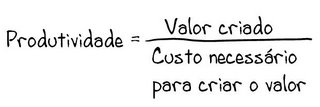
Como não podemos competir e alimentar aumentos de produtividade pelo preço mais baixo, devemos procurar abandonar o combate da eficiência e das economias de escala e apostar no numerador da equação da produtividade.
Compreendo pois, perfeitamente, o sentido destas palavras:
“In the industrial-era model, companies focus on efficiency above all else—on getting things done at the lowest cost possible.In the name of efficiencythey boil their business operations into routinized practices that suppress the creative instincts of their workers, who become standardized parts of a predictable machine. They not only suppress the creative instincts of their workers, they ultimately suppress the individuals themselves. The push-driven programs of these institutions require standardization and predictability. But individuals, especially passionate ones, are ultimately unique and unpredictable.” neste artigo da revista BW.
Precisamos de fugir deste paradigma da eficiência, da produção em massa, do ritmo elevado e concentrarmo-nos na criação de valor.
No entanto, é difícil mudar! Há quem associe a essa dificuldade a designação de O Paradoxo de Ícaro:
“Over the years, companies begin to focus on the thing that made them successful (a particular product, service, production method, etc.). Initially that serves them well and they become even better at it. It will also come at the expense of other products, processes, and viewpoints that the company considers less important and off the mark, that are discarded or brushed aside.
As a result, firms are too late to adapt to fundamental changes in their business environments such as new competitors, different customer demand, radical new technologies, or business models… It also causes organizations to carry on activities too long and too far, despite the presence of some fundamental design or organizational flaws…“
Ao abandonarmos a concentração na eficiência e ao dedicarmo-nos à criação de valor temos de perceber que temos de optar por um novo paradigma de operação. O que era importante deixou de o ser, o que era crítico deixou de o ser:
“Canon is also looking to boost productivity. Already, the company has seen great gains from "cell assembly," where small teams build products from start to finish rather than each worker repeatedly performing a single task on a long assembly line. Canon now has no assembly lines; it ditched the last of its 20 kilometers of conveyor belts in 2002, when a line making ink-jet printers in Thailand was shut down.”
Quantas empresas já despertaram para esta realidade? Com encomendas cada vez mais pequenas, com prazos de entrega cada vez mais curtos, será que faz sentido manter linhas de montagem? Será que faz sentido continuar a planear a produção da mesma forma?
... como referimos aqui. . Mas não é impossível, como demonstra este artigo do Público "Negócio das rações para animais de companhia parece estar imune à crise" . "A Rações Avenal desistiu de fabricar alimentos para animais de criação e passou a dedicar-se apenas a cães e gatos. Decisão estratégica que salvou a empresa da recessão económica." . E sobretudo "Com uma facturação de 4,2 milhões de euros em 2008, a empresa espera facturar mais 23 por cento este ano." . Fundamental, o acto de reflectir em que filme estamos inseridos e para onde é que ele nos leva. E, se não gostamos do final mais provável... por que não reescrever o guião e mudar de filme?
Tenho percebido, no último semestre, o acentuar de uma tendência no mundo industrial actual.
A diminuição do tempo disponível para produzir bens no ramo do “pronto moda”:
A data de entrega dos produtos para as prateleiras e montras no inicio de uma época mantém-se constante (?) (em Julho no Porto já vi lojas em centros comerciais com uma das montras dedicadas à nova época de Outono-Inverno), no entanto, a data de colocação das encomendas firmes vai deslizando cada vez mais para a frente diminuindo o tempo disponível para produção.
Esta compressão temporal acarreta uma mudança de paradigma que tem de ser encarada de frente.
Durante aqueles dois meses, de meados de Março a meados de Maio, as empresas têm de pagar salários e não produzem. Os operários têm de compensar dando horas-extra durante o tempo de produção. Contudo, por mais horas que dêem, como o tempo está comprimido e as máquinas estão ocupadas, as empresas acabam por ter de subcontratar produção para além do que seria necessário ou desejável.
Por isso, assistimos a um fenómeno deveras interessante e sintomático de algo não corre bem no modelo, os subcontratados negoceiam numa posição de força porque não são suficientes para as encomendas.
Esta compressão temporal é algo que já vem de há anos, por causa da progressiva aposta na flexibilidade e no serviço em detrimento do preço-baixo puro e simples, no entanto, agora, com a crise actual acentuou-se.
A incerteza, a quebra na procura, a baixa do poder de compra, tudo contribui para que as encomendas sejam postas cada vez mais tarde, cada vez mais em cima da hora, devido ao receio e ao risco envolvido.
A par desta compressão temporal acentuam-se tendências que já vêm em aceleração há alguns anos: encomendas cada vez mais pequenas; maior variedade de modelos e explosão do número de amostras na fase pré-produção.
Tudo isto contribui para a necessidade de repensar:
·O planeamento da produção (definitivamente optar pelo puxar em vez do empurrar, pull vs push);
·A subcontratação;
·O aprovisionamento;
·A organização das equipas de produção (células versus linhas);
·A modelação, ou a engenharia de processo, ou a engenharia de produto.
Precisamos de:
·Reduzir os tempos de ciclo;
·Aprender a trabalhar com muita variedade;
·Aprender a controlar os custos de outra forma;
·Aumentar a flexibilidade.
Só que o modelo mental que funcionava no passado é cada vez mais um entrave a este novo panorama.
"It is widely believed that restructuring has boosted productivity by displacing low-skilled workers and creating jobs for the high skilled."Mas, e como isto é profundo:"In essence, creative destruction means that low productivity plants are displaced by high productivity plants." Por favor voltar a trás e reler esta última afirmação. . "Lovaglia’s Law: The more important the outcome of a decision, the more people will resist using evidence to make it."
"If an organisation is too stable it can ossify, but if it is too unstable it can disintegrate. Successful organisations work between these two conditions or states, in what Stacey called ‘the chaos zone’."
"If the customer doesn't care about the price, then the retailer shouldn't care about the cost," “It's not enough that we do our best; sometimes we have to do what's required”. "Das Leben, das uns gegeben ist, ist uns nicht als etwas Fertiges gegeben, sondern wir müssen es uns gestalten, und zwar jeder sein eigenes." "Eine Regierung, die nichts wert ist, kostet am meisten." "Forget trying to persuade them; light their pants on fire." "O futuro é o que importa. O futuro é a base do significado, é de onde vem o projecto que alguém tem para si próprio" "The single biggest problem in communication is the illusion that it has taken place."
“It is not the strongest of the species that survives, nor the most intelligent; it is the one that is most adaptable to change.”
"o Marketing só existe a partir do pensamento estratégico, caso contrário "não resulta"" "It is difficult to get a man to understand something, when his salary depends upon his not understanding it" "Perder diversidade é como arrancar páginas de um livro. Quantas páginas poderemos arrancar até deixar de compreender o enredo?" The great enemy of the truth is very often not the lie – deliberate, contrived and dishonest – but the myth, persistent, persuasive, and unrealistic. Belief in myths allows the comfort of opinion without the discomfort of thought."
"By strategy, I mean a cohesive response to a challenge. A real strategy is neither a document nor a forecast but rather an overall approach based on a diagnosis of a challenge. The most important element of a strategy is a coherent viewpoint about the forces at work, not a plan."
"Un desastre està punt de succeir a Espanya. El malentès de la gravetat de la crisi costarà car als inversors, ja que tindrà profundes conseqüències per a tot el sistema bancari europeu", afirma.
Entre d'altres coses, Mauldin diu que "els inversors estan fumant crack si creuen que els bancs espanyols són entre els més forts d'Europa, ja que estan amagant les seves pèrdues".
“… there are no “sunset” industries condemned to disappear in high wage economies, although there are certainly sunset and condemned strategies, among them building a business on the advantages to be gained by cheap labor”
"o vencedor da vida, o optimista que vive em incesto com o próprio ego, é o traço mais frágil do líder"
"We shall not grow wiser before we learn that much that we have done was very foolish." You may not be able to change the world but can at least get some entertainment & make a living out of the epistemic arrogance of the human race.
"I wanted you to see what real courage is, instead of getting the idea that courage is a man with a gun in his hand. It's when you know you're licked before you begin but you begin anyway and you see it through no matter what. You rarely win, but sometimes you do."
“Trust your guts. But not too much!”
"Customers will try 'low-cost providers,' because the majors have not given them any clear reason not to." "
"Natal é quando as Crianças pedem e os Pais pagam. Défices é quando os Pais pedem e as Crianças pagam."
"A imprevidência dos povos é infinita, a dos governos é legal"
"What a man sees depends both upon what he looks at and also upon what his previous visual-conceptual experience has taught him to see"
“The leaders first task is to be the trumpet that sounds a clear sound”
"lamented the lack of any systematic data on the scale of unfunded IOUs that care-free politicians have handed out like confetti."
"Let them call me rebel and welcome, I feel no concern from it; but I should suffer the misery of devils, were I to make a whore of my soul..."
O problema não é o consumo. O problema é o consumo assente em endividamento."
"There are designations, like "economist", "prostitute", or "consultant" for which additional characterization doesn't add information."
When it becomes more difficult to suffer than change, you will change"
"Hope is not a strategy and a crisis is a terrible thing to waste"
The more you can see of the present, the more you can see of the future"
Yes, You can change the future, but only changing the present"
"Entrepreneurship is 'Having aspirations greater than your resources'"
“The single biggest reason companies fail is they overinvest in what is, as opposed to what might be."
"The first principle is that you must not fool yourself - and you are the easiest person to fool. So you have to be very careful about that"
"A estabilidade é uma ilusão"
"When we create the conditions of possibility, the universe becomes our co-conspirator"
Thinking about doing is not doing. Talking about doing is not doing. Doing is doing."
"'God has created me to do him some definite service. He has committed some work to me which he has not committed to another'.
...
"Each of us has a mission, each of us is called to change the world, to work for a culture of life, a culture forged by love and respect for the dignity of each human person.
"As our Lord tells us in the Gospel we have just heard, our light must shine in the sight of all, so that, seeing our good works, they may give praise to our heavenly Father."
"The future is not there waiting for us. We create it by the power of imagination."
"confusing testosterone with strategy is a bad idea"
"Much consulting involves the application of models to a system, as opposed to getting involved in the system as a positive change agent""
"O Portugal que pára sem orçamento é precisamente aquele que vive dele e que há todo o interesse em parar."
"credibilidade da política financeira e dos seus executores está ao nível da credibilidade de uma barraca das farturas"
"The role of the manager is thought to be reduction of uncertainty rather than the capacity to live creatively in it"
"today an entrepreneur is closer to artists than managers"
"A business without a path to profit isn’t a business, it’s a hobby"
"If no one’s upset by what you’re saying, you’re probably not pushing hard enough. (And you’re probably boring, too.)"
"Storytelling isn’t just how we construct our identities, stories are our identities"
"'He who has a why to live can bear almost any how' "
"They can because they think they can"
"Se há coisa que não suporto é misturar catequese com negócios, é a incapacidade para calçar os sapatos do outro e só pensar na nossa posição de coitadinhos, pobres vítimas indefesas dos maus e que por isso precisamos do Estado todo poderoso para nos proteger e, nem percebem na volta, os juros que o Estado cobra por esse serviço mafioso de protecção que, ainda por cima não resolve nada."
"Empathy is like a universal solvent. Any problem immersed in empathy becomes soluble."
"In victory, do not brag; in defeat, do not weep"
"Value it's a feeling not a calculation"
"An economist is someone who has had a human being described to him, but has never actually seen one."
"Don't finish first--it's not about running a rat race. Start with a better ending in mind."
"If you sit in on a poker game and don’t see a sucker, get up. You’re the sucker.”
"The 'value added' for most any company, tiny or enormous, comes from the Quality of Experience provided."
"Crediting government with the success of entrepreneurs is like crediting the guy who built Bill Gates’ garage with the success of Microsoft."
"I have found that assuming social scientists understand the difference between correlation and causality is not generally a good one."
"Promising never to raise taxes, without reaching a deal on spending, really means a high and rising commitment to future taxes."
"Some things are so foolish that only an intellectual could believe them, for no ordinary man could be such a fool"
"os bancos não financiam a economia, a poupança sim"
"I do not know the key to success, but the key to failure is trying to please everybody"
"Never be afraid to try, remember... Amateurs built the ark. Professionals built the Titanic."
"terms such as 'experiment' and 'observation' cover complex processes containing many strands. 'Facts' come from negotiations between different parties and the final product - the published report - is influenced by physical events, dataprocessors, compromises, exhaustion, lack of money, national pride and so on."
"'science in the making' is 'the consequence of [a] settlement' of 'controversies'."
"If the state wishes to spend more, it can do so only by borrowing your savings or taxing you more. And it's no good thinking someone else will pay, that someone else is you."
"All failures of strategy are rooted in the assumption that outcomes are predictable."
"Doing things like your bigger competitors is how to get killed in the wars out there"
“Uma moeda boa e forte é como a saúde. Só lhe damos verdadeiramente valor quando não a temos.”
"Life’s tough. It’s tougher if you’re stupid"
"O homem de bem exige tudo de si próprio; o homem medíocre espera tudo dos outros"
"Change is a threat when done to me, but an opportunity when done by me."
"As elites foram deixando de falar das exportações à medida que se foi percebendo que o país consegue exportar sem elas"
"Your toughest competition is the little voice inside your head telling you to stop"
"Pain is just weakness leaving your body"
"Built to last" is bad economics. Built to do something great" is the better idea. Think: "Creative destruction."
"the world is an uncertain place no matter how many Greek letter equations you affix to a problem."
"You never change things by fighting existing reality. To change s.th., build a new model making the existing model obsolete"
“No, no, you're not thinking; you're just being logical.”
"Success is not a destination. It's the trail you leave behind you."
"Winners make a habit of manufacturing their own positive expectations in advance of the event."
“You’ve got to start with the customer experience and work back toward the technology – not the other way around”
"Strategy as the "smallest set of - intended or actual - choices and decisions sufficient to guide all other choices and decisions sufficient to guide all other choices and decisions."
"When something is commoditized, an adjacent market becomes valuable"
"nature evolves away from constraints, not toward goals"
"There aren't any textbooks on what to stop doing!"
"With great power comes great irresponsibility "
"Weird things happen when you take price out of the equation for consumers"
"‘It’s so damn complex. If you ever think you have the solution to this, you’re wrong and you’re dangerous.’"
"Saruman believes it is only great power that can hold evil in check, but that is not what I have found. I found it is the small everyday deeds of ordinary folk that keep the darkness at bay. Small acts of kindness and love."
"Increasing stuff that doesn't add value dilutes existing value."
"O federalismo não é a alternativa à troika, é a troika para sempre."
"Never underestimate the difficulty of changing false beliefs by facts"
"Stressors are information"
“If you hear a “prominent” economist using the word ‘equilibrium,’ or ‘normal distribution,’ do not argue with him; just ignore him, or try to put a rat down his shirt.”
"The advantage of experiences over things for most of us is that we can make them seem unique, which = scarce, which = value"
"Pedras no caminho?
Guardo todas, um dia vou construir um castelo"
"Without risk, faith is an impossibility."
"Não posso com quem vive a achar que os outros lhe devem sempre alguma coisa."
"In a world of increasing automation, our ability to perform tasks is not nearly as important as our ability to dream. The questions we need to ask are not ones of action, but ones of meaning"
"Me arrancam tudo a força e depois me chamam de contribuinte."
"Letting people vote for expensive programs that “somebody else” will finance is a good recipe for getting people to vote irresponsibly"
"what's fairness gotta do with pricing based in value?"
"The epic battle of our generation is between the status quo of mass and the never-ceasing tide of weird."
“Price is emotional”
"There will always be a reason why you can't pursue it, until competitors create a reason why you must."
"The most important thing to study is opening theory"
"The greater the contrast, the greater the potential"
“Customers don't care about your solution, they care about their problems.”
"Todos querem conhecer a verdade, mas o que desejam é que lhes contem uma mentira em que não sejam protagonistas."
"Execution efficiency strangles innovation in the crib, but not with malice, by default.”
"Our obsession with scalability is getting in the way of unleashing the potential of the 21st century."
"The system is optimized to mitigate risk, not create value"
"Champions are made when no one is looking"
"Don't bargain on value. Half as expensive is often twice as cheap."
"Customers care about outcomes, not effort, technology, or originality."
" I can't believe it. That is why you fail."
"You don't have to pick between 1) playing the game and 2) not playing the game. You can *change* the game."
""The first principle is that you must not fool yourself and you are the easiest person to fool." "
"Debt may have ended up as a problem, but it always starts out as a solution."

 Parque repleto de produto acabado (apetece perguntar, tratando-se de uma tubagem que tem por destino final estar enterrada, será que na receita é adicionado alguma ingrediente anti-UV para os proteger dos meses de stock ao ar livre?).
 É claro que quem está no negócio dos materiais de construção quase sempre compete pelo preço mais baixo. Assim, há que ter os custos fixos unitários os mais espremidos possíveis, daí ter as máquinas a trabalhar 24h por dia (mais as noites, :) ) a vomitar o máximo de produto seja o padrão.

%2006.21.jpeg)