terça-feira, junho 26, 2018

"The market is poised to take off"

"Mass customization.
This model takes product variation to the extreme. It entails creating one-off products that are precisely adjusted to the needs or whims of individual buyers—adjustments that can be carried out by simply uploading each customer’s digital file into a 3-D printer. Thanks to the efficiency and precision of digital technology, these products cost less than conventionally manufactured items but fit individuals’ specifications more exactly.
.
Mass customization is suitable for any large market in which customers are dissatisfied with standardized, conventionally produced offerings and it’s easy to collect customer information. ...
This model can rapidly and significantly affect an entire industry. With hearing aids the shift happened in a year and a half, forcing some manufacturers into bankruptcy.
.
The main competitive challenge is to reduce the cost of acquiring individual customers’ information. Hearing-aid companies first needed a scanning device that audiologists could easily use. In this case, customers were willing to go to an audiologist to be measured. In contrast, buyers of custom orthotics and insoles didn’t want to visit an expensive podiatrist to be measured. That’s why SOLS Systems, which innovated in this area, couldn’t make it on its own; it was acquired in 2017 by another footwear company, Aetrex Worldwide. But the development of smartphone apps that allow people to measure their own feet is overcoming the information-collection obstacle. And HP Inc. has devised a 3-D scanning solution, FitStation, that can be placed in stores. The market is poised to take off."

Trecho retirado de "The 3-D Printing Playbook"

"people organize their brains with conversation"

Com quem conversa sobre a estratégia da sua empresa?
"The fact is important enough to bear repeating: people organize their brains with conversation. If they don’t have anyone to tell their story to, they lose their minds. Like hoarders, they cannot unclutter themselves. The input of the community is required for the integrity of the individual psyche. To put it another way: It takes a village to organize a mind. Much of what we consider healthy mental function is the result of our ability to use the reactions of others to keep our complex selves functional. We outsource the problem of our sanity."
Ler isto e recordar de imediato Popper e Espinosa:
"Popper tinha razão ao criticar Espinosa, de que vale a liberdade de pensamento se não há com quem conversar, discutir e aprender"

Peterson, Jordan B.. 12 Rules for Life: An Antidote to Chaos

segunda-feira, junho 25, 2018

Anónimo da província, mas à frente

Volta e meia ouvimos representantes da produção - as marcas - queixarem-se do poder da distribuição grande. Aqui no blogue basta pesquisar: Centromarca (por exemplo este postal de 2009 e este outro de 2015)

Sempre aconselhei as marcas a concentrarem-se em seduzir os que mandam nos donos das prateleiras, os consumidores, através de produtos e experiências inovadoras (por exemplo este postal de 2012 e este outro de 2016)

Agora, via "Big box retailers aren’t always able to squeeze small suppliers" chego a um artigo interessante, "Are Supermarkets Squeezing Small Suppliers? Evidence from Negotiated Wholesale Prices" de Carlos Noton e Andrés Elberg, publicado por The Economic Journal. Interessa-me sobretudo o tema de como é que os pequenos produtores pode lidar com a distribuição muito concentrada:
"Combining data on prices at the retail and wholesale levels, quantities and estimated coffee production costs, we find that while the largest supplier, Nestlé, is able to secure a large fraction of the pie (around 65 per cent) the median fraction of the surplus obtained by other smaller suppliers is a sizeable 41 per cent. This indicates that it is not necessarily the case that small suppliers bargaining with large supermarket chains are doomed to earn negligible profits. Some are able to secure relatively large fractions of the surplus at stake in negotiations with retailers in spite of their small market sizes.
.
What explains the ability of small suppliers to earn such a large share of the channel surplus?
...
the researchers estimate a demand system and use these demand estimates to compute a measure of the profits that the supermarket would obtain if a given supplier’s products were taken off its shelves. The less substitutable (more differentiated) the product is, the lower the profits a supermarket would obtain in the event of a disagreement in their negotiations with the supplier. In this case, the supplier is in a better bargaining position.
...
The study finds that the relatively large share of the surplus earned by small coffee manufacturers can be rationalised by retailers’ low ‘outside options’ (disagreement profits are about 27 per cent of agreement profits). The results suggest that the most likely explanation for small manufacturers’ ability to capture value is that they provide differentiated products to a small but highly loyal group of customers."
Do artigo sublinhamos:
"Our finding that small manufacturers are able to capture a sizable share of the channel surplus runs contrary to the conventional wisdom that market size is a primary driver of bargaining outcomes. Along these lines, Nestlé’s large payoffs may not be solely driven by its market size. The strong brand loyalty of Nestlé’s customers, as supported by our demand estimations, are an important source of bargaining leverage. Thus, our evidence suggests that the most likely explanation to small manufacturers capturing value is that they provide differentiated products to small groups of loyal consumers. This finding has profound implications for the public debate on the profit-sharing between big-box retailers and small manufacturers, stressing the role played by brand loyalty as a counteracting force to market size. Recall that market size is endogenous in our model and that the exogenous sources of bargaining leverage are the size of the outside options of players and their relative firm specific characteristics such as bargaining skills, patience rate, risk aversion, etc.
...
Our results support the hypothesis that brand loyalty plays a key role in profit-sharing between retailers and manufacturers"

"Giants invariably descend into suckiness" (parte XV)

Parte I, parte IIparte IIIparte IVparte Vparte VIparte VIIparte VIIIparte IXparte Xparte XI, parte XII, parte XIII e parte XIV.
By the end of the twentieth century P&G had scaled up to a behemoth, offering more than three hundred brands and raking in yearly revenue of $37 billion. P&G was one of the world’s corporate superpowers.
.
In 2016 analyst firm CB Insights published a graphic showing all the ways unscaled companies were attacking P&G. [Moi ici: Por que não gostamos de ser tratados como plancton] It looks like a swarm of bees taking down a bear. In that rendering P&G no longer appears to be a monolithic scaled-up company that has built up powerful defenses against upstarts; instead, it is depicted as a series of individual products, each vulnerable to small, unscaled, agile, AI-driven, product-focused, entrepreneurial companies.
...
CBI called the overall phenomenon the “unbundling of P&G.” It is as clear an indication as any of what big corporations face in an era that favors economies of unscale over economies of scale. Small unscaled companies can challenge every piece of a big company, often with products or services more perfectly targeted to a certain kind of buyer—products that can win against mass-appeal offerings. If unscaled competitors can lure away enough customers, economies of scale will work against the incumbents as fewer units move through expensive, large-scale factories and distribution systems—a cost burden not borne by unscaled companies.
...
Over the past hundred years, as the era of scale unfolded, small companies of course continued to exist, and many prospered even as they stayed small. Small business was the US economy’s underlying strength throughout the scaling age. In 2010, according to the US Census, the nation had about 30 million small businesses and only 18,500 companies that employed more than five hundred people.
However, in an era when economies of scale usually prevailed, when a scaled-up company competed directly against a small business, the small business usually lost. Just think of all the small-town Main Street retailers Walmart bulldozed over the past twenty-five years.
.
We will see the big-beats-small dynamic reverse as we unscale. Over the next ten to twenty years companies that relied on scale as a competitive advantage will increasingly find themselves defanged. They will be at a disadvantage against focused unscaled businesses. Large corporations won’t disappear, just as small business didn’t disappear in the last era. But the big companies that don’t change their model will see their businesses erode, and some of today’s giants will fall. [Moi ici: Nada podem fazer contra a suckiness, têm de a abandonar]”

Excerto de: Taneja, Hemant, Maney, Kevin. “Unscaled”.

domingo, junho 24, 2018

Trabalho 4.0

Assim como o governo alemão lançou o tema da Indústria 4.0, também lançou recentemente um documento para discutir o Trabalho 4.0 sobre como será o trabalho do futuro.

Penso que é um documento demasiado preso ao paradigma do emprego criado pelo século XX, deixando por isso para segundo ou terceiro plano a "gig economy", mas não deixa de ser interessante:
"Whilst decent work and income remain fundamentally important, a new balance will permanently have to be struck between security and flexibility. Social security and the integration of all citizens into occupation will continue to be a key goal. However, increasingly pluralistic life and work styles call for a stronger element of self-determination and flexibility in, for example, where and when people decide to work.
...
The predominant assumption is that the witnessed transformations will not lead to mass job losses but a massive change in occupations and job profiles. This makes skills development and life-long learning even more important than it already is.
...
[Moi ici: Desconfio que muitos partidários do status quo, em ambos os lados do balcão, não vão gostar disto] Why should social security systems only kick-in when people approach the end of their working lives or risk losing their jobs? The whitepaper instead turns to an idea of preventative social policy and suggests gradually expanding the currently existing unemployment insurance into an employment insurance, with an individual right to independent vocational guidance and continuing education and training. This should also transform the agency managing unemployment into a more pro-active qualification agency.
...
Issues that will most likely become even more relevant in coming years are around working time and flexibility. Whereas a lot of employees still prefer fixed working hours and don’t want to check their emails on their weekends, more and more people value the flexibility modern forms of communication can provide and would rather leave the office early to spend time with their children and catch up on emails later in the evening.
...
Suggestions also include the establishment of long-term personal accounts that each individual sets up at the start of their working life, equipped with a basic “capital” and then earning credits through employment or individual contributions. These credits could then be used for education, skill enhancement or career breaks."
Trechos retirados de "Work 4.0: How Germany is shaping the future of work"

"True thinking is rare"

"The people I listen to need to talk, because that’s how people think. People need to think. Otherwise they wander blindly into pits. When people think, they simulate the world, and plan how to act in it. If they do a good job of simulating, they can figure out what stupid things they shouldn’t do. Then they can not do them. Then they don’t have to suffer the consequences. That’s the purpose of thinking. But we can’t do it alone. We simulate the world, and plan our actions in it. Only human beings do this. That’s how brilliant we are. We make little avatars of ourselves. We place those avatars in fictional worlds. Then we watch what happens. If our avatar thrives, then we act like he does, in the real world. Then we thrive (we hope). If our avatar fails, we don’t go there, if we have any sense. We let him die in the fictional world, so that we don’t have to really die in the present.
...
People think they think, but it’s not true. It’s mostly self-criticism that passes for thinking. True thinking is rare— just like true listening.
...
Thinking is listening to yourself. It’s difficult. To think, you have to be at least two people at the same time. Then you have to let those people disagree. Thinking is an internal dialogue between two or more different views of the world. Viewpoint One is an avatar in a simulated world. It has its own representations of past, present and future, and its own ideas about how to act. So do Viewpoints Two, and Three, and Four. Thinking is the process by which these internal avatars imagine and articulate their worlds to one another."
E pensar para além do dia a dia? E pensar para além do que se está a fazer sobre o que se deverá estar a fazer depois de amanhã? E pensar para além do apagar o fogo que irrompeu esta noite? E pensar sobre se o que se está a fazer é o que deve ser feito mesmo?

Peterson, Jordan B.. 12 Rules for Life: An Antidote to Chaos

sábado, junho 23, 2018

Em vez de copiar, o truque é diferenciar

"For all the panic in the retail sector about Amazon replacing traditional sales, I don’t see the person-to-person experience going away anytime soon. With a few exceptions, people like leaving the house. They like the experience of shopping, discovery, and interacting with each other."
Quando um modelo de negócio está em ascensão, recebe a luz e a atenção dos holofotes. Por isso, toda a gente está condenada a ser bombardeada pelos media com a sua mensagem de que "a nova única via para o sucesso é esta". Os incautos caem na armadilha e tentam combater no terreno onde o concorrente é mais forte, tentam copiá-lo e tramam-se, inevitavelmente.

Nunca esquecer a frase:
"When something is commoditized, an adjacent market becomes valuable"
Em vez de copiar o truque é diferenciar. Ok, talvez tenha de começar por encolher a organização (grande exemplo da Apple de 1997), mas depois há que procurar fugir o mais possível do espaço competitivo em que o outro modelo de negócio está a ter sucesso.

Trecho retirado de "Retailers can’t out-Amazon Amazon, but they can change the rules"

"Truth makes the past truly past"

"Things fall apart. What worked yesterday will not necessarily work today. We have inherited the great machinery of state and culture from our forefathers, but they are dead, and cannot deal with the changes of the day. The living can. We can open our eyes and modify what we have where necessary and keep the machinery running smoothly. Or we can pretend that everything is alright, fail to make the necessary repairs, and then curse fate when nothing goes our way. Things fall apart: this is one of the great discoveries of humanity. And we speed the natural deterioration of great things through blindness, inaction and deceit. Without attention, culture degenerates and dies, and evil prevails.
...
To tell the truth is to bring the most habitable reality into Being. Truth builds edifices that can stand a thousand years. Truth feeds and clothes the poor, and makes nations wealthy and safe. Truth reduces the terrible complexity of a man to the simplicity of his word, so that he can become a partner, rather than an enemy. Truth makes the past truly past, and makes the best use of the future’s possibilities. [Moi ici: Como não recordar Joaquim Aguiar, enquanto a verdade for escondida estamos condenados a repetir os erros do passado... o FMI já veio 3 vezesTruth is the ultimate, inexhaustible natural resource. It’s the light in the darkness. See the truth. Tell the truth.
...
If your life is not what it could be, try telling the truth. If you cling desperately to an ideology, or wallow in nihilism, try telling the truth. If you feel weak and rejected, and desperate, and confused, try telling the truth. In Paradise, everyone speaks the truth. That is what makes it Paradise."

Peterson, Jordan B.. "12 Rules for Life: An Antidote to Chaos"

sexta-feira, junho 22, 2018

Autenticidade

"The relentless rise of globalisation has seen our world, on and offline, become homogenised. Many local touchpoints from within our communities are disappearing. The local pub, the library, the sports club, the playing fields, these focal points and hubs for community involvement and interaction are being lost. 27 pubs close in the UK every single week.
.
For every trend, there is a counter-trend and so with globalisation swings back localisation. The reaction to globalisation has been for people to become more protective of their communities and the signifiers of ‘local’. As 'local' becomes increasingly scarce, demand for 'local' increases. A more global, connected and homogenised experience of the world means people long to discover the original and unique again. A strong sense of place gives identity and meaning to people, and offers a sense of belonging.
.
Inevitably, brands are changing their own habits and behaviours to reflect this desire. Today, many brands display a marked emphasis on provenance. Some leverage the cachet of being 'local', but many also challenge existing business models, and can become valued pillars of the community they serve."
Trecho retirado de "How brands use 'local' as a source of competitive advantage"

Acerca do bombeirismo

"Make no mistake, a firefighting mentality starts at the top of the organization. If managers see their senior leaders constantly reacting to every issue that comes across their desk, they too will adopt this behavior. Fire-fighting then becomes embedded in the culture and those that are seen as the most reactive, oddly enough, garner the greatest recognition. Managers who thoughtfully consider each issue before responding don't seem to be doing as much as the firefighters, when in reality, they're exponentially more productive.
.
"Let's think about that," is a simple but powerful phrase that can eliminate reactivity within your business and culture. The next time you receive an e-mail marked urgent or someone comes charging into your office with how to react to a competitor's activity or a new flavor-of-the-month project, reply with "Let's think about that. "Then stop and consider how this helps you achieve your goals and supports your strategic focus. To do so, determine the probability of success, impact on the business, and resources required. If after this analysis, the new task doesn't appear to support your goals and strategies, kindly inform the relevant parties that, relative to the other initiatives you're working on, this doesn't warrant resource allocation."

Recordar Setembro de 2006 e "Não adianta chorar sobre leite derramado (I)"

Trecho retirado de "The Strategic Thinking Manifesto" de Rich Horwath


quinta-feira, junho 21, 2018

Desabafo

Num desabafo pouco habitual neste blogue que se quer optimista.

Receio que Portugal no médio prazo se torne novamente num país ideal para o low-cost e as respectivas estratégias eficientistas:


E a Roménia... meu Deus!!!

Recordo as instituições extractivas de Acemoglu e imagino 44 anos de perseguição normanda saqueadora, comparando com o tenho visto nos últimos anos sobre o alojamento local.

A tendência crescente

"The great opportunities in the consumer market will revolve around giving every individual exactly what he wants, when he wants it. It reflects the constant theme in unscaling: scaled-up, mass-market products have long made us conform to them, but unscaled products and services conform to us. They will seem like they are built just for each one of us—customization built with automation. Over the next decade we’ll see innovators transform one kind of product after another, moving them from mass markets to markets of one.
Here are some of the opportunities I see:
.
“UNBUNDLING THE GIANTS: Consumer product companies from P&G to Nestlé to Samsung were built on the mass market. A hit product was one that appealed to the greatest number of people—one size fits most. But mass-market products are a compromise for most consumers. They’re not exactly what we might want, but it’s good enough and easily available. And that leaves an opening for small, new companies that can use technology to create products that hold great appeal for narrow slices of the consumer market—consumers who will feel like that product was created especially for them.
...
OMNI-CHANNEL STORES: Through the history of civilization people have been drawn to markets. We like to shop. For many people it’s a social and entertainment experience as much as a search for a product. So no matter how much commerce moves online, it’s not likely that retail stores will disappear. But retail will certainly change. Successful retail stores will be part of a complete experience that connects online and offline shopping.
...
LOCAL FARMING: Scaled-up farming has fed the world, but it’s also given us “fresh” tomatoes that taste like plastic. A host of technologies, from AI-controlled grow lamps to IoT sensors that can constantly measure nutrients in soil, are making it feasible to profitably grow food indoors near customers—the farming equivalent of distributed manufacturing."

Excerto de: Taneja, Hemant,Maney, Kevin. “Unscaled”. iBooks.

quarta-feira, junho 20, 2018

Para reflexão

"Poor preparation is a lousy excuse for a last-minute selfish frenzy. That frenzy distracts us from doing it right the next time.
.
If you want to understand where mastery and success come from, take a look at the inputs and the journey, not simply the outputs."
Trecho retirado de "Cold yeast"

Testar rapidamente

"But today’s pop-up is hardly about smashing annual revenue numbers. Much as a Silicon Valley start-up might release a prototype or beta version to study user feedback, many retailers are treating their pop-up stores as a way to test, learn and iterate on new ideas.
.
To some, it’s about testing a hypothesis or validating a new concept. To others, it’s about evaluating new markets, studying consumer behaviour or collecting actionable data to inform marketing strategy, R&D and business decisions. But for most, it’s still about building brand recognition, engaging new and loyal customers, and igniting social media and PR buzz."
Trecho retirado de "The Pop-Up Has Grown Up"

terça-feira, junho 19, 2018

"o destino é este constante subir, crescer e, depois, ser suplantado por outros"

"Zara fue pionera en el concepto de moda rápida en la década de 1980. Fue la primera en desarrollar un método de reacción rápida a las tendencias cambiantes, utilizando cadenas de suministro ágiles basadas en la producción de abastecimiento cerca de la sede para acelerar sus "plazos de entrega" que desde el comienzo del proceso de diseño hasta llegar a las tiendas tardaba semanas.
.
Pero los nuevos competidores crecen rápidamente, sin presión por la propiedad de las tiendas físicas, acercan la producción a la distribución y a la constante renovación de la mercancía.
.
Boohoo.com, fundada en la ciudad británica de Manchester en 2006, opera en un modelo de "prueba y repetición" por el cual produce pequeños lotes y aumenta la producción de los que mejor se venden. Más de la mitad de sus productos se fabrican en Gran Bretaña.
.
La compañía, cuyas ventas se duplicaron el año pasado, dijo que tenía plazos de entrega tan cortos como dos semanas. Missguided, que también tiene su sede en Manchester, ha dicho que sus plazos de entrega pueden ser de tan solo una semana."
Esta é a beleza da história da evolução da vida na Terra. Quando os governos não protegem os incumbentes, o destino é este constante subir, crescer e, depois, ser suplantado por outros:


Trecho retirado de "Así utiliza Zara la tecnología para mantenerse líder en la industria de la moda"

Pobres gigantes... não vão ter qualquer hipótese

“The power of the unscale dynamic can be seen as Warby Parker developed its business model by renting scale instead of building and owning it and, in a flash, competed against Luxottica for a slice of the entrenched company’s global market. The company can rent computing power on cloud services like AWS and Microsoft Azure, rent manufacturing from contract factories in Asia, rent access to consumers via the internet and social media, rent distribution from delivery companies like UPS and the US Postal Service. Warby today can succeed against an entrenched player with fewer than eight hundred employees. The company as I write this is worth well north of $1 billion and has become a fixture in the market for hip eyeglasses.
.
Warby is also part of a trend that is changing consumers’ relationships with brands. Brands were created to convey information about products at a time when it was hard for consumers to get information. But our hypernetworked and data-engorged era is killing the very reason for mass-market branding. We can find out everything about some gadget or shirt or hockey stick from a maker we never heard of. We can read reviews, Google the company, ask about it on social networks. As we get better information about small-scale products, people feel safe seeking out the unique, the undiscovered, the unbrands—giving a company like Warby an opening against a Luxottica.
...
We used to want the brands everybody else had. But now we’re moving toward mass individualism, wanting stuff “nobody else has. This leaves big brands vulnerable to hordes of quirky little unbrands.
...
All the dynamics of mass-market consumerism reinforced one another. For instance, big producers could claim more shelf space at big outlets, making it difficult for niche products to reach consumers. And economies of scale ruled. The bigger the retailer, the harder it could bargain for lower prices and the more efficiently it could operate. Walmart especially gained an advantage in this way. The bigger the consumer product maker, the more it could spend on advertising while gaining efficiencies from mass production and massive distribution. Here, P&G took the lead ahead of other manufacturers.
But when you think about it, the mass-market consumer companies made each of us conform to the experience that was best for them, not us.
...
On top of that, the products we wind up with probably don’t conform to our specific taste. We’re often buying a compromise product—Budweiser beer, Levi’s jeans—designed to appeal to as many people as possible. The experience most of us really want is to easily find exactly the product we’re looking for, no matter where we are at the moment, and “have it delivered into our hands within a couple of hours. That’s an unscaled consumer experience.”
Pobres gigantes... não vão ter qualquer hipótese... a menos que os políticos, com medo das alterações a nível da sociedade entrem em campo e reforcem o apoio que já dão aos incumbentes.

Excerto de: Taneja, Hemant,Maney, Kevin. “Unscaled”.

segunda-feira, junho 18, 2018

As quatro estratégias-base para o retalho (parte III)

Parte I e parte II.
2. Lead on Experiential: Offer Enhanced Customer ExperienceRetailers in the Experiential quadrant offer a physical customer experience that provides more pleasure, more excitement, and more fun than other retailers can provide.
...
Here, the customer journey is more experiential, and is seen as a lifestyle choice, not a chore. This is a high-touch, social experience.
...
excitement and discovery in-store.
...
Other retailers augment the customer experience in-store by becoming community centers and hosting events such as book readings, celebrity talks, and community get-togethers. Lifestyle brands often offer aerobic classes, rock climbing walls, and basketball courts. Pop-up stores within stores offer excitement, “newness,” and innovation.
...
3. Lead on Low Price: Offer Operational Excellence, Lowest-Cost EfficienciesRetailers in the Low Price quadrant provide reliable products or services at the lowest prices, and therefore offer customers the best savings. Retailers who can consistently offer the lowest prices have developed operating models that can efficiently manage inventory, keep overhead costs down, eliminate unnecessary intermediary steps, and reduce transaction costs at every step.
...
are companies that look for creative ways to minimize overhead costs and to eliminate unnecessary transaction costs. They also offer reliability and efficiency, excellent customer service, and strong customer-focused policies for returns. These retailers build their entire business models around these goals.
...
4. Lead on Frictionless: Offer Comprehensive Customer Understanding and Total ConvenienceRetailers in the Frictionless quadrant prioritize providing a frictionless customer experience that eliminates all pain points and offers the customer the easiest and most convenient way to shop. The key deliverable here is a simple, seamless integration of the shopping experience across all touchpoints. This requires the collection, capture, and analysis of all available customer data. Constantly analyzing the data allows for customization and personalization.
...
In order to succeed here, retailers must identify the current pain points in the shopping experience.”
E para terminar esta introdução:
A company’s choice in strategy will depend upon that retailers’ inherent strengths and the culture of the organization, and ultimately will set priorities for future allocation of resources. Customers are attracted to different retailers depending upon their own needs, so the choice of strategy will inevitably attract specific customer segments—and, by extension, inevitably turn away others.”

Excerto de: Barbara E. Kahn. “The Shopping Revolution”

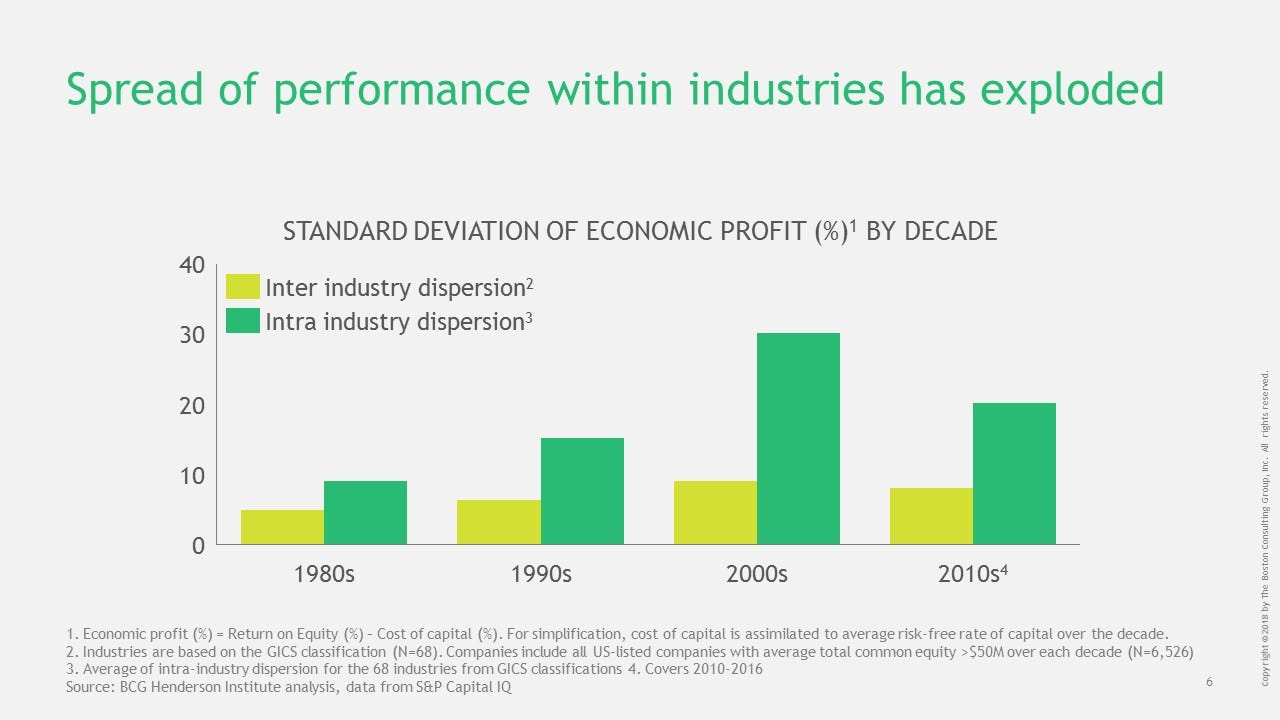
A dispersão de desempenho intra-sectorial a explodir


Costumo usar esta figura para ilustrar a evolução que acredito ter acontecido desde meados do século XX até aos nossos dias.

O século XX valorizava a uniformização para tirar partido da vantagem da escala. Assim, basicamente havia uma estratégia única para o sucesso, crescer mais depressa que os outros e via escala e eficiência conquistar os clientes e aumentar a quota de mercado. Mongo, terra de tribos apaixonadas, permite a coexistência de cada vez mais estratégias. Recordar McArthur:

Esta narrativa pode ser traduzida numericamente a:
"Corporate strategy is increasingly challenging for today’s leaders. Business environments are becoming more and more varied, which requires companies to actively choose strategic approaches that match their own specific situations. External forces such as political pressures, social expectations and macroeconomic circumstances are having greater impacts, adding to the complexity of strategy. And the increasing pace of change means that strategic assumptions must be re-evaluated constantly.
At the same time, corporate strategy is also becoming more important. With aggregate growth trending downward globally and new competitors presenting a constant threat of disruption, companies can no longer count on merely extending and exploiting historical strategies over the long term. This means that strategy has become a more important source of differentiation between firms: Within a given industry, the average dispersion of performance has doubled since the 1980s."

Trecho e imagens retirados de "The Board’s Role in Strategy in a Changing Environment"

domingo, junho 17, 2018

As quatro estratégias-base para o retalho (parte II)

Parte I.
"“1. Lead on Brand: Offer Branded Product SuperiorityRetailers in the Product Brand quadrant offer branded products that provide more differentiation, more value, more pleasure, and ultimately more confidence to a particular customer segment, as compared to other products on the market. Here I am specifically referring to the value that comes from branded product. It is the product’s brand equity that brings the customer into the store.
There are several ways retailers can leverage the value offered through products that have strong brand equity. First, there are multibrand retailers who carry multiple lines of strong branded products that “pull” the customer into the store.
...
Other retailers in this quadrant will include high-quality brands that are sold directly to the end user. These are known as vertical brands and the product brand name is the same as the retailer’s brand name. Examples include luxury brands like Louis Vuitton or Hermès, specialty retailers such as Lululemon or Zara, or the newer digitally native vertical brands such as Warby Parker or Glossier.
.
In all of these cases, these brands have developed deep emotional connections with consumers and a strong narrative; their customers frequently become brand advocates. In the luxury markets, these brands have heritage, exclusivity, and prestige. For the nonluxury brands, they have strong identity and values that resonate with their devotees.
...
Retailers in this quadrant also excel in design and style. ... Finally, leaders in this quadrant may also compete on state-of-the art technology. All in all, the leaders here succeed in developing an innovative culture where new ideas are embraced and commercialized quickly.”

Excerto de: Barbara E. Kahn. “The Shopping Revolution”

"formulate clear problem statements" (parte VI)

Parte I, parte IIparte III e parte IV.

Em "The Most Underrated Skill in Management" propõe-se o uso do A3 como forma de sistematizar o desenvolvimento de uma acção de melhoria:
"To track problem-solving projects, we have modified the A3, a famous form developed by Toyota, to better enable its use for tracking problem- solving in settings other than manufacturing. The A3 form divides the structured problem-solving process into four main steps, represented by the big quadrants, and each big step has smaller subphases, captured by the portions below the dotted lines.
...
Though the form may often have supporting documentation, restricting the project summary to a single page forces the user to be very clear in his or her thinking. The A3 divides the structured problem-solving process into four main steps, represented by the big quadrants, and each big step has smaller subphases, captured by the portions below the dotted lines. The first step (represented by the box at the upper left) is to formulate a clear problem statement. [Moi ici: 1.1 Qual é o problema que temos de resolver] In the Background section (in the bottom part of the Problem Statement box), you should provide enough information to clearly link the problem statement to the organization’s larger mission and objectives. [Moi ici: 1.2 Porque temos de trabalhar neste projecto? Qual o contexto. Qual a importância deste projecto. Que objectivo queremos atingir?] The Background section gives you the opportunity to articulate the why for your problem-solving effort."
2.1 - Como é que que funciona o processo actual? Qual o fluxograma? Que resultados temos? Que segmentação é possível fazer? Pareto(s)? Histograma(s)?

2.1 - Que suspeitas? Que hipóteses de causas mais prováveis? Que análises/testes devem ser feitos para despistar hipóteses irrelevantes? Espinha-de-peixe? Diagramas de correlação? 5 Porquês
"asking the “5 whys,” meaning that for each observed problem, the investigator should ask “why” five times in the hope that five levels of inquiry will reveal a problem’s true cause. Later, Kaoru Ishikawa developed the “fishbone” diagram to provide a visual representation of the multiple chains of inquiry that might be required to dig into the fundamental cause of a problem.
...
The purpose of all root-cause approaches is to help the user understand how the observed problem is rooted in the existing design of the work system. Unfortunately, this type of systems thinking does not come naturally. When we see a problem (again, thanks to pattern matching) we have a strong tendency to attribute it to an easily identifiable, proximate cause. This might be the person closest to the problem or the most obvious technical cause, such as a broken bracket. Our brains are far less likely to see that there is an underlying system that generated that poorly trained individual or the broken bracket. Solving the immediate problem will do nothing to prevent future manifestations unless we address the system-level cause.
A good root-cause analysis should build on your investigation to show how the work system you are analyzing generates the problem you are studying as a part of normal operations."
3.1 - Que acções vão ser implementadas? Que processo futuro vai ser implementado?
"to propose an updated system to address the problem. Often the necessary changes will be simple. In the Target Design section, you should map out the structure of an updated work system that will function more effectively. ... The needed changes will rarely be an entirely new program or initiative. Instead, they should be specific, targeted modifications emerging from the root-cause analysis. Don’t try to solve everything at once; propose the minimum set of changes that will help you make rapid progress toward your goal.
3.2 - Que resultados pretendemos atingir?
"First, create an improvement goal — a prediction about how much improvement your proposed changes will generate. A good goal statement builds directly from the problem statement by predicting both how much of the gap you are going to close and how long it will take you to do it. If your problem is “24% of our service interactions do not generate a positive response from our customers, greatly exceeding our target of 5% or less,” then an improvement goal might be “reduce the number of negative service interactions by 50% in 60 days.” Clear goals are highly motivating, and articulating a prediction facilitates effective learning.
.
Finally, set the leadership guidelines. Guidelines are the “guardrails” for executing the project; they represent boundaries or constraints that cannot be violated. For example, the leadership guidelines for a project focused on cost reduction might specify that the project should identify an innovation that reduces cost without making trade-offs in quality."
4.1 - Qual o plano de implementação?
"lay out a plan for implementing your proposed design. Be sure that the plan is broken into a set of clear and distinct activities (for example, have the invoice form reprinted with the general ledger code or hold a daily meeting to review quality issues) and that each activity has both an owner and a delivery date.
Now execute your plan and meet your target. But, even as you start executing, you are not done engaging in conscious learning."
4.2 - Resultados atingidos? Projecto eficaz? O que se aprendeu? Qual o próximo desafio?