quinta-feira, julho 01, 2010
Time to shut down the US Federal Reserve?
"Time to shut down the US Federal Reserve?"
.
"Actually, Greenspan never got a Phd. His honourary doctorate was awarded later for political reasons. (He had been a Nixon speech-writer). But never mind." LOL, I know what you mean, here we have Vieira da Silva.
Lugar do Senhor dos Perdões (parte V)
Continuado daqui: parte I, parte II, parte III e parte IV.
.
Voltando ao livro "Job Creation and Destruction" de Steven Davis, John Haltiwanger e Scott Schuh:
.
"Like most people, policymakers and bureaucrats evince a reluctance to acknowledge mistakes. Consequently, targeted policy programs tend to persist beyond the point of economic desirability, and they are likely to be managed in a way that obscures evidence of policy failure. (Moi ici: Qimonda, Aerosoles, ...) Once again, this political economy argument is not new, but it acquires added force in light of the dominant role of idiosyncratic determinants of business performance. To minimize job loss and business failure - thereby helping to preserve the image of a successful policy - the least successful businesses in targeted sectors often receive more generous subsidies or other forms of assistance."
Acerca do deboche...
"Stimulus alone will not work because the U.S. private sector needs a debt restructuring. Too much consumption has been pulled forward and financed by too much debt. The result a horrible misallocation of productive investment to which we are now awakening. That necessarily means lower economic growth and lower income growth going forward – a situation which makes many debt contracts of yesteryear uneconomic. Debtors are simply too indebted to take on more. (Moi ici: está cá tudo)
And should the Federal Government continue to socialize these losses as they have done, we can be sure that a disproportionate amount of real resources will continue to be devoted to buying and selling houses or concocting financial products to sell to one another. And then perhaps the day of reckoning can be put off. Is that going to make the U.S. grow again?
...
It is this lack of global aggregate demand (Moi ici: este é um ponto importante: ver aqui e aqui) – resulting from too much debt in parts of the global economy and not enough in others – that is the essence of the problem, which only economists with names beginning in R seem to understand (there is no R in PIMCO no matter how much I want to extend the metaphor, and yes, Paul _Rugman fits the description as well!)."
And should the Federal Government continue to socialize these losses as they have done, we can be sure that a disproportionate amount of real resources will continue to be devoted to buying and selling houses or concocting financial products to sell to one another. And then perhaps the day of reckoning can be put off. Is that going to make the U.S. grow again?
...
It is this lack of global aggregate demand (Moi ici: este é um ponto importante: ver aqui e aqui) – resulting from too much debt in parts of the global economy and not enough in others – that is the essence of the problem, which only economists with names beginning in R seem to understand (there is no R in PIMCO no matter how much I want to extend the metaphor, and yes, Paul _Rugman fits the description as well!)."
.
Trechos retirados de "It’s the debt, stupid – Bill Gross edition"
Ainda mais uma vez: acerca da produtividade
Nem de propósito, ontem colocámos no blogue vários artigos sobre a produtividade, ao final do dia a McKinsey Quarterly publicava o artigo "The productivity imperative":
.
"In the wealthy nations of the developed world, by contrast, low birthrates and graying workforces will make it enormously difficult to maintain what economist Adam Smith called “the natural progress of opulence.”
These countries’ best hope for keeping the wealth creation engine stoked is improved productivity—producing more with fewer workers. Paradoxically, doing that well across an economy is also the only way to generate lasting employment gains.
...
We call the productivity challenge an imperative because the need is so compelling. But to eke out even modest GDP increases, OECD1 nations must achieve nothing short of Herculean gains in productivity."
These countries’ best hope for keeping the wealth creation engine stoked is improved productivity—producing more with fewer workers. Paradoxically, doing that well across an economy is also the only way to generate lasting employment gains.
...
We call the productivity challenge an imperative because the need is so compelling. But to eke out even modest GDP increases, OECD1 nations must achieve nothing short of Herculean gains in productivity."
.
Basta olhar para o exemplo japonês "Japan May Wither as Working Population Reaches 20-Year Low: Chart of Day"
quarta-feira, junho 30, 2010
“Numa empresa dele talvez”
Grande resposta de Belmiro de Azevedo, ao nível dos tempos áureos de Pinto da Costa:
.
"O ministro da Economia, Vieira da Silva afirma que se as empresas estiverem em condições de absorver o impacto da subida do IVA em 1%, que amanhã entra em vigor, o devem fazer. Em resposta a esse apelo, o chairman da Sonae, Belmiro de Azevedo, não deixa margem para dúvidas. “Numa empresa dele talvez”, enfatizou.
Belmiro de Azevedo pensa que as empresas não devem suportar nova subida de impostos e justifica.”A Sonae paga rigorosamente, “on time”, os impostos devidos. Não deve pagar mais nem menos, deve pagar tudo. Não faz sentido o Estado andar a pedir esmola ou a fazer favores à custa dos empresários. Já há encargos fiscais enormes”, disse o chairman da Sonae, à margem da apresentação do novo edifico da empresa, o “Sonae Maia Business Center”, evento em que esteve também presente Vieira da Silva."
.
Trecho retirado daqui.
.
Por favor, alguém que lhe tire a venda que continua às apalpadelas.
.
Ainda acerca da Produtividade
"Redefining Manufacturing Productivity"
.
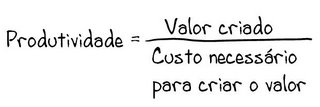
"If the traditional definition of productivity is output per worker hour, most improvement efforts historically have been focused on the denominator in that equation: worker hours."
...
""Over the past 20 years, manufacturing plants were considered outside the domain of the business itself," says Peter Martin, vice president of strategic ventures at Invensys Process Systems. "Executives viewed plants as necessary evils, and they focused a lot of their productivity improvement activities on headcount reduction."
.
"If the traditional definition of productivity is output per worker hour, most improvement efforts historically have been focused on the denominator in that equation: worker hours."
...
""Over the past 20 years, manufacturing plants were considered outside the domain of the business itself," says Peter Martin, vice president of strategic ventures at Invensys Process Systems. "Executives viewed plants as necessary evils, and they focused a lot of their productivity improvement activities on headcount reduction."
.
In the 1970s and 1980s, the investments in new plant floor automation and control systems were most often justified by headcount reductions. Productivity-focused technology investments were calculated primarily to reduce labor costs rather than streamline or reengineer core processes.
.
In the 1970s and 1980s, the investments in new plant floor automation and control systems were most often justified by headcount reductions. Productivity-focused technology investments were calculated primarily to reduce labor costs rather than streamline or reengineer core processes.
.
As a result, Martin says, "In the '70s and '80s, we saw huge reductions in the headcount of field and control room operators. In the '80s and '90s, the focus was on automating maintenance, and headcounts in maintenance departments plunged. And, in the '90s and 2000s," he says, "the focus has been on engineering.
.
.
It's gotten to the point that many plants found themselves below the critical mass level in terms of headcount.
.
.
So the focus on reducing headcount as a way to generate productivity is over."
.
.
Now, Martin says, manufacturers must shift their focus from the headcount denominator part of the productivity equation to the numerator: making sure the plant is operating at maximum efficiency, that assets are generating the greatest possible return on investment, and that companies are agile enough to recognize shifts in demand and to respond to them quickly.
In order to do that, experts say, manufacturers must leave behind the notion that the plant is a necessary evil, divorced from the rest of the business. Plant-level processes and systems must be integrated with the processes and systems of the extended enterprise such as sales, fulfillment, and procurement, so that business managers and manufacturing operators alike have better, up-to-date visibility into not just how well a machine or production line is operating in isolation, but how well it is contributing overall to profitability, return on assets, and production goals.
.
With that kind of integrated view, analysts say, the definition of productivity itself will change. Rather than finetuning operations so that they simply pump out the most widgets per hour, manufacturers will be able to optimize, for example, on profitability or the ability to respond quickly to changes in demand."
.
Não é fácil encontrar esta linguagem que pregamos aqui no blogue.
Reflexões sobre a produtividade
"What determines productivity?"
.
"When Bartelsman and Doms (2000) reviewed the state of knowledge in this area a decade ago, one of the most prominent and substantive findings were the enormous and persistent differences in measured productivity across producers, even within narrowly defined industries.
.
That some producers obtained twice as much output (or more) from the same measured inputs shaped research agendas over the past decade in a number of fields, including macroeconomics, industrial organisation, labour, organisational economics, and trade. Recent research efforts have been directed at trying to understand why these productivity differences exist and are so ubiquitous."
...
"The new findings offer two categories of explanations for inter-firm productivity differences.
- One includes factors that operate primarily within businesses, be it at the firm, plant, or even production line level. These are potentially under the control of management or other economic actors inside the firm.
- The second set contains elements external to the firm. The impact of these “environmental” factors might not always be direct, but they can affect producers’ willingness and ability to harness factors in the first set. They may also influence the amount of productivity dispersion that is sustainable in equilibrium."
IMHO, o factor mais importante, intra-sector, para explicar a disparidade na produtividade reside:
- "Managerial practice/talent
Os jogadores de bilhar amador...
só pensam na jogada imediata. 10 anos é muito, muito à frente.
.
"In the whole discussion about whether the U.S. should borrow more now when the interest rates are low, I miss one crucial thing - what happens when the debt comes due?
.
Risk-free debt is really risk-free only when the maturity also coincides with terminal repayment. "
.
Risk-free debt is really risk-free only when the maturity also coincides with terminal repayment. "
.
Texto completo aqui.
Lugar do Senhor dos Perdões (parte IV)
Continuado daqui, daqui e daqui.
.
Voltando ao livro "Job Creation and Destruction" de Steven Davis, John Haltiwanger e Scott Schuh:
.
"First, the great heterogeneity of plant-level job growth and productivity outcomes suggests that businesses probably exhibit sharply different responses to policy interventions, even within narrowly defined industries or other sectoral groupings. Because businesses are not easily classifiable into sectors with homogeneous behavior, policies that grant preferential treatment to identifiable groups of firms can be poor tools for encouraging or discouraging particular economic activities. For example, when an industry successfully lobbies for import protection in the name of protecting jobs, some firms may not use the resulting increase in cash flow to preserve jobs."
...
"the large role played by idiosyncratic factors makes it more difficult to discern the impact of policy interventions on the performance of affected firms."
...
"the idiosyncratic determinants of business performance exacerbate the cost and difficulty of evaluating targeted commercial policies. As a consequence, useless or harmful targeted policies are more likely to persist over time before recognition of their inefficay sets in."
...
"Debates about targeted industrial policy often center on the government's capacity or lack of capacity to identify potential winners. (Moi ici: Pois, o Grande Planeador, o Grande Geometra que tudo sabe) In our view, an even more serious problem with targeted industrial policies involves the government's ability to respond appropriately to economic losers. By their nature, targeted policies engender political constituencies with a special interest in preserving the benefits of preferential tax, subsidy, or regulatory treatment. Once organized, these political constituencies continue to press for preferential treatment regardless of whether the targeted policy continues to promote greater economic efficiency. Thus, targeted policies encourage the formation of special interest groups that, in turn, undermine the application of economic efficiency criteria to future economic policy decisions. (Moi ici: Como diz o miúdo do filme "O Sexto Sentido", "All the time!!!" )
.
This line of argument is not new, but it acquires greater force from the evidence of heterogeneity in plant-level employment and productivity outcomes. The large magnitude of job creation and destruction, including the important role of births and deaths, suggests that trial and error play a central role in economic growth and in the evolution of businesses and industries. Put differently, large-scale business failure and job destruction are normal, probably essential, elements of a successful market economy. But targeted policies impede the trial-and-error process by inhibiting business failure and job destruction when such outcomes are economically desirable. ... Market mechanisms for dealing with economic failure are likely to operate more efficiently and expeditiously than political mechanisms."
.
Continua.
terça-feira, junho 29, 2010
Nós também vamos precisar de um corte de cabelo
"Roubini says Greece needs orderly debt restructuring to avoid 'inevitable default'"
.
"He argues that orderly restructurings, such as in Pakistan in 1999 and Uruguay in 2002, "are better for most private creditors, the debtor nation and multilateral institutions thatn an Argentine-style botched bail-out"."
.
Vamos precisar e não vou ter pena de quem empresta droga a governos viciados.
Primeiro passo para iniciar a mudança
Acabar com as negações e biombos e enfrentar a realidade de frente...
.
Não consigo imaginar um político da Península Ibérica com esta linguagem:
.
"many people are under the “delusion” that just because the UK has historically been one of the richest countries on earth, it will always remain so.
.
Only if we “reboot and rebuild” the UK economy can the country’s future prosperity be assured, he said."
...
"“I think too many people in this country are living under the delusion that a prosperous past guarantees a prosperous future. But it isn’t written anywhere that this country deserves a place at the top table.."
.
Por cá, ainda há dias, Mário Soares dizia que somos um país de futuro... por causa do nosso esforço e trabalho? Não, por causa da nossa história e localização geográfica.
.
Que inveja...
.
Trecho inicial retirado de "David Cameron: 'The world doesn't owe us a living'"
Somos todos alemães (parte VI)
Esta é uma afirmação antiga neste blogue, basta recordar "Somos todos alemães (parte V)"
.
Sintomático que Merkel hoje a tenha repetido "«Princípios da economia alemã devem ser seguidos por todos»"
Está tudo relacionado
"Portugal entre os países onde o IVA mais subiu"
.
"Sócrates é recordista europeu da subida dos impostos sobre trabalho"
.
"O tira-teimas de 2011"
.
"Sócrates discute crédito à economia com banqueiros"
.
"Sócrates é recordista europeu da subida dos impostos sobre trabalho"
.
"O tira-teimas de 2011"
.
"Sócrates discute crédito à economia com banqueiros"
.
Tudo consequências naturais de uma espiral de degradação decorrente do estertor de uma economia socialista normanda.
Sensory branding (parte II)
Já escrevemos aqui sobre o conceito de sensory branding: aqui e aqui.
.
Pois bem, "Sensory branding from Singapore Airlines"
O choque chinês num país de moeda forte (parte VI)
Em linha com o segundo gráfico deste postal "O choque chinês num país de moeda forte (parte II)" (o título é sintomático e premonitório), em linha com este postal sobre o emprego e a produtividade (especial atenção ao quadrante C):


Este interessante artigo "Downsizing in German Chemical Manufacturing Industry during the 1990s. Why Small is Beautiful?" lança mais algumas pistas de reflexão sobre o jogo do gato e do rato e sobre como o choque chinês é enfrentável num país de moeda forte.
.
"The 1990s have brought about severe competitive challenges and new rules of playing game in chemical industry. Freeman (1999) claims that the last decade was accompanied by great changes, with the massive restructuring as the key feature:
The days of the integrated chemical company were coming to an end, with companies abandoning noncore business segments in efforts to boost the creation of shareholder value. The reshaping of the industry had begun in the 1980s, but it was on a small scale compared to that in the 1990s.
...
The German chemical industry have been doing tremendous job (Landau and Arora, 1999) and continues to do so in development of the global and national economies in terms of employment, investments and value added as reported by the President of the Verband der Chemischen Industrie e.V. (Association of the German Chemical Industry). In past several years, the industry has been downsizing, “right sizing,” and producing new companies through small mergers, megamergers, and spin-offs. The new business reality gives every reason to believe there will be further consolidation and subsequent downsizing in the chemical industry (Millenium Special Report, 1999). This is also confirmed by the data for German chemical industry for 1992–2004 period, which tells us that the average size, defined as the number of employees of the firm, has decreased by about 47% (from 813 to 433).
.
This seems counterintuitive to the general trend of merges and acquisitions (Weston et al., 1999), and to the literature, which documents that relatively larger firms have better propensity
to survive, and that economical/technological situation has put considerable pressure on smaller firms (Swift, 1999). Then the natural question arises: “Why small is beautiful?”
.
The globalization has taken great pace during the 1990s and the “whales” of the traditional German manufacturing industries had to respond to changing environment in which production process could be transferred to nearby low-cost geographical locations. Audretsch and Elston (2006) claim that the dominant (largest) firms have reacted by substituting of technology and capital by labor as well as by locating the new plants outside Germany. In the chemical sector during 1991–1995 the domestic employment decreased by 80 thousands, while 14 thousands jobs were created by chemical firms outside Germany;
...
"Baily et al. (1996) check the conventional faith that the rise in productivity and dowsizing are linked through some microeconomic mechanism.
Authors find, though, that both dowsizers and upsizers increase in productivity and the relationship is quite complex and not clearcut. In their other paper, Baily et al. (2001) try to resolve the debate on cyclical nature of the labor productivity over time. They claim that the productivity of long-term downsizers tends to be quite considerable, much larger than that of long-run upsizers." (Moi ici: A melhoria disruptiva é mais rentável que a melhoria incremental)
...
These findings suggest that for German chemical manufacturing firms improving technical efficiency has not been the first priority during the 1990s. Instead, they have been paying special attention to establishment of an optimal scale, while technical efficiency has been supported on a certain level.
...
Bathelt (2000) identifies three types of German chemical firms: (i) semiflexible integrated firms, mainly medium-large and large sized, with main features being high degree of vertical and/or horizontal integration and limited product and process flexibility; (ii) conventionally specialized firms, mostly small and medium sized, which are characterized by a low degree of product and process flexibility; and (iii) flexible specialized firms, which are mostly small and can only be found in the narrow chemical subindustry (pigments, dyes, paints, and varnishes). Except for the third type of firms, which tries to achieve economies of scope to adjust to market-segmentation tendencies, the first two care about economies of scale by various production activities and by producing relatively long-term homogeneous goods."
...
Bathelt (2000) identifies three types of German chemical firms: (i) semiflexible integrated firms, mainly medium-large and large sized, with main features being high degree of vertical and/or horizontal integration and limited product and process flexibility; (ii) conventionally specialized firms, mostly small and medium sized, which are characterized by a low degree of product and process flexibility; and (iii) flexible specialized firms, which are mostly small and can only be found in the narrow chemical subindustry (pigments, dyes, paints, and varnishes). Except for the third type of firms, which tries to achieve economies of scope to adjust to market-segmentation tendencies, the first two care about economies of scale by various production activities and by producing relatively long-term homogeneous goods."
O jogo do gato e do rato (parte VI)
"Paul Krugman Explains The Unmistakable Link Between Inequality And Financial Crises"
.
"His basic thesis: it's not an accident that the two "big ones" in American history have both occurred just as inequality reached extreme peaks."
.
"His basic thesis: it's not an accident that the two "big ones" in American history have both occurred just as inequality reached extreme peaks."
.
O que causa o aumento da desigualdade dos salários?
.
A globalização!!!
.
Basta recordar a parte V desta série.
segunda-feira, junho 28, 2010
Poupança alheia e paciência
"Primeiro, não se pode ancorar processos sustentáveis de crescimento em poupanças alheias, tipicamente volúveis. Segundo, não existem milagres instantâneos e indolores. O sucesso económico demora a conquistar-se, exigindo paciência, perseverança, consistência e constância."
.
Trecho retirado de "Crescimento: a mãe de todas as soluções"
O jogo do gato e do rato (parte V)
Eis um artigo com conclusões em linha com o modelo de competição defendido neste espaço, "Rising Wage Inequality in Germany" de Johannes Gernandt e Friedhelm Pfeiffer.
Voltemos ao nosso esquema habitual:
.
"Based on samples from the German Socio-Economic Panel (GSOEP) 1984 to 2004, this paper investigates the evolution of wages and wage inequality in Germany. Between 1984 and 1994 wages for prime age dependent male workers increased on average by 23 percent and the wage distribution in West Germany was fairly stable. Between 1994 and 2004 average wages rose by about 8 percent in West Germany and 28 percent in East Germany. In this period wage inequality for prime age dependent males, measured by the ratio of the ninetieth to tenth percentile of the wage distribution, increased from 2.1 to 2.5 in West Germany and from 2.3 to 2.9 in East Germany.
.
In West Germany rising wage inequality has occurred mainly in the lower part of the wage distribution, whereas in East Germany wage inequality predominantly rose in the upper part of the wage distribution."
...
"Based on the rich GSOEP data the findings suggest that wage inequality in Germany started to increase after the economic downturn 1992/93.5 The significant rise in wage inequality in Germany is a phenomenon that seems not to be related to specific groups of workers as for example the self-employed, women or foreigners. Figure 1 show the evolution of wages between 1984 and 2004 for West Germany."
"For West Germany this implies a strong increase in inequality in a period with only moderate average wage growth."
...
"Figure 3 illustrates the wage distributions for workers in the overall and in the restricted samples for the years 1984, 1994 and 2004. For 1984 and, to some degree, for 1994 the figures indicate the well-known compressed distribution of German wages which is skewed to the right and shaped like a log-normal distribution. The 2004 figure, however, shows more dispersion and more symmetry. Apparently, compared to 1994, more workers earn both very low and also relatively high wages."
As empresas no quadrante A, para tentarem sobreviver, vão baixar salários nominais, aumentar horas de trabalho, reduzir regalias e direitos dos trabalhadores. Por exemplo, os trabalhadores da VW na Alemanha, que têm de competir com trabalhadores portugueses e eslovacos. (Como me recordou um meu cunhado esta semana, a VW ainda está na Alemanha na dimensão que está porque o estado da Baixa-Saxónia é o segundo maior accionista. As empresas do quadrante A, são empresas de grande dimensão, politicamente sensíveis, sempre sob a atenção dos media.
.
As empresas do quadrante A são as que aumentam a sua produtividade sobretudo à custa da melhoria da eficiência obtida com a redução de custos e desperdícios.
.
As empresas a que Hermann Simmon chama de "campeões escondidos" são pequenas empresas ágeis que operam sobretudo no quadrante D. As empresas do quadrante D são as que aumentam a sua produtividade sobretudo à custa do aumento do valor acrescentado dos bens produzidos, ou seja, o famoso numerador. Basta recordar Rosiello para perceber o poder de alavancagem que este tipo de aumento da produtividade permite. Os trabalhadores das empresas do quadrante D podem aumentar os seus trabalhadores sem porem em risco a sua competitividade.
.
Trata-se mais uma vez, para os trabalhadores das empresas do quadrante A, a estória do "The Itchy & Scratchy Show" (quatro parte anteriores) como ainda há dias recordou o ministro TdS.
.
Se não fosse o peso das empresas dos quadrantes D e C na economia alemã, como seria possível compatibilizar um aumento de 8% dos salários nominais na Alemanha no mesmo período em que os custos unitários de trabalho baixaram 20%.
.
BTW, comparar com números por cá aqui.
Subscrever:
Comentários (Atom)