domingo, junho 07, 2015

Curiosidade do dia

No ano passado tive uma reunião com o gerente de uma empresa de balões. STOP!!!
.
Pára tudo!!!
.
Balões?!?!?!
.
Pois, também eu pensava o mesmo. Balões são balões, fabricam-se algures na Ásia e vendem-se por tuta-e-meia. Ignorância minha!!! Percebi que sim, que existe esse mundo, mas que também existe o mundo dos balões de qualidade no acabamento, não para as festas de aniversário da pequenada, mas para animar congressos, seminários, feiras, ...
.
Foi disso que me lembrei ao ver estas imagens:
É animador e, sobretudo, revelador, perceber que em todos os sectores existe espaço para uma panóplia de abordagens estratégicas:


O importante é não generalizar receitas


Há dias o JdN publicou o artigo "O crescimento nos extremos da cadeia do valor". Confesso que a mensagem me surpreendeu:
"As cadeias de valor mudaram radicalmente com a abertura ao comércio da China e de outros países em vias de desenvolvimento, a existência de tecnologia de informação e a modernização da logística. Com esta transformação, o valor concentrou-se nos extremos da cadeia de valor. O design, o branding, a concepção dos produtos que o consumidor quer comprar e, depois a distribuição, as vendas a retalho, onde é preciso convencer o consumidor a comprar os produtos. [Moi ici: Este trecho está muito mal metido, uma concepção obsoleta. Em vez de produzir produtos que têm de ser impingidos, que têm de ser empurrados, produzir produtos que são puxados pelos clientes, que são co-criados com elesA produção, que ficou no meio, perdeu o seu atractivo.
...
Por isso, para capturar um maior valor nestas cadeias as empresas têm de se especializar nas fases com maior capacidade de diferenciação e externalizar as restantes. "Tipicamente,as actividades que agregam mais valor são as que se encontram a montante da cadeia de valor (como inovação. desenvolvimento de produto e design) ou a jusante (como, por exemplo, o marketing, a gestão da marca e o controlo dos canais de distribuição)"
Depois, o artigo termina com:
"Os caiaques Nelo deviam ser uma bandeira da indústria portuguesa, pois qualquer canoísta quer ter um caiaque Nelo"
Ou seja, o artigo termina com um exemplo baseado na produção nacional.
.
Pessoalmente, prefiro que se mantenha a produção por cá e se suba na escala de valor, como o têm feito os sectores tradicionais, incorporando os "extremos da cadeia" junto da produção. Realmente a produção tem menos valor se a oferta for básica, for madura, for standard, for ... obsoleta e baratucha. Contudo, quando fazemos uso da flexibilidade, da proximidade, das pequenas séries, da rapidez, da autenticidade, é fundamental ter a produção por perto.
.
O importante é não generalizar receitas, por exemplo, no mobiliário vemos o casamento de empresas que dominam os extremos com empresas que produzem, e a combinação parece resultar. No calçado vemos cada vez mais empresas que dominam a produção, a dar o salto, com marca própria, para ocuparem também os extremos ao seu ritmo, sem pôr em causa o private-label.

“Who is our customer?”

"Customer Confusion
Ask 10 random people in your organization “Who is our customer?” How many different answers would you get?
Ideally, the answer is the same. There is only one customer. Your strategy, resources and goals and objectives must be aligned around a singularly defined customer.[Moi ici: Um dos temas mais queridos neste blogue, a importância fundamental de definir quem são os clientes-alvo. Ao longo dos anos marcadores como: clientes-alvo; miudagem, fantasmas estatísticos. É fundamental perceber quem são os clientes-alvo, para poder desenhar uma proposta de valor talhada para os servir]
...
A lack of clarity and alignment about the customer leads to confusion and uncertainty about critical organizational priorities. A consistent definition of customer, can break down silos, unlock lost productivity and empower your people.
...
Getting consensus about a single definition about who your customer is can be a very powerful driver of high performance, but very difficult to achieve. You will have to contend with identifying who is not your customer, just as much as you will have to define who your customer is. Once the senior leadership team is aligned on the customer definition then it will be critical to define how each of the units led by the senior leadership team fits into the value chain of the customer.
Misalignment about the customer at the senior leadership team impacts the entire organization."
Vale a pena ler o artigo para perceber algumas consequências de não ter definido e comunicado quem são os clientes-alvo.


Trechos retirados de "Customer Clarity … Exactly who is your Customer?"

Acerca do futuro, a caminho de Mongo

Três textos, três temas que se relacionam permitindo perspectivar, espreitar, um pouco do futuro em Mongo.
"Solar PV works differently: it converts sunlight directly into electricity.
...
This difference sounds technical, but it is enormously consequential. It brings three obvious advantages, often touted by solar proponents.
.
First, a solar cell has no moving parts, so operation and maintenance costs tend to be very low. It has to be kept clean, but that's about it.
Second, a solar cell requires no fuel — so fuel costs are zero. Once the initial investment is paid off, and subtracting modest O&M costs, the power produced is  free.
And third, a solar cell generates power without any pollution."
Os painéis solares vão ser cada vez mais eficientes e mais presentes no dia a dia, em locais que hoje não imaginamos, como a fachada de um edifício. A energia estará disponível em todo o lado, mesmo sem rede eléctrica (parte I e II).
 "[Moi ici: O choque da passagem da máquina a vapor como alimentadora de energia de uma fábrica, para a electricidade] Electrification enabled, for the first time, equipment that could operate independently of others in the factory, with the introduction of local electrical motors. Instead of being dependent on one or more line shafts, each piece of machinery could operate with a unit drive. This possibility completely confounded the designers and operators of the existing plants. Indeed, the magnitude of the potential change in plant design and possibility was so significant that many operators simply could not comprehend how vast the changes would be.
...
With the advent of commercial 3-D printing, we are on the cusp of yet another seismic change in our assumptions of how manufacturing is conducted. Entire concepts that have underpinned the gospel of manufacturing, including lean manufacturing, six sigma quality, supply chain management, and many others will be challenged in the same, difficult-to-grasp way that electric motors called into question the gospel of plant design back in the 1900s. Many will have the same difficulty making the transition as their predecessors who depended on a centralized source of power did."
"Within days of Perry’s performance, he began to sell his Left Shark figurine on Shapeways, a central marketplace for 3-D-printed objects,
...
The following day, Shapeways heard from Perry's lawyers. They demanded that the site swiftly remove Left Shark from the site, claiming that Perry owned the copyright on the shark suit. [Moi ici: Weird! Patentes no vestuário?] Within hours, the site complied.
...
Familiar with the terrain, Sosa moved his Left Shark to Etsy and his personal website, then took to Twitter to drum up awareness of Perry’s lawyers’ accusations. As Sosa’s tweets went viral, NYU law professor Christopher Sprigman, who specializes in intellectual property conflicts, offered to represent him.
...
Second, the copyright claim was erroneous to begin with. Perry didn’t own the copyright on the shark suit, because the suit wasn't necessarily copyrightable to begin with. Costumes fall into the category of "functional goods,"[Moi ici: Eu sabia] legal jargon for something that serves a useful purpose, as opposed to just being ornamental, Springman explains.
...
It isn't clear yet if the rapidly growing technology of 3-D printing is straining other potentially competitive industries. At the moment, the NPD Group reports that action figures, accessories, and role-play toys accounted for $1.26 billion of $20 billion in U.S. toy sales in 2014.[Moi ici: Como não pensar no exemplo da indústria discográfica, nos jornais, na ...]
...
"We have all learned a lot from technological disruptions in the past decade or two, and the biggest lesson seems to be that the best response to your customers adopting a new technology is to meet them there," he says. More legal battles over 3-D printing are coming, and uglier ones too. Weinberg underscores the upside to all the fighting for the future of the technology as a whole. "The good news is that all of this is a sign of a growing industry, and is really only happening because we are starting to see success."[Moi ici: Não pensei que começassem tão cedo]"


Ter uma estratégia clara = escolhas claras = ideias claras = desejar sucesso à concorrência (parte IV)

Parte I, parte II e parte III.
Um intervalo no comentário das entrevistas no relatório "European Health & Fitness Market - Report 2015" da Deloitte, para sublinhar alguns pontos interessantes em "Comment on Pure Gym buying LA fitness":
"What does this mean for the UK fitness industry?.
As the LA fitness clubs convert over to the Pure Gym brand it means one of the industry’s founding gym brands will leave the high street, subject to CMA approval of course. It’s a little sad but also a reflection of how the gym landscape has changed and how consumers have quickly embraced new fitness trends. The longer established gym brands have recently been re-defining their core offering to ensure they remain relevant in an era of abundant gym and broader fitness offerings. I believe this is the year they need to demonstrate a real leap in value for their members otherwise they face a bleak outlook.
.
Has the fitness industry become increasingly stratified by cost?.
I see the UK health and fitness market bifurcating or forking along two distinct pathways – ‘self-service’ and ‘supported’. ... Low-cost gyms have tapped this phenomenon very effectively, attracting members seeking a more ‘narrow’ gym-led fitness experience and content to serve themselves. However, perhaps less conspicuous is the second pathway, which I describe as ‘supported’, where customers seek and pay for a more guided experience. This is where the very best specialist studios are to found purposely engaged in helping customers reach a desired health and wellbeing aspiration. So one pathway serves up outputs (facilities) and the other outcomes, a critical difference. [Moi ici: Muito bom. Uns disponibilizam equipamentos, disponibilizam instalações, outros ajudam a atingir objectivos. É o "How can we help?". Costumo usar esta comparação]
.
I think the issue for legacy brands such as LA fitness is that the consumer has been receiving more of a self-service experience, but at monthly fees far higher than offered by low-cost gym brands.[Moi ici: Outra vez muito bom!!! Em sintonia com o meu diagnóstico. O que só revela o quanto há por fazer nas "legacy brands"]
...
What future moves do you anticipate in the sector?.
The low-cost gym brands will continue building momentum and their geographic reach in order to bring affordable and accessible fitness to all corners of the UK. However, also look out for the specialist boutique-style studios such as Psycle, Heartcore Fitness, Barry’s Bootcamp and 1Rebel that attract a fanatical following from customers seeking expert-led sessions. These people are prepared to pay £20 for a single 45-minute class, which is proof that parts of the industry are not commoditising."
BTW, não esquecer esta citação retirada da coluna de citações:
"When something is commoditized, an adjacent market becomes valuable"
O mundo económico é, cada vez mais, não o triunfo de um modelo, mas a explosão de diferentes modelos, dedicados a diferentes tribos, permitindo a coabitação pacífica


sábado, junho 06, 2015

Curiosidade do dia

"A newly-released headset hopes to wake people up or calm them down by manipulating the electricity in their brain.
.
Thync costs $299 and has just been released to the public. It provides “calm or energy on demand”, the company says, by using “neurosignalling” to activate nerves and change people’s state of mind."
Isto pode ser mau para o ecossistema que vive da venda de comprimidos para as depressões e para dormir.

Trecho retirado de "Thync: company launches mood-changing wearable that zaps brains"

Limpinho, limpinho, limpinho

"Um regime económico baseado na dívida é diferente do regime económico estruturado pelo capital. O capital vale mais do que o seu valor actual, porque nele está inscrito o padrão de relações económicas, sociais e políticas que permitiram no passado a sua acumulação e que contém a potencialidade de continuar a gerar mais capital no futuro. A dívida revela que foi gerada por um padrão de relações que é inviável, pelo que só tem interesse como via de entrada para quem, tendo capital, quiser impor a dominação e a subordinação, é uma canga que se põe ao pescoço.
 .
Na estimativa de Francisco Louçã, a dívida de toda a economia portuguesa será de 702 mil milhões de euros, quatro vezes o PIB, a que corresponde uma dívida por habitante de 70 mil euros. É melhor descobrir esta realidade tarde do que nunca, mas já não chega a tempo de evitar as consequências. Quando a esfera da dívida interfere na articulação das esferas económica, social e política, tudo fica distorcido e perturbado e as relações em que se baseiam as decisões já não podem insistir nas ilusões do passado."
Trecho retirado de "A canga e o pescoço"

Mais material, sim, mais material para reflexão

Por várias vezes ao longo dos anos, neste blogue, tenho criticado a Centromarca por desperdiçar tanta energia numa guerra com os seus clientes, a distribuição grande, e não se concentrar no mais importante, naqueles que mandam na distribuição grande, os consumidores, os clientes dos seus clientes.
.
Por isso, não surpreende um resultado como este:
"E se, de repente, as marcas que conhecemos desaparecessem?
Na maior parte dos casos, isso não teria qualquer impacto para a vida dos portugueses. Pelo menos, isso é o que dizem os resultados do estudo Meaningful Brands Portugal 2015. Este estudo mostrou que as únicas marcas que fariam falta são as marcas relevantes, que representam apenas 26% do total de 96 marcas  analisadas no País. São aquelas que são imprescindíveis, porque fazem de facto uma diferença na vida das pessoas.
.
Este fenómeno não é exclusivo de Portugal e, a nível global, os valores são os mesmos. Resultados, aliás, que se têm vindo a agudizar desde 2011, o primeiro ano em que foi realizado o Meaningful Brands. Se nesse ano 71% das marcas poderiam desaparecer sem as pessoas se importarem, em 2015 o número aumentou para 74%, confirmando uma tendência generalizada de cepticismo e desconexão dos consumidores em relação às marcas."
Num mundo a entranhar-se em Mongo, em que há cada vez mais gente fora da caixa, os consumidores apreciam menos as marcas?
.
Julgo é que desconfiam cada vez mais das marcas gigantes herdades do século XX, não admira que depois vejamos isto "These Are The Giant Corporations That Own Your Favorite Organic, Mom-And-Pop Brands" (e não querem que se saiba), procuram autenticidade e atenção a pontos que vão contra a religião dominante, a da eficiência.
.
Trecos retirados de "E se de repente as marcas que conhecemos desaparecessem?"

Mais material para reflexão

Acha mesmo que a evolução demográfica em Portugal se deve à troika, ou à falta de creches, ou à falta de condições económicas?
Não será antes por outro conjunto de razões mais gerais, mais transnacionais, mais profundas?
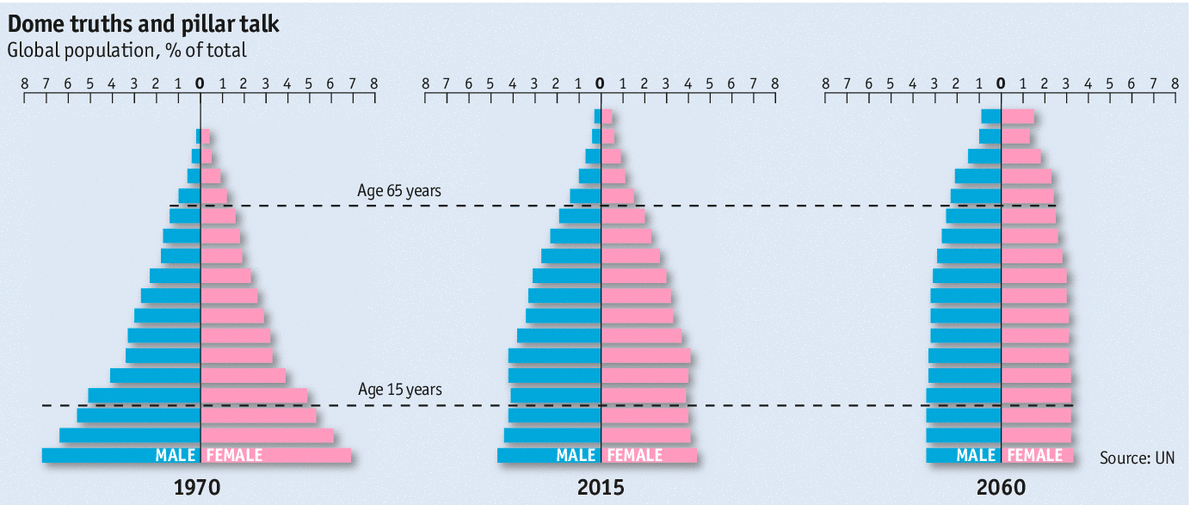
"The size of the Earth’s population is still rising, from 7.2 billion in 2015 to 9.5 billion in 2060. But, according to calculations by Emi Suzuki and Wolfgang Fengler of the World Bank, two-thirds of the extra 2.2 billion people in 2060 will be in the age group between 40 and 79, not from younger people. The increase in the last, oldest segment is especially marked. Between 2015 and 2060, the number of 60- to 79-year-olds will increase by 1.1 billion, or 131%. That is five times the increase in the number of children and teenagers, which will rise by only 220m, or 9%. The numbers of the oldest people of all (those above 85, here lumped together in one bar) will rise at the fastest rate of all (by 281% in 2015-60), but from a much lower base, so they do not add as many people to the total."
Por formação, por mania, sei lá porquê, tenho tendência a colocar este tipo de questões tentando prejudicar o mínimo possível as gerações posteriores a mim, talvez por causa da definição de desenvolvimento sustentável da senhora Brundtland. No entanto, esse não é o ponto de vista da maioria das pessoas e dos governantes, que pensam primeiro nos votos.
.
Por isso, há anos que incuto nos meus filhos a possibilidade de emigrar, para não serem escravos dos velhos egoístas. Há dias, no Twitter, apanharam bem a coisa:
"Os apologistas do modelo de SS baseado na explor da geração seguinte esqueceram-se q esta podia preferir emigrar"
Daí que não admira que isto seja uma realidade "Cerca de 65% dos médicos portugueses em formação ponderam emigrar", agora podem acreditar nas justificações que verbalizam para o justificar, eu não acredito.


Trechos e imagem retirados de "The world reshaped"

Alimento para reflexão

"In this paper, we propose a model in which the effects of taxation on growth are highly non-linear. Taxes have a small impact on long-run growth when taxes rates and other disincentives to investment are low or moderate. But, as tax rates rise, the marginal impact of taxation on growth also rises. This non-linearity is generated by heterogeneity in entrepreneurial ability. In a low-tax economy, the ability of the marginal entrepreneur is relatively low. So, increasing the tax rate leads to the exit of low-ability entrepreneurs and to a small decline in the growth rate. In a high-tax economy the ability of the marginal entrepreneur is relatively high. So, increasing the tax rate leads to the exit of high-ability entrepreneurs and in a large decline in the growth rate."
Agora, é só decidir onde estamos colocados, como país.
.
Trecho retirado das conclusões de "Non-linear Effects of Taxation on Growth" de
Nir Jaimovich e Sergio Rebelo (Março de 2015)

Reflexão-previsão acerca do futuro das plataformas

A propósito de "The sharing economy has created 17 billion dollar companies (and 10 unicorns)" uma reflexão-previsão.
.
Uma espécie X chega a um novo continente cheio de recursos, desabitado ou habitado muito escassamente por espécies muito menos preparadas para a concorrência, essa nova espécie X ocupa rapidamente o espaço e expulsa os fracos concorrentes que encontra e tem oportunidade de crescer e desenvolver-se.
.
Hoje em dia, quando a tecnologia permite criar uma nova forma de ajudar os clientes a realizarem um trabalho em falta na sua vida, é muito fácil ter sucesso, a nova abordagem facilita de tal forma a vida aos clientes que estes acorrem em números sucessivos a essa nova possibilidade. A conjugação da oportunidade com o acesso rápido a capital permite criar uma vantagem de ser o primeiro, que alimenta um crescimento, muitas vezes, espectacular.
.
Este rápido crescimento permite ganhar músculo para enfrentar o principal adversário, os incumbentes de formas clássicas de ajudar os clientes a realizarem o tal trabalho na sua vida.
.
Tudo isto tem algo de universidades privadas em Portugal nos anos 80 do século passado. Nessa altura, a procura era tão grande que a uma nova universidade, para ganhar clientes, bastava aparecer e dizer estou aqui. Depois, a oferta pública cresceu, a oferta privada cresceu e a procura começou a baixar ... e muitas universidades privadas não se prepararam para esse novo cenário, onde teriam de ter uma estratégia de diferenciação face à oferta pública "low-price".
.
Estas plataformas criaram um continente novo, facilitaram tanto a vida aos seus clientes que estes acorreram em massa, o acesso a capital permitiu acompanhar o crescimento do mercado nesta fase inicial da oferta (anos 80 do século passado das universidades privadas) em que os clientes ainda procuram a novidade, ainda estão deliciados com a novidade. Com o desenrolar do tempo, uma vez vencido o papão dos incumbentes das alternativas clássicas conluiados com os poderes estabelecidos, começará a nascer junto da procura e da oferta a necessidade, o interesse na diferenciação e assistiremos a uma explosão de novas formas de prestação do serviço através de plataformas alternativas, mais pequenas, mais segmentadas, mais tribais.

sexta-feira, junho 05, 2015

Curiosidade do dia

"Todas as empresas se voltaram para as exportações e o Norte aumentou a sua liderança em número de empresas.
.
A crise exigiu uma resposta às empresas para não serem obrigadas a fechar as portas. Assim, entre 2008 e 2013, a percentagem de empresas exportadoras aumentou nas sociedades de todas as dimensões, mas o aumento mais significativo, dez pontos percentuais verificou-se entre as pequenas empresas, revela ao estudo da Informa D&B sobre o que mudou no universo empresarial."
Faz recordar aquela afirmação sobre a biologia:
"nature evolves away from constraints, not toward goals"

Trecho retirado de "Pequenas sociedades apostam mais na exportação"

Demasiado lucro?

Para quem como este blogue, promove a máxima:
Volume is vanity, profit is sanity
Comecei de pé atrás com a leitura de "Too Much Profit Can Doom Your Company" ainda para mais fazendo de herói a Amazon.
.
Contudo, depois percebi a mensagem:
"an excessive focus on profits can compete away investments that could lead to creating the next big thing."
Algo em linha com a lição dos nabateus ou "Acerca do lucro".

A mudança fundamental

"Businesses and their leaders think and act still mainly firm-centric instead of customer-centric.
...
The problem is that many businesses are stuck in manufacturing patterns of thought, still embracing a goods-dominant logic. It centres around the notion that value is embedded in the goods which the firms produce. Sounds yesterday, doesn’t it?
.
In contrast, through a service lens value is co-created with customers while they try to get certain jobs done by using a service. This changed perspective offers entirely new possibilities to value creation. Features and incremental  improvements of offerings are no longer in the focus, but the question of how to help customers best to get their job done.[Moi ici: Esta é a mudança fundamental]
...
Strategic advantage comes less through predicting what’s going to happen. Instead, it comes through actions that are taken to create an envisioned future, test it, get feedback and iterate forward." [Moi ici: Por todo o lado, nos últimos dias, vejo esta abordagem bayesiana]
Trechos retirados de "What I learnt about combining SDL and JTBD"

Plataformas em todo o lado

Mais um exemplo do mundo das plataformas em que vamos viver. Para já chegam e encontram oceanos azuis, basta aparecerem e cobram bem por isso, em breve começará a estratificação por nichos:
"zTailors, a website and app that connects customers and their frumpy wardrobes with on-demand tailors who are ready to make house calls.
.
“It’s Uber for tailors,
...
has the potential to transform millions of ill-fitting garments into like-new items.
.
Its app and website allow customers to schedule a tailor to come to their homes or offices, where they will measure and refit suits, shirts, jackets and dresses for a set price. The altered items are then returned in a few days.
...
“In the closets of Americans, there is billions of dollars’ worth of apparel that has accumulated over the years,” he said. “It doesn’t all appear on the good side of the closet. It doesn’t all fit. That’s either because it has shrunk, or you have grown.”
Trechos retirados de "George Zimmer Starts an ‘Uber for Tailors’"

Ter uma estratégia clara = escolhas claras = ideias claras = desejar sucesso à concorrência (parte III)

Parte I e parte II.

Do relatório "European Health & Fitness Market - Report 2015" da Deloitte, retiro estes trechos de uma entrevista com Stefan Tilk, director geral da cadeia Fitness First Germany.
.
Esta é a terceira entrevista que aqui citamos, e a terceira abordagem diferente ao mundo do fitness, mais uma forma de servir um segmento de clientes diferente.
"From your point of view, what are the major trends and developments in the fitness industry that influence your company now and also in the future?.
Digitalisation plays a key role. We see it as an instrument for achieving our major goal: interaction with our customers. Therefore, we use different ways to get in contact with the customers and plan to increase the integration of fitness in the daily life of our members by implementing innovative products and services. Digitalisation also means having an increasing focus on individualisation. With the term "mass customisation", other companies from different industries have already shown that there can be new business models out of this movement. We challenge ourselves: How can we fulfil the customers' increasing expectations? We cannot expect that our members are automatically satisfied when we open a new club. The entire fitness industry, and in particular Fitness First, needs to focus on the individual members' needs. It is important to find reasonable answers to new questions. Moreover, the fitness market is fragmenting. Particularly, micro gyms have seen strong growth over the last years because those concepts fulfil the customers' needs and the investment is manageable. We adopted this development and opened a site with a focus on slow movement in March in Cologne under the new brand "re-level". With "re-level" we implement a different brand identity and offer a new course and price model. The range of courses of re-level includes different elements from yoga to Pilates to functional patterns of movement and cardio sequences that lead to a compensation of tension. The visitor can choose from a unique combination of courses. Instead of a monthly membership fee, "re-level" clubs offer a "pay-as-you-go" concept to be flexible concerning the visits in our sites. If the new concept will be successfully adopted in Cologne, we can envision implementing this concept in other cities. [Moi ici: Mais uma referência ao uso da experimentação para a tomada de decisões de escalar de novas abordagens de negócios]
.
In which market segments do you see a potential to catch up compared to other industries and from which industry can your industry learn? .
The fitness industry can learn from different market segments and industries. A comparison with the retail industry seems to be reasonable. With its new design and product concepts the retail industry offers lots of approaches and inspiration for the fitness industry. More precisely, I think about "shop-in-shop" systems, a link between product worlds and cooperations. [Moi ici: E, com isto, fico a pensar num modelo de negócio de loja multimarcas. Um espaço comum gerido por uma entidade que o promove e aluga a profissionais especializados em disciplinas de fitness, cobrando aos clientes e pagando aos profissionais. Uma espécie de El Corte Ingles de serviços de fitness?]
...
How would you assess the development of the different fitness industry segments and how do you see the alignment of Fitness First in the future? .
There will always be a market for the premium segment. The net income of the German population is increasing constantly and the demand for exclusivity is analogue to this development. Vice versa, the discount segment focuses on the opposed trend. Nowadays, people do not associate "discount" with lower standards, but with "value-for-money" aspects. Concepts such as McFIT, clever fit and FitX have adopted this trend and their success validates their existence."

Duas dúvidas de um anónimo da província

Duas notícias, duas empresas, duas dúvidas de um anónimo da província:

"Para a Efacec, a entrada do novo accionista vai implicar a mudança na gestão e uma aposta crescente em Angola e noutros mercados africanos."
A aposta crescente em Angola, e em outros mercados africanos, significa que deixará de ter recursos para trabalhar o mercado norte-americano? Se sim, é uma genuína escolha estratégica legítima. Terá consequências na gama de produtos e nas margens? Implicará produtos mais maduros? É uma mudança importante nos factores críticos de sucesso, que implicará outros tipos de competências.

"Um grupo de seis bancos, encabeçado pelo maior credor de 23 milhões de euros em dívida, afastou a família Rocha da gestão e nomeou um ex-quadro da Sonae e da Amorim para arrumar a casa"
Espero que o afastamento tenha só a ver com os cargos da gestão de topo e, porquê um ex-quadro da Sonae e da Amorim?
.
Quadros da Sonae Indústria e da Amorim são treinados e são muito bons na gestão de negócios em que a eficiência é fundamental, em que a gestão interna da "Gemba" é crítica. Contudo, o campeonato da Viriato não é o preço, não é a eficiência. O princípio dos problemas da Viriato resultaram do azar de um investimento forte, motivado por um grande sucesso comercial, ter cruzado com uma baixa importante da procura no terrível ano de 2009, algo conjuntural, o know-how e o know-who da família continuam a ser importantes. Continuam ligados ao projecto?

quinta-feira, junho 04, 2015

Curiosidade do dia

Agora, neste momento em que Jesus deixa o Benfica, recordo esta imagem mais do que nunca.
.
Nas duas épocas seguintes saiu por cima.
.
Todos nós podemos ter de ajoelhar. O Eclesiastes diz-nos que ninguém pode prever o futuro, que se pode fazer tudo bem e, no fim, não ganhar o prémio.
.
O importante não é o termos de ajoelhar, o importante é o que fazemos depois do ajoelhar, é a forma como lidamos com o infortúnio... podemos optar por lá ficar, por nos martirizarmos, por culparmos outros pelo que nos aconteceu e não digerirmos, e não aprendermos com a derrota.
.
BTW, espero que Bruno de Carvalho, que estava a fazer o papel de Sócrates-2005, e bem, não tenha passado a fazer o papel de Sócrates-2009

Acerca das escolhas que fazemos

Um excelente resumo dos vários mecanismos que afectam as escolhas que os humanos fazem em "The Psychology Behind How We Make Choices":
  • Bias;
  • Priming and Behavior;
  • Priming and Choice;
  • Bias and Choice;
  • 1) Anchoring bias
  • 2) Framing effect bias
  • 3) Ingroup bias
  • 4) Loss aversion bias
  • Choice Overload;
  • Choice and Willpower;
  • How to Make Choosing Easier
  • 1) Cut
  • 2) Make things concrete
  • 3) Categorize
  • 4) Condition for complexity
"The reasons we make decisions are not always rational and can’t be isolated from who we are, where we are, or maybe even how long it took us to decide what outfit to wear that morning. But by being aware of the psychological factors that affect our choices -- and recognizing how a decision we make at 8 a.m. affects one at 3 p.m. -- we’ll be able to not only make better decisions for ourselves, but help others do the same."


Para reflexão (parte VI)

Parte I, parte IIparte IIIparte IV e parte V.
.
Nos últimos dias tem sido um festival de textos e vídeos associados à Bayesian approach da estratégia.
.
Por exemplo:
"You are so busy looking at what 3D printing can’t do that you’re ignoring what it can do!
.
While her competitors had dismissed additive manufacturing because it couldn’t (at that point) print an entire product, she had focused on just one element of the product. Her firm ramped up from 100 customized parts to 10,000 in just one year. It is now expanding into other parts, and will soon be able to offer customization of the overall product at a premium price. As the company moves down the learning curve and costs come down, the savings from reduced waste, inventory, and assembly labor will even make it competitive for the mass production segment of the market."
  • "The Discipline of Business Experimentation" (artigo de Stefan Thomke e Jim Manzi, publicado na HBR de Dezembro de 2014)
"big data can provide clues only about the past behavior of customers - not about how they will react to bold changes. When it comes to innovation, then, most managers must operate in a world where they lack sufficient data to inform their decisions. Consequently, they often rely on their experience or intuition. But ideas that are truly innovative - that is, those that can reshape industries - typically go against the grain of executive experience and conventional wisdom.
.
Managers can, however, discover whether a new product or business program will succeed by subjecting it to a rigorous test.
...
A rigorous scientific test, in which companies separate an independent variable (the presumed cause) from a dependent variable (the observed effect) while holding all other potential causes constant, and then manipulate the former to study changes in the latter."

  • Numa outra entrevista incluída no relatório "European Health & Fitness Market - Report 2015" da Deloitte, desta feita com Stefan Tilk, Director Geral da cadeia Fitness First Germany
"Before looking into the future, what have been the major developments and milestones for your company during the last twelve months?
.
A major milestone in 2014 was the acquisition of New-Moove, an online gym. We are convinced that there will be a strong link between the online and offline world in the near future. Therefore, we negotiated with different providers of online gyms and finally decided to acquire NewMoove for a number of good reasons.
...
Particularly with emphasis on the second aspect, we had to develop and revise our products and prices, for both our new and existing members."

Ou até mesmo: