Mostrar mensagens com a etiqueta obliquity. Mostrar todas as mensagens

quarta-feira, agosto 20, 2025

Melhorar o retorno da certificação ISO 9001 (parte IX)


A última imagem da Parte VIII pode ser melhorada acrescentando a satisfação, só por causa disso vamos conseguir (?) orquestrar um ecossistema em favor de todos, incluindo a nossa organização. E já agora, sublinhamos os tópicos que incluímos na politica e que caracterizam o nosso alvo (desta vez não escrevi cliente-alvo porque o arquitecto não compra os materiais à Vitrumo, mas prescreve-os ao empreiteiro):

Recordo o trecho da política retirado da Parte VII:
Relaciono também os trechos da política sobre os compromissos, a resposta a pergunta: em que é que temos de ser bons com a satisfação das partes interessadas (a figura acima não inclui todas, por exemplo faltam os centros de saber):

Recordo que queremos desenvolver objectivos relevantes para o negócio.

Pergunto: qual é o teste do ácido para sabermos se uma estratégia resulta ou não? 

Resposta: Resultados financeiros positivos! Lucro!

O lucro, a rentabilidade resulta de dois vectores:
Gastar menos significa ter mais produtividade:
Ter mais produtividade significa ter margem mais elevada:
A margem pode ser aumentada através da oferta de produtos/serviços de maior valor acrescentado, ou através do aumento da eficiência.
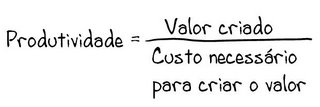
A maior parte das pessoas quando pensa em aumento da produtividade olha para a equação da produtividade e parte do princípio que o numerador, o que se oferece, é uma constante e que só se pode aumentar a produtividade actuando sobre o denominador. Nada mais errado!

Para leitura futura recomendo aqui no blogue dois temas:
BTW, aquele ou (V) na figura acima é essencialmente exclusivo. É claro que uma empresa pode e deve actuar no numerador e denominador, mas um será sempre preponderante em termos estratégicos. Por exemplo, gosto da citação: 
"If the customer doesn't care about the price, then the retailer shouldn't care about the cost."
É bom que a Ferrari trabalhe para ser eficiente, mas esse não será um objectivo da gestão de topo que deve antes ocupar a escassa banda de atenção na criação de valor. 

O teste do ácido para sabermos se uma estratégia resulta ou não é dado pelos resultados financeiros. Contudo, os resultados financeiros não devem ser vistos como um objectivo directo, mas como uma consequência de outras acções. Estamos a falar do tema da obliquidade:
Uma estratégia nunca é eterna, por isso devemos estar sempre atentos a objectivos na vertente financeira. Objectivos de rentabilidade, objectivos de vendas, objectivos de custos ou objectivos de margens. 

De onde é que o dinheiro vem?


Resultados financeiros são uma consequência natural de servir, satisfazer e manter clientes:

Assim, faz todo o sentido seguir objectivos sobre clientes ganhos (clientes novos e recorrentes), sobre clientes satisfeitos e clientes insatisfeitos (satisfação de clientes e reclamações), e sobre clientes mantidos (clientes perdidos, clientes recorrentes, clientes ganhos por word-of-mouth, ...). 

Aqui convém recordar o tema dos clientes-alvo. Para isso recomendo:
Na próxima reflexão vamos desenvolver os objectivos estratégicos para os processos da empresa.

terça-feira, agosto 19, 2025

Obliquidade e lucro


Em 2013 aprendi com John Kay o termo obliquity — obliquidade — que então registei num texto aqui no blogue. A ideia é simples, mas poderosa: certos objectivos não se atingem de forma directa. Lucro, para uma empresa, é como o desemprego para um governo. São metas desejáveis, mas que não podem ser perseguidas de frente. É preciso trabalhar de forma indirecta, sobre as causas que lhes dão origem.

Retomei esse tema em 2021, no texto "Lucro? E para quê e para quem?", onde escrevi que o lucro deve ser entendido como um objectivo oblíquo. Considero absurdo elegê-lo como objectivo directo, tal como seria absurdo ouvir um político declarar que o seu objectivo é apenas reduzir o desemprego. Sempre que isso acontece, dá asneira. O lucro, como a redução do desemprego, é consequência de outras coisas: de clientes conquistados, de clientes satisfeitos, de clientes que continuam a confiar em nós.

Esta semana voltei a encontrar John Kay, agora numa recensão publicada na revista Money Week ao seu mais recente livro "The Corporation in the 21st Century: Why (almost) Everything We Are Told About Business is Wrong". O artigo intitula-se "The goal of business is virtue, not profit" e a tese central é clara: a obsessão com o conceito de shareholder value e a maximização de lucros distorceu a natureza das empresas modernas e acabou por prejudicar não só a sociedade mas também os próprios accionistas.

Kay mostra, com a clareza que lhe é habitual, que a insistência em maximizar lucros não beneficia, em última análise, quem supostamente deveria beneficiar:
“The last people to benefit from the pursuit of ‘shareholder value’ are shareholders.”
Ao focar-se no lucro imediato, desencadeiam-se comportamentos desviantes que acabam por gerar desconfiança pública e queda das empresas:
“Yet a turn to focus on maximising profits at all costs, and the misbehaviour that predictably follows from that, brings a fall, and explains why the public came to mistrust big business.”
Além disso, a própria ideia de que os accionistas controlam efectivamente as empresas é ilusória. As grandes corporações estão envolvidas em teias complexas de relações contratuais, financeiras e regulatórias que tornam o exercício real de propriedade extremamente difícil:
“…figuring out who really ‘owns’ modern corporations… is no easy matter… actually exercising the rights of ownership and control is far easier said than done.”
Os exemplos abundam. Empresas outrora ícones de excelência, como a Boeing, a General Electric ou a Bear Stearns, colapsaram precisamente quando passaram a subordinar a sua cultura e a sua estratégia ao dogma do lucro imediato:
“Boeing was a world-leading engineering firm… until a change in the culture led to a focus on profit. The end result was aeroplanes falling from the sky.”
“General Electric was for much of the 20th century regarded as the best-run company in the US. A ruthless turn to focus on ‘shareholder value’… led in the end to the collapse of the firm.”
Em contrapartida, Kay sublinha que o verdadeiro motor do sucesso empresarial não está apenas no capital acumulado ou nos activos detidos, mas na capacidade de mobilizar talento, inteligência colectiva e relações duradouras. O que distingue as empresas bem-sucedidas é a sua aptidão para transformar competências individuais em capacidades únicas que criam valor e são difíceis de replicar:
“The hallmark of a successful business today is ‘harnessing collective intelligence that isn’t common property’.”
O sucesso empresarial, portanto, não nasce de transacções meramente instrumentais, mas da construção de relações de confiança inseridas num contexto social mais vasto:
“…successful commercial relationships are not simply instrumental and transactional, they are ‘social and embedded in a wider framework of communities and teams’.”
A lógica é simples e, diria eu, profundamente oblíqua: sirvam-se bem os clientes, criem-se relações de confiança e de longo prazo, e o lucro virá como consequência natural. É um erro inverter a ordem:
“Serve your customers well and the profits will follow… It rarely works the other way around.”
Em suma, o pensamento de John Kay sobre obliquidade aplica-se aqui de forma exemplar. O lucro não é um objectivo directo. É um resultado, uma consequência. A obsessão em persegui-lo frontalmente destrói empresas, distorce mercados e mina a confiança social. Já o foco em clientes, em relações e em inteligência colectiva cria as condições para que o lucro surja de forma sustentável e duradoura.

terça-feira, julho 29, 2025

Melhorar o retorno da certificação ISO 9001 (parte IV)

Parte I, Parte II e Parte III. 

Por que é que a aplicação da abordagem por processos falha?

  • Foco excessivo em documentação e procedimentos. A norma é interpretada de forma literal, levando à criação de documentos redundantes apenas para "cumprir requisitos", o que torna o sistema burocrático sem melhorar verdadeiramente os processos.
  • Mapeamento superficial ou inadequado dos processos. Ignorar o mapeamento e a análise inicial dos processos existentes resulta em lacunas não identificadas. Sem compreender totalmente as sequências e interacções, não se definem responsáveis claros nem pontos de controlo eficazes.
  • Confundir departamentos com processos de negócio. Tratar funções departamentais isoladas como se fossem processos completos, em vez de gerir processos transversais que agregam valor do início ao fim. Ou seja, considerar Compras, Vendas e Produção cada um como um processo independente, sem mapear a ligação entre eles (como um pedido do cliente que atravessa várias áreas), o que impede a visão sistémica e a optimização do fluxo de trabalho.
  • Ossificação ou cristalização dos processos, o que leva à estagnação. Uma abordagem rígida, sem revisão contínua, deixa os processos estagnados no tempo. Dificulta-se a inovação e a adaptação a mudanças do mercado ou a requisitos dos clientes.

O que é que a abordagem sistémica à gestão pressupõe e falha na sua aplicação?

  • Não há relação entre os objectivos da empresa e os objectivos dos processos. Explico melhor, dizer que o somatório dos objectivos dos processos é igual aos objectivos da empresa é não considerar a emergência, uma propriedade fundamental dos sistemas e que o povo traduz por "o todo é mais do que a soma das partes". Ou seja, optimizar o todo, (a organização), implica subordinar alguns processos a outros, daí a clássica imagem dos silos e deste exemplo que uso há anos:


Lembro-me de exemplos de empresas em que o departamento de Comercial ganha vendas não lucrativas porque as vendas são boas para o bónus departamental, mesmo que não sejam lucrativas. O argumento é: isso não é problema meu!


Ou o departamento de Compras que alcança grandes bónus com as poupanças obtidas, enquanto o resto da empresa é atormentada por problemas de qualidade, atrasos ou erros dos fornecedores. O argumento é: isso não é problema meu!


Ou o departamento de Produção tão focado no cumprimento dos objectivos de eficiência que não se preocupa com os acordos com os clientes a nível de prazos de entrega. O argumento é: isso não é problema meu!


Ou o cliente que negociou uma entrega especial, pagou mais por ela, contratou uma equipa para receber e aplicar a entrega e, em seguida, ... já adivinharam, a entrega não é realizada porque o departamento da Logística é valorizado por minimizar os custos de envio e está à espera de mais encomendas para consolidar a entrega. Já sabem qual o argumento ... isso não é problema meu!


A abordagem sistémica à gestão pressupõe definir onde se quer chegar, perceber que existe uma coisa chamada obliquidade, e formular o caminho para lá chegar. Os resultados de hoje resultam dos processos actuais, se queremos resultados futuros diferentes temos de fazer alterações nos processos para criar os processos do futuro, processos diferentes dos processos actuais (pelos alguns deles serão diferentes).


A abordagem sistémica à gestão trabalha com a abordagem por processos através desta representação metafórica:


Os resultados da organização como um todo (Y) são fruto do trabalho realizado em alguns dos processos da organização (xi).

O subordinar alguns processos a outros depende da orientação estratégica, o tal ingrediente que a ISO 9001 não contempla.

Na Parte V desta série vamos abordar o reconhecimento do problema e a vertente da estratégia através da política do sistema de gestão:

domingo, agosto 06, 2023

"Don't aim at success"

"What I "discovered" was that happiness is not something that happens. It is not the result of good fortune or random chance. It is not something that money can buy or power command. It does not depend on outside events, but, rather, on how we interpret them. Happiness, in fact, is a condition that must be prepared for, cultivated, and defended privately by each person. People who learn to control inner experience will be able to determine the quality of their lives, which is as close as any of us can come to being happy.

Yet we cannot reach happiness by consciously searching for it. "Ask vourself whether vou are happy." " said J. S. Mill, "and vou cease to be so." It is by being fully involved with every detail of our lives, whether good or bad, that we find happiness, not by trying to look for it directly. Viktor Frankl, the Austrian psychologist, summarized it beautifully in the preface to his book Man's Search for Meaning: "Don't aim at success - the more you aim at it and make it a target, the more you are going to miss it. For success, like happiness, cannot be pursued; it must ensue... as the unintended side effect of one's personal dedication to a course greater than oneself." So how can we reach this elusive goal that cannot be attained by a direct route?"

O bom velho tema da obliquidade:

Trecho inicial retirado de "Flow - The Psychology of Optimal Experience" de Mihaly Csikszentmihalyi. 

domingo, julho 09, 2023

"Rush to a solution"

"one of the consultant's most important contributions to a client is a redefinition of the problem. The line manager begins by experiencing some pain: people are restless, equipment isn't working, output is down, the invoicing process is flawed, the line extension is running way late.
Most consulting projects get started because managers feel pain. Once in a while, they get started because of a desire for further success or preventive measures, but most often there is some pain in the picture. When the organization feels the pain, managers start to describe for themselves why the pain exists. When their explanation of what is causing the pain is accurate, their attempts to solve the problem are usually successful. When consultants are called in, the line manager's attempts at solving the problem have not been that successful, or maybe the manager has no idea at all how to solve the problem. When a manager's attempts to solve the problem have not succeeded, it is probably because the manager's attempts to describe the cause of the pain have been inaccurate.
The client's initial attempt to describe to us the cause of the difficulties is called the presenting problem. As a consultant, I never accept the presenting problem as the real problem without doing my own discovery and analysis. The presenting problem and the real (or underlying) problem are different. Because line managers start from an incomplete definition of the problem, their attempts at solution have not entirely worked out. Therefore, an important contribution for the consultant is to redefine that initial problem statement for the client."

Ao ler isto lembrei-me logo dos políticos que perante um sintoma doloroso, trabalham directamente para o resolver sem irem à causa. Aliás, não o resolvem, lançam fogo de artifício para fazer de conta que fazem alguma coisa (rush to a solution). Recordo:

"The last form of resistance is the client's desire for solutions, solutions, solutions: "Don't talk to me about problems; I want to hear solutions." Because the consultant is also eager to see the problems solved, some collusion can take place between consultant and client if the discussion of solutions is not held off a little.

The desire for solutions can prevent the client from learning anything important about the nature of the problem. It also keeps the client dependent on consultants to solve these problems. If the line manager hasn't the patience or stomach to stop and examine the problem, then the solutions are not going to be implemented effectively."

Trechos retirados de "Flawless consulting: a guide to getting your expertise used" de Peter Block.  

sábado, junho 04, 2022

Quem é este morcão?

Um desafio para quem está satisfeito com o rumo que as coisas estão a ter no curto-médio prazo?

Supostamente, implementar um sistema de gestão passa por chegar a uma empresa tirar uma série de fotografias sobre como é que a empresa funciona, comparar com os requisitos da norma de referência e colmatar as lacunas.

Assim, arranja-se um consultor, um suposto especialista na norma de referência, e colmatam-se as lacunas.

Desta forma implementamos um sistema que responde aos requisitos da norma de referência, obtemos a certificação, mas não obtemos um verdadeiro sistema de gestão. Recordar Carl Sagan. O vídeo agora está aqui.

Um verdadeiro sistema de gestão é um sistema que estabelece uma orientação estratégica, uma resposta à pergunta: O que devemos fazer? Depois, traduz essa resposta num conjunto de objectivos claros e promove as mudanças necessárias para os conseguir atingir.

É claro que uma empresa quer aumentar as vendas e o lucro, mas isso é uma consequência do que se faz. Querer aumentar as vendas e o lucro nada nos diz sobre o que a empresa deve fazer para o conseguir. Recordar a obliquidade.

Numa empresa formula-se uma política da qualidade e ambiente e um conjunto de objectivos da qualidade e ambiente. Depois, têm de se definir que planos de trabalho devem ser seguidos para cumprir esses objectivos.

Obter a certificação é importante? Claro que sim, senão a empresa estaria a desperdiçar dinheiro, mas certificar a empresa sem ficar com um verdadeiro sistema de gestão é uma oportunidade perdida.

Em que mundo vive a empresa? 

Há dois tipos de pessoas no mundo e à frente das empresas, as que têm o locus de controlo no interior e as que têm o locus de controlo no exterior. As que têm o locus de controlo no exterior acreditam que o poder para mudar a realidade está no exterior. Por isso, estão sempre à espera que o governo, ou a associação X, ou a União Europeia, ou ... faça, dê.

Em conversa numa empresa, ao perceber a incomodidade com os objectivos comerciais, pensei ser um caso clássico de locus de controlo no exterior. No entanto, algum tempo de reflexão sobre o tema pôs-me a pensar que se calhar a falha teria sido minha por não ter sido mais exigente na formulação da política da qualidade e ambiente, supostamente a redacção da orientação estratégica.

Foi registada uma análise do contexto que não sei se circulou o suficiente e se foi objecto de reflexão e discussão interna. Estamos a falar de coisas demasiado importantes e pessoais de uma empresa para que um consultor consciente tenha a veleidade de impor o que quer que seja. Na análise do contexto, que pode estar incompleta, há duas grandes forças:

  • o aumento dos custos - uma espécie de onda longa. Pode agora estar a ter um pico exagerado por causa da guerra, mas é uma tendência de longo prazo que as empresas dos sectores tradicionais não podem ignorar. A evolução demográfica, a pressão da emigração, a pressão dos impostos de um estado gordo e irreformável, a pressão dos salários 
  • uma tendência de reindustrialização da Europa que no curto prazo aumenta a procura pela produção europeia de produtos tradicionais e de mais tudo o resto. Ou seja, no médio prazo os sectores tradicionais terão de competir por trabalhadores com outros sectores com melhores margens. Acredito que no médio prazo acontecerá aos sectores tradicionais em Portugal o mesmo que na Alemanha dos anos 70, só ficarão empresas mais pequenas a trabalhar para nichos de mercado capazes de suportar preços mais elevados. Acredito também que as pequenas séries, a variabilidade de modelos e a rapidez de resposta será cada vez mais importante.

Estas duas forças vão condicionar o futuro do sector da empresa, na minha opinião, mas eu não sou mágico e não conheço o futuro. Se tiverem outras ideias incluam-nas.

Admitindo que estas forças vão realmente condicionar o futuro do sector, o que deve a empresa fazer para continuar a ter futuro nesse futuro exigente?

Só depois de responder a esta pergunta é que faz sentido pensar em objectivos.

Que tipo de empresa, a trabalhar para que tipo de clientes pode fazer sentido para ter futuro no futuro?

Um grande desafio mesmo. Quem tem cabeça para pensar no depois de amanhã, quando hoje e amanhã o sol vai aparecer e o dia vai estar agradável? 

Quem é este morcão para me vir falar de problemas quando tudo corre bem?

sábado, abril 16, 2022

"become that target audience’s “obvious choice” supplier"

Mais um desfile de temas habituais neste blogue: eficientismo, objectivos versus consequências, obliquidade, originação de valor, clientes-alvo, monopólios informais.
"There seems to be consensus that the purpose of a business is to make money. In other words, success is equated with money. Therefore, everything is given a price tag including people, humanity, health, safety, organizational culture, work climate, values, morality, ethics, pride of workmanship, and the environment.
Consequently, based on theories of operational efficiency, decisions are reduced to an analytic process of determining which solution is economic and which is uneconomic. The one that costs less wins.
...
No one denies the necessity for a commercial enterprise to pursue revenue and a healthy profit margin. The criticism against “making money” is that it should not be professed as the purpose of a business system.
Rather, earning a profit margin is not the purpose of a business but a “prerequisite” for operating a sustainable business. Please do not disregard this distinction between purpose and prerequisite as a matter of semantics, for it is nothing of the sort. Profits are the applause for a job well done, and receiving a standing ovation is the cry for an encore. It is a show of being in demand; it is the proof of a success!
...
The price people are willing to pay for a product or service is equal to the perceived use value they anticipate receiving from their purchase or investment. Because not everyone has the same perception of what constitutes use value, not everyone is a prospective buyer of your brand or your kind of product or service—hence the recognition of market segmentation and the identification of different target audiences.
Rather than creating use value similar to one’s competitors, different expressions of use value can be created by changing the business’s transformation process.
...
The profit margin is thus equal to the utility that a product or service delivers to its intended target audience. Therefore, the challenge of any business, with the exception of monopolies and oligopolies, is to add more utility to its value proposition targeting a specific audience than its immediate competitors. In other words, pursuing this strategy to become that target audience’s “obvious choice” supplier—and thus standing out as the only choice in the hearts and minds of your market segment."

Trecho retirado de "The Root Cause: Rethink Your Approach to Solving Stubborn Enterprise-Wide Problems" de Hans Norden

quinta-feira, abril 30, 2020

"to achieve success, we have to stop aiming for it"

Ontem, ao continuar a leitura de “Surviving Survival: The Art and Science of Resilience” de Laurence Gonzales apanhei uma referência que me fez recordar o tema da obliquidade.

Obliquity é um termo que descobri em 2013 para ilustrar algo sobre o qual escrevia no blogue há muito mais tempo.
"VIKTOR FRANKL, the author of Man’s Search for Meaning, said that to achieve success, we have to stop aiming for it. “The more you aim at it and make it a target, the more you are going to miss it.” We must be doing something else with passion and a true heart, and only then will the thing that we call success present itself."

quarta-feira, janeiro 08, 2020

Context, interested parties and risks

I have a commitment to publish a video about context, interested parties and risks, according to ISO 9001:2015, during this month. So, I'm starting to gather raw material to that video.

Let us start with ISO 9000:2015 risk definition.

risk = effect of uncertainty

It's important to higlight the word "uncertainty". Something that we cannot control, something that it is outside of our level of control.

And an effect is a deviation from the expected — positive or negative.

So, one can say that risk is a deviation from the expected (positive or negative) resulting from a trigger event that we cannot control. BTW, the ability to control the trigger event is what separates a positive risk from an improvement opportunity.

What are we talking about when we talk about "the expected"?
Let us keep the conversation here at a strategic level.

Expected results are the results we want the organization as a whole to achieve.

Who expects these results?

The capital owners. 

So, the capital owners are an interested party of this organization. 

We started with expected results and connected those expected results to an interested party. Normally, things go in the opposite direction. Because we have an interested party with should work for some expected results.

Let us consider another example. 

Making money in a sustainable way has a funny particularity, we cannot elect that objective as a first order objective, we should consider that kind of objectives as an indirect consequence of other objectives (something that I learned to call obliquity)

To get a profit an organization must be able to sell a service to a set of target customers at a price above the cost. Why would a set of target customers decide to buy the service to a particular supplier?

Let us consider those target customers as another interested party for this organization.

So, we have here another set of expected results.

A risk would be a consequence, an impact that could afect negatively the ability of an organization to meet an expected result.

An opportunity would be a consequence, an impact that could afect positively the ability of an organization to meet an expected result.

When we think about expected results we can immediately realize that although we work for expected results, because the outside world and the organization are complex entities we can get undesired results that affect our ability to serve interested parties.

We started this text with the risk definition and keep coming to interested parties. Why are interested parties so relevant for managing risks and opportunities?

Interest parties are relevant at two levels.

Level 1 - relevant needs and expectations of relevant interested parties determine expected and undesired results.
Events that we can't control can act together to make our organization get an undesired result (no-compliance with legal requirements)
Level 2 - relevant needs and expectations of relevant interested parties can be used as a basis for determining the importance of each risk and opportunity.

This figure has the three topics that I want to include in the video:
Clause 4.1 (context) gives us a potential trigger event (internal ou external) that reacts with another Clause 4.1 (context) issue, an internal strength or vulnerability. The consequence of that reaction (risk - Clause 6.1) is evaluated against the requirements of interested parties (Clause 4.2).

 If the consequences are significant an action plan should be developed in order to minimize the risk or take advantage of the opportunity.

What is becoming more and more clear to me is the relevance of the expectations and needs of the interested parties in determining the risks and opportunities and their relevance.

Next topic will be focused on the events (Clause 4.1)

segunda-feira, setembro 09, 2019

O “Mendelian executive” - a intencionalidade na busca de uma resposta (parte IV)

Parte I, parte II. e parte III.
"Mattis reads Roman writers like Marcus Aurelius, but he is no stoic. Decade after decade he is touring some front or another, starting a million affectionate conversations. “How’s it going?” “Living the dream, sir,” is how those conversations begin. He trusts his Marines enough to delegate authority down. He clearly expresses a commander’s intent in any situation and gives them latitude to adapt to circumstances. [Moi ici: Recordar a importância da "commander's intent" (aqui, aqui e aqui)]
.
Love is a motivational state. It propels you. You want to make promises to the person or organization you love. Character is forged in the keeping of those promises. If, on the other hand, you are unable to love and be loved, you’re never going to be in a position to make commitments or live up to them. You’re never going to forge yourself into a person who can be relied upon.
...
Much of the work is intellectual. He thought the second Iraq war was a crazy idea, but when he was ordered to command part of it, he started reading Xenophon and ancient books about warfare in Mesopotamia.
.
If you haven’t read hundreds of books, you are functionally illiterate, and you will be incompetent, because your personal experiences alone aren’t broad enough to sustain you,” Mattis and West write."[Moi ici: Daqui - "Aprendemos com o que reflectimos, com o que vemos/lemos e com o que experimentamos.]
Trechos retirados de "The Man Trump Wishes He Were"

sexta-feira, setembro 06, 2019

O “Mendelian executive” - a selecção das opções (parte III)

Parte I e parte II.
"The Mendel executive makes a conscious selection among alternative possibilities and does not merely rely on the result of a Darwinian process of contested market selection. [Moi ici: Afirmação um bocado forte. Que dizer das estratégias emergentes?] There then arises the question of when to engage in this selection and what criteria to use for the “culling.” This issue of timing and criteria are clearly related. To the extent that selection is more ex post, then measures of financial outcomes in the market place can be more useful in evaluating the merit of alternative strategies. By contrast, as the timing of evaluation becomes closer to the onset of the initiative, then interim metrics, such as test markets and milestones, become more relevant, and in the limit, an ex ante evaluation must rely on beliefs of possible merit. ... One can speculate about a business strategy, but feedback about its value can ultimately only be evaluated in situ. However, it is important to recognize that such feedback is, in general, ambiguous. Thus, persistence, faith, and psychological commitment are critical elements in terms of how an actor will respond to such ambiguous feedback. [Moi ici: E não esquecer quer o comportamento dos amadores a jogar bilhar, quer a obliquidade. Os amadores ficam-se pelo primeiro nível de pensamento, a obliquidade faz-nos perceber que alguns objectivos não podem devem ser atingidos como objectivos, mas como consequências] Just as a vector in physics is characterized by both momentum and direction, so too does a strategist’s vision have both elements of psychological commitment and a point of view regarding directionality.
...
strategic efforts to influence the bases of selection of the external environment, what Teece (2007) terms “shaping” strategies and what Gavetti et al. (2017) develop further as a process of “niche construction.” Firms strive to influence standard bodies, create ecosystems, and legitimate new organizational forms. Such efforts go well beyond the basic marketing function of attempting to influence consumers’ perceptions and preferences to influencing the very economic forces in which the firm operates. [Moi ici: Aquilo que a ISO 9001:2015 inclui na cláusula 4.2. Mais do que o cliente, as partes interessadas] Thus, while the idea of an “artificial” selection environment has been put forth to characterize the potential loose coupling between the bases of selection within the enterprise, in contrast to the immediate selection pressure of the firm’s competitive environment, the notion of niche construction invites an element of a “design” consideration with regard to the external environment. Emergence need not imply a lack of foresight and intentionality. Effective strategic leaders are very mindful of potentially attractive adjacent market spaces into which they could move.
...
The Mendel executive is mindful. She is engaged in one course of action but cognizant of other possibilities. She is alert to indicators of both failure and success. The Mendel executive has both the boldness and imagination to design novelty but, at the same time, the humility to understand the inherent limitations of any effort of design and the nearly universal need for refinements and modifications of a given trajectory. [Moi ici: Fundamental esta coragem casada com a humildade. Faz-me recuar a Fevereiro de 2007 e a um mapa: “The generic process involved is that meaning is produced because the leader treats a vague map or plan as if it had some meaning, even though he knows full well that the real meaning will come only when people respond to the map and do something. The secret of leading with a bad map is to create a self-fulfilling prophecy. Having predicted that the group will find its way out, the leader creates the combination of optimism and action that allows people to turn their confusion into meaning and find their way home.”] The Mendel executive is aware of multiple possible “worlds” in which strategic actions can be enacted. There are the current markets and customers, but there are other markets and customers who might be reached by changes to a product, mode of distribution, or shifts in means of value capture. Boldness, imagination, and humility are not generally observed as co-occurring traits; but, when jointly present, they offer the possibility of identifying valuable and novel strategic initiatives."


Trechos retirados de "Mendel in the C-Suite: Design and the Evolution of Strategies" de Daniel A. Levinthal e publicado em 2017 por Strategy Science 2(4):282-287.

sexta-feira, agosto 23, 2019

Acerca da doença anglo-saxónica


Há anos que escrevo aqui no blogue sobre Mongo.
Já usei esse marcador 1347 vezes, a primeira em Agosto de 2010.
A primeira vez que usei essa metáfora aqui no blogue foi em Novembro de 2007 com "A cauda longa e o planeta Mongo".

No mundo em que trabalho vejo cada vez mais exemplos de empresas que seguem o caminho de Mongo porque é uma boa alternativa para fugir do embate directo com os gigantes que competem pela eficiência. Como escrevo aqui há milhares de anos, competir pelo preço não é para quem quer, é para quem pode. E quase nenhuma PME pode. [Recordar Agosto de 2006]

Seguir o caminho de Mongo é também uma boa opção para subir na escala de valor, aproveitar o poder do numerador, praticar o Evangelho do Valor e aumentar a produtividade muito mais do que só com base no denominador.

O meu mundo profissional não costuma ser o mundo das empresas grandes, das empresas cotadas na bolsa e das empresas com accionistas de curto-prazo. Esse outro mundo onde raramente entro é um mundo que vejo como dominado por uma doença, a doença anglo-saxónica (Fevereiro de 2014 e Julho de 2019). Só conhecem a eficiência para aumentar a produtividade, não sabem que a criatividade é muito mais eficaz a consegui-lo. Pensam que a paisagem competitiva continua a ser a da figura da esquerda quando estamos cada vez mais na da direita:
Conhecem Kevin O'Leary? Ele é o paradigma da doença amplo-saxónica, produto do século XX. (Atenção ao post scrcriptum no final deste postal)

Este mês de Agosto tem sido fértil em leituras sobre esta temática, mas sobre o ponto de vista de quem trabalha sobretudo com empresas grandes. Por exemplo, esta manhã li "Reflections of a business guru":
"The experience led him to reflect on the “curse of efficiency”. Organisations focus so much on efficiency that they fail to be effective. [Moi ici: Isto até arrepia de tão em linha com a comparação que costumamos fazer aqui entre eficácia e eficiência Eficácia, eficiência, e produtividade e Apostar no numerador, no valor e não no lápis vermelho (parte II)] Instead of concentrating on their core goal, they pay attention to narrower measures like cutting costs, or reducing the inconvenience suffered by their staff. Examples of the problem can be found in many places."
Mas a lista é longa, por exemplo:
Já por várias vezes tive discordâncias no Twitter com gente da minha área política porque para eles o grande objectivo é que as empresas tenham lucro. Para mim, ter lucro é uma consequência não o objectivo. Para mim, ter lucro é uma condição de sobrevivência não a razão de ser de um negócio. Aquilo a que John Kay chama de obliquity.

terça-feira, dezembro 18, 2018

"When you pay attention to the outcomes that produce results"

Um trecho a merecer reflexão:
"Because there are outcomes that occur all along the path to results, the outcomes are worth noticing and appreciating. Each outcome that results in progress are worth planning and executing well because they are important—and often critical—to producing results. When you pay attention to the outcomes that produce results, you increase the likelihood of producing those results."
Como não recordar a obliquidade.
Há desafios que queremos atingir (results), mas que não podemos eleger como objectivos directos, terão de ser consequência de outros objectivos (outcomes).

Trecho retirado de "Underestimating Progress"

terça-feira, novembro 28, 2017

O todo não é igual à soma das partes

Por que é que continuo a ver cada vez mais empresas com um sistema de gestão da qualidade certificado, segundo os requisitos decorrentes da ISO 9001:2015, em que as empresas consideram como objectivos da qualidade, como objectivos máximos do seu sistema, o somatório dos objectivos associados a cada um dos processos?

De onde veio esta ideia absurda de pensar que o todo é igual à soma das partes?

De onde veio esta ideia absurda de pensar que todos os processos são iguais e que não existe diferença no contributo de cada um para a execução da estratégia?

Muita gente precisa de aprender o que é a obliquidade.

segunda-feira, janeiro 30, 2017

Porque nascem os hábitos

Para um apreciador da filosofia de comando e alinhamento por trás da blitzkrieg o texto levanta dúvidas. Dúvidas que depois diminuem quando o autor entra com variáveis como motivação e a complexidade (ou será obliquidade?) do objectivo.

E recordo os tempos mágicos dos anos 90 em que estudava o que a NASA tinha feito a nível de implementação da ISO 9001 nos seus centros. Ainda hoje me lembro, figurativamente, que eles não davam a comida na boca, eles mastigavam a comida na boca e só depois é que a davam. Queriam correr o menor risco possível de que algo fosse mal interpretado.

Para reflexão, recomendo a leitura de "When to Set Rigid Goals, and When to Be Flexible".

Num outro registo (?) algo em sintonia com a leitura de Charles Duhigg "The Power of Habit":
"While there’s no doubt that a flexible approach encouraged more people to adopt the goal, that same flexibility actually hindered the goal’s completion. But why?
.
The answer, it seems, has to do with the limits of people’s decision-making ability. According to a variety of sources, we are required to make as many as 35,000 decisions a day. So in the context of an already information-overloaded, decision-fatigued workforce, one thing people will likely appreciate is the need to make fewer, not more, decisions. And that’s exactly what a rigid approach to goal pursuit offers. By setting a predetermined sequence for the achievement of a goal, the number of unnecessary “decision points” that arise when people pursue a plan is reduced or perhaps eliminated completely. As a result, a goal both becomes more likely to be achieved and potentially feels easier in the process." [Moi ici: Não se fiquem por este trecho só ou levam uma parte incompleta, truncada da reflexão. O trecho é só sobre o porque nascem os hábitos, para reduzir a quantidade de decisões conscientes que temos de fazer]

domingo, janeiro 15, 2017

"they’ll create more and better jobs by not focusing on creating jobs"

Posso ser um anónimo da província.

Posso nem ter formação académica em Economia.


Quanto mais passam os anos e mais aprendo a pensar por mim do que a seguir sebentas e a opinião da tríade, (gente em torres de marfim qual Sarumans que há muito perderam a ligação à economia real, se é que alguma vez a tiveram), vou formulando hipóteses de interpretação da realidade cada vez mais afastadas do mainstream preguiçoso.

Por exemplo, quantos políticos elegem o emprego como o objectivo do seu mandato? "António Costa: “Emprego, emprego, emprego” é o objetivo"

O que digo acerca do emprego ou do lucro como objectivo? Está errado. O emprego é um resultado, é uma consequência não um objectivo directo. Quando elegemos o emprego ou o lucro como o objectivo directo, imediato, temos as auto-estradas paralelas que se constroem para criar emprego provisório (assar sardinhas com a chama de fósforos) ou as Enrons.

Daí:

Agora encontro "Power Sheet":
"Business leaders and their p.r. advisers are holding a festival of spin on the subject of jobs,
...
There’s no harm in any of this, except in one way: Repetition of the theme could lead to a widely accepted view that the economy’s purpose is to create jobs. It isn’t. That sounds heartless, but jobs are a byproduct of economic growth, not the end product, and remembering that reality is, ironically, crucial to more people having better jobs.
...
Let’s hope that, in proclaiming their growing U.S. employment, they can avoid suggesting it’s the reason for their existence. The paradoxical reality is that they’ll create more and better jobs by not focusing on creating jobs."
Como não recordar Viktor Frankl: as pessoas mais felizes são as que não elegem a felicidade como um objectivo. A felicidade decorre naturalmente como consequência de um outro propósito.

domingo, janeiro 01, 2017

Qual é a missão?

"When he was a high school student, one of his science teachers declared to the class, "Life is nothing more than a combustion process, a process of oxidation." Frankl jumped out of his chair and responded, "Sir, if this is so, then what can be the meaning of life?"
.
As he saw in the camps, those who found meaning even in the most horrendous circumstances were far more resilient to suffering than those who did not. "Everything can be taken from a man but one thing," Frankl wrote in Man's Search for Meaning, "the last of the human freedoms — to choose one's attitude in any given set of circumstances, to choose one's own way."
...
Now, over twenty years later, the book's ethos — its emphasis on meaning, the value of suffering, and responsibility to something greater than the self — seems to be at odds with our culture, which is more interested in the pursuit of individual happiness than in the search for meaning. ... But happiness cannot be pursued; it must ensue. One must have a reason to 'be happy.'"[Moi ici: Outra vez o tema da obliquidade. Outra vez o confundir objectivo com consequência]
...
On the other hand, according to the  Center for Disease Control , about 4 out of 10 Americans have not discovered a satisfying life purpose. Forty percent either do not think their lives have a clear sense of purpose or are neutral about whether their lives have purpose. Nearly a quarter of Americans feel neutral or do not have a strong sense of what makes their lives meaningful.
.
Research has shown that having purpose and meaning in life increases overall well-being and life satisfaction, improves mental and physical health, enhances resiliency, enhances self-esteem, and decreases the chances of depression. On top of that, the single-minded pursuit of happiness is ironically leaving people less happy, according to  recent research . "It is the very pursuit of happiness," Frankl knew, "that thwarts happiness."
Válido para pessoas e para empresas. Qual é a sua missão? Qual é a sua razão de ser?


Trechos retirados de "A Psychiatrist Who Survived The Holocaust Explains Why Meaningfulness Matters More Than Happiness"

sexta-feira, outubro 28, 2016

Porque Mongo é gigantes-unfriendly

Porque Mongo é gigantes-unfriendly:
"“Owners” who are changing all the time, and many of the stock analysts who do their bidding, couldn’t care less about engaging employees, about pride and respect in work, about serving customers, about quality in products and services.  All they care about is MORE: squeezing out more revenues, more savings, more profits. Manage the enterprise the way you make orange juice.
.
But what happens when there is no more to be squeezed out of a place that has been run really well? The answer is easy: provide less to make more. Rip the customers off with add-on fees. Pressure the staff to cut corners. Or “downsize” them altogether so that there is no-one to replenish the toilet paper. And don’t forget to pay the CEO outrageous bonuses to drive all this."
Uma PME pode fazer milagres se vir que ganhar dinheiro é uma consequência e não um objectivo directo, se tiver paciência estratégica, se tiver ao leme quem tenha paixão, se apostar na interacção e na co-criação.

Trecho retirado de "The devil is in a detail"

Estratégia sempre antes dos objectivos

"Like most goals, especially those that come before strategy, ours was an arbitrary one, and it diverted our attention from some fundamental choices.
...
having goals come ahead of strategy is putting the cart before the horse. When this happens, companies often fall into trouble.
...
Beware leaders who tell you their company will be the best this or the largest that before they tell you their strategy for winning. When big, hairy audacious goals drive strategy, they can waste time and money. [Moi ici: Como não recordar os políticos que começam por dizer que o objectivo é aumentar o emprego] The goals companies adopt don’t have to prevent them from coming up with great strategies. But they often do, because the brightness of big goals has a way of blinding their owners to the realities of great strategy.
.
Another lesson is that maintaining sharp thinking about your value proposition is easier said than done.
...
Great strategies require an objective, self-aware, and up-to-date sense of the capabilities that give you the right to win. Most of us are smart enough to recognize when our capabilities have lost their edge. But it’s all too easy for our emotions to get in the way. Companies are often forced into this realization after making a costly mistake.
...
The fundamentals of strategy seem so obvious: Pick, choose, or design a winning value proposition for the right target market that requires the distinctive capabilities you really have — rather than those you used to have or wish you had."
Trechos retirados de "The Strategy Lessons of a Long Hike"

quarta-feira, setembro 21, 2016

"to look beyond the economics of the situation"

"Gray areas are situations with high uncertainty and serious human stakes. In these situations, you have to look hard at the economics, but you can’t stop there. You have to approach these problems as a manager and do the best analysis you can, including hard-headed financial analysis. In the end, however, you have to rely on your judgment and resolve these problems as a human being. In these cases, running the numbers and grasping what they tell you is important, but it isn’t enough. With gray area problems, you have to look hard at the economics and look past the economics.
...
it is important, when you face a great area decision, to look beyond the economics of the situation.
...
this important obligation — to earn strong returns — doesn’t override or replace your fundamental duties as a human being. And managers have to be careful that they don’t use their economic obligations as excuses for putting their good judgment aside, narrowing their focus, and ignoring their basic human duties."

Trechos retirados de "The “Maximize Profits” Trap in Decision Making